Loading...
Deodoro da Fonseca vs Sitiveni Rabuka
Sitiveni Rabuka leads by 2.9 pts · 2 figures compared
…
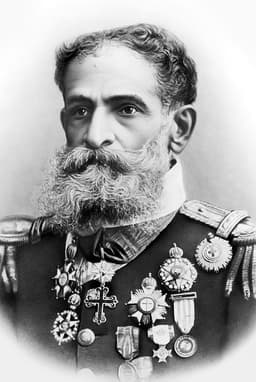
Deodoro da Fonseca
General · Modern
48.8Total
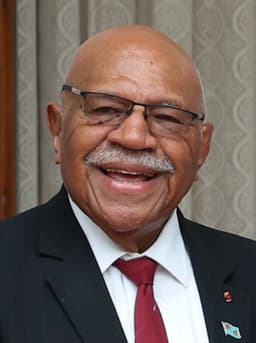
Sitiveni Rabuka
General · Modern
51.7Total
Basic Information
Born
1827
1948
Died
1892
—
Era
Modern
Modern
Nationality
Brazil
Fiji
Occupation
General
General
Civilization
Western
Other
Score Comparison
Military (10%)
50.0
10.2
Political (20%)
45.1
60.0
Influence (20%)
54.1
53.3
Legacy (20%)
44.2
46.7
Leadership (15%)
57.6
85.0
Strategy (15%)
38.6
39.6
TOTAL
48.8
51.7
Deodoro da Fonseca — Complete Timeline
1889 AD
Proclamation of the Brazilian RepublicPolitical Action
Deodoro da Fonseca led a military coup that overthrew Emperor Pedro II on November 15, 1889. He proclaimed the Republic of the United States of Brazil, ending 67 years of imperial rule.
CoupRepublic
Impact: globalprogressive
1891 AD
Election as First President of BrazilPolitical Action◆ Major
Deodoro da Fonseca was elected the first President of Brazil by the Constituent Congress on February 25, 1891. He took office under the new republican constitution, but his rule was brief and authoritarian.
ElectionPresidency
Impact: national
Dissolution of the National CongressPolitical Action◆ Major
Facing political opposition, Deodoro da Fonseca dissolved the National Congress on November 3, 1891, and declared a state of siege. This authoritarian act triggered a naval revolt and his eventual resignation.
AuthoritarianismPolitical Crisis
Impact: nationaldestructive
Resignation from the PresidencyPolitical Action◆ Major
Deodoro da Fonseca resigned the presidency on November 23, 1891, after a naval rebellion threatened his government. He handed power to Vice President Floriano Peixoto, ending his 9-month rule.
ResignationPolitical Crisis
Impact: nationaltragic
Sitiveni Rabuka — Complete Timeline
1987 AD
1987 Fijian Coup d'étatPolitical Action
Rabuka, as a colonel in the Fijian military, led a coup overthrowing the elected government of Timoci Bavadra. The coup was motivated by ethnic Fijian opposition to Indo-Fijian political influence. Rabuka declared Fiji a republic.
CoupMilitary InterventionEthnic Tension
Impact: nationaldestructive
1992 AD
1992 Election as Prime MinisterPolitical Action◆ Major
Rabuka transitioned from military leader to civilian politician, winning the 1992 general election as leader of the Fijian Political Party. He became Prime Minister, serving until 1999.
ElectionCivilian GovernmentPolitical Transition
Impact: national
1997 AD
1997 Constitution ReformReform◆ Major
Rabuka's government oversaw the adoption of a new constitution that removed ethnic-based voting and provided for a multi-ethnic government. The constitution aimed to reduce ethnic tensions and promote national unity.
ConstitutionReformEthnic Reconciliation
Impact: nationalconstructive
1999 AD
1999 General Election DefeatPolitical Action◆ Major
Rabuka's government was defeated in the general election by the Labour Party led by Mahendra Chaudhry. Rabuka stepped down as Prime Minister, marking the end of his first period in power.
Election DefeatGovernment ChangeChaudhry
Impact: national
2022 AD
2022 Return as Prime MinisterPolitical Action◆ Major
Rabuka led the People's Alliance to victory in the 2022 general election, forming a coalition government. He became Prime Minister again, 23 years after his previous tenure, promising democratic reforms.
ElectionReturn to PowerCoalition Government
Impact: national
Expert Analysis
Sitiveni Rabuka vs Deodoro da Fonseca
# The General Who Became Democrat: Two Paths from Coup to Constitution
On a humid November morning in 1889, Marshal Deodoro da Fonseca stood at the head of Brazilian troops in Rio de Janeiro, his heart heavy with the weight of a decision that would end a sixty-seven-year empire. Less than a century later, on a tense May morning in 1987, Colonel Sitiveni Rabuka marched into Fiji’s Parliament House in Suva, a Bible in one hand and a gun in the other, to topple a government that had been in power for barely a month. Both men were soldiers who seized power. Both would eventually hand that power back to the ballot box. But the stories of how they got there—and what they did with their power—could not be more different.
Origins
Deodoro da Fonseca was born in 1827 into a military family in Alagoas, a poor northeastern province of the Brazilian Empire. His father was a veteran of the wars of independence, and young Deodoro grew up breathing the air of barracks and battlefields. By the time he was twenty, he had fought in the brutal Paraguayan War, where he earned a reputation for courage and a chronic lung condition that would plague him for life. The Brazil of his youth was a slaveholding empire, the only monarchy in the Americas, and its army was increasingly restless with civilian politicians who seemed to care more about coffee exports than national honor.
Sitiveni Rabuka was born in 1948 in the village of Drekeniwai on Vanua Levu, Fiji’s second-largest island. His father was a Methodist lay preacher, and young Sitiveni grew up in a world of communal obligations, chiefly hierarchies, and the quiet tension between indigenous Fijians and the Indo-Fijian descendants of indentured laborers brought by the British. He joined the military young, rising through the ranks of a small, British-trained army that had never fought a war but had long been the guardian of a fragile ethnic balance. Where Deodoro was shaped by the grand narratives of empire and nation-building, Rabuka was shaped by the intimate anxieties of a small island nation where race and land were the only politics that mattered.
Rise to Power
Deodoro’s path to power was a slow burn. By the 1880s, he was a respected general and a hero of the Paraguayan War, but he was also a man of conservative instincts who initially resisted republican agitation. The tipping point came in 1889, when Emperor Pedro II—old, tired, and increasingly detached—appointed a liberal prime minister who threatened the military’s privileges. Deodoro, urged on by younger, more radical officers, finally agreed to lead a coup. On November 15, 1889, he marched his troops through Rio, arrested the cabinet, and, almost reluctantly, proclaimed the republic. He did not want to be emperor; he wanted order.
Rabuka’s rise was faster and more personal. In 1987, Fiji held a general election that, for the first time, brought to power a coalition led by Timoci Bavadra, an ethnic Fijian but one whose government included many Indo-Fijian ministers. To indigenous Fijians who saw their land and political dominance as sacred, this was an existential threat. Rabuka, then a 38-year-old colonel, acted on a mix of personal ambition and genuine fear for his people’s future. On May 14, 1987, he walked into Parliament with ten masked soldiers, arrested the prime minister, and announced that he had taken control. “I have done this to save my country,” he told the nation. The world condemned him, but many indigenous Fijians cheered.
Leadership & Governance
Deodoro’s presidency was a disaster. Elected by the Constituent Congress in February 1891, he proved to be a poor politician: authoritarian, impulsive, and physically ill. When Congress refused to approve his cabinet, he dissolved it on November 3, 1891, and declared a state of siege. He ruled by decree for three weeks, but the navy—loyal to the old empire—revolted, and the country teetered on civil war. On November 23, 1891, Deodoro resigned, broken and humiliated. His total time as president: nine months. He had no strategy, no political party, no vision beyond maintaining order. He was a soldier who never learned to be a statesman.
Rabuka, by contrast, learned. After his 1987 coup, he initially ruled as a military dictator, but he quickly realized that Fiji could not survive isolation. In 1990, he stepped down from the military and formed a political party. In 1992, he won the general election and became prime minister. Over the next seven years, he did something remarkable: he worked with the very Indo-Fijian politicians he had overthrown to draft a new constitution. The 1997 Constitution removed ethnic-based voting and created a multiracial democracy. It was a stunning reversal, and it cost him politically. In 1999, he lost the election to Mahendra Chaudhry, Fiji’s first Indo-Fijian prime minister. But he accepted defeat and stepped down peacefully.
Triumph & Tragedy
Deodoro’s greatest moment was also his tragedy. He ended the Brazilian Empire without a civil war, a feat that spared the country the bloodshed that consumed its Spanish American neighbors. But he could not govern what he had created. His resignation left the republic in chaos, and it would take decades of instability before Brazil found its footing. He died in 1892, a year after leaving office, a broken man who had outlived his usefulness.
Rabuka’s tragedy was the 1987 coup itself—an act that shattered Fiji’s democratic reputation and sowed decades of ethnic mistrust. But his triumph was the 1997 Constitution, a document that, despite later coups, remains the foundation of Fiji’s political system. And then, in a twist that few could have predicted, Rabuka returned to power in 2022, at the age of 74, leading a coalition government as prime minister once again. His journey from coup leader to elder statesman was complete.
Character & Destiny
Deodoro was a man of the 19th century: honorable, rigid, and trapped by his own sense of duty. He believed in order, but he had no idea how to build it in a democracy. His personality—proud, impulsive, physically weak—doomed his presidency. He could start a revolution but not finish one.
Rabuka was a man of the 20th century: pragmatic, adaptable, and capable of learning from his mistakes. His 1987 coup was a crude act of ethnic nationalism, but his later career showed a genuine evolution. He admitted his errors, worked across racial lines, and embraced the very democracy he had once destroyed. His personality—charming, reflective, surprisingly humble—allowed him to reinvent himself. As he once said, “I am a product of my culture, but I am also a student of history.”
Legacy
Deodoro da Fonseca is remembered as the founder of the Brazilian Republic, but his name is often paired with failure. His face appears on Brazilian currency, but historians judge him harshly: a general who could not govern, a liberator who could not lead. His legacy is the republic itself, but it is a republic that he almost destroyed.
Sitiveni Rabuka’s legacy is more complicated. He is both the man who broke Fiji’s democracy and the man who helped rebuild it. Indigenous Fijians often see him as a protector; Indo-Fijians remember him as a usurper. But his later years have softened the judgment. In 2023, he formally apologized for the 1987 coup, calling it “a mistake.” For a man who once held a gun to democracy, that apology may be his most lasting gift.
Conclusion
Both men were soldiers who seized power. Both believed they were saving their countries. But Deodoro remained a general to the end, unable to lay down his sword for the ballot box. Rabuka, in the end, became something rarer: a general who learned to trust the people. Their stories remind us that power is not a destiny—it is a choice. And the hardest choice for any soldier is to walk away from the battlefield and into the voting booth.
Rankings
🥇
Sitiveni RabukaLeader
Mil: 10.2Pol: 60.0Inf: 53.3
51.7
🥈
Deodoro da Fonseca
Mil: 50.0Pol: 45.1Inf: 54.1
48.8
+2.9 behind
How This Comparison Works
Algorithm
Each figure is scored on 6 dimensions (0—100 scale) based on structured historical data: Military (10%), Political (20%), Influence (20%), Legacy (20%), Leadership (15%), Strategy (15%). The weighted total produces the final ranking.
Data Sources
Scores are computed from structured sub-indicators in the database. Scale factors adjust for era (Ancient ×0.85, Modern ×1.0) and civilization size (Eastern ×1.05, Other ×0.80) to account for differences in population and military scale.
Maximum 3 Figures
Comparisons are limited to 2—3 figures to ensure readability and statistical meaningfulness.
Error Margins
±5 points per dimension — Sub-scores are derived from historical records with inherent uncertainty. Two figures within 5 points on a dimension should be considered roughly equivalent in that area.
Total Score Accuracy
±3 points overall — The weighted combination of 6 dimensions produces a total score with approximately ±3 points of uncertainty. Differences of less than 3 points are not statistically significant— the figures are effectively tied.
Known Limitations
- Historical records are incomplete and uneven across civilizations
- Figures from oral-tradition societies may be underrepresented
- Occupation labels can misclassify multi-role figures
- Scores measure capability and impact, not moral character
- Quantitative scoring is a comparison tool, not absolute truth
Capability Radar
Military (10%) — Battles & Warfare
Battles
20
5
Win Rate
25
5
Expansion
10
5
Political (20%) — Governance & Reform
Reform
40
50
Diplomacy
25
45
Economy
15
40
Influence (20%) — Cultural & Global Reach
Cultural
20
30
Global
15
20
Legacy (20%) — Historical Impact
Historical
35
40
Longevity
20
30
Leadership (15%) — Power & Stability
Tenure
30
55
Stability
10
35
Strategy (15%) — Tactics & Innovation
Strategy
25
10
Tactics
20
10
Reform
15
5
Similar Comparisons
Comments & Discussion
MarshalTurncoat6/16/2026
Comparing Rabuka to Fonseca is like comparing a coup d'état to a constitutional crisis with bayonets. Fonseca was a monarchist who overthrew the Empire because he felt the Emperor abandoned the army after the Paraguayan War—classic "loyal opposition" turned traitor. Rabuka was an ethno-nationalist who explicitly wanted to preserve indigenous Fijian supremacy. Different motives, different moral weights. Fonseca at least tried to mask his power grab as republicanism; Rabuka didn't bother.
政变观察员6/16/2026
说真的,把两位拉一起比,纯属偷懒。丰塞卡推翻的是七十年的巴西帝国,当时军方早已不满佩德罗二世忽视军队利益,他搞的政变更多是官僚权斗。拉布卡可是在1987年推翻了民选政府,就因为它由印裔斐济人主导,赤裸裸的种族政治。一个更接近宫廷革命,一个就是现代种族清洗。硬凑一起,你就看不到背后完全不同的政治土壤。
DemocratByAccident6/16/2026
The "eventually democrat" narrative feels forced. Fonseca didn't hand back power willingly—he was forced out after an economic collapse and a naval revolt in 1891, and the real democrat was his successor, Floriano Peixoto. Meanwhile, Rabuka's about-face came after three coups, international isolation, and a decade of constitutional bungling. He didn't see the light; he saw the wall. If you're going to mythologize them as redemption arcs, at least acknowledge the coercion behind their "conversion
数据控6/16/2026
仔细看数据分析:丰塞卡执政两年就下台,拉布卡却主宰斐济政治近二十年,从独裁者到总理再到总统。这叫“共享路径”?更关键的是,丰塞卡政变后巴西进入联邦共和国,拉布卡政变后斐济宪法直接写入种族特权条款。前者努力建立新制度,后者强化旧等级。数据不会撒谎——两人的“民主回归”根本是两条线。别被标题骗了。
ClassicalSkeptic6/16/2026
Both were soldiers who confused military chain of command with civic virtue. Fonseca's problem was the classic "man on horseback" syndrome Plato warned about in the Republic—he couldn't separate his military oath from political ambition. Rabuka's Bible-wielding theatrics suggest he thought divine mandate could override democratic consent. Cincinnatus returned to his plow; these two returned to Parliaments they once smashed. That's not redemption—it's institutional failure dressed as progress.
南洋砧板6/16/2026
一定要分高下的话:丰塞卡至少没有修改宪法来保证自己种族永远执政。拉布卡呢?1987年政变后,斐济宪法被换成一部保证原住民政治