Loading...
Deodoro da Fonseca vs Muhammadu Buhari
Muhammadu Buhari leads by 2.7 pts · 2 figures compared
…
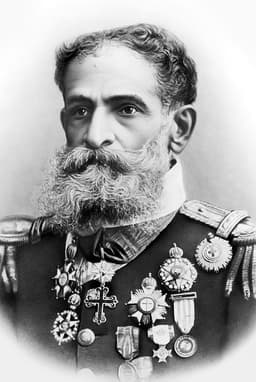
Deodoro da Fonseca
General · Modern
48.8Total
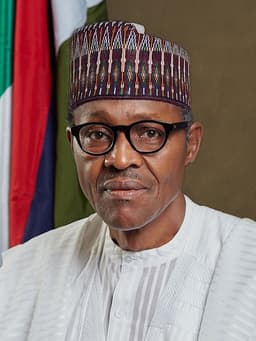
Muhammadu Buhari
General · Modern
51.5Total
Basic Information
Born
1827
1942
Died
1892
—
Era
Modern
Modern
Nationality
Brazil
Nigeria
Occupation
General
General
Civilization
Western
Other
Score Comparison
Military (10%)
50.0
22.6
Political (20%)
45.1
68.0
Influence (20%)
54.1
53.3
Legacy (20%)
44.2
43.3
Leadership (15%)
57.6
72.0
Strategy (15%)
38.6
41.0
TOTAL
48.8
51.5
Deodoro da Fonseca — Complete Timeline
1889 AD
Proclamation of the Brazilian RepublicPolitical Action
Deodoro da Fonseca led a military coup that overthrew Emperor Pedro II on November 15, 1889. He proclaimed the Republic of the United States of Brazil, ending 67 years of imperial rule.
CoupRepublic
Impact: globalprogressive
1891 AD
Election as First President of BrazilPolitical Action◆ Major
Deodoro da Fonseca was elected the first President of Brazil by the Constituent Congress on February 25, 1891. He took office under the new republican constitution, but his rule was brief and authoritarian.
ElectionPresidency
Impact: national
Dissolution of the National CongressPolitical Action◆ Major
Facing political opposition, Deodoro da Fonseca dissolved the National Congress on November 3, 1891, and declared a state of siege. This authoritarian act triggered a naval revolt and his eventual resignation.
AuthoritarianismPolitical Crisis
Impact: nationaldestructive
Resignation from the PresidencyPolitical Action◆ Major
Deodoro da Fonseca resigned the presidency on November 23, 1891, after a naval rebellion threatened his government. He handed power to Vice President Floriano Peixoto, ending his 9-month rule.
ResignationPolitical Crisis
Impact: nationaltragic
Muhammadu Buhari — Complete Timeline
1983 AD
1983 Nigerian coup d'étatPolitical Action
Major General Muhammadu Buhari led a military coup that overthrew the civilian government of President Shehu Shagari. Buhari cited corruption and economic mismanagement as justifications, and he became the head of state.
CoupMilitary RuleCorruption
Impact: nationaldestructive
1984 AD
War Against Indiscipline (WAI)Reform◆ Major
Buhari launched the War Against Indiscipline, a campaign to enforce discipline and order in Nigerian society. It included harsh penalties for minor offenses, such as queue-jumping, and was criticized for human rights abuses.
DisciplineSocial PolicyHuman Rights
Impact: nationaldestructive
1985 AD
Overthrow by Ibrahim BabangidaPolitical Action◆ Major
Buhari was overthrown in a palace coup led by his Chief of Army Staff, Ibrahim Babangida. Babangida cited Buhari's authoritarian style and failure to address the economy as reasons for the coup.
CoupOverthrowBabangida
Impact: national
2015 AD
Anti-corruption campaignReform◆ Major
Buhari launched a high-profile anti-corruption campaign, targeting government officials and recovering stolen assets. The campaign was praised internationally but criticized for being selective and politically motivated.
Anti-CorruptionReformGovernance
Impact: nationalconstructive
Election as President of NigeriaPolitical Action
Buhari won the 2015 Nigerian presidential election, defeating incumbent Goodluck Jonathan. This was the first time an opposition candidate had defeated a sitting president in Nigeria's history, marking a democratic milestone.
ElectionDemocracyOpposition Victory
Impact: nationalprogressive
Expert Analysis
Muhammadu Buhari vs Deodoro da Fonseca
# The General as President: Two Paths from the Barracks to the Palace
On a humid November morning in 1889, Marshal Deodoro da Fonseca, a veteran of Brazil’s wars and a man of faltering health, rode at the head of troops through the streets of Rio de Janeiro. He did not want a republic, his closest friends knew. He had come to defend the army’s honor, not to topple a dynasty. Yet hours later, Emperor Pedro II was on a ship to Europe, and Brazil had become a republic. Nearly a century later and an ocean away, another general, Muhammadu Buhari, seized power in Nigeria with far clearer intentions. The contrast between these two men—one an accidental founder of a nation, the other a determined reformer who would twice rule his country—reveals how personality, circumstance, and the weight of history shape the fate of generals who become presidents.
Origins
Deodoro da Fonseca was born in 1827 in Alagoas, a son of a military family in a Brazil still ruled by a Portuguese emperor. He grew up in a world of rigid hierarchy, where the army was a path to respectability for men of modest means. His career was conventional: he fought in the Paraguayan War, rose through the ranks, and became a respected but not brilliant officer. By the 1880s, he was a marshal, old and sick, troubled by respiratory illness and the creeping sense that Brazil’s monarchy had outlived its usefulness. His era was one of slow decay, not revolution—a time when change came through palace intrigues, not popular uprisings.
Muhammadu Buhari, born in 1942 in Daura, northern Nigeria, came of age in a different world. His Nigeria was a newly independent nation, fractured by ethnic rivalries, oil wealth, and military coups. He entered the army as a young officer in the 1960s, fought in the civil war against Biafra, and watched his country lurch from one coup to another. By 1983, when he seized power, Nigeria was a place where the military had become the arbiter of politics. Buhari’s era was one of urgency: the economy was collapsing, corruption was rampant, and the civilian government seemed helpless.
Rise to Power
Deodoro’s path to power was almost accidental. In November 1889, republican conspirators manipulated him into leading a revolt. They told him that the emperor had ordered his arrest; they exaggerated the threat to the army. When Deodoro marched, he did so believing he was defending the military, not destroying the monarchy. Only later did he realize he had become the figurehead of a revolution he never intended. His rise was a tale of reluctant leadership, of a man pushed by events rather than driving them.
Buhari’s rise was deliberate. On December 31, 1983, Major General Muhammadu Buhari led a coup that overthrew President Shehu Shagari. He acted with precision and purpose, citing the government’s incompetence and corruption. Unlike Deodoro, Buhari knew exactly what he wanted: order, discipline, and a clean break from the chaos of civilian rule. His era demanded decisiveness, and he provided it.
Leadership & Governance
As ruler, Deodoro was indecisive and authoritarian by turns. He presided over the writing of Brazil’s first republican constitution, but when the Congress resisted his policies, he dissolved it in November 1891 and declared a state of siege. It was a desperate act, born of frustration and failing health. He had no vision for the republic beyond maintaining order. His military genius was modest; his political wisdom, limited. He was a transitional figure, not a builder.
Buhari’s rule was more systematic. In 1984, he launched the War Against Indiscipline (WAI), a campaign to enforce punctuality, cleanliness, and obedience. Soldiers arrested people for littering, queue-jumping, or arriving late to work. It was harsh, even absurd, but it reflected Buhari’s core belief: Nigeria’s problems were moral, not structural. His anti-corruption efforts were genuine but brutal—journalists were jailed, opponents silenced. He ruled with the discipline of a drill sergeant, not the tact of a politician.
Triumph & Tragedy
Deodoro’s greatest moment was the proclamation of the republic itself—a bloodless transition that ended sixty-seven years of monarchy. His tragedy came quickly: the dissolution of Congress sparked a naval rebellion, and within weeks, he resigned, broken and isolated. He died in 1892, a year after leaving office, his republic already slipping from his grasp.
Buhari’s triumph came later, in 2015, when he won the Nigerian presidency in a democratic election—the first opposition candidate to defeat an incumbent. It was a stunning comeback for a man overthrown in 1985 by his own chief of army staff, Ibrahim Babangida. His tragedy was that his second rule, despite its anti-corruption campaign, could not arrest Nigeria’s decline. Oil prices fell, the economy stalled, and his health faltered. He left office in 2023, a diminished figure.
Character & Destiny
Deodoro was a man of honor and hesitation. He did not seek power; he stumbled into it. His character was shaped by a world where loyalty to the emperor and the army were the same thing—until they were not. His destiny was to be a symbol, not a ruler. Buhari was a man of iron will and narrow vision. His character was forged in the crucible of Nigeria’s civil war and coups, where only the strong survived. His destiny was to rule twice, but never to transform his country.
Legacy
Today, Deodoro da Fonseca is a footnote in Brazilian history, remembered as the first president of a republic he did not fully believe in. His statue stands in Rio, but his name evokes little passion. Buhari’s legacy is more contested. In Nigeria, he is praised by some for his integrity and condemned by others for his authoritarianism and economic failures. Both men were generals who became presidents; both failed to build lasting institutions. But their failures tell different stories: Deodoro’s was the tragedy of a man who could not lead the revolution he started, while Buhari’s was the tragedy of a man who believed that discipline alone could save a nation.
Conclusion
The barracks produce leaders, but it does not teach them how to govern. Deodoro da Fonseca and Muhammadu Buhari both learned this lesson, one through reluctant revolution, the other through stubborn reform. Their lives remind us that the path from general to president is never straightforward, and that the same qualities that make a soldier—discipline, decisiveness, loyalty—can become liabilities in the messy world of politics. In the end, both men were prisoners of their times, and their legacies are warnings, not models.
Rankings
🥇
Muhammadu BuhariLeader
Mil: 22.6Pol: 68.0Inf: 53.3
51.5
🥈
Deodoro da Fonseca
Mil: 50.0Pol: 45.1Inf: 54.1
48.8
+2.7 behind
How This Comparison Works
Algorithm
Each figure is scored on 6 dimensions (0—100 scale) based on structured historical data: Military (10%), Political (20%), Influence (20%), Legacy (20%), Leadership (15%), Strategy (15%). The weighted total produces the final ranking.
Data Sources
Scores are computed from structured sub-indicators in the database. Scale factors adjust for era (Ancient ×0.85, Modern ×1.0) and civilization size (Eastern ×1.05, Other ×0.80) to account for differences in population and military scale.
Maximum 3 Figures
Comparisons are limited to 2—3 figures to ensure readability and statistical meaningfulness.
Error Margins
±5 points per dimension — Sub-scores are derived from historical records with inherent uncertainty. Two figures within 5 points on a dimension should be considered roughly equivalent in that area.
Total Score Accuracy
±3 points overall — The weighted combination of 6 dimensions produces a total score with approximately ±3 points of uncertainty. Differences of less than 3 points are not statistically significant— the figures are effectively tied.
Known Limitations
- Historical records are incomplete and uneven across civilizations
- Figures from oral-tradition societies may be underrepresented
- Occupation labels can misclassify multi-role figures
- Scores measure capability and impact, not moral character
- Quantitative scoring is a comparison tool, not absolute truth
Capability Radar
Military (10%) — Battles & Warfare
Battles
20
10
Win Rate
25
10
Expansion
10
5
Political (20%) — Governance & Reform
Reform
40
30
Diplomacy
25
25
Economy
15
20
Influence (20%) — Cultural & Global Reach
Cultural
20
25
Global
15
25
Legacy (20%) — Historical Impact
Historical
35
30
Longevity
20
20
Leadership (15%) — Power & Stability
Tenure
30
45
Stability
10
15
Strategy (15%) — Tactics & Innovation
Strategy
25
15
Tactics
20
15
Reform
15
20
Similar Comparisons
Comments & Discussion
Deodoro's Cannon6/16/2026
Calling Deodoro an "accidental founder" gives him too much credit. He literally coughed his way through the coup—asthma attacks and all. Meanwhile, Buhari knew exactly what he wanted: discipline, austerity, and zero tolerance for corruption. The difference isn't personality; it's preparedness. Deodoro stumbled into a republic while checking his pulse; Buhari marched in with a blueprint. One created a nation by default, the other tried to fix one by design. I'll take the determined reformer over
步枪上的改革家6/16/2026
说布哈里是“坚定的改革者”?他1983年上台后的“反对腐败运动”根本是场闹剧:把浪费粮食的妇女关进监狱,却对军政府内部的石油美元暗流视而不见。德奥多罗至少是在帝国崩溃的乱局中被动掌权,他从未伪装成民主派。而布哈里两次执政都证明,将军当总统只会让军队的恶习渗透进政府。所谓“蓝图”,不过是独裁的老调重弹。
The Sick Man of Rio6/16/2026
Here's what the comparison misses: Deodoro didn't want power. He was dragged into history by junior officers, his health failing, his heart still loyal to Pedro II until the final hour. Buhari actively planned his coups and campaigns. That makes Deodoro's "failure" as first president almost tragic—he held elections, resigned when overwhelmed, and died a broken man. Buhari clung to power, stacked courts, and left Nigeria poorer. Which general-turned-president actually showed restraint? The one wh
军靴与皇冠6/16/2026
德奥多罗与布哈里的根本区别在于对历史包袱的态度。前者推翻的是一个存在67年的巴西帝国,佩德罗二世治下国家相对稳定,军人的干预几乎是一种“意外”。后者面对的是独立仅23年、被内战和腐败撕裂的尼日利亚,军队接管几乎成了必然。但布哈里1984年的政变承诺“纠正错误”,结果只是把文官腐败换成了军靴下的勒索。历史教训?没有干净的将军总统。
Historian5716/16/2026
Let's look at numbers: Under Deodoro, Brazil's GDP grew modestly but inflation hit 30% in 1891. Under Buhari's 1984-1985 rule, Nigeria's GDP contracted 9%, inflation hit 40%, and oil revenue collapsed. Both were economic disasters. The romanticism about Fonseca "founding a republic" ignores that he couldn't even balance a checkbook, let alone a budget. Buhari at least stabilized oil accounts temporarily. Neither was fit for civilian leadership, but at least Deodoro had the decency to resign. Buh