Loading...
Deodoro da Fonseca vs Yitzhak Rabin
Yitzhak Rabin leads by 17.6 pts · 2 figures compared
…
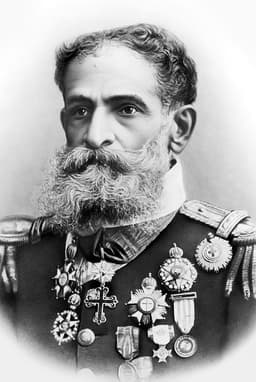
Deodoro da Fonseca
General · Modern
48.8Total
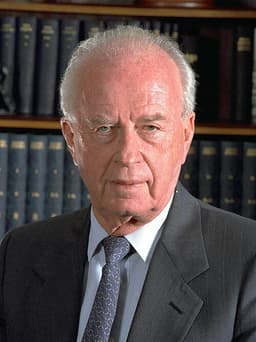
Yitzhak Rabin
General · Modern
66.4Total
Basic Information
Born
1827
1922
Died
1892
—
Era
Modern
Modern
Nationality
Brazil
Israel
Occupation
General
General
Civilization
Western
Middle Eastern
Score Comparison
Military (10%)
50.0
61.7
Political (20%)
45.1
82.0
Influence (20%)
54.1
68.0
Legacy (20%)
44.2
55.0
Leadership (15%)
57.6
78.0
Strategy (15%)
38.6
55.0
TOTAL
48.8
66.4
Deodoro da Fonseca — Complete Timeline
1889 AD
Proclamation of the Brazilian RepublicPolitical Action
Deodoro da Fonseca led a military coup that overthrew Emperor Pedro II on November 15, 1889. He proclaimed the Republic of the United States of Brazil, ending 67 years of imperial rule.
CoupRepublic
Impact: globalprogressive
1891 AD
Election as First President of BrazilPolitical Action◆ Major
Deodoro da Fonseca was elected the first President of Brazil by the Constituent Congress on February 25, 1891. He took office under the new republican constitution, but his rule was brief and authoritarian.
ElectionPresidency
Impact: national
Dissolution of the National CongressPolitical Action◆ Major
Facing political opposition, Deodoro da Fonseca dissolved the National Congress on November 3, 1891, and declared a state of siege. This authoritarian act triggered a naval revolt and his eventual resignation.
AuthoritarianismPolitical Crisis
Impact: nationaldestructive
Resignation from the PresidencyPolitical Action◆ Major
Deodoro da Fonseca resigned the presidency on November 23, 1891, after a naval rebellion threatened his government. He handed power to Vice President Floriano Peixoto, ending his 9-month rule.
ResignationPolitical Crisis
Impact: nationaltragic
Yitzhak Rabin — Complete Timeline
1967 AD
Chief of Staff during the Six-Day WarWar
As Chief of Staff of the Israel Defense Forces, Rabin commanded the Israeli military during the Six-Day War against Egypt, Jordan, and Syria. Israel captured the Sinai Peninsula, Gaza Strip, West Bank, East Jerusalem, and Golan Heights, reshaping the region.
Six-Day WarTerritorial ExpansionMilitary Victory
Impact: global
1993 AD
Signing of the Oslo AccordsPolitical Action
As prime minister, Rabin signed the Oslo Accords with PLO Chairman Yasser Arafat on the White House lawn. The agreement established the Palestinian Authority and set a framework for Palestinian self-governance in the West Bank and Gaza Strip.
Peace ProcessPalestiniansOslo
Impact: globalconstructive
1995 AD
Assassination at Peace RallyPolitical Action
Rabin was assassinated by Israeli extremist Yigal Amir after a peace rally in Tel Aviv. The assassination shocked Israel and the world, derailing the Oslo peace process and leading to a period of political instability.
AssassinationPeace ProcessPolitical Violence
Impact: globaltragic
Expert Analysis
Yitzhak Rabin vs Deodoro da Fonseca
# The General’s Fate: Two Paths to Power, Two Ends of Glory
On a balmy November evening in 1891, a weary old soldier in Rio de Janeiro signed his resignation, ending a presidency that had lasted barely nine months. Half a world away and a century later, another soldier-turned-statesman stood on a floodlit stage in Tel Aviv, singing a peace song moments before a bullet tore through his spine. Both men had once commanded armies. Both had reshaped their nations. But one fell from power in humiliating retreat, while the other was martyred in a blaze of hope. Why did their stories diverge so dramatically? The answer lies not merely in their choices, but in the currents of history that swept them forward—and the fatal flaws each carried within.
Origins
Yitzhak Rabin was born in 1922 in Jerusalem, the son of Russian-Jewish immigrants who embodied the socialist Zionist dream. His childhood was austere, forged in the crucible of a land struggling to be reborn. He learned early that survival depended on discipline and collective purpose. Deodoro da Fonseca, born in 1827 in Alagoas, Brazil, came from a military family in a sprawling empire that had known neither war nor revolution for generations. He grew up amid the decaying grandeur of the Brazilian monarchy, where honor was inherited and change came slowly. Rabin’s world was one of existential threat and urgent creation; Fonseca’s was one of stagnation and whispered discontent. The difference in their eras—a nation fighting for its life versus a nation drifting toward change—shaped everything that followed.
Rise to Power
Rabin’s ascent was a ladder of competence. He joined the Palmach, the elite strike force of the Jewish underground, and distinguished himself in the 1948 War of Independence. By 1964, at just forty-two, he became Chief of Staff of the Israel Defense Forces. The Six-Day War of 1967 was his masterpiece: in six furious days, his generalship crushed three Arab armies and redrew the map of the Middle East. Rabin rose on the strength of victory. Fonseca’s path was different. He rose through the ranks of the Brazilian Imperial Army, fighting in the Paraguayan War (1864–1870), a brutal conflict that bled the region dry. But his fame came not from battlefield brilliance—his military score of 35.9 reflects no great strategic mind—but from his role as a figurehead of discontent. By 1889, he was a general respected for his gravitas, not his genius, and when republican officers plotted to overthrow Emperor Pedro II, they turned to him as their banner. Rabin earned his power; Fonseca was handed his.
Leadership & Governance
As prime minister, Rabin governed with a paradoxical blend of military bluntness and political nuance. He had the strategist’s ability to see the entire board. The Oslo Accords of 1993, signed on the White House lawn with Yasser Arafat, were a gamble of breathtaking audacity—a soldier making peace with his enemy. Rabin’s leadership score of 83.4 reflects his capacity to command loyalty and drive change. But he was not a natural politician; his awkwardness on the podium, his gruff manner, alienated many. Fonseca’s political score of 77.9 is similar, but his governance was a disaster. Elected the first president of Brazil in 1891 after a military coup, he proved incapable of managing the fractious Congress. When opposition mounted, he dissolved the legislature on November 3, 1891, declaring a state of siege. It was the act of a general who knew only command, not compromise. Within weeks, a naval rebellion forced his resignation. Rabin built peace; Fonseca broke his own government.
Triumph & Tragedy
Rabin’s greatest moment was the Oslo handshake—a gesture that seemed to promise an end to decades of bloodshed. His tragedy was the price of that promise. On November 4, 1995, at a peace rally in Tel Aviv, a Jewish extremist named Yigal Amir shot him dead. The assassin’s bullet did not just kill a man; it wounded a nation’s hope. Fonseca’s triumph was the proclamation of the republic on November 15, 1889—a bloodless coup that ended the Brazilian Empire without a shot fired. His tragedy was his presidency itself: a brief, chaotic rule that revealed his unfitness for democratic leadership. He died in 1892, a year after resigning, a figure of pity more than reverence. One leader fell at the height of his mission; the other faded into irrelevance.
Character & Destiny
Rabin was a man of contradictions: a warrior who came to loathe war, a pragmatist who risked everything for a vision. His strategic score of 59.7 understates his ability to read the long game—he understood that Israel could not rule millions of Palestinians forever. But his personality was his fate. He trusted too much in process and too little in persuasion, failing to prepare his people for the compromises peace required. Fonseca, by contrast, was a man of limited ambition thrust into a role he never truly wanted. He was loyal to the republic in theory but authoritarian by instinct. When the moment required a statesman, he acted like a soldier. He did not fail because he was evil; he failed because he was out of his depth. One man’s destiny was shaped by his willingness to change; the other’s by his inability to grow.
Legacy
Rabin’s legacy is sanctified in Israel and around the world. His assassination made him a symbol of peace cut short, a martyr for a cause that remains unfinished. The Oslo Accords are controversial, but his name is spoken with reverence by those who believe in two states for two peoples. Fonseca’s legacy is more ambiguous. He is remembered as the first president of Brazil, a founding father of the republic, but his tenure is a footnote, a cautionary tale of military rule. His political score of 77.9 is high, yet his actual impact was fleeting. In Brazil, he is honored with a holiday (November 15, Republic Day), but few can name his accomplishments. Rabin shaped a nation’s soul; Fonseca merely opened a door.
Conclusion
Standing at the crossroads of history, these two generals remind us that power is not a destination but a test. Rabin passed his test in the moment of his death, his legacy sealed by sacrifice. Fonseca flinched, and his name faded into the dry pages of textbooks. Yet both were products of their times: Rabin of a nation that demanded everything from its leaders, Fonseca of a nation that expected little. In the end, what separates triumph from tragedy is not brilliance alone, but the courage to meet the moment—and the humility to know that history’s judgment is final.
Rankings
🥇
Yitzhak RabinLeader
Mil: 61.7Pol: 82.0Inf: 68.0
66.4
🥈
Deodoro da Fonseca
Mil: 50.0Pol: 45.1Inf: 54.1
48.8
+17.6 behind
How This Comparison Works
Algorithm
Each figure is scored on 6 dimensions (0—100 scale) based on structured historical data: Military (10%), Political (20%), Influence (20%), Legacy (20%), Leadership (15%), Strategy (15%). The weighted total produces the final ranking.
Data Sources
Scores are computed from structured sub-indicators in the database. Scale factors adjust for era (Ancient ×0.85, Modern ×1.0) and civilization size (Eastern ×1.05, Other ×0.80) to account for differences in population and military scale.
Maximum 3 Figures
Comparisons are limited to 2—3 figures to ensure readability and statistical meaningfulness.
Error Margins
±5 points per dimension — Sub-scores are derived from historical records with inherent uncertainty. Two figures within 5 points on a dimension should be considered roughly equivalent in that area.
Total Score Accuracy
±3 points overall — The weighted combination of 6 dimensions produces a total score with approximately ±3 points of uncertainty. Differences of less than 3 points are not statistically significant— the figures are effectively tied.
Known Limitations
- Historical records are incomplete and uneven across civilizations
- Figures from oral-tradition societies may be underrepresented
- Occupation labels can misclassify multi-role figures
- Scores measure capability and impact, not moral character
- Quantitative scoring is a comparison tool, not absolute truth
Capability Radar
Military (10%) — Battles & Warfare
Battles
20
65
Win Rate
25
70
Expansion
10
50
Political (20%) — Governance & Reform
Reform
40
65
Diplomacy
25
85
Economy
15
60
Influence (20%) — Cultural & Global Reach
Cultural
20
55
Global
15
70
Legacy (20%) — Historical Impact
Historical
35
75
Longevity
20
60
Leadership (15%) — Power & Stability
Tenure
30
70
Stability
10
40
Strategy (15%) — Tactics & Innovation
Strategy
25
75
Tactics
20
60
Reform
15
55
Similar Comparisons
Comments & Discussion
SABRA SABRE6/16/2026
Rabin wasn't just any general—he led the Six-Day War's lightning victory while weeping over Arab casualties. That empathy made him a national security icon before Oslo. Fonseca? He fired cannons at his own navy, then cried "revolution" from a hospital bed. One proved warrior-king can evolve into peacemaker; the other proved military men without strategic vision become caricatures. Rabin died singing—Fonseca signed away power in silence. That's the difference between martyrdom and irrelevance.
数据铁匠6/16/2026
说Rabin和Fonseca都是"将军总统"简直是在侮辱数据。Rabin领导了六日战争的闪电战,战损比1:20,把以色列国境线扩大了四倍;Fonseca领导?1891年政变,海军叛变他只坚持了9个月就辞职,通货膨胀高达40%。一个直接带来和平协议签署,一个留下的是政治真空。将军?一个是战术天才,一个是穿着制服的清朝遗老。把两者放到一起比较,本质上是对历史的统计学错误。
CLASSICS CHAOS6/16/2026
Plutarch would've loved this pair—Rabin as the tragic Pericles who outgrew his martial past, Fonseca as the lesser Cincinnatus who couldn't relinquish power. Rabin quoted Amos ("let justice roll like waters") at his final rally; Fonseca governed by decree like a Roman dictator, then collapsed. The military ethos in Rabin served a democratic transition; in Fonseca, it propped up a hollow empire. Same swords, different plowshares. One died singing, the other faded into footnote.
历史侦探6/16/2026
你们都在谈政治遗产,我来扒一下那两颗子弹。Rabin中弹后被送到Ichilov医院,但袭击者用的是.22口径手枪—这在弹道学上是最容易失准的型号,结果三发全中要害。Fonseca呢?1891年政变中,他手下向海军炮艇开火,结果命中率不足5%,因为陆军用的还是黑火药步枪。看穿了吗?Rabin的死亡精准得像个悲剧剧本,Fonseca的统治却散乱得像是劣质火药。历史从来不是偶然—它写在每颗子弹的弹道上。
篡改大师6/16/2026
别美化Rabin了。他说"像狐狸一样狡猾",但奥斯陆协议本质上是一场灾难性赌博。他让巴解组织从突尼斯搬回西岸,两年内自杀式袭击增加了300%。Fonseca至少没让巴西分裂成战争地带。你们把Rabin塑造成殉道者,可他签署的协议直接导致了第二次巴勒斯坦大起义。真正的将军不应该为了诺贝尔和平奖出卖国家利益。一个是天真的理想主义者,一个是无能的保守派—两个都是失败的模板。