Loading...
Deodoro da Fonseca vs Tadeusz Kosciuszko
Tadeusz Kosciuszko leads by 15.3 pts · 2 figures compared
…
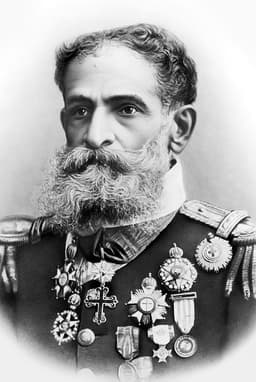
Deodoro da Fonseca
General · Modern
48.8Total
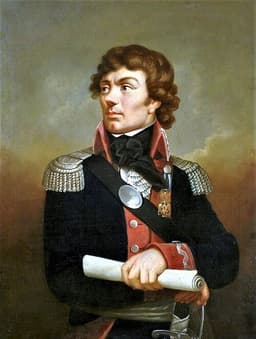
Tadeusz Kosciuszko
General · Modern
64.1Total
Basic Information
Born
1827
1746
Died
1892
1817
Era
Modern
Modern
Nationality
Brazil
Poland
Occupation
General
General
Civilization
Western
Western
Score Comparison
Military (10%)
50.0
47.5
Political (20%)
45.1
68.0
Influence (20%)
54.1
68.0
Legacy (20%)
44.2
68.0
Leadership (15%)
57.6
64.5
Strategy (15%)
38.6
55.0
TOTAL
48.8
64.1
Deodoro da Fonseca — Complete Timeline
1889 AD
Proclamation of the Brazilian RepublicPolitical Action
Deodoro da Fonseca led a military coup that overthrew Emperor Pedro II on November 15, 1889. He proclaimed the Republic of the United States of Brazil, ending 67 years of imperial rule.
CoupRepublic
Impact: globalprogressive
1891 AD
Election as First President of BrazilPolitical Action◆ Major
Deodoro da Fonseca was elected the first President of Brazil by the Constituent Congress on February 25, 1891. He took office under the new republican constitution, but his rule was brief and authoritarian.
ElectionPresidency
Impact: national
Dissolution of the National CongressPolitical Action◆ Major
Facing political opposition, Deodoro da Fonseca dissolved the National Congress on November 3, 1891, and declared a state of siege. This authoritarian act triggered a naval revolt and his eventual resignation.
AuthoritarianismPolitical Crisis
Impact: nationaldestructive
Resignation from the PresidencyPolitical Action◆ Major
Deodoro da Fonseca resigned the presidency on November 23, 1891, after a naval rebellion threatened his government. He handed power to Vice President Floriano Peixoto, ending his 9-month rule.
ResignationPolitical Crisis
Impact: nationaltragic
Tadeusz Kosciuszko — Complete Timeline
1777 AD
Battle of Saratoga (engineering contributions)War◆ Major
Kosciuszko designed fortifications and selected defensive positions for the American army at Saratoga. His work contributed to the American victory, a turning point in the Revolutionary War.
American RevolutionSaratogaEngineering
Impact: regional
1778 AD
Fortification of West PointWar◆ Major
Kosciuszko was assigned to fortify West Point on the Hudson River. He designed and supervised the construction of fortifications that made the site a key American stronghold for the remainder of the war.
American RevolutionWest PointFortifications
Impact: regionalconstructive
1794 AD
Kosciuszko UprisingWar
Kosciuszko led a national uprising in Poland against Russian and Prussian occupation. He proclaimed the Act of Insurrection and won the Battle of Rac
Polish UprisingIndependenceDefeat
Impact: nationaltragic
Battle of RacławiceWar◆ Major
Kosciuszko led Polish forces, including peasant scythemen, to victory over a larger Russian army at Rac
Kosciuszko UprisingBattlePeasants
Impact: national
Capture and imprisonment at the Battle of MaciejowiceWar◆ Major
Kosciuszko was wounded and captured by Russian forces at the Battle of Maciejowice. His capture effectively ended the uprising, and he was imprisoned in St. Petersburg until 1796.
Kosciuszko UprisingCaptureImprisonment
Impact: nationaltragic
Expert Analysis
Deodoro da Fonseca vs Tadeusz Kosciuszko
# The General and the Republic
On a November morning in 1891, a weary old man in Rio de Janeiro signed away a presidency he had held for less than a year. Deodoro da Fonseca, the first president of Brazil, had just dissolved his own Congress, declared a state of siege, and watched his fragile republic crumble into chaos. Half a world away and a century earlier, another general had fallen from a horse on a battlefield in Poland, wounded and captured, his uprising against empire bleeding into the mud at Maciejowice. Both men were soldiers who became the face of a nation’s rebirth. One is remembered as a liberator, the other as a footnote. The difference tells us something profound about how revolutions succeed—and how they fail.
Origins
Tadeusz Kosciuszko was born in 1746 into the minor nobility of the Polish-Lithuanian Commonwealth, a sprawling, decaying state already being carved up by Russia, Prussia, and Austria. He studied engineering in Warsaw and Paris, absorbing Enlightenment ideas about liberty and the rights of man. When the American Revolution erupted, he crossed the Atlantic to fight for a cause he believed universal: the right of a people to govern themselves. Poland, he knew, was next.
Deodoro da Fonseca was born in 1827 in Alagoas, Brazil, into a military family. His father was a marshal; his brothers became generals. Brazil was then an empire, stable and vast, ruled by the popular Emperor Pedro II. Fonseca grew up not dreaming of revolution but of order—the order of the barracks, the discipline of the parade ground. He fought in the Paraguayan War, where he earned a reputation for courage and for a certain rough honesty that endeared him to his men. But he was no philosopher. He never read Rousseau or Jefferson. His politics were the politics of the sword.
Rise to Power
Kosciuszko rose through competence. At Saratoga in 1777, he did not command armies but shaped the ground they fought on. He selected the American positions and designed fortifications that turned the British advance into a slaughter. His work at West Point later made that fortress the most formidable stronghold on the continent. When he returned to Poland in 1784, he carried a reputation for engineering brilliance and a deep conviction that liberty was not a gift but a right. In 1794, when the Polish nation rose against its occupiers, it was Kosciuszko they turned to.
Fonseca rose through presence. He was not a great strategist—his military scores reflect that—but he was a figure of gravitas, a man other officers looked to in moments of crisis. When the Brazilian monarchy faltered in 1889, it was Fonseca who led the coup that sent Pedro II into exile. He did not plan the republic; he merely stood at its head. On November 15, 1889, he proclaimed the Brazilian Republic almost by accident, swept along by younger, more radical officers. He was a figurehead who did not know he was being used.
Leadership & Governance
Kosciuszko’s leadership was visionary. At Racławice in 1794, he led peasant scythemen—farmers armed with nothing but sharpened blades—against a professional Russian army. He won. More importantly, he understood that the uprising could not succeed without freeing the serfs and granting them land. His Act of Insurrection promised just that: emancipation for peasants who fought, and a new social order for Poland. This was not nationalism alone; it was revolution.
Fonseca’s leadership was reactive. As president, he faced a divided Congress, a restless military, and a populace unsure whether to embrace or resist the new republic. His response was to dissolve Congress in November 1891, declaring a state of siege. It was the act of a soldier who had run out of patience with politics. Within weeks, a naval rebellion forced his resignation. He had no vision for Brazil beyond the removal of the emperor. He had won the republic, but he did not know what to do with it.
Triumph & Tragedy
Kosciuszko’s triumph was Racławice, where the scythemen charged and the Russians broke. It was a moment of pure, impossible hope—a nation rising from the dust. His tragedy was Maciejowice, where he was wounded, captured, and the uprising collapsed. He died in exile in Switzerland in 1817, his heart preserved in an urn, his body never returned to a free Poland.
Fonseca’s triumph was the proclamation of the republic itself—a bloodless coup that ended a 67-year monarchy. His tragedy was the presidency that followed. He was a man built for the barracks, not the palace. His resignation in 1891 was not a defeat but a release. He died the next year, largely forgotten, his name attached to a regime he had not shaped.
Character & Destiny
Kosciuszko was a man of principle who believed that liberty was indivisible. He fought for America, then for Poland, and finally for the peasant—the most forgotten figure in European history. His character was his destiny: he could not compromise, could not accept half-measures, and could not survive the empires that crushed him.
Fonseca was a man of instinct who believed that order was paramount. He overthrew a monarchy not out of conviction but out of loyalty to fellow officers. His character was also his destiny: he could not lead, could not govern, and could not endure the chaos he had helped unleash.
Legacy
Kosciuszko is remembered as a national hero in Poland and America alike. His name adorns bridges, monuments, and a mountain in Australia. He is a symbol of the struggle for freedom—not just national freedom, but human freedom.
Fonseca is remembered, if at all, as a transitional figure. His name appears in textbooks, but few Brazilians could tell you what he stood for. He was the first president of a republic that would take decades to find its footing.
Conclusion
The difference between Kosciuszko and Fonseca is the difference between a revolution and a coup. One man fought for an idea; the other fell into a position. One shaped history; the other was shaped by it. In the end, what matters is not who seizes power, but what they do with it—and whether, when they fall, they leave behind something that lasts. Kosciuszko left a dream. Fonseca left an empty chair.
Rankings
🥇
Tadeusz KosciuszkoLeader
Mil: 47.5Pol: 68.0Inf: 68.0
64.1
🥈
Deodoro da Fonseca
Mil: 50.0Pol: 45.1Inf: 54.1
48.8
+15.3 behind
How This Comparison Works
Algorithm
Each figure is scored on 6 dimensions (0—100 scale) based on structured historical data: Military (10%), Political (20%), Influence (20%), Legacy (20%), Leadership (15%), Strategy (15%). The weighted total produces the final ranking.
Data Sources
Scores are computed from structured sub-indicators in the database. Scale factors adjust for era (Ancient ×0.85, Modern ×1.0) and civilization size (Eastern ×1.05, Other ×0.80) to account for differences in population and military scale.
Maximum 3 Figures
Comparisons are limited to 2—3 figures to ensure readability and statistical meaningfulness.
Error Margins
±5 points per dimension — Sub-scores are derived from historical records with inherent uncertainty. Two figures within 5 points on a dimension should be considered roughly equivalent in that area.
Total Score Accuracy
±3 points overall — The weighted combination of 6 dimensions produces a total score with approximately ±3 points of uncertainty. Differences of less than 3 points are not statistically significant— the figures are effectively tied.
Known Limitations
- Historical records are incomplete and uneven across civilizations
- Figures from oral-tradition societies may be underrepresented
- Occupation labels can misclassify multi-role figures
- Scores measure capability and impact, not moral character
- Quantitative scoring is a comparison tool, not absolute truth
Capability Radar
Military (10%) — Battles & Warfare
Battles
20
55
Win Rate
25
60
Expansion
10
30
Political (20%) — Governance & Reform
Reform
40
45
Diplomacy
25
55
Economy
15
35
Influence (20%) — Cultural & Global Reach
Cultural
20
65
Global
15
55
Legacy (20%) — Historical Impact
Historical
35
70
Longevity
20
60
Leadership (15%) — Power & Stability
Tenure
30
40
Stability
10
30
Strategy (15%) — Tactics & Innovation
Strategy
25
65
Tactics
20
70
Reform
15
50
Similar Comparisons
Comments & Discussion
MarshalSkeptic6/16/2026
Let’s be real: calling Deodoro a “founder” is like praising a captain who scuttles his own ship. Sure, he led the coup that ended the empire, but his presidency was a clown car of incompetence—dissolving Congress, declaring a siege, then quitting in under a year. Kosciuszko at least died in exile after fighting for real principles. Fonseca was a placeholder who couldn’t handle power. Stop romanticizing mediocrity.
DirtDynamo6/16/2026
科希丘什科才是真将军,福涅塞只是个借军装混政坛的懦夫。你查查历史:科希丘什科在美国独立战争建了西点要塞,在波兰起义中设计改良炮车,结果福涅塞呢?1891年的经济危机他直接辞职跑路,留下烂摊子。军人的荣耀在于坚守,不是当了总统就耍政变。比?别侮辱波兰英雄了。
KosciuszkoFanboy6/16/2026
Deodoro vs. Kosciuszko? That’s like comparing a rusty bayonet to a lighthouse. Kosciuszko didn’t just fight—he engineered freedom. He built fortifications at Saratoga that helped win the American Revolution, then returned to lead Poland’s doomed uprising against three empires. His legacy is about principle over power. Deodoro’s legacy is a two-month dictatorship and a botched coup. One still inspires; the other collects dust in Brazilian textbooks. Case closed.
帝国碎梦6/16/2026
福涅塞代表巴西帝国末期那些只会开枪的官僚兵痞。你读读细节:他1889年政变后当总统,却对康塔斯塔达叛乱束手无策,最后靠海军战舰威胁才保住脸。科希丘什科虽败犹荣——1794年起义失败后他被囚俄国牢里,还写信给杰斐逊谈自由。一个为理想牺牲,一个因无能逃跑。说他们是同类?历史书乱写。
HabsburgHater6/16/2026
The real irony? Fonseca’s republic was built on a lie of “order and progress,” but he couldn’t order his own cabinet. Kosciuszko, on the other hand, never held formal power—yet he shaped two nations’ identities. Deodoro was a crony handed a presidency because he had a sword. Kosciuszko was a engineer who designed liberty, literally. If you want a general worth celebrating, pick the one who didn’t resign when the going got tough.