Loading...
Deodoro da Fonseca vs Suharto
Suharto leads by 8.4 pts · 2 figures compared
…
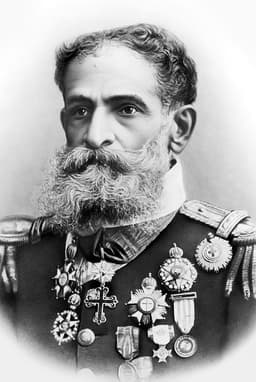
Deodoro da Fonseca
General · Modern
48.8Total
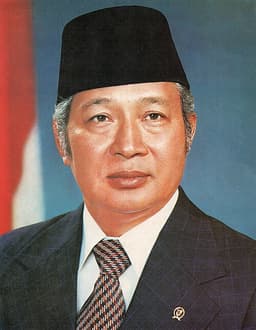
Suharto
General · Modern
57.2Total
Basic Information
Born
1827
1921
Died
1892
—
Era
Modern
Modern
Nationality
Brazil
Indonesia
Occupation
General
General
Civilization
Western
Eastern
Score Comparison
Military (10%)
50.0
20.0
Political (20%)
45.1
59.3
Influence (20%)
54.1
60.0
Legacy (20%)
44.2
52.0
Leadership (15%)
57.6
82.0
Strategy (15%)
38.6
60.0
TOTAL
48.8
57.2
Deodoro da Fonseca — Complete Timeline
1889 AD
Proclamation of the Brazilian RepublicPolitical Action
Deodoro da Fonseca led a military coup that overthrew Emperor Pedro II on November 15, 1889. He proclaimed the Republic of the United States of Brazil, ending 67 years of imperial rule.
CoupRepublic
Impact: globalprogressive
1891 AD
Election as First President of BrazilPolitical Action◆ Major
Deodoro da Fonseca was elected the first President of Brazil by the Constituent Congress on February 25, 1891. He took office under the new republican constitution, but his rule was brief and authoritarian.
ElectionPresidency
Impact: national
Dissolution of the National CongressPolitical Action◆ Major
Facing political opposition, Deodoro da Fonseca dissolved the National Congress on November 3, 1891, and declared a state of siege. This authoritarian act triggered a naval revolt and his eventual resignation.
AuthoritarianismPolitical Crisis
Impact: nationaldestructive
Resignation from the PresidencyPolitical Action◆ Major
Deodoro da Fonseca resigned the presidency on November 23, 1891, after a naval rebellion threatened his government. He handed power to Vice President Floriano Peixoto, ending his 9-month rule.
ResignationPolitical Crisis
Impact: nationaltragic
Suharto — Complete Timeline
1966 AD
Supersemar and Transfer of PowerPolitical Action
President Sukarno signed the Supersemar order, delegating authority to General Suharto to restore order after the 30 September Movement. Suharto used this to ban the Communist Party, purge leftists, and gradually assume executive power, effectively beginning his New Order regime.
SupersemarNew OrderIndonesia
Impact: nationaldestructive
1967 AD
New Order Economic DevelopmentReform◆ Major
Suharto implemented the New Order's economic policies, focusing on foreign investment, agricultural self-sufficiency, and industrialization. The government achieved high growth rates, reduced poverty, and stabilized the economy, but also fostered crony capitalism and corruption.
Economic GrowthDevelopmentIndonesia
Impact: nationalconstructive
1975 AD
Invasion of East TimorWar◆ Major
Suharto ordered the invasion of East Timor after Portugal withdrew. Indonesian forces occupied the territory, leading to a 24-year occupation marked by widespread human rights abuses, including massacres and forced displacement, resulting in an estimated 100,000-200,000 deaths.
East TimorOccupationHuman Rights
Impact: regionaldestructive
1998 AD
Asian Financial Crisis and Fall from PowerPolitical Action
The Asian Financial Crisis devastated Indonesia's economy, leading to massive unemployment and food shortages. Widespread protests and riots forced Suharto to resign in May 1998 after 31 years in power, ending his authoritarian rule and ushering in the Reformasi era.
Financial CrisisResignationReformasi
Impact: nationaltragic
Expert Analysis
Deodoro da Fonseca vs Suharto
The General and the Republic
On a November morning in 1891, a naval squadron anchored in Rio de Janeiro’s harbor trained its guns on the presidential palace. Inside, Marshal Deodoro da Fonseca, the man who had proclaimed Brazil a republic just two years earlier, faced an impossible choice: order his troops to fire on fellow Brazilians, or surrender the power he had seized. Across the world and half a century later, another general, Suharto, would face his own November reckoning in 1998, as students flooded Jakarta’s streets and the Asian Financial Crisis shattered the economy he had built. Both men rose from military camps to presidential palaces. Both promised order and delivered it—until the order collapsed. Why did one fall in months and the other rule for three decades? The answer lies not in the men themselves, but in the worlds they inherited and the nations they remade.
Origins
Deodoro da Fonseca was born in 1827 in Alagoas, a poor northeastern province of the Brazilian Empire. His father was a military officer, his mother a pious Catholic—a combination that shaped his entire life. He entered the military academy at fourteen, where he absorbed not just tactics but positivism, the French philosophy that preached progress through science and order. Brazil in the 1820s was a sprawling empire ruled by a Portuguese-born emperor, its economy dependent on slavery. For a young officer from the provinces, the army offered the only ladder to power.
Suharto’s origins were even humbler. Born in 1921 in a small village in central Java, he was the son of a low-level irrigation official. His parents divorced when he was young, and he was raised by relatives. He attended a Dutch-run school but never finished. Like Deodoro, he joined the colonial army as a teenager, but his Java was a Dutch colony, not an independent nation. The Japanese occupation during World War II shattered the old order and opened paths for Javanese soldiers. Suharto learned to navigate chaos—a skill that would define his career.
Both men emerged from societies where the military was the only institution capable of imposing order. But Deodoro’s Brazil was a constitutional empire with a functioning parliament, while Suharto’s Indonesia was a fragile archipelago barely held together by revolutionary rhetoric.
Rise to Power
Deodoro’s path to power was swift and almost accidental. By 1889, he was a respected but aging general, known more for his courage than his political ambition. The monarchy of Emperor Pedro II had grown unpopular among army officers, who resented their low pay and the government’s preference for the navy. Republican intellectuals, led by Benjamin Constant, courted Deodoro as a figurehead. On November 15, 1889, he reluctantly led a small force of soldiers through Rio’s streets. The emperor, unwilling to see bloodshed, abdicated without a fight. Deodoro had overthrown an empire almost by accident.
Suharto’s rise was more deliberate and bloodier. In 1965, Indonesia was spiraling into chaos. President Sukarno had aligned with the Communist Party, while the army and Islamists grew hostile. On the night of September 30, a group of leftist officers kidnapped and killed six generals. Suharto, then commander of the army’s strategic reserve, crushed the coup attempt within hours. But he did not stop there. Over the following months, he orchestrated a purge of suspected communists that killed an estimated half a million people. In March 1966, Sukarno, isolated and helpless, signed the Supersemar order, delegating authority to Suharto. The transfer of power was complete—not a coup, but a slow strangulation.
Deodoro stumbled into power. Suharto seized it with cold calculation.
Leadership & Governance
Deodoro’s presidency lasted only two years, and it was a disaster. He was a soldier, not an administrator. His government faced economic crisis, inflation, and opposition from both monarchists and radical republicans. In February 1891, he was elected president by the Constituent Congress, but he governed as if the republic were his personal command. When Congress blocked his policies, he dissolved it on November 3, 1891, and declared a state of siege. The navy, loyal to the old empire, rebelled. Within three weeks, Deodoro resigned, handing power to his vice president. He died a year later, broken and forgotten.
Suharto governed with ruthless efficiency. His “New Order” regime prioritized economic development above all else. He invited foreign investment, opened Indonesia to multinational corporations, and achieved rice self-sufficiency by the 1980s. Annual growth averaged 7% for two decades. But this prosperity came at a price: corruption was institutionalized, dissent was crushed, and East Timor was invaded in 1975, leading to decades of occupation and tens of thousands of deaths. Suharto’s political wisdom lay not in ideology but in patronage—he built a network of generals, businessmen, and regional strongmen who enriched themselves in exchange for loyalty.
Deodoro tried to impose order through force and failed. Suharto built a system that made order profitable—until the profits dried up.
Triumph & Tragedy
Deodoro’s greatest moment was the proclamation of the republic itself—a bloodless revolution that ended the Brazilian monarchy. His tragedy was that he had no vision for what came next. He was a liberator without a blueprint.
Suharto’s triumph was the economic transformation of Indonesia. When he took power, the country was one of the poorest in Asia. When he fell, it had a middle class, highways, and factories. His tragedy was that this development was built on corruption and repression. The Asian Financial Crisis of 1997–1998 exposed the fragility of his system. The rupiah collapsed, banks failed, and unemployment soared. Students demanded his resignation. On May 21, 1998, after weeks of protests and riots, Suharto stepped down. He died a decade later, unrepentant and still wealthy.
Character & Destiny
Deodoro was a man of honor but not of cunning. He believed in the republic but did not know how to govern it. His personality—impulsive, proud, and naive—led him to dissolve Congress without a plan. He was a general who never learned that politics requires patience.
Suharto was patient to a fault. He was quiet, calculating, and inscrutable. He spoke in riddles and made decisions in private. His Javanese mysticism taught him that power must be cultivated, not displayed. He built a regime that outlasted him in its structures, if not its legitimacy. His character—disciplined, secretive, and ruthless—allowed him to hold power for 31 years. But it also blinded him to the limits of control.
Legacy
Deodoro da Fonseca is remembered in Brazil as a founding father, but a flawed one. His face adorns the currency, but historians note that the republic he proclaimed took decades to stabilize. He is a statue in a plaza, honored but distant.
Suharto’s legacy is deeply contested. In Indonesia, some remember him as the “Father of Development” who brought prosperity. Others recall the massacres, the corruption, and the stolen elections. His name has been stripped from buildings, but his family remains powerful. He left a nation transformed but traumatized.
Conclusion
Two generals, two republics, two falls. Deodoro fell because he could not build a system strong enough to survive his own mistakes. Suharto fell because his system was too strong—it crushed every alternative until the crisis left no escape. One was a man of action who lacked the patience to govern; the other was a man of patience who lacked the vision to reform. Their stories remind us that power is not just about seizing the moment—it is about understanding the moment you have created. And that understanding, more than any army or decree, is what separates the liberator from the autocrat.
Rankings
🥇
SuhartoLeader
Mil: 20.0Pol: 59.3Inf: 60.0
57.2
🥈
Deodoro da Fonseca
Mil: 50.0Pol: 45.1Inf: 54.1
48.8
+8.4 behind
How This Comparison Works
Algorithm
Each figure is scored on 6 dimensions (0—100 scale) based on structured historical data: Military (10%), Political (20%), Influence (20%), Legacy (20%), Leadership (15%), Strategy (15%). The weighted total produces the final ranking.
Data Sources
Scores are computed from structured sub-indicators in the database. Scale factors adjust for era (Ancient ×0.85, Modern ×1.0) and civilization size (Eastern ×1.05, Other ×0.80) to account for differences in population and military scale.
Maximum 3 Figures
Comparisons are limited to 2—3 figures to ensure readability and statistical meaningfulness.
Error Margins
±5 points per dimension — Sub-scores are derived from historical records with inherent uncertainty. Two figures within 5 points on a dimension should be considered roughly equivalent in that area.
Total Score Accuracy
±3 points overall — The weighted combination of 6 dimensions produces a total score with approximately ±3 points of uncertainty. Differences of less than 3 points are not statistically significant— the figures are effectively tied.
Known Limitations
- Historical records are incomplete and uneven across civilizations
- Figures from oral-tradition societies may be underrepresented
- Occupation labels can misclassify multi-role figures
- Scores measure capability and impact, not moral character
- Quantitative scoring is a comparison tool, not absolute truth
Capability Radar
Military (10%) — Battles & Warfare
Battles
20
40
Win Rate
25
45
Expansion
10
30
Political (20%) — Governance & Reform
Reform
40
55
Diplomacy
25
60
Economy
15
65
Influence (20%) — Cultural & Global Reach
Cultural
20
40
Global
15
50
Legacy (20%) — Historical Impact
Historical
35
55
Longevity
20
45
Leadership (15%) — Power & Stability
Tenure
30
85
Stability
10
50
Strategy (15%) — Tactics & Innovation
Strategy
25
40
Tactics
20
35
Reform
15
50
Similar Comparisons
Comments & Discussion
MARSHAL'S SHADOW6/16/2026
Here's the rub: Deodoro's failure wasn't personal weakness, but institutional. He had no secret police, no systematic purge apparatus. His "fall" came in two years because Brazil's oligarchs simply cut him loose. Suharto had thirty years to build the most sophisticated military-patronage network in Southeast Asia. Compare the 1891 naval revolt with the 1998 student protests—Deodoro faced an armed rebellion; Suharto faced unarmed children. That difference in opponent tells you everything about ho
秩序的铁拳6/16/2026
别被表面相似蒙蔽了。苏哈托统治印尼32年,德奥多罗只撑了两年。关键不是个人能力,是控制手段。苏哈托有"卡特卡瓦克"政策,把整个军队变成家族企业;德奥多罗呢?连巴西海军的忠诚都保不住。一个溺死在洗钱和特务汪洋里,一个淹死在自己的犹豫里。谁更体面?都体面不了。
DATAPOINT DETECTIVE6/16/2026
Suharto's GDP per capita grew 5.6% annually from 1967-1997—one of the best records for any developing country. Deodoro oversaw hyperinflation and recession in his single year of rule. This isn't moral judgment, it's brute fact: Suharto's regime delivered concrete economic results that bought him three decades. Deodoro promised "order and progress" on the flag but delivered neither. The comparison breaks down because one was a competent dictator and the other an incompetent one.
乡土老兵6/16/2026
德奥多罗的悲剧在于他天生是个军人,不是政客。他推翻帝国时是被共和派推着走的,根本不懂操控媒体或收买精英。苏哈托呢?从农村小学教师家庭出身,知道怎么跟地方豪强、军队派系周旋。一个在总统府里孤军奋战,一个在稻田里就学会了合纵连横。说到底是两个人的政治基因不一样:德奥多罗有荣誉感,苏哈托只有生存欲。