Loading...
Deodoro da Fonseca vs Sengge Rinchen
Sengge Rinchen leads by 8.1 pts · 2 figures compared
…
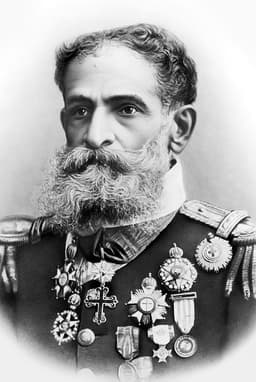
Deodoro da Fonseca
General · Modern
48.8Total
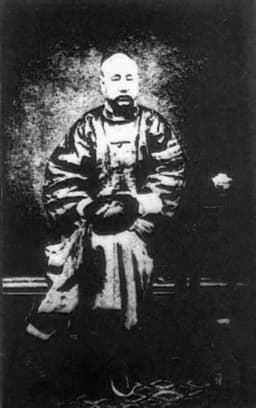
Sengge Rinchen
General · Modern
56.9Total
Basic Information
Born
1827
1811
Died
1892
1865
Era
Modern
Modern
Nationality
Brazil
China
Occupation
General
General
Civilization
Western
Eastern
Score Comparison
Military (10%)
50.0
70.0
Political (20%)
45.1
43.7
Influence (20%)
54.1
55.0
Legacy (20%)
44.2
54.0
Leadership (15%)
57.6
67.0
Strategy (15%)
38.6
60.7
TOTAL
48.8
56.9
Deodoro da Fonseca — Complete Timeline
1889 AD
Proclamation of the Brazilian RepublicPolitical Action
Deodoro da Fonseca led a military coup that overthrew Emperor Pedro II on November 15, 1889. He proclaimed the Republic of the United States of Brazil, ending 67 years of imperial rule.
CoupRepublic
Impact: globalprogressive
1891 AD
Election as First President of BrazilPolitical Action◆ Major
Deodoro da Fonseca was elected the first President of Brazil by the Constituent Congress on February 25, 1891. He took office under the new republican constitution, but his rule was brief and authoritarian.
ElectionPresidency
Impact: national
Dissolution of the National CongressPolitical Action◆ Major
Facing political opposition, Deodoro da Fonseca dissolved the National Congress on November 3, 1891, and declared a state of siege. This authoritarian act triggered a naval revolt and his eventual resignation.
AuthoritarianismPolitical Crisis
Impact: nationaldestructive
Resignation from the PresidencyPolitical Action◆ Major
Deodoro da Fonseca resigned the presidency on November 23, 1891, after a naval rebellion threatened his government. He handed power to Vice President Floriano Peixoto, ending his 9-month rule.
ResignationPolitical Crisis
Impact: nationaltragic
Sengge Rinchen — Complete Timeline
1859 AD
Battle of Dagu FortsWar◆ Major
Sengge Rinchen commanded Qing forces defending the Dagu Forts against a British and French naval attack. His forces repelled the assault, sinking several enemy ships and inflicting heavy casualties, a rare Qing victory in the Second Opium War.
Second Opium WarBattleVictory
Impact: regional
1860 AD
Battle of PalikaoWar◆ Major
Sengge Rinchen commanded Qing cavalry at the Battle of Palikao against Anglo-French forces. His forces were decisively defeated by superior firepower, leading to the fall of Beijing and the burning of the Old Summer Palace.
Second Opium WarBattleDefeat
Impact: regionaltragic
1863 AD
Suppression of the Nian RebellionWar◆ Major
Sengge Rinchen led Qing forces against the Nian rebels in northern China. He achieved several victories but was ultimately killed in battle against the Nian in 1865, marking a turning point in the rebellion.
Nian RebellionCampaignDeath
Impact: regionaltragic
Expert Analysis
Deodoro da Fonseca vs Sengge Rinchen
# The General and the President
On a sweltering August morning in 1860, a Mongol prince named Sengge Rinchen watched from horseback as his elite cavalry—the finest horsemen in Asia—charged across the plains of Palikao, their lances glinting against the Beijing sun. Within hours, they would be annihilated by European rifles and artillery, their bodies scattered like broken toys across the battlefield. Twenty-nine years later and half a world away, another general, Deodoro da Fonseca, stood before a trembling Emperor Pedro II in Rio de Janeiro and told him, simply, that the monarchy was finished. One man died fighting for an empire; the other died having created a republic. What separated them was not talent or courage, but the strange alchemy of timing, temperament, and the particular shape of the worlds they were born to defend or destroy.
Origins
Sengge Rinchen was born in 1811 into the Mongol aristocracy, a world of horsemen and warriors that had once ruled China but now served it. The Qing Dynasty, itself founded by Manchu conquerors, had long relied on Mongol princes to police the empire's vast northern frontiers. Sengge Rinchen learned to ride before he could walk, and his education was one of loyalty, honor, and the unyielding belief that the Qing Mandate of Heaven was eternal. He was a product of the steppe—proud, martial, and deeply conservative.
Deodoro da Fonseca, born in 1827 in Alagoas, Brazil, came from a different kind of military tradition. His father was a Portuguese-Brazilian army officer, and his family had served the Brazilian Empire since its independence in 1822. But Brazil's army was an odd institution—part colonial holdover, part modernizing force, and increasingly a hotbed of republican and positivist ideas. Deodoro grew up in a world where soldiers were expected not just to fight, but to think about the future of their nation. He was a man of the barracks, but also of the salon, where officers debated Auguste Comte and dreamed of progress.
Rise to Power
Sengge Rinchen's path to prominence was traditional: he proved himself in battle. By the 1850s, he had become one of the Qing Empire's most trusted generals, tasked with crushing the Taiping Rebellion, a cataclysmic uprising that had already consumed millions of lives. His victories against the Taiping earned him the title of Prince and the personal favor of the Xianfeng Emperor. He was, by any measure, a loyal servant of a dynasty fighting for its survival.
Deodoro da Fonseca's rise was more ambiguous. He fought in the Paraguayan War (1864–1870), a brutal conflict that turned Brazil into a regional power but also radicalized its officer corps. The war exposed the monarchy's incompetence and the army's potential as a political force. Deodoro returned from the front lines with a reputation for courage but also for a simmering resentment against the imperial government. By the 1880s, he had become a symbol of military discontent—a general who might either defend the throne or topple it.
The key turning point for each man came in a single year: 1859 for Sengge Rinchen, 1889 for Deodoro da Fonseca. In 1859, at the Battle of Dagu Forts, Sengge Rinchen achieved his greatest military triumph. British and French warships attempted to force their way up the Hai River toward Beijing, and his gunners repulsed them with devastating accuracy, sinking four vessels and killing over 400 enemy soldiers. It was a rare moment of Qing victory against the Western powers, and Sengge Rinchen was hailed as a national hero. But the triumph was deceptive. The British and French returned the following year with a larger force, and at Palikao, his cavalry was destroyed. The emperor fled, Beijing was occupied, and the Qing never fully recovered.
Deodoro da Fonseca's turning point was bloodless but no less decisive. On November 15, 1889, he led a military coup that deposed Emperor Pedro II after 58 years of rule. The emperor, old and weary, offered no resistance. Deodoro proclaimed the Republic of the United States of Brazil and became its provisional head of state. It was a revolution without a battle, a victory won by sheer force of political will.
Leadership & Governance
Sengge Rinchen was a battlefield commander of genuine skill. He understood cavalry tactics, knew how to inspire loyalty among his Mongol troops, and had a strategic mind that grasped the importance of terrain and timing. His defense of the Dagu Forts in 1859 was a masterpiece of combined-arms warfare—artillery, infantry, and cavalry working in concert. But his governance was nonexistent. He was a general, not an administrator, and his role in the Qing hierarchy was to fight, not to rule.
Deodoro da Fonseca was the opposite. His military record was unremarkable—his strategy score of 40.2 reflects a man who never commanded a major battle with distinction. But his political score of 77.9 tells a different story. He understood power, coalition-building, and the art of the coup. As Brazil's first president, he faced the immense challenge of turning a military takeover into a stable republic. He failed, in the end, but not for lack of trying. He dissolved Congress in November 1891 when it opposed him, declaring a state of siege. A naval rebellion forced his resignation just weeks later. He had overthrown an emperor, but he could not govern a nation.
Triumph & Tragedy
Sengge Rinchen's greatest moment was the victory at Dagu in 1859. His greatest tragedy was Palikao in 1860, where his beloved cavalry were slaughtered by superior technology. He survived that defeat, but his reputation was shattered. He spent his remaining years fighting the Nian Rebellion, a peasant uprising in northern China, and achieved several victories. But in 1865, he was ambushed and killed in battle, his body never recovered. The Qing Dynasty erected a memorial to him, but his death marked the end of an era—the last time a Mongol prince would command the armies of China.
Deodoro da Fonseca's triumph was the proclamation of the republic itself. His tragedy was his presidency. Elected by Congress in February 1891, he proved incapable of managing the political factions that had united only in their opposition to the monarchy. His authoritarian instincts, forged in the barracks, clashed with the democratic ideals he had claimed to champion. He resigned on November 23, 1891, and died less than a year later, a broken and bitter man.
Character & Destiny
Sengge Rinchen was a man of the old world—brave, loyal, and ultimately anachronistic. He believed in honor and the emperor, and he died for both. His personality was forged on the steppe, where courage was the highest virtue and retreat was shame. He could not adapt to the modern age of rifles and gunboats, and his destiny was to be crushed by it.
Deodoro da Fonseca was a man of the new world—ambitious, pragmatic, and ultimately tragic in a different way. He understood that the old order was dying, but he did not know what to build in its place. His personality was shaped by the contradictions of the Brazilian officer class: progressive in ideas, authoritarian in practice. He could destroy an empire, but he could not construct a republic.
Legacy
Sengge Rinchen is remembered today as a symbol of resistance against Western imperialism, a Mongol prince who stood firm against the tide. In China, his defense of the Dagu Forts is taught as a moment of national pride. But his legacy is also a cautionary tale: the Qing Empire, for all its ancient glory, could not survive the modern world, and neither could its most loyal sons.
Deodoro da Fonseca is remembered as the founder of the Brazilian Republic, and his face appears on Brazilian currency. But his legacy is ambiguous. He is honored as a patriot who ended the monarchy, but criticized as a dictator who could not handle democracy. The republic he proclaimed survived, but it took decades of instability, coups, and military regimes before Brazil found its footing.
Conclusion
Two generals, two empires, two failures. Sengge Rinchen fought to preserve a world that was already dying; Deodoro da Fonseca fought to create a world he could not control. One died on the battlefield, the other in disgrace. But perhaps the deepest difference lies in what they believed. Sengge Rinchen believed in loyalty to a dynasty, a tradition, a way of life that stretched back centuries. Deodoro da Fonseca believed in progress, in the future, in the idea that men could remake their own societies. Both were wrong, in their own ways. But their failures remind us that history is not kind to generals who outlive their moment—whether they come too late, like the Mongol prince, or too soon, like the Brazilian republican.
Rankings
🥇
Sengge RinchenLeader
Mil: 70.0Pol: 43.7Inf: 55.0
56.9
🥈
Deodoro da Fonseca
Mil: 50.0Pol: 45.1Inf: 54.1
48.8
+8.1 behind
How This Comparison Works
Algorithm
Each figure is scored on 6 dimensions (0—100 scale) based on structured historical data: Military (10%), Political (20%), Influence (20%), Legacy (20%), Leadership (15%), Strategy (15%). The weighted total produces the final ranking.
Data Sources
Scores are computed from structured sub-indicators in the database. Scale factors adjust for era (Ancient ×0.85, Modern ×1.0) and civilization size (Eastern ×1.05, Other ×0.80) to account for differences in population and military scale.
Maximum 3 Figures
Comparisons are limited to 2—3 figures to ensure readability and statistical meaningfulness.
Error Margins
±5 points per dimension — Sub-scores are derived from historical records with inherent uncertainty. Two figures within 5 points on a dimension should be considered roughly equivalent in that area.
Total Score Accuracy
±3 points overall — The weighted combination of 6 dimensions produces a total score with approximately ±3 points of uncertainty. Differences of less than 3 points are not statistically significant— the figures are effectively tied.
Known Limitations
- Historical records are incomplete and uneven across civilizations
- Figures from oral-tradition societies may be underrepresented
- Occupation labels can misclassify multi-role figures
- Scores measure capability and impact, not moral character
- Quantitative scoring is a comparison tool, not absolute truth
Capability Radar
Military (10%) — Battles & Warfare
Battles
20
75
Win Rate
25
60
Expansion
10
20
Political (20%) — Governance & Reform
Reform
40
20
Diplomacy
25
50
Economy
15
20
Influence (20%) — Cultural & Global Reach
Cultural
20
40
Global
15
35
Legacy (20%) — Historical Impact
Historical
35
55
Longevity
20
30
Leadership (15%) — Power & Stability
Tenure
30
40
Stability
10
30
Strategy (15%) — Tactics & Innovation
Strategy
25
70
Tactics
20
80
Reform
15
30
Similar Comparisons
Comments & Discussion
草原铁骑·帕里卡奥6/16/2026
你们那些西装革履的键盘军事家,整天吹什么“现代武器碾压传统骑兵”。但帕里卡奥之战根本不是武器差距的问题——清军自己就有火器,英法联军的线膛枪也没到代差碾压的地步。真正致命的是指挥:桑格林钦把精锐全押在正面冲锋上,而蒙托邦将军早就用侧翼包抄看穿了他的战术。这不是骑兵vs步枪,是老派英雄主义vs现代参谋制度。他若多学点孙子兵法,帕里卡奥河谷至少能活下来一半蒙古勇士。|zh
Marshal's Paradox6/16/2026
The key difference here isn't guns vs lances—it's how each man read his era. Fonseca understood that Brazil's monarchy was a hollow shell; he didn't need to win a war, just show up with the army. In his 1891 constitution, he modeled Brazil's presidency on the U.S., not Europe. Sengge Rinchen, by contrast, fought the British-French alliance with medieval tactics while ignoring that even the Qing court had started modernizing after the Opium Wars. Both were military men, but Fonseca had political
Skeptic76/16/2026
I call shenanigans on the "annihilated by European rifles" narrative. Artillery did most of the damage at Palikao—the infantry volleys were just cleanup. Also, Fonseca's "republic" was a coup dressed in military medals; he dissolved the Constituent Assembly when it disagreed with him, then stayed in power through a naval revolt. Comparing them as "one defending empire, one creating republic" is a storybook gloss. Both were authoritarian soldiers who got lucky with their enemies' collapse.