Loading...
Deodoro da Fonseca vs Samori Toure
Samori Toure leads by 21.7 pts · 2 figures compared
…
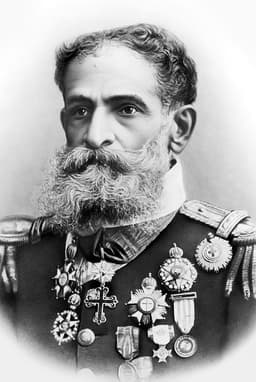
Deodoro da Fonseca
General · Modern
48.8Total
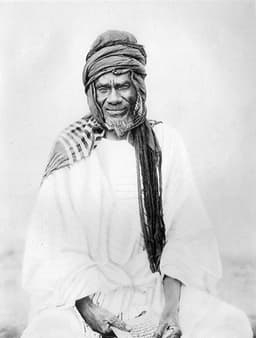
Samori Toure
General · Modern
70.5Total
Basic Information
Born
1827
1830
Died
1892
1900
Era
Modern
Modern
Nationality
Brazil
Wassoulou Empire
Occupation
General
General
Civilization
Western
Other
Score Comparison
Military (10%)
50.0
60.0
Political (20%)
45.1
78.0
Influence (20%)
54.1
68.0
Legacy (20%)
44.2
72.0
Leadership (15%)
57.6
72.0
Strategy (15%)
38.6
70.0
TOTAL
48.8
70.5
Deodoro da Fonseca — Complete Timeline
1889 AD
Proclamation of the Brazilian RepublicPolitical Action
Deodoro da Fonseca led a military coup that overthrew Emperor Pedro II on November 15, 1889. He proclaimed the Republic of the United States of Brazil, ending 67 years of imperial rule.
CoupRepublic
Impact: globalprogressive
1891 AD
Election as First President of BrazilPolitical Action◆ Major
Deodoro da Fonseca was elected the first President of Brazil by the Constituent Congress on February 25, 1891. He took office under the new republican constitution, but his rule was brief and authoritarian.
ElectionPresidency
Impact: national
Dissolution of the National CongressPolitical Action◆ Major
Facing political opposition, Deodoro da Fonseca dissolved the National Congress on November 3, 1891, and declared a state of siege. This authoritarian act triggered a naval revolt and his eventual resignation.
AuthoritarianismPolitical Crisis
Impact: nationaldestructive
Resignation from the PresidencyPolitical Action◆ Major
Deodoro da Fonseca resigned the presidency on November 23, 1891, after a naval rebellion threatened his government. He handed power to Vice President Floriano Peixoto, ending his 9-month rule.
ResignationPolitical Crisis
Impact: nationaltragic
Samori Toure — Complete Timeline
1878 AD
Establishment of the Wassoulou EmpirePolitical Action
Samori Toure founded the Wassoulou Empire in West Africa, uniting various Mandinka states under his rule. He established a centralized administration and a professional army, creating a powerful state that resisted French expansion.
EmpireWassoulouUnification
Impact: regionalconstructive
1880 AD
Military Reforms and ModernizationReform◆ Major
Samori Toure modernized his army by importing firearms from European traders and establishing a standing army of up to 35,000 men. He organized his forces into regular units and introduced new tactics, making them effective against French troops.
Military ReformFirearmsArmy
Impact: regionalconstructive
1882 AD
First Franco-Wassoulou WarWar◆ Major
Samori Toure's forces fought the French army in the first major conflict between the Wassoulou Empire and France. The war ended with a treaty in 1886, recognizing Samori's control over the Niger River region.
WarFranceTreaty
Impact: regional
1891 AD
Second Franco-Wassoulou WarWar◆ Major
The French resumed hostilities, forcing Samori to retreat eastward. He employed a scorched-earth strategy, destroying villages and crops to deny resources to the French, prolonging the conflict for years.
WarScorched EarthRetreat
Impact: regionaltragic
1898 AD
Capture and ExileWar
Samori Toure was captured by French forces after a long campaign. He was exiled to Gabon, where he died in 1900. His capture ended the Wassoulou Empire and marked the completion of French conquest in West Africa.
CaptureExileEnd of Empire
Impact: regionaltragic
Expert Analysis
Deodoro da Fonseca vs Samori Toure
### The General and the Emperor: Two Paths to Power in a World Transformed
In the autumn of 1898, a weary, gray-bearded man in his late sixties sat in a French military camp in West Africa, a captive of the very empire he had defied for nearly two decades. Samori Toure, the founder of the Wassoulou Empire, had just been outmaneuvered, his epic resistance finally crushed. Half a world away, in the balmy November of 1889, another general, a stout, mustachioed figure named Deodoro da Fonseca, stood at the head of a column of soldiers in Rio de Janeiro. With a single, decisive command, he ended a half-century of imperial rule and declared Brazil a republic. One man fought to build a new kingdom; the other, to tear an old one down. Both were generals, both were leaders of their nations, yet their stories—one of tragic, magnificent failure, the other of uneasy, fleeting triumph—could not be more different. Why did one become a legend of resistance and the other a footnote of political transition?
### Origins: The Soil and the Crown
Samori Toure was born around 1830 into a world of small, competing Mandinka chiefdoms in what is now Guinea. His early life was not one of privilege; he was a trader and a soldier of fortune, a man who learned the brutal arithmetic of power in a region already feeling the distant tremors of European encroachment. His era was one of fragmentation and violence, where a man’s worth was measured by his skill with a rifle and his ability to forge alliances. He had no royal blood, no formal education in the Western sense. His rise was a testament to raw ambition and tactical genius, forged in the crucible of the slave trade and the creeping shadow of French colonialism. The land itself—vast, forested, and disease-ridden—was his classroom, and survival his curriculum.
Deodoro da Fonseca, born in 1827 in Alagoas, Brazil, was a child of the Empire. His family was part of the military aristocracy that served the Brazilian monarchy, a stable, Portuguese-speaking world of coffee plantations, Catholic rituals, and a rigid social hierarchy. He was a product of the military academy, not the battlefield. His Brazil was a nation that had achieved independence without a bloody revolution, a constitutional monarchy that, for all its flaws, offered a path to power through the officer corps. Where Samori’s world was one of constant, existential warfare, Deodoro’s was one of political maneuvering within a system that, by the 1880s, was creaking under the weight of its own contradictions—slavery, regionalism, and a restless officer class.
### Rise to Power: The Sword and the Coup
Samori Toure’s ascent was a slow, grinding campaign of conquest and consolidation. In 1878, he formally established the Wassoulou Empire, uniting a patchwork of states under his rule. This was not a single event but the culmination of years of warfare, diplomacy, and sheer will. He understood that to resist the French, he needed a state, not just a following. His rise was a masterclass in improvisation: he imported firearms from British and German traders, built a standing army of up to 30,000 men, and introduced a system of military ranks and logistics that rivaled those of his European adversaries. His power was earned, bloodied, and personal.
Deodoro da Fonseca’s rise was far more swift and far less bloody. He was a respected but not brilliant officer, known more for his loyalty to the military institution than for any grand vision. His moment came on November 15, 1889, when he led a bloodless coup against Emperor Pedro II. The monarchy had become a symbol of stagnation, and the army, frustrated by low pay and political irrelevance, was ripe for revolt. Deodoro did not build a movement; he stepped into one. He was the figurehead, the sword that cut the Gordian knot of empire. His power was granted, not grown.
### Leadership & Governance: The Builder and the Bungler
As a ruler, Samori Toure was a visionary pragmatist. His military score of 60.3 and strategy of 68.0, while not extraordinary, hide the sheer adaptability of his command. He used scorched-earth tactics during the Second Franco-Wassoulou War in 1891, burning villages and crops to deny the French supplies, a strategy of desperate brilliance. Politically, his score of 70.5 reflects a man who ruled through a mix of Islamic legitimacy, Mandinka tradition, and personal charisma. He reformed his army, standardized taxation, and tried to create a modern state. His leadership score of 78.4 is perhaps his most telling: he inspired loyalty, even in defeat.
Deodoro da Fonseca’s political score of 77.9 seems high, but it masks a catastrophic failure of governance. As Brazil’s first president, he was a general, not a statesman. He lacked the patience for constitutional democracy. When the National Congress opposed him, he dissolved it on November 3, 1891, declaring a state of siege—a move that immediately triggered a naval rebellion and his own resignation just twenty days later. His military score of 35.9 and strategy of 40.2 are not just numbers; they reflect a man who had never commanded a real war. He was a coup-maker, not a nation-builder.
### Triumph & Tragedy: The Long March and the Short Presidency
Samori Toure’s greatest moment was not a single battle but the sustained act of resistance itself. For nearly two decades, he held off the French, a feat that made him a legend across West Africa. His tragedy was the capture in 1898, not in a grand battle, but by a ruse, as he negotiated a surrender. He was exiled to Gabon, where he died in 1900, a prisoner of the empire he could never defeat. His triumph was his refusal to submit; his tragedy, that his empire died with him.
Deodoro da Fonseca’s triumph was the Proclamation of the Republic itself, a moment of national transformation that he, more than any other man, embodied. His tragedy was his presidency. He lasted less than two years, and his own actions—the dissolution of Congress—destroyed his legitimacy. He resigned in disgrace, his health broken, and died in 1892, a man who had overthrown an emperor only to find himself incapable of ruling a republic.
### Character & Destiny: The Iron Will and the Hollow Man
Samori Toure’s character was forged in fire. He was relentless, patient, and deeply strategic. His decisions were driven by a single, overriding goal: survival and sovereignty. He learned from his enemies, adopting their weapons and tactics, but never their worldview. His destiny was to be a symbol, a man whose resistance outlived his own life.
Deodoro da Fonseca’s character was that of a loyal soldier thrust into a political role he did not want and could not handle. He was not a tyrant; he was a man of limited vision, who saw the republic as a military project, not a democratic one. His destiny was to be a placeholder, the first of many Brazilian generals who would try, and fail, to govern a nation that had outgrown its old masters.
### Legacy: The Eternal Flame and the Forgotten Flag
Samori Toure’s legacy score of 73.9 and influence of 75.8 reflect his enduring power as a symbol of anti-colonial resistance. In Guinea, he is a national hero, his name invoked in schools, on stamps, and in political speeches. He represents the African capacity to fight back, to organize, to dream of empire in the face of overwhelming force.
Deodoro da Fonseca’s legacy score of 60.6 is lower, and telling. He is remembered, but not revered. The Brazilian Republic he proclaimed still stands, but his own role is a historical footnote. He is the man who started something he could not finish, a general who became a president and then, almost immediately, a cautionary tale.
### Conclusion: Two Faces of Modernity
Standing at the edge of the twentieth century, both Samori Toure and Deodoro da Fonseca were swept up in forces larger than themselves—colonialism, nationalism, the end of old empires. One built a kingdom to resist the new world; the other tore down a kingdom to join it. Their fates were not just products of their choices but of their contexts. Samori, fighting against a European power, could only lose, but lose gloriously. Deodoro, fighting alongside the forces of modernity, could only win, but win hollowly. In the end, the general who lost his empire gained an immortal name, while the general who founded a republic became a ghost in his own creation. Their stories remind us that history’s greatest figures are not always its most successful, and that the measure of a life is not always the victory, but the fight.
Rankings
🥇
Samori ToureLeader
Mil: 60.0Pol: 78.0Inf: 68.0
70.5
🥈
Deodoro da Fonseca
Mil: 50.0Pol: 45.1Inf: 54.1
48.8
+21.7 behind
How This Comparison Works
Algorithm
Each figure is scored on 6 dimensions (0—100 scale) based on structured historical data: Military (10%), Political (20%), Influence (20%), Legacy (20%), Leadership (15%), Strategy (15%). The weighted total produces the final ranking.
Data Sources
Scores are computed from structured sub-indicators in the database. Scale factors adjust for era (Ancient ×0.85, Modern ×1.0) and civilization size (Eastern ×1.05, Other ×0.80) to account for differences in population and military scale.
Maximum 3 Figures
Comparisons are limited to 2—3 figures to ensure readability and statistical meaningfulness.
Error Margins
±5 points per dimension — Sub-scores are derived from historical records with inherent uncertainty. Two figures within 5 points on a dimension should be considered roughly equivalent in that area.
Total Score Accuracy
±3 points overall — The weighted combination of 6 dimensions produces a total score with approximately ±3 points of uncertainty. Differences of less than 3 points are not statistically significant— the figures are effectively tied.
Known Limitations
- Historical records are incomplete and uneven across civilizations
- Figures from oral-tradition societies may be underrepresented
- Occupation labels can misclassify multi-role figures
- Scores measure capability and impact, not moral character
- Quantitative scoring is a comparison tool, not absolute truth
Capability Radar
Military (10%) — Battles & Warfare
Battles
20
75
Win Rate
25
65
Expansion
10
60
Political (20%) — Governance & Reform
Reform
40
75
Diplomacy
25
80
Economy
15
60
Influence (20%) — Cultural & Global Reach
Cultural
20
65
Global
15
55
Legacy (20%) — Historical Impact
Historical
35
70
Longevity
20
60
Leadership (15%) — Power & Stability
Tenure
30
70
Stability
10
55
Strategy (15%) — Tactics & Innovation
Strategy
25
85
Tactics
20
80
Reform
15
70
Similar Comparisons
Comments & Discussion
Cavalryman's Critique6/16/2026
Samori Toure wins this comparison for sheer strategic vision, hands down. Fighting the French with a mix of scorched earth and imported rifles while his opponent was just a cardboard figure leading a bloodless coup. Fonseca's "victory" was basically walking into a palace that had already been vacated, while Toure held off one of Europe's major colonial powers for two decades. One's a tragic badass, the other's a footnote only Brazilians remember. Not even close.
分数统计员6/16/2026
数据不会骗人:Toure领导了18年抵抗运动,对抗的是当时世界第二军事强国,建立了完整的行政体系和军队建设计划;Fonseca呢?他指挥的是一枪未开的政变,统治了不到两年就被迫下台,经济政策一塌糊涂。一个用最低资源上演战略奇迹,另一个连小政府都搞不定。把这两个人放天平上,任何客观比较都会倒向Toure那边。
Republic's Ghost6/16/2026
You're all missing the irony here. Fonseca didn't want power—he literally told his fellow conspirators he'd resign after freeing the slaves and establishing a republic. Compare that to Toure, who built an empire so he could personally rule it, complete with a hereditary monarchy. One was a reluctant revolutionary thrust into an emperor's chair, the other a determined imperialist in republicans' clothing. History's judgment is biased toward rebels who lost, not transition figures who won then fai
殖民反思者6/16/2026
把目光从英雄叙事移开吧。Toure的帝国建立在对周边部族的征服之上,强制征兵、部落联盟靠铁血维系,他的抵抗虽然悲壮,本质也是军阀兼并。Fonseca的问题在于巴西帝国本来就是葡萄牙植入的异物,他做的不过是剪掉一根已经枯死的藤蔓。两个人都被历史浪漫化了:一个因失败而神化,一个因成功而遗忘。真正的英雄应当属于那些无名的平民,而不是这两个将军。
Numismatic Nerd6/16/2026
Follow the money, folks. Fonseca's coup was bankrolled by coffee barons tired of imperial tariffs, and the Brazilian currency tanked 40% under his watch due to the "Encilhamento" bubble. Meanwhile, Toure funded his war machine by taxing kola nut trade and selling war captives—a pre-capitalist economy fighting industrial armies. Fonseca was a tool for new money; Toure was a genuine self-made power. When your economic legacy is a spectacular crash, you've lost even if you won.