Loading...
Muhammadu Buhari vs Samori Toure
Samori Toure leads by 19.0 pts · 2 figures compared
…
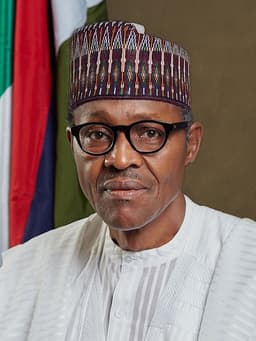
Muhammadu Buhari
General · Modern
51.5Total
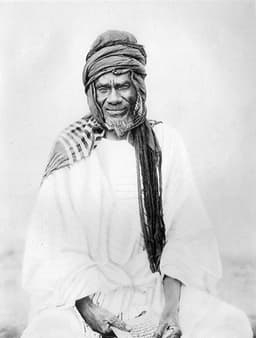
Samori Toure
General · Modern
70.5Total
Basic Information
Born
1942
1830
Died
—
1900
Era
Modern
Modern
Nationality
Nigeria
Wassoulou Empire
Occupation
General
General
Civilization
Other
Other
Score Comparison
Military (10%)
22.6
60.0
Political (20%)
68.0
78.0
Influence (20%)
53.3
68.0
Legacy (20%)
43.3
72.0
Leadership (15%)
72.0
72.0
Strategy (15%)
41.0
70.0
TOTAL
51.5
70.5
Muhammadu Buhari — Complete Timeline
1983 AD
1983 Nigerian coup d'étatPolitical Action
Major General Muhammadu Buhari led a military coup that overthrew the civilian government of President Shehu Shagari. Buhari cited corruption and economic mismanagement as justifications, and he became the head of state.
CoupMilitary RuleCorruption
Impact: nationaldestructive
1984 AD
War Against Indiscipline (WAI)Reform◆ Major
Buhari launched the War Against Indiscipline, a campaign to enforce discipline and order in Nigerian society. It included harsh penalties for minor offenses, such as queue-jumping, and was criticized for human rights abuses.
DisciplineSocial PolicyHuman Rights
Impact: nationaldestructive
1985 AD
Overthrow by Ibrahim BabangidaPolitical Action◆ Major
Buhari was overthrown in a palace coup led by his Chief of Army Staff, Ibrahim Babangida. Babangida cited Buhari's authoritarian style and failure to address the economy as reasons for the coup.
CoupOverthrowBabangida
Impact: national
2015 AD
Anti-corruption campaignReform◆ Major
Buhari launched a high-profile anti-corruption campaign, targeting government officials and recovering stolen assets. The campaign was praised internationally but criticized for being selective and politically motivated.
Anti-CorruptionReformGovernance
Impact: nationalconstructive
Election as President of NigeriaPolitical Action
Buhari won the 2015 Nigerian presidential election, defeating incumbent Goodluck Jonathan. This was the first time an opposition candidate had defeated a sitting president in Nigeria's history, marking a democratic milestone.
ElectionDemocracyOpposition Victory
Impact: nationalprogressive
Samori Toure — Complete Timeline
1878 AD
Establishment of the Wassoulou EmpirePolitical Action
Samori Toure founded the Wassoulou Empire in West Africa, uniting various Mandinka states under his rule. He established a centralized administration and a professional army, creating a powerful state that resisted French expansion.
EmpireWassoulouUnification
Impact: regionalconstructive
1880 AD
Military Reforms and ModernizationReform◆ Major
Samori Toure modernized his army by importing firearms from European traders and establishing a standing army of up to 35,000 men. He organized his forces into regular units and introduced new tactics, making them effective against French troops.
Military ReformFirearmsArmy
Impact: regionalconstructive
1882 AD
First Franco-Wassoulou WarWar◆ Major
Samori Toure's forces fought the French army in the first major conflict between the Wassoulou Empire and France. The war ended with a treaty in 1886, recognizing Samori's control over the Niger River region.
WarFranceTreaty
Impact: regional
1891 AD
Second Franco-Wassoulou WarWar◆ Major
The French resumed hostilities, forcing Samori to retreat eastward. He employed a scorched-earth strategy, destroying villages and crops to deny resources to the French, prolonging the conflict for years.
WarScorched EarthRetreat
Impact: regionaltragic
1898 AD
Capture and ExileWar
Samori Toure was captured by French forces after a long campaign. He was exiled to Gabon, where he died in 1900. His capture ended the Wassoulou Empire and marked the completion of French conquest in West Africa.
CaptureExileEnd of Empire
Impact: regionaltragic
Expert Analysis
Muhammadu Buhari vs Samori Toure
# Two Generals, Two Centuries: The Divergent Paths of Samori Toure and Muhammadu Buhari
In the sweltering heat of Gabon in 1900, an old man died in exile, his empire shattered, his armies scattered. Samori Toure, the Lion of Wassoulou, had spent seventeen years fighting the French, only to end his days far from the savannahs he once ruled. A century later, another general stood before a cheering crowd in Abuja, sworn in as Nigeria's democratically elected president. Muhammadu Buhari had returned from the political wilderness, his military past forgiven, his future uncertain. Both men were generals. Both led nations. But their stories could not have diverged more sharply—one ending in exile, the other in triumph. What drove these outcomes? The answer lies not in fate, but in the times that shaped them and the choices they made.
Origins
Samori Toure was born around 1830 into a Dyula trading family in what is now Guinea. He grew up in a world of fragmented Mandinka states, where power was local and European influence was just beginning to creep inland. His early life was marked by hardship—his mother was captured by raiders, and Samori himself was forced into servitude before escaping. This crucible forged a man of iron resolve. He learned the arts of war and diplomacy in equal measure, understanding that survival in West Africa required both the sword and the word.
Muhammadu Buhari was born in 1942 in Daura, northern Nigeria, into a Fulani family with deep roots in the region's Islamic traditions. His world was already shaped by colonialism—Nigeria was a British creation, an artificial nation of over 250 ethnic groups. Buhari grew up under the shadow of independence, attending military school and rising through the ranks of the Nigerian Army. His generation inherited a country that had never known self-rule, and the military seemed the only institution capable of holding it together.
The difference in their upbringings is stark. Samori faced a world of pre-colonial flux, where he could build something new. Buhari entered a world of post-colonial chaos, where he had to manage something already broken.
Rise to Power
Samori’s path to power was a slow, deliberate climb. By the 1860s, he had become a respected war leader, uniting Mandinka clans through a combination of military prowess and diplomatic marriages. In 1878, he formally established the Wassoulou Empire, a confederation of states stretching from modern Guinea to Ivory Coast. His rise was organic—he answered a need for order in a region threatened by external forces.
Buhari’s rise was sudden and violent. On December 31, 1983, he led a coup that overthrew President Shehu Shagari, citing corruption and economic mismanagement. He was 41 years old, a major general with little political experience. His justification was simple: the civilians had failed, and the military must save the nation.
One man built an empire from scratch. The other seized a state that already existed. The difference in opportunity is profound—but so is the difference in vision.
Leadership & Governance
Samori’s leadership was a masterclass in adaptation. He modernized his army, importing firearms from European traders and establishing a standing force of up to 30,000 men. He built a centralized administration, collected taxes, and maintained a network of spies. When the French first attacked in 1882, he fought them to a standstill, forcing a treaty that recognized his empire. His military score of 60.3 reflects a man who understood war as an extension of politics—he knew when to fight and when to negotiate.
Buhari’s leadership was rigid. His 1984 "War Against Indiscipline" was a campaign to enforce order through draconian measures—public floggings, long jail terms, and a ban on public spitting. It worked in the short term: crime fell, and streets were cleaner. But it alienated the very people he claimed to serve. His military score of 20.7 is unusually low for a general, but it captures a truth: Buhari was not a strategist in the field but a disciplinarian in the office. He governed by decree, not by persuasion.
Samori’s political score of 70.5 reflects his ability to build alliances and manage diverse peoples. Buhari’s political score of 61.0, while respectable, masks a deeper flaw: he could win power but could not wield it wisely.
Triumph & Tragedy
Samori’s greatest triumph was his resistance itself. Between 1891 and 1898, he fought the French in the Second Franco-Wassoulou War, employing scorched-earth tactics that delayed their advance for years. He retreated eastward, burning villages and crops, denying the enemy supplies. It was a brutal strategy, but it worked—for a time. His tragedy came in 1898, when he was captured and exiled to Gabon. He died two years later, his empire erased from the map.
Buhari’s triumph was his 2015 election—the first time a Nigerian opposition candidate had defeated an incumbent president. It was a moment of democratic maturity, proof that Nigeria could change leaders peacefully. His tragedy was his first term as military ruler: overthrown in 1985 by his own chief of army staff, Ibrahim Babangida, who cited his authoritarianism as the reason. Buhari spent decades in the political wilderness, watching others govern.
One man’s tragedy was his defeat by a foreign power. The other’s was his rejection by his own people.
Character & Destiny
Samori’s character was forged in resistance. He was patient, calculating, and willing to sacrifice for the long game. He understood that his empire was a means to an end—the preservation of Mandinka independence. When the end came, he accepted it with dignity. His leadership score of 78.4 reflects a man who inspired loyalty even in defeat.
Buhari’s character was forged in discipline. He was rigid, moralistic, and intolerant of dissent. He believed that order was the highest good, and he was willing to impose it by force. His leadership score of 77.5 is similar to Samori’s, but it masks a crucial difference: Samori led by example, while Buhari led by command.
Destiny dealt them different hands. Samori faced a colonial empire at its peak. Buhari faced a nation struggling to define itself. One fought for survival; the other fought for control.
Legacy
Samori Toure is remembered as a hero of African resistance. His legacy score of 73.9 places him among the great anti-colonial leaders. In Guinea, his image adorns currency and monuments. He is a symbol of defiance, a reminder that Africans did not submit quietly to colonialism.
Muhammadu Buhari is more complicated. His legacy score of 56.7 is modest, reflecting a mixed record. He is praised for his anti-corruption campaign, which recovered billions of dollars in stolen assets. But he is criticized for his human rights record, both as a military ruler and as a democratic president. His influence score of 70.3 suggests he remains a powerful figure, but his place in history is still being written.
Conclusion
Samori Toure and Muhammadu Buhari are two sides of the same coin—generals who led nations in times of crisis. But their stories reveal how context shapes character. Samori built an empire to resist a foreign invader; Buhari seized a state to fix a broken system. One died in exile, a martyr to a lost cause. The other died in office, a survivor of a flawed democracy. Their scores tell the tale: Samori’s total of 72.0 reflects a life of coherent purpose; Buhari’s 60.7 reflects a life of contradictions. In the end, both men remind us that leadership is not about victory or defeat, but about the choices we make when the world is watching—and when it is not.
Rankings
🥇
Samori ToureLeader
Mil: 60.0Pol: 78.0Inf: 68.0
70.5
🥈
Muhammadu Buhari
Mil: 22.6Pol: 68.0Inf: 53.3
51.5
+19.0 behind
How This Comparison Works
Algorithm
Each figure is scored on 6 dimensions (0—100 scale) based on structured historical data: Military (10%), Political (20%), Influence (20%), Legacy (20%), Leadership (15%), Strategy (15%). The weighted total produces the final ranking.
Data Sources
Scores are computed from structured sub-indicators in the database. Scale factors adjust for era (Ancient ×0.85, Modern ×1.0) and civilization size (Eastern ×1.05, Other ×0.80) to account for differences in population and military scale.
Maximum 3 Figures
Comparisons are limited to 2—3 figures to ensure readability and statistical meaningfulness.
Error Margins
±5 points per dimension — Sub-scores are derived from historical records with inherent uncertainty. Two figures within 5 points on a dimension should be considered roughly equivalent in that area.
Total Score Accuracy
±3 points overall — The weighted combination of 6 dimensions produces a total score with approximately ±3 points of uncertainty. Differences of less than 3 points are not statistically significant— the figures are effectively tied.
Known Limitations
- Historical records are incomplete and uneven across civilizations
- Figures from oral-tradition societies may be underrepresented
- Occupation labels can misclassify multi-role figures
- Scores measure capability and impact, not moral character
- Quantitative scoring is a comparison tool, not absolute truth
Capability Radar
Military (10%) — Battles & Warfare
Battles
10
75
Win Rate
10
65
Expansion
5
60
Political (20%) — Governance & Reform
Reform
30
75
Diplomacy
25
80
Economy
20
60
Influence (20%) — Cultural & Global Reach
Cultural
25
65
Global
25
55
Legacy (20%) — Historical Impact
Historical
30
70
Longevity
20
60
Leadership (15%) — Power & Stability
Tenure
45
70
Stability
15
55
Strategy (15%) — Tactics & Innovation
Strategy
15
85
Tactics
15
80
Reform
20
70
Similar Comparisons
Comments & Discussion
SamoriSkeptic6/16/2026
Glad you romanticize Samori's resistance, but military historians know the score: he lost. Seventeen years of guerrilla tactics and scorched earth couldn't stop French artillery and the railroad. Compare that to Buhari, who actually held power—first as a coup leader in '83, then winning elections in 2015. Toure's "empire" was a temporary alliance of nervous chieftains, not a nation. Buhari faced Boko Haram and an oil crash and still handed over power. That's real leadership, not tragic exile por
数据侦探6/16/2026
这个对比根本不在一个量级上。萨摩里的军队最多三万人,用的还是老式火枪;布哈里治理的是两亿人的现代国家。拿19世纪的部落领袖和21世纪的总统比,就像比较自行车和火箭的速度。再说了,萨摩里输给法国殖民者是因为技术和组织全面落后,而布哈里至少保持了尼日利亚的完整。数据不会骗人:尼日利亚GDP在他任内从4800亿涨到5100亿(虽然通胀严重),萨摩里有啥GDP?零。
ClassicsChad6/16/2026
As a classical scholar, I see Thucydides' ghost in both stories. Samori was Alcibiades in Africa—brilliant, charismatic, but ultimately undone by overreach and a coalition of enemies. Buhari is more like Cincinnatus: the reluctant strongman who leaves his farm (or military barracks) to save the republic, then returns. Except Cincinnatus was dictator for 16 days; Buhari was president for 8 years of mixed results. The real lesson? Exile is for losers of wars, elections are for survivors of systems
民国老炮6/16/2026
说个冷知识:萨摩里·杜尔和袁世凯有点像。都是旧时代的军人,面对列强都搞过"自强",都玩过合纵连横。萨摩里跟法国签完《比桑杜古条约》转头又反悔,袁世凯对日本搞"二十一条"也是阳奉阴违。区别在于袁世凯后来当了83天皇帝,萨摩里连提都没提称帝。布哈里呢?倒是跟张作霖更像——都是北方军阀出身,都靠军人干政上台。但张作霖被炸死在皇姑屯,布哈里活到88岁善终。历史真会挑人开玩笑。
RebelCritic6/16/2026
Revisionist take: stop turning Samori Toure into a martyr. He sold slaves to finance his wars, and his "empire" relied on forced labor and child soldiers. Buhari's military regime in the 1980s also had a bloody record—human rights abuses, press gagging, corruption in the shadows. Both were authoritarian generals who crushed