Loading...
Deodoro da Fonseca vs Ramon Castilla
Ramon Castilla leads by 10.9 pts · 2 figures compared
…
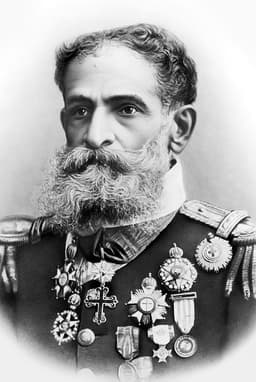
Deodoro da Fonseca
General · Modern
48.8Total
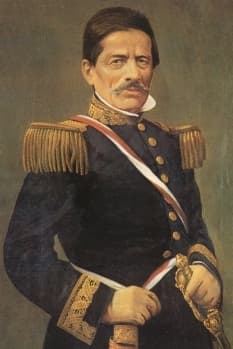
Ramon Castilla
General · Modern
59.7Total
Basic Information
Born
1827
1797
Died
1892
1867
Era
Modern
Modern
Nationality
Brazil
Peru
Occupation
General
General
Civilization
Western
Western
Score Comparison
Military (10%)
50.0
40.0
Political (20%)
45.1
72.0
Influence (20%)
54.1
56.7
Legacy (20%)
44.2
52.0
Leadership (15%)
57.6
78.0
Strategy (15%)
38.6
60.0
TOTAL
48.8
59.7
Deodoro da Fonseca — Complete Timeline
1889 AD
Proclamation of the Brazilian RepublicPolitical Action
Deodoro da Fonseca led a military coup that overthrew Emperor Pedro II on November 15, 1889. He proclaimed the Republic of the United States of Brazil, ending 67 years of imperial rule.
CoupRepublic
Impact: globalprogressive
1891 AD
Election as First President of BrazilPolitical Action◆ Major
Deodoro da Fonseca was elected the first President of Brazil by the Constituent Congress on February 25, 1891. He took office under the new republican constitution, but his rule was brief and authoritarian.
ElectionPresidency
Impact: national
Dissolution of the National CongressPolitical Action◆ Major
Facing political opposition, Deodoro da Fonseca dissolved the National Congress on November 3, 1891, and declared a state of siege. This authoritarian act triggered a naval revolt and his eventual resignation.
AuthoritarianismPolitical Crisis
Impact: nationaldestructive
Resignation from the PresidencyPolitical Action◆ Major
Deodoro da Fonseca resigned the presidency on November 23, 1891, after a naval rebellion threatened his government. He handed power to Vice President Floriano Peixoto, ending his 9-month rule.
ResignationPolitical Crisis
Impact: nationaltragic
Ramon Castilla — Complete Timeline
1824 AD
Battle of AyacuchoWar
Castilla fought as a junior officer in the decisive Battle of Ayacucho, which ended Spanish rule in Peru. This victory secured Peruvian independence and marked the end of the Spanish Empire in South America, shaping Castilla's nationalist views.
Peruvian War of IndependenceBattleLiberation
Impact: regional
1845 AD
First Presidency of PeruPolitical Action◆ Major
Castilla was elected President of Peru in 1845, serving until 1851. His first term focused on economic development, including the guano boom, and infrastructure projects such as railroads and ports, modernizing the Peruvian state.
PresidencyEconomic DevelopmentGuano
Impact: nationalconstructive
1854 AD
Abolition of Slavery in PeruReform◆ Major
During his second presidency, Castilla issued a decree abolishing slavery in Peru on December 3, 1854. This reform freed approximately 25,000 slaves and was part of a broader liberal agenda, though it faced opposition from slave-owning elites.
AbolitionSlaveryHuman Rights
Impact: nationalprogressive
Abolition of Indigenous TributeReform◆ Major
Castilla also abolished the indigenous tribute tax in 1854, which had been a burden on native communities since colonial times. This measure aimed to integrate indigenous peoples into the Peruvian state as equal citizens, though its implementation was uneven.
Indigenous RightsTax ReformCitizenship
Impact: nationalprogressive
1855 AD
Second Presidency and Guano BoomPolitical Action◆ Major
Castilla served a second term from 1855 to 1862, during the peak of the guano export boom. He used guano revenues to fund public works, pay off foreign debt, and modernize the military, but also faced criticism for corruption and over-reliance on a single resource.
PresidencyGuanoModernization
Impact: nationalconstructive
1860 AD
Constitutional Reform of 1860Reform◆ Major
Castilla oversaw the adoption of a new constitution in 1860, which established a centralized republic with a strong executive. The constitution remained in effect until 1920 and shaped Peru's political structure, though it limited regional autonomy.
ConstitutionPolitical ReformCentralization
Impact: nationalconstructive
Expert Analysis
Deodoro da Fonseca vs Ramon Castilla
# The General Who Freed the Slaves, and the General Who Freed a Nation
On December 3, 1854, in the Andean city of Huancayo, a Peruvian general named Ramón Castilla signed a decree that would forever change his country. He abolished slavery. Two days later, he abolished the indigenous tribute tax. In a single week, he dismantled two pillars of colonial oppression. Thirty-five years later and two thousand miles away, another general—Deodoro da Fonseca—stood on a train platform in Rio de Janeiro, watching Emperor Pedro II board a ship for exile. He had just ended the Brazilian Empire with a single proclamation. Both men were soldiers who became presidents. Both reshaped their nations at moments of profound transition. But their paths, their choices, and their endings could not have been more different.
Origins
Ramon Castilla was born in 1797 in Tarapacá, then part of the Viceroyalty of Peru, to a Spanish father and a native mother. He was a *mestizo*—a man of two worlds—and that duality shaped everything. He grew up in the desert north, far from Lima’s aristocratic salons, learning early what it meant to live between privilege and poverty. When the wars of independence erupted, he joined the royalist army initially, then switched sides to the patriots. It was a pragmatic decision, but also a deeply personal one: he had seen the brutal inequalities of colonial rule firsthand.
Deodoro da Fonseca was born in 1827 in Alagoas, in Brazil’s impoverished northeast. His family was military to the bone—his father and uncles were officers, and his brother would become a marshal. Unlike Castilla, Deodoro grew up inside the establishment. He entered the army at sixteen, served in the Paraguayan War, and rose through the ranks as a loyal servant of the empire. But loyalty does not always mean contentment. By the 1880s, Deodoro had become a republican, convinced that Brazil’s monarchy was an anachronism, a relic of a European past that held back American progress.
Rise to Power
Castilla’s rise was slow and earned. He fought at the Battle of Ayacucho in 1824 as a junior officer—the final, decisive clash that ended Spanish rule in South America. He was wounded, promoted, and noticed. Over the next two decades, he served as a minister, a diplomat, and a military commander in Peru’s chaotic early republic. He learned that power in Peru was not won by birthright but by alliances, timing, and the willingness to use force when necessary. When he was elected president in 1845, he was forty-eight years old, battle-tested and politically seasoned.
Deodoro’s rise was faster and more dramatic. In 1889, at age sixty-two, he was a respected but frustrated general. The Brazilian monarchy was deeply unpopular among the military, which resented civilian interference and the emperor’s abolition of slavery without compensating slaveowners. On November 15, 1889, Deodoro led a bloodless coup. He marched his troops through Rio, arrested the prime minister, and proclaimed a republic. The emperor, old and weary, abdicated without a fight. In a single morning, Deodoro had become the de facto ruler of Brazil.
Leadership & Governance
Castilla governed like a builder. During his first presidency (1845–1851), he focused on economic development—roads, ports, schools, and the first railway in South America. But his true genius emerged during his second term (1855–1862), when Peru was riding the guano boom. Bird droppings from the coastal islands were suddenly worth a fortune as fertilizer. Castilla seized the moment. He nationalized the guano trade, used the revenues to pay off foreign debt, finance public works, and fund the abolition of slavery by compensating former slaveowners. He also abolished the indigenous tribute tax, a colonial levy that had crushed native communities for centuries. In 1860, he oversaw a new constitution that centralized power in the presidency but also guaranteed civil rights and abolished the death penalty. He was, by any measure, a reformer who used the state to modernize and emancipate.
Deodoro governed like a soldier. He had no political experience, no party, no program. He assumed the presidency of the provisional government and then, in February 1891, was elected the first constitutional president by the Constituent Congress. But he was temperamentally unsuited to democratic politics. He distrusted congress, resented criticism, and saw opposition as disloyalty. When the legislature resisted his authority, he dissolved the National Congress on November 3, 1891, and declared a state of siege. It was a desperate act of authoritarianism that backfired instantly. Within days, a naval rebellion erupted, and Deodoro found himself isolated. On November 23, just twenty days after his coup, he resigned.
Triumph & Tragedy
Castilla’s triumph was the abolition of slavery. It was not a symbolic gesture—it freed tens of thousands of people and fundamentally altered Peruvian society. His tragedy was that the guano boom he so skillfully managed would eventually become a curse. After his presidency, successive leaders squandered the wealth, and Peru fell into debt and war. But Castilla himself died in 1867, respected and mourned.
Deodoro’s triumph was the proclamation of the republic. He ended sixty-seven years of monarchy and set Brazil on a path to democracy, however imperfect. His tragedy was that he could not govern the republic he had created. He was a liberator who could not lead. He died in 1892, just months after his resignation, a broken and bitter man.
Character & Destiny
Castilla was pragmatic, patient, and strategic. He understood that power required legitimacy, and legitimacy required reform. He did not abolish slavery because it was popular—he did it because it was right, and because he had the political capital to make it stick. He compensated slaveowners, consulted the church, and timed the decree to maximize support. He was a reformer, not a revolutionary.
Deodoro was impulsive, proud, and idealistic. He believed that toppling the monarchy was enough, that the republic would somehow govern itself. He had no patience for the messy compromises of democracy. When faced with opposition, he reached for the sword—the only tool he truly understood. He was a revolutionary, not a reformer.
Legacy
Castilla is remembered as Peru’s greatest nineteenth-century president. His face appears on the one sol coin. Schools, streets, and provinces bear his name. His abolition decree is celebrated annually. He is the father of modern Peru.
Deodoro is a more ambiguous figure. He is honored as the first president and the founder of the republic, but his authoritarian instincts and failed presidency are not forgotten. His portrait hangs in the Planalto Palace, but it is a reminder of both the birth of Brazilian democracy and its fragility.
Conclusion
Two generals, two republics, two very different endings. Castilla used power to build; Deodoro used it to destroy. Castilla governed with a vision of the future; Deodoro governed with a nostalgia for the barracks. Both men were products of their time—Castilla of the post-independence scramble for order, Deodoro of the late-century crisis of empire. But in the end, what separated them was not circumstance but character. Castilla understood that leadership is about making difficult choices and living with their consequences. Deodoro understood only how to make a choice and then flee from it. History remembers both, but it cherishes only one.
Rankings
🥇
Ramon CastillaLeader
Mil: 40.0Pol: 72.0Inf: 56.7
59.7
🥈
Deodoro da Fonseca
Mil: 50.0Pol: 45.1Inf: 54.1
48.8
+10.9 behind
How This Comparison Works
Algorithm
Each figure is scored on 6 dimensions (0—100 scale) based on structured historical data: Military (10%), Political (20%), Influence (20%), Legacy (20%), Leadership (15%), Strategy (15%). The weighted total produces the final ranking.
Data Sources
Scores are computed from structured sub-indicators in the database. Scale factors adjust for era (Ancient ×0.85, Modern ×1.0) and civilization size (Eastern ×1.05, Other ×0.80) to account for differences in population and military scale.
Maximum 3 Figures
Comparisons are limited to 2—3 figures to ensure readability and statistical meaningfulness.
Error Margins
±5 points per dimension — Sub-scores are derived from historical records with inherent uncertainty. Two figures within 5 points on a dimension should be considered roughly equivalent in that area.
Total Score Accuracy
±3 points overall — The weighted combination of 6 dimensions produces a total score with approximately ±3 points of uncertainty. Differences of less than 3 points are not statistically significant— the figures are effectively tied.
Known Limitations
- Historical records are incomplete and uneven across civilizations
- Figures from oral-tradition societies may be underrepresented
- Occupation labels can misclassify multi-role figures
- Scores measure capability and impact, not moral character
- Quantitative scoring is a comparison tool, not absolute truth
Capability Radar
Military (10%) — Battles & Warfare
Battles
20
45
Win Rate
25
50
Expansion
10
30
Political (20%) — Governance & Reform
Reform
40
85
Diplomacy
25
70
Economy
15
75
Influence (20%) — Cultural & Global Reach
Cultural
20
55
Global
15
50
Legacy (20%) — Historical Impact
Historical
35
65
Longevity
20
60
Leadership (15%) — Power & Stability
Tenure
30
65
Stability
10
60
Strategy (15%) — Tactics & Innovation
Strategy
25
45
Tactics
20
40
Reform
15
55
Similar Comparisons
Comments & Discussion
MarshalManumitter6/16/2026
Castilla’s 1854 abolition wasn’t just a decree—it was a battlefield move. In the middle of a civil war against Echenique, he promised freedom to slaves who joined his army. We’re talking 3,000 men arming for liberty while Peru’s treasury paid owners compensation they never saw. That’s a general who understood war and justice in one swing. Fonseca’s coup was a palace whisper compared to that.
StatWatchRebel6/16/2026
数据不会说谎:卡斯蒂利亚废除奴隶制时,秘鲁有约25,000名奴隶;丰塞卡废奴时,巴西还有近150万奴隶,但他只做了帝国体制转移的工具。丰塞卡实际掌权不到两年就垮台,而卡斯蒂利亚执政两届,国家债务还清、经济转型。说“两人都重要”是懒人历史,丰塞卡根本不算解放者,他只是顺水推舟的过客。
ClassicsPhD6/16/2026
The real measure of leadership is legacy, not timing. Castilla’s indigenous tribute abolition—the *contribución de indígenas*—was his true masterstroke. That tax had been bleeding Andean communities since 1570. He killed a 284-year-old wound. Fonseca ended a 67-year empire, sure, but what did he build? A provisional government, a mutiny, then dementia in a newspaper editor’s office. One man remade a nation’s soul; the other just changed the flag.
铁血考据派6/16/2026
别忘了军事背景:卡斯蒂利亚在玻利维亚独立战争中打过残酷的伊基亚马战役,他知道政权存亡靠的是军纪和民心。丰塞卡呢?他是巴西帝国军官出身,1889年政变前没指挥过任何重要战役。他的“共和国”是在咖啡种植园的烟幕下诞生的,士兵没开一枪,奴隶制三年后才正式废掉。这不是英雄,这是官僚换装秀。
CondorChronicler6/16/2026
The comparison ignores one brutal truth: Castilla’s abolition papered over ongoing coastal *enganche* labor systems that trapped former slaves in debt peonage. He freed them on paper, then watched coolies from China replace them. Fonseca at least inherited a slave system already rotting from the 1871 Free Womb Law. Let’s not canonize either—both used abolition as a political prop, not a moral crusade.