Loading...
Deodoro da Fonseca vs Prem Tinsulanonda
Prem Tinsulanonda leads by 8.4 pts · 2 figures compared
…
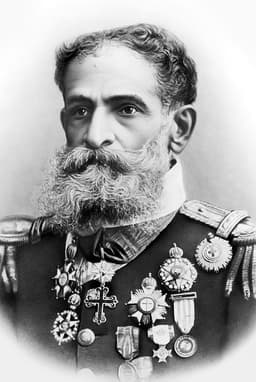
Deodoro da Fonseca
General · Modern
48.8Total
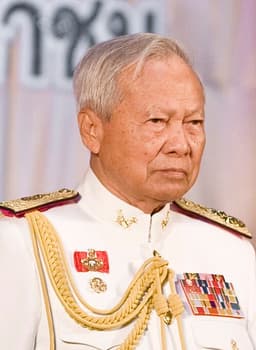
Prem Tinsulanonda
General · Modern
57.2Total
Basic Information
Born
1827
1920
Died
1892
—
Era
Modern
Modern
Nationality
Brazil
Thailand
Occupation
General
General
Civilization
Western
Eastern
Score Comparison
Military (10%)
50.0
50.0
Political (20%)
45.1
59.3
Influence (20%)
54.1
54.9
Legacy (20%)
44.2
47.5
Leadership (15%)
57.6
78.0
Strategy (15%)
38.6
60.0
TOTAL
48.8
57.2
Deodoro da Fonseca — Complete Timeline
1889 AD
Proclamation of the Brazilian RepublicPolitical Action
Deodoro da Fonseca led a military coup that overthrew Emperor Pedro II on November 15, 1889. He proclaimed the Republic of the United States of Brazil, ending 67 years of imperial rule.
CoupRepublic
Impact: globalprogressive
1891 AD
Election as First President of BrazilPolitical Action◆ Major
Deodoro da Fonseca was elected the first President of Brazil by the Constituent Congress on February 25, 1891. He took office under the new republican constitution, but his rule was brief and authoritarian.
ElectionPresidency
Impact: national
Dissolution of the National CongressPolitical Action◆ Major
Facing political opposition, Deodoro da Fonseca dissolved the National Congress on November 3, 1891, and declared a state of siege. This authoritarian act triggered a naval revolt and his eventual resignation.
AuthoritarianismPolitical Crisis
Impact: nationaldestructive
Resignation from the PresidencyPolitical Action◆ Major
Deodoro da Fonseca resigned the presidency on November 23, 1891, after a naval rebellion threatened his government. He handed power to Vice President Floriano Peixoto, ending his 9-month rule.
ResignationPolitical Crisis
Impact: nationaltragic
Prem Tinsulanonda — Complete Timeline
1980 AD
Appointed Prime Minister after a coupPolitical Action◆ Major
Prem Tinsulanonda was appointed Prime Minister of Thailand by the military after a coup. He served for over eight years, overseeing a period of political stability and economic growth.
Prime MinisterMilitary RuleStability
Impact: national
1981 AD
Survived a coup attemptPolitical Action◆ Major
Prem survived a coup attempt by military officers loyal to the 'Young Turks' faction. The coup failed due to lack of support and the loyalty of key military units, allowing Prem to remain in power.
Coup AttemptPolitical CrisisMilitary
Impact: national
1988 AD
Resigned as Prime MinisterPolitical Action◆ Major
Prem resigned as Prime Minister after the general election, handing over power to a civilian government led by Chatichai Choonhavan. His resignation marked a rare peaceful transition of power in Thai politics.
ResignationDemocratic TransitionPeaceful
Impact: nationalconstructive
2016 AD
Appointed Regent of ThailandPolitical Action
After the death of King Bhumibol, Prem was appointed Regent of Thailand until the ascension of King Maha Vajiralongkorn. He served as a key figure in the transition of the monarchy.
RegentMonarchyTransition
Impact: national
Expert Analysis
Deodoro da Fonseca vs Prem Tinsulanonda
# The General as Statesman: Two Paths from Barracks to Power
On a humid November morning in 1891, Brazil’s first president, Deodoro da Fonseca, sat alone in his palace in Rio de Janeiro, his hand trembling as he signed his resignation. Just two years earlier, he had been hailed as the father of a republic, the man who toppled an emperor. Now, his dream lay in ruins, crushed by his own impatience. Half a world away and nearly a century later, another general, Prem Tinsulanonda of Thailand, would navigate the same treacherous waters between military power and civilian rule—but he would succeed where Fonseca failed. Why did one man’s revolution end in ignominy while the other’s stewardship endured?
Origins
Deodoro da Fonseca was born in 1827 in Alagoas, a poor province of the Brazilian Empire, into a military family with a tradition of service. He grew up in a world where the army was a ladder for ambitious men of modest means, and where the emperor, Pedro II, was both revered and resented. Fonseca’s formative years were shaped by the long Paraguayan War (1864–1870), a brutal conflict that forged his reputation as a capable but unpolished commander. He emerged from that war with scars, both physical and psychological—a man who had seen too much death and believed the monarchy had failed the nation.
Prem Tinsulanonda, born in 1920 in Songkhla, southern Thailand, came from a different world entirely. His father was a judge, his family part of the educated elite that served the absolute monarchy. But Thailand in the 1920s was a kingdom in transition, having already abolished absolute rule in 1932. Prem grew up in a society where the military was not just a career but a pillar of national identity, defending a nation that had never been colonized. He studied at the elite Chulachomklao Royal Military Academy and later in the United States, absorbing not just tactics but a philosophy of service that prized stability over personal ambition.
Rise to Power
Fonseca’s path to power was forged in crisis. By the late 1880s, the Brazilian monarchy was unraveling—the emperor was old, the abolition of slavery in 1888 had alienated powerful landowners, and the military felt humiliated by a civilian government that denied them honors. Fonseca, now a marshal, became the reluctant figurehead of a republican conspiracy. On November 15, 1889, he led a bloodless coup, surrounding the imperial palace with troops and demanding Pedro II’s departure. It was a moment of immense courage: Fonseca, suffering from poor health and deep ambivalence, almost backed out. But he went through with it, and Brazil became a republic.
Prem’s rise was slower and more deliberate. He served in the military through the 1960s and 1970s, a period of intense political turbulence in Thailand, with frequent coups and counter-coups. He earned a reputation as a steady hand, a man who could mediate between rival factions. In 1980, after a coup ousted the civilian government, the military turned to him as a compromise candidate for prime minister. He was sixty years old, a general who had never sought power—but he accepted it, understanding that his role was to restore order and prepare the way for democracy.
Leadership & Governance
Here the two men diverged most sharply. Fonseca was a man of action, not patience. As Brazil’s first president, he faced a fractious Constituent Congress that debated endlessly while the economy stagnated. He had no party, no political base, only his uniform and his temper. When the Congress drafted a constitution that limited presidential powers, Fonseca grew furious. On November 3, 1891, he dissolved the National Congress and declared a state of siege, ruling by decree. It was a catastrophic miscalculation. The navy, loyal to the old regime, rebelled; the army, divided, did not support him. Within twenty days, he was forced to resign.
Prem governed with a different philosophy. He understood that military rule could only be temporary. During his eight years in power (1980–1988), he walked a tightrope: he kept the military loyal by granting them influence, but he also allowed elections, a free press, and a growing civilian political class. In 1981, when the “Young Turks” faction attempted a coup, Prem did not respond with brute force. He rallied loyal troops, but more importantly, he appealed to the king and the public. The coup collapsed from lack of support. Prem’s genius was in knowing when to use power and when to share it.
Triumph & Tragedy
Fonseca’s greatest moment was also his undoing. The Proclamation of the Republic was a triumph—a peaceful transition from monarchy to republic, a bold step into modernity. But he could not sustain it. His tragedy was that he lacked the political skills to build consensus. He was a soldier who believed that orders should be obeyed, not debated. In the end, he died in 1892, a broken man, just months after his resignation, remembered as a failed dictator rather than a founding father.
Prem’s triumph was quieter but more lasting. In 1988, after a general election, he voluntarily resigned as prime minister, handing power to Chatichai Choonhavan, a civilian. It was a historic moment—the first peaceful transfer of power to an elected government in decades. Prem did not cling to office; he stepped aside. But his influence did not end. In 2016, after the death of King Bhumibol, Prem was appointed regent, serving as the symbolic guardian of the throne. He had become the elder statesman, the man who held the kingdom together.
Character & Destiny
Fonseca was a man of the 19th century—impetuous, honorable, but tragically inflexible. He saw politics as a battlefield and opponents as enemies. His personality, forged in war, could not adapt to the compromises of peace. Prem, by contrast, was a product of the 20th century, a cold war pragmatist who understood that survival required subtlety. He was patient, even enigmatic—a man who spoke little but observed everything. Where Fonseca sought glory, Prem sought stability. Their destinies flowed from these choices.
Legacy
Today, Deodoro da Fonseca is a footnote in Brazilian history, a name on a street sign, a statue in a forgotten square. He is honored as the first president, but his failure to build institutions left a legacy of instability that plagued Brazil for decades. Prem Tinsulanonda, who died in 2019 at the age of ninety-eight, is remembered as a pivotal figure in Thailand’s modern history—a kingmaker, a guardian, a man who navigated the impossible space between democracy and military power. His legacy is more controversial, for critics argue he perpetuated military interference in politics, but his skill in managing transition was undeniable.
Conclusion
Both men were generals who became statesmen, but they represent two different answers to the same question: How does a soldier govern a democracy? Fonseca believed in the force of command; Prem believed in the art of patience. One broke his country; the other held it together. Their stories remind us that power, once seized, is not enough—it must be wielded with wisdom, or it will slip through the fingers like sand.
Rankings
🥇
Prem TinsulanondaLeader
Mil: 50.0Pol: 59.3Inf: 54.9
57.2
🥈
Deodoro da Fonseca
Mil: 50.0Pol: 45.1Inf: 54.1
48.8
+8.4 behind
How This Comparison Works
Algorithm
Each figure is scored on 6 dimensions (0—100 scale) based on structured historical data: Military (10%), Political (20%), Influence (20%), Legacy (20%), Leadership (15%), Strategy (15%). The weighted total produces the final ranking.
Data Sources
Scores are computed from structured sub-indicators in the database. Scale factors adjust for era (Ancient ×0.85, Modern ×1.0) and civilization size (Eastern ×1.05, Other ×0.80) to account for differences in population and military scale.
Maximum 3 Figures
Comparisons are limited to 2—3 figures to ensure readability and statistical meaningfulness.
Error Margins
±5 points per dimension — Sub-scores are derived from historical records with inherent uncertainty. Two figures within 5 points on a dimension should be considered roughly equivalent in that area.
Total Score Accuracy
±3 points overall — The weighted combination of 6 dimensions produces a total score with approximately ±3 points of uncertainty. Differences of less than 3 points are not statistically significant— the figures are effectively tied.
Known Limitations
- Historical records are incomplete and uneven across civilizations
- Figures from oral-tradition societies may be underrepresented
- Occupation labels can misclassify multi-role figures
- Scores measure capability and impact, not moral character
- Quantitative scoring is a comparison tool, not absolute truth
Capability Radar
Military (10%) — Battles & Warfare
Battles
20
20
Win Rate
25
25
Expansion
10
10
Political (20%) — Governance & Reform
Reform
40
55
Diplomacy
25
60
Economy
15
50
Influence (20%) — Cultural & Global Reach
Cultural
20
30
Global
15
30
Legacy (20%) — Historical Impact
Historical
35
40
Longevity
20
35
Leadership (15%) — Power & Stability
Tenure
30
65
Stability
10
60
Strategy (15%) — Tactics & Innovation
Strategy
25
30
Tactics
20
30
Reform
15
35
Similar Comparisons
Comments & Discussion
Deodoro's Dissector6/16/2026
Fonseca was a bungler who had no feel for democratic norms—he dissolved Congress in 1891 after just 16 months, triggering a naval revolt that sank his presidency. Prem, by contrast, spent 8 years carefully balancing junta and parliament, stepping down gracefully in 1988. One man tried to rule by decree like a caudillo; the other understood that generals must share power to keep it. That's not "two paths"—that's competence versus ego.
历史铁匠6/16/2026
拿德奥多罗跟炳·廷素拉暖比,简直是侮辱了后者的政治智慧。德奥多罗是巴西帝国时代的军阀,靠枪杆子逼佩德罗二世退位,结果自己连两届政府都撑不住;炳将军在泰国当了八年总理,1980年代成功过渡到议会制,还保住了军队的体面。事实很清楚:一个把共和搞砸了,一个让君主制与军人政权共存。德奥多罗的“丰功伟绩”不过是一纸空文。
Classics Curmudgeon6/16/2026
Let's cut the romantic nonsense—both men were strongmen who traded on military laurels to seize civilian power. Fonseca's Paraguayan War record is overstated; he was a mediocre divisional commander who rose by seniority, not brilliance. Prem's "stewardship" rested on a coup in 1976 and tacit royal backing. Comparing them as "statesmen" whitewashes the authoritarian core. Machiavelli would see two princes who differed only in how they managed their exit, not their entry.
数据冷眼6/16/2026
分析里说德奥多罗“缺乏耐心”,炳将军“善于平衡”,这叫描述性结论,不是证据。我问你:德奥多罗任期内通货膨胀率是多少?炳将军执政期间泰国GDP增长率是多少?文献里根本没说。还有,德奥多罗1891年解散国会时,巴西各省实际是半独立状态,他的“失败”可能只是联邦制脆弱的反映。没有硬数字,这种对比就是讲故事,不是历史。
Strategic Veteran6/16/2026
Prem succeeded because he mastered the art of the "juste milieu"—splitting power between Bangkok's royalists, the army's factions, and civilian elites. Fonseca missed this entirely: his 1891 coup alienated both the coffee oligarchs and the navy, leaving him isolated. Leadership from the barracks requires coalition-building, not just a good C.V. from the Paraguayan slaughter. Prem knew when to be a general and when to be a puppet-master; Deodoro only knew how to slam the table.