Loading...
Deodoro da Fonseca vs Oscar Mejia Victores
Oscar Mejia Victores leads by 3.1 pts · 2 figures compared
…
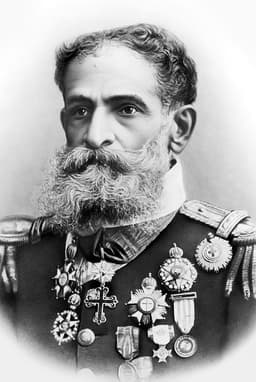
Deodoro da Fonseca
General · Modern
48.8Total

Oscar Mejia Victores
General · Modern
51.9Total
Basic Information
Born
1827
1930
Died
1892
—
Era
Modern
Modern
Nationality
Brazil
Guatemala
Occupation
General
General
Civilization
Western
Western
Score Comparison
Military (10%)
50.0
22.6
Political (20%)
45.1
68.0
Influence (20%)
54.1
50.2
Legacy (20%)
44.2
43.3
Leadership (15%)
57.6
80.0
Strategy (15%)
38.6
41.0
TOTAL
48.8
51.9
Deodoro da Fonseca — Complete Timeline
1889 AD
Proclamation of the Brazilian RepublicPolitical Action
Deodoro da Fonseca led a military coup that overthrew Emperor Pedro II on November 15, 1889. He proclaimed the Republic of the United States of Brazil, ending 67 years of imperial rule.
CoupRepublic
Impact: globalprogressive
1891 AD
Election as First President of BrazilPolitical Action◆ Major
Deodoro da Fonseca was elected the first President of Brazil by the Constituent Congress on February 25, 1891. He took office under the new republican constitution, but his rule was brief and authoritarian.
ElectionPresidency
Impact: national
Dissolution of the National CongressPolitical Action◆ Major
Facing political opposition, Deodoro da Fonseca dissolved the National Congress on November 3, 1891, and declared a state of siege. This authoritarian act triggered a naval revolt and his eventual resignation.
AuthoritarianismPolitical Crisis
Impact: nationaldestructive
Resignation from the PresidencyPolitical Action◆ Major
Deodoro da Fonseca resigned the presidency on November 23, 1891, after a naval rebellion threatened his government. He handed power to Vice President Floriano Peixoto, ending his 9-month rule.
ResignationPolitical Crisis
Impact: nationaltragic
Oscar Mejia Victores — Complete Timeline
1983 AD
1983 Guatemalan coup d'étatPolitical Action◆ Major
Mejia Victores, then Defense Minister, led a coup that ousted President Efrain Rios Montt. He assumed the presidency, becoming the last military ruler of Guatemala.
CoupMilitary RuleGuatemala
Impact: nationaldestructive
1984 AD
Human rights abuses during his ruleOther◆ Major
During his presidency, Mejia Victores' government continued counterinsurgency operations that resulted in forced disappearances and massacres of indigenous Maya communities, as documented by truth commissions.
Human RightsCivil WarAtrocities
Impact: nationaltragic
1985 AD
Transition to civilian rulePolitical Action
Under pressure, Mejia Victores oversaw the drafting of a new constitution and called for democratic elections. He transferred power to civilian President Vinicio Cerezo in 1986, ending decades of military rule.
DemocratizationConstitutionElection
Impact: nationalconstructive
Expert Analysis
Deodoro da Fonseca vs Oscar Mejia Victores
# The General Who Gave Up the Crown
On a November morning in 1891, a sick and exhausted old man sat in the presidential palace of Brazil, watching warships steam into Guanabara Bay. The naval rebellion was the final blow. Deodoro da Fonseca, the man who had toppled an emperor, wrote his resignation and vanished from power. Half a world away and nearly a century later, another general faced a similar choice. Oscar Mejia Victores, a taciturn Guatemalan officer who had seized power in a coup, could have clung to the presidency with the same iron fist his predecessors had used. Instead, he called for elections and walked away. What makes a general surrender his crown?
Origins
Deodoro da Fonseca was born in 1827, a child of the Brazilian Empire’s military aristocracy. His father was a career officer, his family steeped in the traditions of the Portuguese monarchy. He grew up in a world where the emperor was father to the nation, and the army was his sword. Yet by the 1880s, that world was crumbling. The empire had grown brittle, the emperor old, and a new generation of positivist officers—inspired by Auguste Comte’s creed of order and progress—dreamed of a republic. Deodoro was not a revolutionary by nature. He was a loyal soldier, a veteran of the Paraguayan War, a man who had shed blood for the empire. But loyalty, in the end, bent to ambition.
Oscar Mejia Victores was born in 1930, in a Guatemala that had known little but dictatorship. The Cold War had turned Central America into a battlefield. The United States backed any strongman who promised stability, and the army was the only real institution in the land. Mejia rose through the ranks of a military that had learned to crush dissent with impunity. He was not an idealist. He was a survivor, a man who understood that in Guatemala, power came from the barrel of a gun.
Rise to Power
Deodoro’s path to power was a coup, but a peculiar one. On November 15, 1889, he led a small column of troops through the streets of Rio de Janeiro. There was no battle. The emperor, Pedro II, was asleep when the news arrived. He abdicated without a fight. Deodoro had not planned to be president. He had expected a provisional government, perhaps a return to order. But the republic’s architects—a clique of civilian republicans and young officers—thrust the title upon him. He was the reluctant strongman, a man who stumbled into history.
Mejia Victores’ rise was far more deliberate. In 1983, he was the Defense Minister under Efrain Rios Montt, a general who had unleashed a genocidal campaign against the Maya highlands. When Rios Montt’s evangelical fervor and erratic behavior alarmed the officer corps, Mejia struck. The coup was bloodless, a quiet palace affair. He became president not as a liberator, but as a caretaker for a military establishment that had lost its way.
Leadership & Governance
Deodoro governed like a man who had never wanted the job. He was a soldier, not a statesman. His presidency lurched from crisis to crisis. The economy was in chaos, the coffee barons hostile, and the Congress full of men who despised him. In a desperate act, he dissolved the National Congress on November 3, 1891, and declared a state of siege. It was the move of a man who believed that only force could impose order. But Brazil was not ready for a dictatorship. The navy rebelled, the army wavered, and Deodoro’s nerve broke.
Mejia Victores, by contrast, was a cold pragmatist. He continued the counterinsurgency war, and his government was stained by forced disappearances and human rights abuses. He did not pretend to be a democrat. But he understood that the old model—the general as permanent ruler—was bankrupt. Guatemala was isolated, its economy a wreck, its international reputation ruined. Mejia made a calculation: power was not worth the price. He oversaw the drafting of a new constitution in 1985 and called for elections. He did not run. He handed the presidency to a civilian, Marco Vinicio Cerezo, and returned to the shadows.
Triumph & Tragedy
Deodoro’s triumph was the proclamation of the republic itself. He had broken the monarchy without a civil war, a feat that many nations have failed to achieve. His tragedy was that he could not govern what he had created. He was a man out of time, a monarchist in a republican’s body, a general who could win a war but not a budget debate.
Mejia’s triumph was the transition itself. He gave Guatemala a democratic framework that, however flawed, has endured. His tragedy is that he did so while still committing atrocities. The constitution he allowed was born from the blood of the disappeared. His legacy is a paradox: the man who opened the door to democracy had first locked it for so many.
Character & Destiny
Deodoro was proud, impulsive, and haunted by illness. His body failed him as his political world collapsed. He was a man who could not adapt. Mejia was cold, patient, and calculating. He saw the end of the Cold War coming and knew that the United States would no longer prop up military dictators. He adapted because he had no choice.
Legacy
Deodoro da Fonseca is remembered as a founder, but a flawed one. His face is on Brazilian currency, his name on streets, but historians note that he nearly destroyed the republic he created. Mejia Victores is a footnote in Guatemalan history, a transitional figure who is neither vilified nor celebrated. He did what few Latin American generals have done: he gave up power.
Conclusion
In the end, the difference between these two generals is not one of virtue, but of timing. Deodoro lived in an age when generals believed they could rule forever. Mejia lived in an age when they knew they could not. One man’s tragedy was that he could not let go. The other’s ambiguous gift was that he did. History does not reward the reluctant, nor does it condemn the pragmatic. It simply moves on.
Rankings
🥇
Oscar Mejia VictoresLeader
Mil: 22.6Pol: 68.0Inf: 50.2
51.9
🥈
Deodoro da Fonseca
Mil: 50.0Pol: 45.1Inf: 54.1
48.8
+3.1 behind
How This Comparison Works
Algorithm
Each figure is scored on 6 dimensions (0—100 scale) based on structured historical data: Military (10%), Political (20%), Influence (20%), Legacy (20%), Leadership (15%), Strategy (15%). The weighted total produces the final ranking.
Data Sources
Scores are computed from structured sub-indicators in the database. Scale factors adjust for era (Ancient ×0.85, Modern ×1.0) and civilization size (Eastern ×1.05, Other ×0.80) to account for differences in population and military scale.
Maximum 3 Figures
Comparisons are limited to 2—3 figures to ensure readability and statistical meaningfulness.
Error Margins
±5 points per dimension — Sub-scores are derived from historical records with inherent uncertainty. Two figures within 5 points on a dimension should be considered roughly equivalent in that area.
Total Score Accuracy
±3 points overall — The weighted combination of 6 dimensions produces a total score with approximately ±3 points of uncertainty. Differences of less than 3 points are not statistically significant— the figures are effectively tied.
Known Limitations
- Historical records are incomplete and uneven across civilizations
- Figures from oral-tradition societies may be underrepresented
- Occupation labels can misclassify multi-role figures
- Scores measure capability and impact, not moral character
- Quantitative scoring is a comparison tool, not absolute truth
Capability Radar
Military (10%) — Battles & Warfare
Battles
20
10
Win Rate
25
10
Expansion
10
5
Political (20%) — Governance & Reform
Reform
40
55
Diplomacy
25
50
Economy
15
30
Influence (20%) — Cultural & Global Reach
Cultural
20
15
Global
15
15
Legacy (20%) — Historical Impact
Historical
35
30
Longevity
20
20
Leadership (15%) — Power & Stability
Tenure
30
40
Stability
10
35
Strategy (15%) — Tactics & Innovation
Strategy
25
15
Tactics
20
15
Reform
15
20
Similar Comparisons
Comments & Discussion
Guanabara's Ghost6/16/2026
Deodoro didn't "give up" anything—his body gave out first. The man was literally pissing blood from kidney failure when he resigned. Compare that to Mejia Victores, who walked away healthy and rich, likely cutting a deal with the CIA to avoid prosecution. True power surrender requires a conscious choice, not a deathbed abdication. One was a medical event, the other a calculated retreat.|zh|不要神化德奥多罗——他1891年11月辞职时已经尿血三周,肾衰竭晚期。梅希亚1985年下台时精神矍铄,还带着危地马拉军方贪污的巨额财富全身而退。一个是被病魔击倒的旧时代残党,另一个是精明的冷战赌徒。别把临终遗言当成
数字拆弹手6/16/2026
数据不会撒谎:德奥多罗执政仅两年就遭两次政变,通胀率飙到300%;梅希亚统治期间危地马拉GDP年均增长2.1%,虽低但稳定。评论家总说军人不懂经济,扯淡!德奥多罗废除奴隶制后既无土地改革也无产业政策,活该被海军炮舰赶下台。梅希亚至少平衡了预算,还让国际货币基金组织闭嘴了两年。
Porfirio's Shadow6/16/2026
What these romantic narratives miss is the institutional framework. Deodoro inherited a functioning 67-year-old monarchy's bureaucratic apparatus; Mejia Victores took over a country that had seen 10 coups in 30 years. The Brazilian general could afford to resign because the state machine didn't depend on him. The Guatemalan? His 1985 elections were a fig leaf for continued military dominance—his party's candidate lost, but the generals kept power anyway. That's not virtue, that's theater.