Loading...
Deodoro da Fonseca vs Olusegun Obasanjo
Olusegun Obasanjo leads by 11.4 pts · 2 figures compared
…
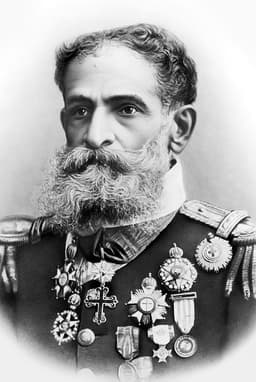
Deodoro da Fonseca
General · Modern
48.8Total
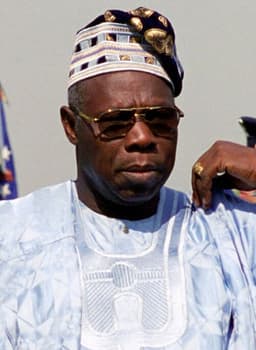
Olusegun Obasanjo
General · Modern
60.2Total
Basic Information
Born
1827
1937
Died
1892
—
Era
Modern
Modern
Nationality
Brazil
Nigeria
Occupation
General
General
Civilization
Western
Other
Score Comparison
Military (10%)
50.0
45.0
Political (20%)
45.1
72.0
Influence (20%)
54.1
55.0
Legacy (20%)
44.2
54.0
Leadership (15%)
57.6
78.0
Strategy (15%)
38.6
60.0
TOTAL
48.8
60.2
Deodoro da Fonseca — Complete Timeline
1889 AD
Proclamation of the Brazilian RepublicPolitical Action
Deodoro da Fonseca led a military coup that overthrew Emperor Pedro II on November 15, 1889. He proclaimed the Republic of the United States of Brazil, ending 67 years of imperial rule.
CoupRepublic
Impact: globalprogressive
1891 AD
Election as First President of BrazilPolitical Action◆ Major
Deodoro da Fonseca was elected the first President of Brazil by the Constituent Congress on February 25, 1891. He took office under the new republican constitution, but his rule was brief and authoritarian.
ElectionPresidency
Impact: national
Dissolution of the National CongressPolitical Action◆ Major
Facing political opposition, Deodoro da Fonseca dissolved the National Congress on November 3, 1891, and declared a state of siege. This authoritarian act triggered a naval revolt and his eventual resignation.
AuthoritarianismPolitical Crisis
Impact: nationaldestructive
Resignation from the PresidencyPolitical Action◆ Major
Deodoro da Fonseca resigned the presidency on November 23, 1891, after a naval rebellion threatened his government. He handed power to Vice President Floriano Peixoto, ending his 9-month rule.
ResignationPolitical Crisis
Impact: nationaltragic
Olusegun Obasanjo — Complete Timeline
1976 AD
Military coup that brought Obasanjo to powerPolitical Action
Following the assassination of General Murtala Mohammed in a failed coup, Obasanjo, as Chief of Staff, Supreme Headquarters, succeeded him as head of state. He oversaw the continuation of the transition to civilian rule.
CoupSuccessionMilitary Rule
Impact: national
1979 AD
Handover of power to civilian governmentPolitical Action
Obasanjo voluntarily handed over power to the elected civilian government of Shehu Shagari, marking the first peaceful transfer of power from military to civilian rule in Nigeria. This act established a precedent for democratic transition.
DemocracyTransitionCivilian Rule
Impact: nationalconstructive
1999 AD
Election as President of NigeriaPolitical Action
Obasanjo won the 1999 Nigerian presidential election as the candidate of the People's Democratic Party (PDP). His victory ended 16 years of military rule and began the Fourth Nigerian Republic.
ElectionDemocracyFourth Republic
Impact: nationalprogressive
2005 AD
Debt relief from Paris ClubPolitical Action◆ Major
Obasanjo's government negotiated a debt relief agreement with the Paris Club, resulting in the cancellation of $18 billion of Nigeria's external debt. This freed up resources for domestic spending and was a major economic achievement.
Debt ReliefEconomyNegotiation
Impact: nationalconstructive
2006 AD
Third term bid failurePolitical Action◆ Major
Obasanjo attempted to amend the Nigerian constitution to allow him to run for a third term. The bid was rejected by the National Assembly, marking a significant political defeat and reinforcing term limits.
Third TermConstitutionDefeat
Impact: national
Expert Analysis
Deodoro da Fonseca vs Olusegun Obasanjo
### The General Who Gave Power Away and the General Who Took It
In the annals of history, two generals stand at opposite ends of a single, fateful decision: what to do after seizing power. One, Olusegun Obasanjo, voluntarily handed over his military command to a civilian government and later returned to lead his nation as a democratically elected president. The other, Deodoro da Fonseca, proclaimed a republic, became its first president, and within two years dissolved the congress and resigned under the shadow of a naval rebellion. Both were soldiers who shaped the modern destinies of their countries—Nigeria and Brazil—yet their paths diverged so sharply that their stories read less like parallel lives and more like a dialogue between two different kinds of political courage.
### Origins
Olusegun Obasanjo was born in 1937 in the village of Ibogun-Olaogun, in what was then British Nigeria. He was the son of a farmer, raised in a world where colonial rule was a fact of life. The Nigeria of his youth was a patchwork of ethnicities and regions, a creation of European mapmakers that would struggle to hold together after independence in 1960. Obasanjo joined the army young, and by the 1970s he had risen through the ranks, shaped by the brutal Biafran War and the coup-prone politics of post-independence Africa. He was a pragmatist, a man who learned early that survival in Nigeria required both military discipline and political cunning.
Deodoro da Fonseca was born in 1827 in Alagoas, then part of the Empire of Brazil. He came from a military family—his father was a soldier, his brothers officers. The Brazil of his youth was a monarchy, the only one in the Americas, ruled by Emperor Pedro II. Unlike Obasanjo, who grew up in a colony, Fonseca grew up in an empire that was stable, prosperous, and increasingly at odds with its own army. The military had grown restless, infected by republican ideas from Europe and resentful of the emperor’s civilian ministers. Fonseca was a man of the barracks, blunt and loyal to his fellow officers, but not a deep political thinker.
### Rise to Power
Obasanjo’s rise came through a corpse. On February 13, 1976, General Murtala Mohammed, the military head of state, was assassinated in a failed coup. As Chief of Staff, Supreme Headquarters, Obasanjo was the next in line. He did not orchestrate the coup; he inherited the power. His first act was to crush the plotters, but his second was more remarkable: he announced that the military’s promise to return Nigeria to civilian rule by 1979 would be kept. He was not a man who sought power for its own sake; he saw himself as a steward.
Fonseca’s rise came through a proclamation. On November 15, 1889, he led a bloodless military coup against Emperor Pedro II. The emperor, old and tired, offered no resistance. Fonseca marched into Rio de Janeiro, declared the republic, and became the provisional head of government. Unlike Obasanjo, he had sought this moment. He was the figurehead of a movement that had been brewing for years among young officers and urban republicans. But he had no clear plan for what came next.
### Leadership & Governance
As military ruler from 1976 to 1979, Obasanjo governed with a steady hand. He focused on economic reforms, fighting corruption, and maintaining stability. His greatest political achievement was the 1979 handover: he wrote a new constitution, held elections, and handed power to Shehu Shagari, a civilian. It was the first peaceful transfer of power in Nigerian history. His leadership score of 83.4 reflects this—a general who used his military authority to build democratic institutions.
Fonseca, as provisional president and then elected president in 1891, governed with a heavy hand. He faced a divided congress, a weak economy, and a federalist rebellion in the south. His solution was to dissolve the National Congress on November 3, 1891, and declare a state of siege. It was a blunt instrument that solved nothing. A naval rebellion followed, and within weeks he resigned. His strategy score of 40.2 reveals a man who could seize power but could not manage it.
### Triumph & Tragedy
Obasanjo’s triumph was his return. After leaving office in 1979, he retired to his farm and wrote books. But Nigeria’s democracy collapsed, and military rule returned. In 1999, after the death of General Sani Abacha, Obasanjo was elected president, this time as a civilian. He served two terms, from 1999 to 2007, and oversaw economic growth, debt relief from the Paris Club in 2005 (cancelling $18 billion), and democratic consolidation. His tragedy was his failed third-term bid in 2006, an attempt to amend the constitution that was rejected by the National Assembly. It tarnished his legacy but did not destroy it.
Fonseca’s triumph was the republic itself. He ended the monarchy, and Brazil never looked back. His tragedy was his presidency. He could not govern what he had created. After his resignation, he retired to Rio de Janeiro, embittered and ill, and died the following year. His legacy score of 60.6 is lower than Obasanjo’s 69.0, and for good reason: he is remembered more as a symbol than as a statesman.
### Character & Destiny
Obasanjo was a survivor. He had a politician’s instinct for timing and a general’s discipline in execution. He knew when to hold power and when to let it go. His personality was shaped by the chaos of Nigeria—a country where the only constant was change. He learned to be flexible, to negotiate, to wait.
Fonseca was a true believer. He was driven by ideals of republicanism and military honor, but he lacked the patience for the messy compromises of democracy. He was a man of action, not deliberation. His personality was forged in the certainties of the empire—a world where loyalty to the emperor was clear, and then suddenly it was not. He could not adapt.
### Legacy
Today, Obasanjo is a controversial but towering figure in Africa. He is criticized for human rights abuses during his military rule and for the corruption that plagued his civilian presidency. Yet he is also praised for his role in ending apartheid in South Africa, for his debt relief, and for proving that a military general could become a democrat. He remains active in global diplomacy, a voice for African development.
Fonseca is a footnote in Brazilian history. He is honored as the first president, but his tenure is seen as a failure. His portrait hangs in the presidential palace, but few Brazilians know his story. He is a reminder that founding a republic is easier than sustaining one.
### Conclusion
What separates these two generals is not their ambition or their courage—both had plenty. What separates them is their relationship with power itself. Obasanjo understood that power, to be lasting, must be shared. Fonseca believed that power, once taken, must be held. One built a bridge to democracy; the other built a wall. In the end, the general who gave power away achieved more than the general who took it. Their stories ask a question that every soldier-turned-leader must answer: Is the goal to rule, or to govern?
Rankings
🥇
Olusegun ObasanjoLeader
Mil: 45.0Pol: 72.0Inf: 55.0
60.2
🥈
Deodoro da Fonseca
Mil: 50.0Pol: 45.1Inf: 54.1
48.8
+11.4 behind
How This Comparison Works
Algorithm
Each figure is scored on 6 dimensions (0—100 scale) based on structured historical data: Military (10%), Political (20%), Influence (20%), Legacy (20%), Leadership (15%), Strategy (15%). The weighted total produces the final ranking.
Data Sources
Scores are computed from structured sub-indicators in the database. Scale factors adjust for era (Ancient ×0.85, Modern ×1.0) and civilization size (Eastern ×1.05, Other ×0.80) to account for differences in population and military scale.
Maximum 3 Figures
Comparisons are limited to 2—3 figures to ensure readability and statistical meaningfulness.
Error Margins
±5 points per dimension — Sub-scores are derived from historical records with inherent uncertainty. Two figures within 5 points on a dimension should be considered roughly equivalent in that area.
Total Score Accuracy
±3 points overall — The weighted combination of 6 dimensions produces a total score with approximately ±3 points of uncertainty. Differences of less than 3 points are not statistically significant— the figures are effectively tied.
Known Limitations
- Historical records are incomplete and uneven across civilizations
- Figures from oral-tradition societies may be underrepresented
- Occupation labels can misclassify multi-role figures
- Scores measure capability and impact, not moral character
- Quantitative scoring is a comparison tool, not absolute truth
Capability Radar
Military (10%) — Battles & Warfare
Battles
20
25
Win Rate
25
30
Expansion
10
20
Political (20%) — Governance & Reform
Reform
40
65
Diplomacy
25
75
Economy
15
55
Influence (20%) — Cultural & Global Reach
Cultural
20
45
Global
15
60
Legacy (20%) — Historical Impact
Historical
35
55
Longevity
20
50
Leadership (15%) — Power & Stability
Tenure
30
70
Stability
10
60
Strategy (15%) — Tactics & Innovation
Strategy
25
40
Tactics
20
35
Reform
15
50
Similar Comparisons
Comments & Discussion
MarshalOutcast6/16/2026
Fonseca's dismissal of Congress wasn't just bad politics—it was a military man failing to grasp that republics need institutions, not strongmen. He had the chance to build Brazil's first real civilian government after the 1889 coup, but he botched it within two years. Obasanjo proved you can wear the uniform and still love the ballot box. That handover in 1979 wasn't weakness; it was the most disciplined act of command I've seen from any general.
数字质问者6/16/2026
别把奥巴桑乔捧成圣人了。他1999年回来当总统难道算"自愿交出权力"?非洲民选领袖有几个真放手了?数据说话:尼日利亚的军费在他任内从约3亿美元暴涨到近20亿,这叫民主文官统治?对比丰塞卡倒是有意思,巴西1891年政变后通胀顶多20%,奥巴桑乔走人时尼日利亚通胀超50%。退一步说,一个把自己包装成救世主的军阀和一个几乎被遗忘的元帅,谁更危险?
CiceroOfTheBarracks6/16/2026
What strikes me isn't the handover, but the founding act. Fonseca, whatever his flaws, declared a republic in a monarchy-addicted continent in 1889. That took nerve. Obasanjo inherited a broken state and chose reform over empire—admirable, but he walked into a country that already knew vote-counting. Fonseca had no template. His blunder was pride, not cowardice. The man who keeps power when chaos looms is sometimes the realist, not the tyrant.
旧书堆里的考古学家6/16/2026
别忘了语境:丰塞卡被浪漫化了。他1889年政变靠的是军队对帝国皇室的幻灭感,而不是什么共和理想——当时他的战友都笑话他连宪法都看不懂。奥巴桑乔1960年代在比夫拉战争中学习的是如何用子弹统治,而不是议会的妥协。真正有意思的是历史怎么洗白:一个可笑的独裁元帅变成悲情英雄,一个血腥军阀变成民主灯塔。真相在两个极端之间腐烂。
AfricanLens6/16/2026
You're all missing the key chain: Fonseca ruled a white-majority settler state that cherished its old empire; Obasanjo governed a postcolonial nation born from genocide and resource wars. Their choices mirror different latitudes of power: Fonseca dissolved parliament because he saw no legitimacy outside his uniform; Obasanjo handed over because Biafra taught him that blood alone crumbles. Neither was saint or sinner—just men reading the revolt around them. I'd pick the guy who stepped down over