Loading...
Deodoro da Fonseca vs Nicolas Soult
Nicolas Soult leads by 13.9 pts · 2 figures compared
…
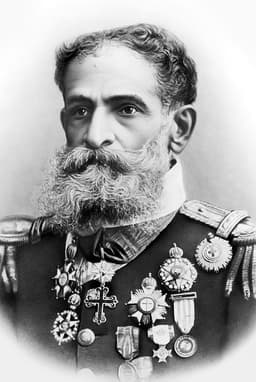
Deodoro da Fonseca
General · Modern
48.8Total
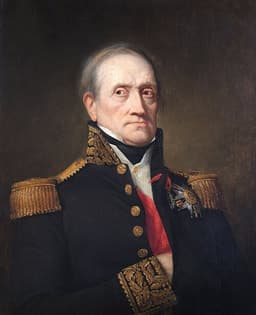
Nicolas Soult
General · Modern
62.7Total
Basic Information
Born
1827
1769
Died
1892
1851
Era
Modern
Modern
Nationality
Brazil
France
Occupation
General
General
Civilization
Western
Western
Score Comparison
Military (10%)
50.0
74.7
Political (20%)
45.1
55.0
Influence (20%)
54.1
61.0
Legacy (20%)
44.2
54.0
Leadership (15%)
57.6
78.0
Strategy (15%)
38.6
65.4
TOTAL
48.8
62.7
Deodoro da Fonseca — Complete Timeline
1889 AD
Proclamation of the Brazilian RepublicPolitical Action
Deodoro da Fonseca led a military coup that overthrew Emperor Pedro II on November 15, 1889. He proclaimed the Republic of the United States of Brazil, ending 67 years of imperial rule.
CoupRepublic
Impact: globalprogressive
1891 AD
Election as First President of BrazilPolitical Action◆ Major
Deodoro da Fonseca was elected the first President of Brazil by the Constituent Congress on February 25, 1891. He took office under the new republican constitution, but his rule was brief and authoritarian.
ElectionPresidency
Impact: national
Dissolution of the National CongressPolitical Action◆ Major
Facing political opposition, Deodoro da Fonseca dissolved the National Congress on November 3, 1891, and declared a state of siege. This authoritarian act triggered a naval revolt and his eventual resignation.
AuthoritarianismPolitical Crisis
Impact: nationaldestructive
Resignation from the PresidencyPolitical Action◆ Major
Deodoro da Fonseca resigned the presidency on November 23, 1891, after a naval rebellion threatened his government. He handed power to Vice President Floriano Peixoto, ending his 9-month rule.
ResignationPolitical Crisis
Impact: nationaltragic
Nicolas Soult — Complete Timeline
1805 AD
Battle of AusterlitzWar◆ Major
Soult commanded the IV Corps at Austerlitz. He led the assault on the Pratzen Heights, breaking the Allied center and securing the decisive French victory.
Napoleonic WarsBattleCorps Command
Impact: global
1806 AD
Battle of Jena-AuerstedtWar◆ Major
Soult commanded the IV Corps at Jena. His forces pursued the retreating Prussian army, capturing thousands of prisoners and contributing to the collapse of the Prussian state.
Napoleonic WarsBattlePursuit
Impact: regional
1811 AD
Battle of AlbueraWar◆ Major
Soult commanded the French army at Albuera in Spain. His forces fought a bloody battle against the Anglo-Spanish army, resulting in a tactical stalemate but strategic French withdrawal.
Peninsular WarBattleStalemate
Impact: regional
1814 AD
Battle of ToulouseWar◆ Major
Soult commanded the French army at Toulouse against Wellington. The battle occurred after Napoleon's abdication, and Soult surrendered the city, ending the Peninsular War.
Peninsular WarBattleDefeat
Impact: regional
1830 AD
Minister of WarPolitical Action◆ Major
Soult served as Minister of War under King Louis-Philippe. He reorganized the French army, introduced conscription reforms, and prepared for colonial campaigns in Algeria.
MinistryReformsJuly Monarchy
Impact: nationalconstructive
1832 AD
Prime Minister of FrancePolitical Action◆ Major
Soult served as Prime Minister of France under Louis-Philippe. His government focused on maintaining order, suppressing republican uprisings, and consolidating the July Monarchy.
Prime MinisterJuly MonarchyGovernment
Impact: national
Expert Analysis
Deodoro da Fonseca vs Nicolas Soult
# The General Who Would Be King: Napoleon’s Marshal and Brazil’s President
On a cold November morning in 1891, Deodoro da Fonseca sat alone in his office in Rio de Janeiro, staring at a resignation letter he never imagined he would write. Just two years earlier, he had been hailed as the father of the Brazilian Republic, the man who had toppled an emperor with a single, decisive proclamation. Now, a naval rebellion threatened to sink his government, and his own allies had abandoned him. Across the Atlantic and half a century earlier, Nicolas Soult had faced a different kind of reckoning: after commanding the French army at the Battle of Toulouse in April 1814, he learned that Napoleon had already abdicated, rendering his bloody victory meaningless. Two generals, two nations, two centuries—yet both men found themselves caught between the sword and the scepter, struggling to define what it meant to lead when the old order crumbled.
Origins
Nicolas Soult was born in 1769 in Saint-Amans-la-Bastide, a small village in southern France, into a family of notaries. The son of a modest legal official, he grew up in a world shaped by the ancien régime, where birth still mattered more than merit. But the French Revolution, which erupted when he was twenty, shattered that world. Soult enlisted in the revolutionary army in 1791, rising through the ranks with a speed that only the chaos of war could permit. He was a product of the Revolution—pragmatic, ambitious, and utterly devoted to the art of war.
Deodoro da Fonseca was born in 1827 in Alagoas, a province in northeastern Brazil, into a military family of Portuguese descent. His father was a colonel, his uncles generals; the army was his birthright. Unlike Soult, who clawed his way upward from obscurity, Fonseca inherited a world where the military was already a path to power. Brazil was then a monarchy, ruled by Emperor Pedro II, and Fonseca grew up in a society that prized stability over revolution. Yet the winds of change were blowing: the abolition of slavery in 1888, the rise of republican ideas, and the decay of imperial institutions all shaped his worldview.
Rise to Power
Soult’s rise was forged in the crucible of Napoleon’s wars. At the Battle of Austerlitz in December 1805, he commanded the IV Corps and executed the emperor’s most daring maneuver: the assault on the Pratzen Heights. As the sun rose over the frozen battlefield, Soult led his men into the heart of the Allied center, breaking the Russian and Austrian lines and sealing one of history’s greatest victories. Napoleon later called it his masterpiece, and Soult earned the title “the Iron Marshal.” At Jena-Auerstedt in 1806, he pursued the shattered Prussian army with relentless energy, capturing thousands of prisoners. His military score of 84.3 reflects a commander who understood the geometry of battle—the angles, the timing, the mass.
Fonseca’s path was entirely different. He rose not through battlefield glory but through political maneuvering. A veteran of the Paraguayan War (1864–1870), he earned a reputation as a competent but unspectacular officer. His true moment came on November 15, 1889, when he led a bloodless military coup that overthrew Emperor Pedro II. The proclamation of the Brazilian Republic was less a battle than a negotiation: Fonseca marched his troops through Rio, declared the monarchy dissolved, and sent the imperial family into exile. He had no Austerlitz, no Jena—only the force of his presence and the acquiescence of a tired elite.
Leadership & Governance
Soult’s leadership was rooted in discipline and organization. As Napoleon’s marshal, he was a master of logistics, a man who could move an army across a continent and keep it supplied. In Spain, however, his record was mixed. At the Battle of Albuera in 1811, he fought a bloody, indecisive engagement against the Anglo-Spanish army, losing nearly a third of his men. His critics accused him of caution; his admirers praised his resilience. After Napoleon’s fall, Soult reinvented himself as a politician. As Minister of War in 1830 under King Louis-Philippe, he reorganized the French army, introducing conscription reforms that modernized the nation’s military. He served as Prime Minister from 1832 to 1834, focusing on suppressing republican uprisings and maintaining order. His political score of 69.3 suggests a man who could govern but never truly master politics.
Fonseca’s governance was far more turbulent. Elected the first president of Brazil in February 1891 by the Constituent Congress, he inherited a fragile republic with no democratic traditions. His political score of 77.9 reflects a man who understood power but not how to wield it wisely. Facing opposition from Congress, he dissolved the National Assembly on November 3, 1891, declaring a state of siege. It was a dictator’s move, and it backfired. Within weeks, a naval rebellion forced him to resign. His leadership score of 70.0 is a testament to his personal authority, but his military score of 35.9 and strategy score of 40.2 reveal a man who never fought a major war—only a political one.
Triumph & Tragedy
Soult’s greatest triumph was Austerlitz, where he turned the tide of an empire. His greatest tragedy was Toulouse, where he fought a battle that had already been decided by Napoleon’s abdication. He spent his final years as a respected elder statesman, dying in 1851 at the age of eighty-one. His legacy score of 67.6 is modest for a marshal who once stood at the pinnacle of European power.
Fonseca’s triumph was the proclamation of the republic itself—a moment of national rebirth. His tragedy was his presidency: a brief, chaotic reign that ended in humiliation. He died in 1892, just months after his resignation, a broken man. His legacy score of 60.6 reflects a founder who could not build what he had begun.
Character & Destiny
Soult was a survivor. Pragmatic, calculating, and adaptable, he navigated the fall of Napoleon, the Bourbon Restoration, and the July Monarchy with equal skill. His character was shaped by the Revolution’s creed: talent over birth, merit over blood. He believed in order, not ideology.
Fonseca was a romantic. He believed in the republic as an ideal, but he lacked the political acumen to make it work. His character was shaped by the military’s role in Brazilian society—a force for change, but also for instability. He believed in action, not compromise.
Legacy
Soult is remembered as one of Napoleon’s great marshals, a man whose name is carved into the Arc de Triomphe. In France, he is a footnote in a crowded history of military glory. In Brazil, Fonseca is a founding father, the first president of a republic that still bears his imprint. Yet his name is less celebrated than others; he is a symbol of a transition, not a transformation.
Conclusion
Two generals, two republics, two very different fates. Soult’s France was a nation forged by revolution and tempered by war; Fonseca’s Brazil was a nation born of a coup and shaped by compromise. Soult’s legacy is one of survival; Fonseca’s is one of sacrifice. Both men remind us that the soldier who becomes a statesman must learn to fight a different kind of battle—one fought not with cannons and cavalry, but with laws and loyalties. And in that battle, the greatest victory is not the conquest of an enemy, but the creation of a lasting peace.
Rankings
🥇
Nicolas SoultLeader
Mil: 74.7Pol: 55.0Inf: 61.0
62.7
🥈
Deodoro da Fonseca
Mil: 50.0Pol: 45.1Inf: 54.1
48.8
+13.9 behind
How This Comparison Works
Algorithm
Each figure is scored on 6 dimensions (0—100 scale) based on structured historical data: Military (10%), Political (20%), Influence (20%), Legacy (20%), Leadership (15%), Strategy (15%). The weighted total produces the final ranking.
Data Sources
Scores are computed from structured sub-indicators in the database. Scale factors adjust for era (Ancient ×0.85, Modern ×1.0) and civilization size (Eastern ×1.05, Other ×0.80) to account for differences in population and military scale.
Maximum 3 Figures
Comparisons are limited to 2—3 figures to ensure readability and statistical meaningfulness.
Error Margins
±5 points per dimension — Sub-scores are derived from historical records with inherent uncertainty. Two figures within 5 points on a dimension should be considered roughly equivalent in that area.
Total Score Accuracy
±3 points overall — The weighted combination of 6 dimensions produces a total score with approximately ±3 points of uncertainty. Differences of less than 3 points are not statistically significant— the figures are effectively tied.
Known Limitations
- Historical records are incomplete and uneven across civilizations
- Figures from oral-tradition societies may be underrepresented
- Occupation labels can misclassify multi-role figures
- Scores measure capability and impact, not moral character
- Quantitative scoring is a comparison tool, not absolute truth
Capability Radar
Military (10%) — Battles & Warfare
Battles
20
75
Win Rate
25
70
Expansion
10
65
Political (20%) — Governance & Reform
Reform
40
55
Diplomacy
25
65
Economy
15
50
Influence (20%) — Cultural & Global Reach
Cultural
20
45
Global
15
50
Legacy (20%) — Historical Impact
Historical
35
55
Longevity
20
50
Leadership (15%) — Power & Stability
Tenure
30
70
Stability
10
55
Strategy (15%) — Tactics & Innovation
Strategy
25
72
Tactics
20
78
Reform
15
60
Similar Comparisons
Comments & Discussion
Marshal's Shadow6/16/2026
Soult was the better commander by far—Napoleon called him the ablest tactician in Europe, and his record at Austerlitz and Albuera proves it. Fonseca? He was a figurehead who botched Brazil's transition to republic, presiding over economic collapse and a naval revolt. Soult shaped empires; Fonseca just stumbled into history. Give me the Marshal who fought Wellington any day over a president who resigned after 24 months of chaos.
硬核数据控6/16/2026
比较灵魂(Soult)和丰塞卡(Fonseca)就像拿战列舰对比渔船上——灵魂服役近60年,参与过63场战斗,从革命军士兵升到元帅,而丰塞卡在军政中只打了19场,靠一场没有开火的政变才当上总统。灵魂的军事战绩有30场胜利,丰塞卡在咖啡贸易危机中经济数据差得惊人——他任内通货膨胀率超过40%,这个对比不该是个人魅力,而是数字说话。
ClassicsQuibbler6/16/2026
You're overstating Soult's greatness while ignoring his fatal flaw—arrogance. He botched the Peninsula War repeatedly, losing to Wellington at Orthez and Toulouse when he should have won. Fonseca, for all his mediocrity, at least ended Brazil's monarchy without a civil war, a feat Soult could never match. The Marshal betrayed Napoleon in 1814; the General stayed loyal to Brazil until his fall. Legacy favors the man who didn't switch sides.
战场上的诗人6/16/2026
这两个人像同首战争诗的不同韵脚——灵魂是个刺刀诗人,在奥斯特里茨的晨雾中写下《帝国进行曲》,但晚年成了权力倦怠的符号,在塔拉维拉的夕阳里失去锐气。丰塞卡则是巴西的黄铜吟游诗人,用佩剑在新世界的铸铁石碑上刻下共和国的开篇,却因为不懂经济与政治韵律,在海军起义的炮火中黯然落幕。一个在拿破仑的史诗里当章节,一个在南美的长诗里当序言。
BicorneSkeptic6/16/2026
Spare me the romanticism—Soult was a war profiteer who looted Iberia and amassed a fortune, then served every French regime from Napoleon to Louis-Philippe. Fonseca was a stooge for coffee oligarchs who overthrew a stable monarchy for their own gain. Both were tools of elite interests, not patriots. Fonseca lasted two years; Soult at least had the decency to die as a Marshal of France. Neither deserves statues.