Loading...
Deodoro da Fonseca vs Mohammad Fahim
Mohammad Fahim leads by 0.9 pts · 2 figures compared
…
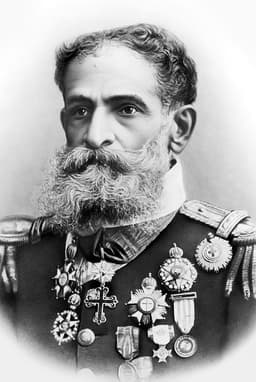
Deodoro da Fonseca
General · Modern
48.8Total
Mohammad Fahim
General · Modern
49.7Total
Basic Information
Born
1827
1957
Died
1892
—
Era
Modern
Modern
Nationality
Brazil
Afghanistan
Occupation
General
General
Civilization
Western
Middle Eastern
Score Comparison
Military (10%)
50.0
40.0
Political (20%)
45.1
43.7
Influence (20%)
54.1
51.0
Legacy (20%)
44.2
43.3
Leadership (15%)
57.6
74.0
Strategy (15%)
38.6
45.0
TOTAL
48.8
49.7
Deodoro da Fonseca — Complete Timeline
1889 AD
Proclamation of the Brazilian RepublicPolitical Action
Deodoro da Fonseca led a military coup that overthrew Emperor Pedro II on November 15, 1889. He proclaimed the Republic of the United States of Brazil, ending 67 years of imperial rule.
CoupRepublic
Impact: globalprogressive
1891 AD
Election as First President of BrazilPolitical Action◆ Major
Deodoro da Fonseca was elected the first President of Brazil by the Constituent Congress on February 25, 1891. He took office under the new republican constitution, but his rule was brief and authoritarian.
ElectionPresidency
Impact: national
Dissolution of the National CongressPolitical Action◆ Major
Facing political opposition, Deodoro da Fonseca dissolved the National Congress on November 3, 1891, and declared a state of siege. This authoritarian act triggered a naval revolt and his eventual resignation.
AuthoritarianismPolitical Crisis
Impact: nationaldestructive
Resignation from the PresidencyPolitical Action◆ Major
Deodoro da Fonseca resigned the presidency on November 23, 1891, after a naval rebellion threatened his government. He handed power to Vice President Floriano Peixoto, ending his 9-month rule.
ResignationPolitical Crisis
Impact: nationaltragic
Mohammad Fahim — Complete Timeline
2001 AD
Led Northern Alliance Forces in Fall of KabulWar
Mohammad Fahim, as a senior Northern Alliance commander, led forces that captured Kabul from the Taliban in November 2001. This victory followed the US invasion and was a turning point in the war, leading to the collapse of Taliban rule.
AfghanistanWarTaliban
Impact: national
Appointed Vice President of AfghanistanPolitical Action◆ Major
Mohammad Fahim was appointed Vice President of Afghanistan under Hamid Karzai in 2001, serving until 2004. He was a key Northern Alliance commander and his appointment was part of the post-Taliban power-sharing arrangement.
AfghanistanVice PresidencyNorthern Alliance
Impact: nationalconstructive
Served as Minister of DefensePolitical Action◆ Major
Mohammad Fahim served as Afghanistan's Minister of Defense from 2001 to 2004. He oversaw the formation of the new Afghan National Army and security forces, integrating former mujahideen and Northern Alliance fighters.
AfghanistanDefenseMilitary
Impact: nationalconstructive
2009 AD
Appointed First Vice President in 2009Political Action◆ Major
Mohammad Fahim was appointed First Vice President of Afghanistan under President Hamid Karzai in 2009. He served until his death in 2014, playing a key role in security and political affairs.
AfghanistanVice PresidencyGovernment
Impact: nationalconstructive
Expert Analysis
Deodoro da Fonseca vs Mohammad Fahim
# The General Who Would Be President: Two Paths from Battlefield to Power
On a November morning in 1889, a Brazilian general with a weary face and a booming voice stood before the Imperial Palace in Rio de Janeiro, his troops at his back. Across the world, more than a century later, another general led his men into the streets of Kabul, the Afghan capital falling like a ripe fruit into his hands. Both men were about to become presidents of nations born from violence. Yet their stories could not have diverged more sharply—one founding a republic, the other struggling to hold a fractured country together. What made the difference? The answer lies not just in their characters, but in the very soil from which they grew.
Origins
Manoel Deodoro da Fonseca was born in 1827 in Alagoas, a province of the Brazilian Empire, into a military family that had served Portugal and then Brazil for generations. He was a product of the Old World's decay—a cavalry officer trained in the rigid hierarchies of a monarchy that had outlived its time. By contrast, Mohammad Fahim entered the world in 1957 in the Panjshir Valley of Afghanistan, a land that had known little but war for decades. Where Fonseca learned to salute emperors, Fahim learned to fight Soviets. The Brazilian grew up in a nation slowly industrializing, its institutions creaking but intact. The Afghan grew up in a country being torn apart by superpowers, where loyalty meant clan and commander, not constitution.
Rise to Power
Fonseca's path was that of a loyalist turned revolutionary. He fought for the Empire in the Paraguayan War, earning a reputation for bravery and bluntness. But as the decades passed, he grew disillusioned with a monarchy that seemed deaf to the ambitions of the army and the plantation elites who funded it. When the Emperor Pedro II appointed a civilian prime minister who threatened military privileges, Fonseca found his moment. On November 15, 1889, he led a bloodless coup that toppled the Empire in a single day. It was a palace revolution, not a popular uprising.
Fahim's rise was forged in fire. As a young commander in the Northern Alliance, he fought the Soviet occupation throughout the 1980s, then turned his guns on the Taliban in the 1990s. His turning point came in 2001, when American airstrikes shattered Taliban lines. Fahim led his forces into Kabul on November 13, 2001, a conquest that was both military triumph and political opportunity. Within weeks, he was named Vice President and Minister of Defense under Hamid Karzai. Unlike Fonseca, who inherited a functioning state, Fahim inherited rubble.
Leadership and Governance
Fonseca's rule was a study in clumsy authoritarianism. As Brazil's first president, he governed by decree, alienating the very elites who had supported him. His military mind saw opposition as insubordination, not democracy. When Congress refused to approve his cabinet, he dissolved it on November 3, 1891, declaring a state of siege. It was a fatal miscalculation. Within weeks, a naval rebellion forced his resignation. He had held power for less than nine months.
Fahim's governance was more pragmatic but no less troubled. As Defense Minister, he oversaw the creation of a new Afghan army from scratch—tribal militias, former enemies, and raw recruits. His political score of 56.5 reflects a man who knew how to bargain but not how to build institutions. Corruption flourished under his watch, and his loyalty to Karzai was as much about survival as principle. Yet he survived where Fonseca failed, serving as First Vice President from 2009 until his death. His leadership score of 75.8 suggests a commander who could hold men together, even if he could not hold a nation.
Triumph and Tragedy
Fonseca's greatest moment was the proclamation of the republic itself—a single speech that ended sixty-seven years of monarchy. His tragedy was that he could not govern what he had created. He died in 1892, a year after his resignation, a figure more mourned for what he had been than what he had done.
Fahim's triumph was the fall of Kabul in 2001, a victory that ended Taliban rule and brought him to the pinnacle of power. His tragedy was that the peace he helped win never truly came. He died in 2014, a wealthy man in a poor country, his legacy stained by allegations of drug trafficking and human rights abuses. Where Fonseca's failure was institutional—he could not make a republic work—Fahim's was moral. He could not make power clean.
Character and Destiny
Fonseca was a man of the 19th century: honor-bound, impulsive, and convinced that military men made better rulers than civilians. His strategy score of 40.2 reveals a general who could win battles but not wars of politics. Fahim was a man of the 20th century's end: a survivor in a world without rules, where alliances shifted with the wind. His strategy score of 48.9 is only slightly better, but his leadership score of 75.8 suggests a different kind of skill—the ability to inspire loyalty in men who had no reason to trust anyone.
Their personalities shaped their fates. Fonseca's temper undid him; he could not compromise. Fahim's flexibility kept him alive but cost him his soul. One died disgraced but mourned; the other died powerful but unloved.
Legacy
Today, Deodoro da Fonseca is a footnote in Brazilian history—the first president, yes, but not the one who built the republic. That honor belongs to the civilians who followed. His name survives on streets and squares, but his vision died with him. Fahim's legacy is more ambiguous. He is remembered as a key figure in the fight against the Taliban, but also as a symbol of the corruption that plagued post-2001 Afghanistan. His legacy score of 56.7 places him squarely in the middle—neither hero nor villain, but a man who seized his moment and could not rise above it.
Conclusion
What separates a founding father from a failed leader? In the end, it is not military genius or political cunning, but the ability to build something that outlasts oneself. Fonseca tore down an empire but could not raise a republic. Fahim helped defeat the Taliban but could not build a state. Both were generals who became presidents, but neither became the statesman their nations needed. Their stories remind us that power is easier to seize than to wield, and that the hardest battle a soldier can fight is the one for peace.
Rankings
🥇
Mohammad FahimLeader
Mil: 40.0Pol: 43.7Inf: 51.0
49.7
🥈
Deodoro da Fonseca
Mil: 50.0Pol: 45.1Inf: 54.1
48.8
+0.9 behind
How This Comparison Works
Algorithm
Each figure is scored on 6 dimensions (0—100 scale) based on structured historical data: Military (10%), Political (20%), Influence (20%), Legacy (20%), Leadership (15%), Strategy (15%). The weighted total produces the final ranking.
Data Sources
Scores are computed from structured sub-indicators in the database. Scale factors adjust for era (Ancient ×0.85, Modern ×1.0) and civilization size (Eastern ×1.05, Other ×0.80) to account for differences in population and military scale.
Maximum 3 Figures
Comparisons are limited to 2—3 figures to ensure readability and statistical meaningfulness.
Error Margins
±5 points per dimension — Sub-scores are derived from historical records with inherent uncertainty. Two figures within 5 points on a dimension should be considered roughly equivalent in that area.
Total Score Accuracy
±3 points overall — The weighted combination of 6 dimensions produces a total score with approximately ±3 points of uncertainty. Differences of less than 3 points are not statistically significant— the figures are effectively tied.
Known Limitations
- Historical records are incomplete and uneven across civilizations
- Figures from oral-tradition societies may be underrepresented
- Occupation labels can misclassify multi-role figures
- Scores measure capability and impact, not moral character
- Quantitative scoring is a comparison tool, not absolute truth
Capability Radar
Military (10%) — Battles & Warfare
Battles
20
35
Win Rate
25
40
Expansion
10
25
Political (20%) — Governance & Reform
Reform
40
20
Diplomacy
25
40
Economy
15
15
Influence (20%) — Cultural & Global Reach
Cultural
20
15
Global
15
20
Legacy (20%) — Historical Impact
Historical
35
30
Longevity
20
20
Leadership (15%) — Power & Stability
Tenure
30
45
Stability
10
20
Strategy (15%) — Tactics & Innovation
Strategy
25
35
Tactics
20
30
Reform
15
20
Similar Comparisons
Comments & Discussion
PROCLAMATION PROFESSOR6/16/2026
Fonseca's "acclamation" as president was a masterclass in constitutional theater. He literally had the elected government arrested, then claimed the new regime sprang from "national will." Compare that to Fahim, who at least didn't pretend his 2001 ascension was anything but military victory. Fonseca wrapped his coup in parliamentary language like a lawyer's brief; Fahim wore his like a bloodstained uniform. One deceived, the other didn't bother. I prefer the honest thug over the dishonest burea
帝国余晖观察者6/16/2026
两人选择的历史时机简直是天壤之别。丰塞卡推翻的是一个垂死的巴西帝国,佩德罗二世早已失去军队支持,王朝气数已尽。而法希姆接手的是阿富汗这个永远在崩溃的国家——苏联刚走,军阀割据,部落分裂。丰塞卡在共和国初创时还能靠积攒的帝国威望维持两年;法希姆呢?他的"总统"头衔还没坐热,哈米德·卡尔扎伊就来了。一个死在辞职后,一个死在任期内。都说是将军治国,其实都是时代的一粒尘埃。|
PANSHIR ACCOUNTANT6/16/2026
Let's talk logistics. Fahim commanded the Northern Alliance, whose strength peaked around 15,000 fighters supplied by Iran, Russia, and India through the Panjshir Valley. Fonseca led Rio Grande do Sul's provincial forces, maybe 3,000 men against the imperial navy. Fahim's force held against the Taliban 1996-2001; Fonseca's coup succeeded in two days with zero serious casualties. Yet Fahim died wealthy in 2014 while Fonseca died in obscurity. The resource-scarce commander who held his line became
铜像推手6/16/2026
最讽刺的是他们的历史书写方式。丰塞卡在巴西有城市、广场、州名,可你去问普通巴西人他做了什么,他们会说"哦,那个共和国第一任总统。"法希姆在阿富汗被记住的是指挥北方联盟,他死后喀布尔的权力真空直接导致塔利班十年后卷土重来。丰塞卡开创了一个从帝国到共和国可以和平过渡的假象;法希姆留下的却是一个军阀干政的诅咒。一个被神化成国父,一个被遗忘成过渡品——历史的剪刀差从来不留情。|
SOVIET GHOST6/16/2026
Fahim learned to fight Soviets? More precisely, he learned to fight for Soviet money. In the 1980s, he served under Ahmad Shah Massoud, the "Lion of Panjshir," who took CIA and ISI cash while claiming independence. Fahim's real education came in the 199