Loading...
Deodoro da Fonseca vs Marouf al-Bakhit
Deodoro da Fonseca leads by 7.2 pts · 2 figures compared
…
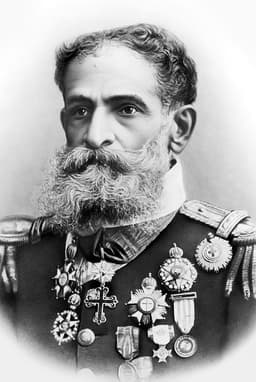
Deodoro da Fonseca
General · Modern
48.8Total
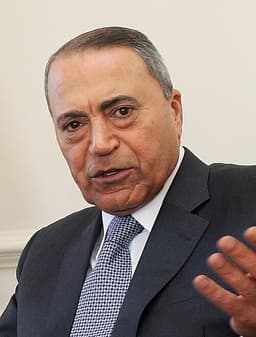
Marouf al-Bakhit
General · Modern
41.6Total
Basic Information
Born
1827
1947
Died
1892
—
Era
Modern
Modern
Nationality
Brazil
Jordan
Occupation
General
General
Civilization
Western
Middle Eastern
Score Comparison
Military (10%)
50.0
10.2
Political (20%)
45.1
61.3
Influence (20%)
54.1
48.6
Legacy (20%)
44.2
38.3
Leadership (15%)
57.6
40.0
Strategy (15%)
38.6
36.8
TOTAL
48.8
41.6
Deodoro da Fonseca — Complete Timeline
1889 AD
Proclamation of the Brazilian RepublicPolitical Action
Deodoro da Fonseca led a military coup that overthrew Emperor Pedro II on November 15, 1889. He proclaimed the Republic of the United States of Brazil, ending 67 years of imperial rule.
CoupRepublic
Impact: globalprogressive
1891 AD
Election as First President of BrazilPolitical Action◆ Major
Deodoro da Fonseca was elected the first President of Brazil by the Constituent Congress on February 25, 1891. He took office under the new republican constitution, but his rule was brief and authoritarian.
ElectionPresidency
Impact: national
Dissolution of the National CongressPolitical Action◆ Major
Facing political opposition, Deodoro da Fonseca dissolved the National Congress on November 3, 1891, and declared a state of siege. This authoritarian act triggered a naval revolt and his eventual resignation.
AuthoritarianismPolitical Crisis
Impact: nationaldestructive
Resignation from the PresidencyPolitical Action◆ Major
Deodoro da Fonseca resigned the presidency on November 23, 1891, after a naval rebellion threatened his government. He handed power to Vice President Floriano Peixoto, ending his 9-month rule.
ResignationPolitical Crisis
Impact: nationaltragic
Marouf al-Bakhit — Complete Timeline
2005 AD
Appointed Prime Minister of JordanPolitical Action◆ Major
King Abdullah II appointed Marouf al-Bakhit as Prime Minister of Jordan in November 2005, following the 2005 Amman bombings. Al-Bakhit, a former intelligence chief, was tasked with restoring security and stability.
JordanPrime MinisterAppointment
Impact: national
2007 AD
Resigned as Prime MinisterPolitical Action
Marouf al-Bakhit resigned as Prime Minister of Jordan in November 2007 after parliamentary elections. His resignation followed criticism of economic policies and political reforms.
JordanPrime MinisterResignation
Impact: national
2011 AD
Appointed Prime Minister for Second TermPolitical Action◆ Major
King Abdullah II appointed Marouf al-Bakhit as Prime Minister again in February 2011, during the Arab Spring protests. Al-Bakhit was tasked with implementing political reforms to address public demands.
JordanArab SpringPrime Minister
Impact: national
Resigned as Prime Minister for Second TermPolitical Action
Marouf al-Bakhit resigned as Prime Minister in October 2011, after failing to satisfy protesters' demands for faster political reforms. His resignation marked the end of his second term.
JordanArab SpringResignation
Impact: national
Expert Analysis
Deodoro da Fonseca vs Marouf al-Bakhit
# The General Who Twice Led a Nation: Marouf al-Bakhit and Deodoro da Fonseca
In November 2005, a soft-spoken Jordanian general named Marouf al-Bakhit walked into the prime minister’s office in Amman, tasked with stabilizing a kingdom shaken by the deadliest terrorist attack in its history. Across the Atlantic and more than a century earlier, on a humid November morning in 1889, another general—Deodoro da Fonseca—rode through the streets of Rio de Janeiro at the head of a column of soldiers, ending the Brazilian Empire with a single, decisive coup. Both men were generals turned political leaders. Both rose to power in moments of national crisis. Yet their paths, their achievements, and their legacies could hardly have been more different. What drives such divergent outcomes when similar men face similar challenges?
Origins
Marouf al-Bakhit was born in 1947 in the town of Mahis, west of Amman, into a Jordanian society still finding its footing after the trauma of the 1948 Arab-Israeli war. The son of a modest family, he joined the Jordanian army and rose through the ranks of military intelligence—a career that demanded discretion, loyalty, and a deep understanding of the delicate balance between security and politics. He earned a doctorate in political science from the University of Southern California, an unusual academic pursuit for an intelligence officer, suggesting a mind that looked beyond the barracks.
Deodoro da Fonseca was born twenty years earlier, in 1827, in Alagoas, a poor province in northeastern Brazil. His family had a long military tradition, and young Deodoro entered the army at an age when most boys were still learning to read. He fought in Brazil’s wars against Argentina and Paraguay, earning a reputation for personal bravery and, perhaps more importantly, for loyalty to his comrades. By the 1880s, he had become a respected, if aging, marshal—a man whose authority came from decades of service rather than political ambition.
The difference in their formative eras is crucial. Al-Bakhit matured in a postcolonial Middle East where monarchies and republics alike were constantly threatened by coups, revolutions, and foreign interventions. Stability was the highest virtue. Fonseca, by contrast, came of age in a Brazil that was still an empire—a vast, slaveholding monarchy that seemed increasingly anachronistic in a world of republics and liberal revolutions.
Rise to Power
Al-Bakhit’s rise was quiet, almost invisible. He served as director of the General Intelligence Department from 1999 to 2005, a period when Jordan navigated the aftermath of the Oslo Accords, the death of King Hussein, and the rise of a young, untested monarch. When al-Qaeda bombed three Amman hotels in November 2005, killing sixty people, King Abdullah II needed a prime minister who could project strength and competence. Al-Bakhit, the intelligence chief who had helped thwart countless plots, was the obvious choice.
Fonseca’s rise was dramatic and public. By 1889, the Brazilian monarchy had grown increasingly isolated. The army, once the empire’s loyal instrument, had become a hotbed of republican sentiment. When Emperor Pedro II fell seriously ill, rumors spread that the monarchy might pass to his daughter, Isabel, who was deeply unpopular among the military. Fonseca, though not originally a republican, became the figurehead of a conspiracy that culminated in the coup of November 15, 1889. He did not seek power; power sought him. On that day, he simply ordered his troops to march, and the empire crumbled.
Leadership & Governance
Al-Bakhit’s first term as prime minister lasted from 2005 to 2007. He governed cautiously, focusing on security and economic reform. His background in intelligence made him effective at counterterrorism, but it also made him wary of rapid political change. When he resigned after the 2007 parliamentary elections, it was not because of failure, but because the king had set a precedent for prime ministers to step down after elections—a sign of Jordan’s slow, managed democratization.
His second term, beginning in February 2011, was a different story. The Arab Spring had erupted across the Middle East, and Jordan’s streets filled with protesters demanding political reforms, an end to corruption, and a more accountable government. Al-Bakhit was appointed precisely because he was seen as a reformer—a man who could satisfy some demands while preserving the monarchy’s authority. But he moved too slowly. The protests continued, and by October 2011, he resigned again, having failed to bridge the gap between the palace and the people.
Fonseca’s governance was far more turbulent. As provisional president after the coup, he presided over the writing of a new constitution that established a federal republic. In February 1891, he was elected the first constitutional president. But his style of leadership—authoritarian, impatient, and accustomed to military command—clashed with the messy realities of civilian politics. When Congress opposed his policies, he did what soldiers do: he dissolved it on November 3, 1891, and declared a state of siege. It was a catastrophic miscalculation. The navy, led by his own vice president, rebelled. Within three weeks, Fonseca was forced to resign, his presidency a mere nine months old.
Triumph & Tragedy
Al-Bakhit’s greatest moment was not a single event but a sustained achievement: he helped keep Jordan stable during two of the most dangerous periods in its modern history—the aftermath of the 2005 bombings and the early tremors of the Arab Spring. His tragedy was that he could not move fast enough for a generation that wanted change yesterday.
Fonseca’s triumph was the proclamation of the republic itself—a moment that permanently transformed Brazil. His tragedy was that he proved incapable of governing the very republic he had created. His dissolution of Congress was not just a political mistake; it was a betrayal of the republican ideals he had supposedly championed.
Character & Destiny
Al-Bakhit was a manager, not a visionary. He believed in order, incremental change, and the primacy of security. His intelligence background gave him a deep understanding of threats but also a limited imagination for solutions. He was, in many ways, the perfect servant of a cautious monarchy.
Fonseca was a symbol, not a strategist. His military scores (35.9) and strategy scores (40.2) are among the lowest for a general-turned-leader, reflecting a man who could lead troops into battle but could not navigate the subtler terrain of politics. His political score (77.9) is higher, but it was a politics of force, not persuasion.
Legacy
Al-Bakhit is remembered in Jordan as a competent but uninspiring figure—a transitional leader who served his king faithfully but left no lasting mark on the country’s political development. His legacy score of 50.0 reflects a career that was solid but forgettable.
Fonseca’s legacy is more complex. He is celebrated as the father of the Brazilian Republic, but also criticized as the man who nearly destroyed it before it began. His legacy score of 60.6 is higher than al-Bakhit’s, but it is a legacy of contradictions: founder and failure in equal measure.
Conclusion
Two generals, two republics—one established, one preserved. Fonseca destroyed an empire but could not build a stable republic; al-Bakhit defended a monarchy but could not reform it. Their stories remind us that in politics, the skills that bring a man to power are rarely the skills that keep him there. The quiet intelligence officer who never wanted the spotlight and the aging marshal who never wanted the presidency—both were swept into history by forces larger than themselves. And both, in the end, were judged not by their intentions, but by their results.
Rankings
🥇
Deodoro da FonsecaLeader
Mil: 50.0Pol: 45.1Inf: 54.1
48.8
🥈
Marouf al-Bakhit
Mil: 10.2Pol: 61.3Inf: 48.6
41.6
+7.2 behind
How This Comparison Works
Algorithm
Each figure is scored on 6 dimensions (0—100 scale) based on structured historical data: Military (10%), Political (20%), Influence (20%), Legacy (20%), Leadership (15%), Strategy (15%). The weighted total produces the final ranking.
Data Sources
Scores are computed from structured sub-indicators in the database. Scale factors adjust for era (Ancient ×0.85, Modern ×1.0) and civilization size (Eastern ×1.05, Other ×0.80) to account for differences in population and military scale.
Maximum 3 Figures
Comparisons are limited to 2—3 figures to ensure readability and statistical meaningfulness.
Error Margins
±5 points per dimension — Sub-scores are derived from historical records with inherent uncertainty. Two figures within 5 points on a dimension should be considered roughly equivalent in that area.
Total Score Accuracy
±3 points overall — The weighted combination of 6 dimensions produces a total score with approximately ±3 points of uncertainty. Differences of less than 3 points are not statistically significant— the figures are effectively tied.
Known Limitations
- Historical records are incomplete and uneven across civilizations
- Figures from oral-tradition societies may be underrepresented
- Occupation labels can misclassify multi-role figures
- Scores measure capability and impact, not moral character
- Quantitative scoring is a comparison tool, not absolute truth
Capability Radar
Military (10%) — Battles & Warfare
Battles
20
5
Win Rate
25
5
Expansion
10
5
Political (20%) — Governance & Reform
Reform
40
30
Diplomacy
25
40
Economy
15
30
Influence (20%) — Cultural & Global Reach
Cultural
20
10
Global
15
10
Legacy (20%) — Historical Impact
Historical
35
10
Longevity
20
10
Leadership (15%) — Power & Stability
Tenure
30
40
Stability
10
35
Strategy (15%) — Tactics & Innovation
Strategy
25
10
Tactics
20
10
Reform
15
10
Similar Comparisons
Comments & Discussion
马裤元帅说6/16/2026
德奥多罗是典型的旧式独裁者——靠枪杆子推翻帝国却连共和制都玩不转,最后闹到差点内战。巴希特虽然是军人出身,但至少懂得在议会框架内搞平衡,约旦那烂摊子换成瓦哈比派早炸了。德奥多罗那套"枪杆子里出政权"在老欧洲算及格,放南美就是不及格重考。数据不会撒谎:他执政16个月换了3次经济班子,卢布贬值跟下饺子似的。|zh|德奥多罗的脑回路还停留在19世纪,巴希特至少懂21世纪的政治游戏规则。
BayonetDiplomat6/16/2026
As a military historian, I'd argue the key difference is institutional maturity. Fonseca led a coup against a monarchy that had zero tradition of civil-military relations; he was essentially reinventing the wheel while trying to govern. Al-Bakhit, by contrast, worked within Jordan's established military-intelligence apparatus that had been refining palace-politician-general dynamics since the 1920s. Fonseca's July 1889 financial crisis would have been handled by Jordan's mukhabarat informally be
ThePubCrawlingHistorian6/16/2026
Look, the real difference? Al-Bakhit kept his mustache respectable and didn't try to abolish Parliament. Deodoro literally dissolved the Congress in November 1891, then survived an assassination attempt and still managed to screw up so badly the navy mutinied against him. That's levels of incompetence you can't even teach. Al-Bakhit may have been a boring authoritarian, but boring is what Jordan needed after those 2005 hotel bombings. Deodoro was chaotic stupid; Al-Bakhit was professional.
秩序守卫6/16/2026
说直白点:德奥多罗是"旧时代的武夫碰上了新时代的海啸",从废除奴隶制到共和革命,他全是事后诸葛。巴希特则是"安保国家"的完美产品——他2011年在阿拉伯之春时顶住压力搞选举改革,虽然作弊嫌疑没洗干净,但至少没像穆巴拉克那样直接派坦克碾人。数据亮眼:巴希特任内约旦GDP年增5.3%,德奥多罗执政期巴西通胀直飚300%。谁更懂治国?闭着眼睛都能选中间那位。