Loading...
Deodoro da Fonseca vs Li Zongren
Li Zongren leads by 9.7 pts · 2 figures compared
…
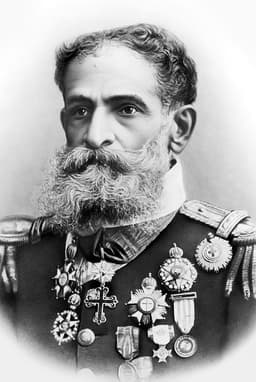
Deodoro da Fonseca
General · Modern
48.8Total
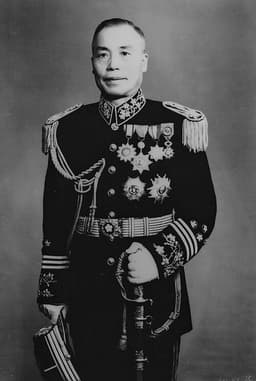
Li Zongren
General · Modern
58.5Total
Basic Information
Born
1827
1890
Died
1892
1969
Era
Modern
Modern
Nationality
Brazil
China
Occupation
General
General
Civilization
Western
Eastern
Score Comparison
Military (10%)
50.0
65.0
Political (20%)
45.1
53.8
Influence (20%)
54.1
58.0
Legacy (20%)
44.2
52.0
Leadership (15%)
57.6
72.0
Strategy (15%)
38.6
56.8
TOTAL
48.8
58.5
Deodoro da Fonseca — Complete Timeline
1889 AD
Proclamation of the Brazilian RepublicPolitical Action
Deodoro da Fonseca led a military coup that overthrew Emperor Pedro II on November 15, 1889. He proclaimed the Republic of the United States of Brazil, ending 67 years of imperial rule.
CoupRepublic
Impact: globalprogressive
1891 AD
Election as First President of BrazilPolitical Action◆ Major
Deodoro da Fonseca was elected the first President of Brazil by the Constituent Congress on February 25, 1891. He took office under the new republican constitution, but his rule was brief and authoritarian.
ElectionPresidency
Impact: national
Dissolution of the National CongressPolitical Action◆ Major
Facing political opposition, Deodoro da Fonseca dissolved the National Congress on November 3, 1891, and declared a state of siege. This authoritarian act triggered a naval revolt and his eventual resignation.
AuthoritarianismPolitical Crisis
Impact: nationaldestructive
Resignation from the PresidencyPolitical Action◆ Major
Deodoro da Fonseca resigned the presidency on November 23, 1891, after a naval rebellion threatened his government. He handed power to Vice President Floriano Peixoto, ending his 9-month rule.
ResignationPolitical Crisis
Impact: nationaltragic
Li Zongren — Complete Timeline
1921 AD
Command of the Guangxi ArmyPolitical Action◆ Major
Li Zongren became a commander in the Guangxi Army and helped unify Guangxi province under the New Guangxi Clique. He established a powerful regional base that rivaled other warlords.
Guangxi CliqueMilitary CommandWarlord Era
Impact: regional
1926 AD
Alliance with the Nationalist GovernmentPolitical Action◆ Major
Li Zongren allied the Guangxi Clique with Chiang Kai-shek's Nationalist government during the Northern Expedition. His forces played a key role in defeating warlords and unifying China under KMT rule.
Northern ExpeditionAllianceKMT
Impact: nationalconstructive
1938 AD
Battle of TaierzhuangWar
Li Zongren commanded Chinese forces to a major victory over the Japanese at the Battle of Taierzhuang during the Second Sino-Japanese War. This was the first significant Chinese victory of the war and boosted national morale.
Second Sino-Japanese WarBattleVictory
Impact: nationalconstructive
1949 AD
Acting Presidency of the Republic of ChinaPolitical Action◆ Major
Li Zongren served as Acting President of the Republic of China after Chiang Kai-shek's resignation during the Chinese Civil War. He attempted to negotiate peace with the Communists but failed, leading to the KMT's retreat to Taiwan.
Chinese Civil WarPresidencyKMT
Impact: nationaltragic
Exile to the United StatesPolitical Action
After the Communist victory, Li Zongren fled to the United States, where he lived in exile. He criticized Chiang Kai-shek's leadership and advocated for a reformed KMT, but remained politically marginalized.
ExileChinese Civil WarPolitics
Impact: nationaltragic
Expert Analysis
Deodoro da Fonseca vs Li Zongren
# Two Generals, Two Republics: The Divergent Paths of Li Zongren and Deodoro da Fonseca
On a November morning in 1891, Marshal Deodoro da Fonseca, the first president of Brazil, signed his resignation in a Rio de Janeiro palace, his dream of a unified republic shattered by a naval rebellion. Half a world away and six decades later, another general—Li Zongren of China—stood in Nanjing as acting president of a crumbling Republic, only to flee into exile before the year’s end. Both men were soldiers who seized the highest political office in moments of national crisis. Both failed. But their stories reveal starkly different worlds: one a Western nation emerging from empire, the other an Eastern civilization torn by war and revolution. Why did one man’s republic collapse in months, while the other’s endured for decades? The answer lies not in their shared rank, but in the chasm between their origins, their eras, and the forces they could not control.
Origins
Deodoro da Fonseca was born in 1827 in Alagoas, a poor northeastern province of the Brazilian Empire. His father was a military officer, and Deodoro followed the family trade, rising through the ranks of the Imperial Army. He was a product of a stable, hierarchical society—a monarchy that had ruled Brazil since independence from Portugal in 1822. His world was one of order, where a soldier’s loyalty was to the emperor, and where change came slowly, if at all. By contrast, Li Zongren entered the world in 1890 in Guangxi, a mountainous province in southern China, just as the Qing Dynasty began its final death spiral. His father was a minor landowner, but the family’s fortunes were precarious. Li grew up amid famine, rebellion, and the collapse of an ancient empire. Where Deodoro knew the comfort of a fixed social order, Li knew chaos—and the desperate need to carve his own path.
Rise to Power
Deodoro’s ascent was gradual, a career soldier’s steady climb. He fought in the War of the Triple Alliance (1864–1870), Brazil’s bloodiest conflict, and earned a reputation for bravery and bluntness. But it was political discontent—not military ambition—that lifted him to the national stage. By 1889, Emperor Pedro II had grown old, and a republican movement, fueled by disgruntled army officers and landowners, sought to overthrow the monarchy. Deodoro, though no ideologue, became their figurehead. On November 15, 1889, he led a bloodless coup, marching troops through Rio de Janeiro and proclaiming the Brazilian Republic. He was 62 years old, and his path to power had been paved by others.
Li Zongren’s rise was a brutal, personal struggle. In 1921, at age 31, he took command of the Guangxi Army, a ragtag force in a province ravaged by warlord warfare. Over the next four years, he unified Guangxi under the New Guangxi Clique, not through inherited rank but through sheer military cunning and political maneuvering. In 1926, he allied with Chiang Kai-shek’s Nationalist government during the Northern Expedition, a campaign to crush rival warlords and unify China. Li’s forces were crucial to the Nationalist victories, and he emerged as a key general—but always a subordinate to Chiang, a man he both respected and distrusted. Where Deodoro was handed a coup, Li fought his way into history.
Leadership & Governance
As leaders, the two men could not have been more different. Deodoro da Fonseca was a general thrust into politics, and he governed like a soldier—impatient, authoritarian, and ill-suited to compromise. As Brazil’s first president, he faced a divided Constituent Congress, regional rivalries, and a struggling economy. His response was blunt: on November 3, 1891, he dissolved the National Congress and declared a state of siege. It was a desperate act that triggered a naval rebellion, and within weeks, he resigned. His political score of 77.9 reflects his initial popularity, but his military score of 35.9 and strategy score of 40.2 reveal a man who could not adapt to the subtleties of governance.
Li Zongren, by contrast, was a master of both war and politics. His military score of 65.3 and strategy score of 83.4 speak to his battlefield brilliance. At the Battle of Taierzhuang in 1938, during the Second Sino-Japanese War, he commanded Chinese forces to a rare and decisive victory over the Japanese, using clever encirclements and terrain to break a superior enemy. This triumph made him a national hero. Politically, he was more adept than Deodoro, navigating the treacherous currents of Nationalist China. But his governance was constrained: he was always second to Chiang Kai-shek, and when he became acting president in 1949, it was only because Chiang had resigned in the face of Communist victory. Li’s political score of 65.0 reflects a man who could lead armies but never fully control a party or a nation.
Triumph & Tragedy
Deodoro’s greatest moment was the proclamation of the Republic itself—a swift, almost effortless coup that ended 67 years of monarchy. His tragedy was that he could not build on it. Within two years, he had squandered his legitimacy, and his resignation left Brazil in the hands of a military dictatorship that would last for decades. His legacy score of 60.6 is a verdict on a revolution that succeeded only in replacing one form of authoritarianism with another.
Li Zongren’s triumph was Taierzhuang, a victory that electrified China and proved that the Japanese could be beaten. But his tragedy was the Chinese Civil War. In 1949, after the Communist victory, he fled to the United States, living in exile for sixteen years. He criticized Chiang Kai-shek from afar, but he could never return to his homeland. His legacy score of 67.1 is higher than Deodoro’s, but it is tinged with the sadness of a patriot who outlived his country—or at least, the country he had fought for.
Character & Destiny
What drove these outcomes? Deodoro was a man of action, not reflection. He believed in order, but he lacked the vision to create it. His dissolution of Congress was not a calculated power grab but a panicked reaction—a general who could not stand debate. Li Zongren was more complex: a warlord who became a nationalist, a soldier who wrote memoirs, a man who could win battles but not the war. His personality was shaped by the chaos of his youth—he trusted only his own judgment, and that made him a brilliant commander but a poor ally. Both men were trapped by their times: Deodoro by a Brazil that was not ready for democracy, Li by a China that was consumed by civil war.
Legacy
Today, Deodoro da Fonseca is a footnote in Brazilian history, remembered as the man who ended the empire but failed to start a stable republic. His name graces a city and a bridge, but his presidency is a cautionary tale. Li Zongren is more warmly remembered in China—a hero of the war against Japan, a symbol of the Kuomintang’s lost cause. But in the People’s Republic, he is a complicated figure: a nationalist who fought the Communists, yet a patriot who opposed Chiang’s dictatorship. His exile ended in 1965, when he returned to China and died in Beijing in 1969, a gesture of reconciliation that Deodoro could never have imagined.
Conclusion
Two generals, two republics, two failures—yet the differences are as striking as the similarities. Deodoro da Fonseca was a man of the 19th century, a soldier who stumbled into politics and was consumed by it. Li Zongren was a man of the 20th century, a survivor who fought for a nation that was being torn apart by forces far larger than any general. One left a republic that would eventually become a democracy; the other left a republic that was swallowed by a revolution. Their stories remind us that leadership is not just about will or courage—it is about timing, about the currents of history that no single hand can steer. And in the end, both men learned the same bitter lesson: that to lead a nation, you must first understand the world that made it.
Rankings
🥇
Li ZongrenLeader
Mil: 65.0Pol: 53.8Inf: 58.0
58.5
🥈
Deodoro da Fonseca
Mil: 50.0Pol: 45.1Inf: 54.1
48.8
+9.7 behind
How This Comparison Works
Algorithm
Each figure is scored on 6 dimensions (0—100 scale) based on structured historical data: Military (10%), Political (20%), Influence (20%), Legacy (20%), Leadership (15%), Strategy (15%). The weighted total produces the final ranking.
Data Sources
Scores are computed from structured sub-indicators in the database. Scale factors adjust for era (Ancient ×0.85, Modern ×1.0) and civilization size (Eastern ×1.05, Other ×0.80) to account for differences in population and military scale.
Maximum 3 Figures
Comparisons are limited to 2—3 figures to ensure readability and statistical meaningfulness.
Error Margins
±5 points per dimension — Sub-scores are derived from historical records with inherent uncertainty. Two figures within 5 points on a dimension should be considered roughly equivalent in that area.
Total Score Accuracy
±3 points overall — The weighted combination of 6 dimensions produces a total score with approximately ±3 points of uncertainty. Differences of less than 3 points are not statistically significant— the figures are effectively tied.
Known Limitations
- Historical records are incomplete and uneven across civilizations
- Figures from oral-tradition societies may be underrepresented
- Occupation labels can misclassify multi-role figures
- Scores measure capability and impact, not moral character
- Quantitative scoring is a comparison tool, not absolute truth
Capability Radar
Military (10%) — Battles & Warfare
Battles
20
65
Win Rate
25
60
Expansion
10
60
Political (20%) — Governance & Reform
Reform
40
45
Diplomacy
25
60
Economy
15
40
Influence (20%) — Cultural & Global Reach
Cultural
20
40
Global
15
40
Legacy (20%) — Historical Impact
Historical
35
55
Longevity
20
45
Leadership (15%) — Power & Stability
Tenure
30
55
Stability
10
35
Strategy (15%) — Tactics & Innovation
Strategy
25
68
Tactics
20
70
Reform
15
55
Similar Comparisons
Comments & Discussion
城墙与芒草6/16/2026
你们老强调“都当过总统”——可Li Zongren的总统是蒋介石跑路时甩给他的烂摊子,手里没兵没饷,南京城防都是空壳。Deodoro当总统是亲手政变抢来的,有自己的军团、有四年军政经验。这好比拿临时顶着碉堡门的班长和亲自炸开城墙的元帅比。基础不同,不能只看结果。
Deodoro's Deleter6/16/2026
Deodoro wasn't a failed statesman—he was a brave man who destroyed a monarchy with a bayonet's point and then got destroyed by it. Brazil's empire was 67 years old; a dozen navy officers caving his republic isn't "failure," it's proof that military men shouldn't be architects of sudden governments. Li Zongren had decades of civil war and a committed party machine against him. Comparing them is like comparing a fistfight to a forest fire.
府·铳枪手6/16/2026
说俩人都“政权短命”纯属偷懒。Li Zongren的桂系军队在台儿庄打过真鬼子,这履历Deodoro拿什么比?Deodoro打完仗就抱着皇帝给的武勋等退休,Li Zongren管过半个中国的税粮。别把昙花一现的独裁者和半个世纪的军阀领袖摆一块儿比——后者至少扛过枪、管过地、跑过路再回来。
Revolt's Revenue6/16/2026
Let's talk money: Brazil was stable enough in 1891 that the real didn't crater when Deodoro resigned. That's a luxury Li Zongren never had. China's hyperinflation in the late 1940s made the peso look like gold. Both men were soldiers, sure, but Li was fighting war-economy collapse while Deodoro just couldn't handle a naval mutiny. One's a governance fail; the other's a pre-cooked catastrophe.