Loading...
Deodoro da Fonseca vs Justo Rufino Barrios
Justo Rufino Barrios leads by 9.8 pts · 2 figures compared
…
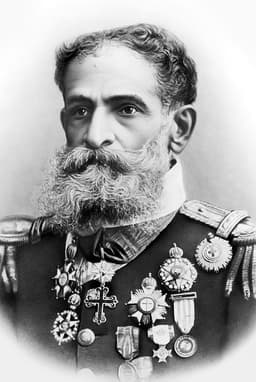
Deodoro da Fonseca
General · Modern
48.8Total
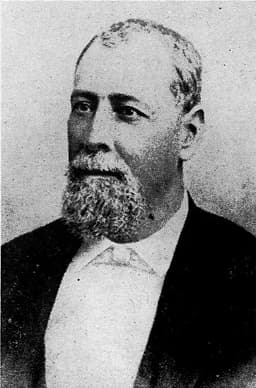
Justo Rufino Barrios
General · Modern
58.6Total
Basic Information
Born
1827
1835
Died
1892
1885
Era
Modern
Modern
Nationality
Brazil
Guatemala
Occupation
General
General
Civilization
Western
Western
Score Comparison
Military (10%)
50.0
52.5
Political (20%)
45.1
72.0
Influence (20%)
54.1
60.0
Legacy (20%)
44.2
49.2
Leadership (15%)
57.6
65.0
Strategy (15%)
38.6
55.0
TOTAL
48.8
58.6
Deodoro da Fonseca — Complete Timeline
1889 AD
Proclamation of the Brazilian RepublicPolitical Action
Deodoro da Fonseca led a military coup that overthrew Emperor Pedro II on November 15, 1889. He proclaimed the Republic of the United States of Brazil, ending 67 years of imperial rule.
CoupRepublic
Impact: globalprogressive
1891 AD
Election as First President of BrazilPolitical Action◆ Major
Deodoro da Fonseca was elected the first President of Brazil by the Constituent Congress on February 25, 1891. He took office under the new republican constitution, but his rule was brief and authoritarian.
ElectionPresidency
Impact: national
Dissolution of the National CongressPolitical Action◆ Major
Facing political opposition, Deodoro da Fonseca dissolved the National Congress on November 3, 1891, and declared a state of siege. This authoritarian act triggered a naval revolt and his eventual resignation.
AuthoritarianismPolitical Crisis
Impact: nationaldestructive
Resignation from the PresidencyPolitical Action◆ Major
Deodoro da Fonseca resigned the presidency on November 23, 1891, after a naval rebellion threatened his government. He handed power to Vice President Floriano Peixoto, ending his 9-month rule.
ResignationPolitical Crisis
Impact: nationaltragic
Justo Rufino Barrios — Complete Timeline
1871 AD
Enacted the Liberal Reforms of 1871Reform
Justo Rufino Barrios, after coming to power, implemented sweeping liberal reforms. These included the separation of church and state, confiscation of church lands, establishment of secular education, and promotion of coffee cultivation for export.
GuatemalaLiberal ReformSecularization
Impact: nationalprogressive
1873 AD
Modernized Guatemala's InfrastructureReform◆ Major
Barrios oversaw the construction of roads, telegraph lines, and railways, particularly to support coffee exports. He also promoted immigration and foreign investment, transforming Guatemala's economy.
GuatemalaInfrastructureEconomic Development
Impact: nationalconstructive
1885 AD
Killed at the Battle of ChalchuapaWar
Barrios was killed in battle at Chalchuapa, El Salvador, while leading an invasion to forcibly reunify Central America. His death ended the unification attempt and preserved the sovereignty of the individual Central American states.
Central AmericaBattleDeath
Impact: regionaltragic
Declared the Unification of Central AmericaPolitical Action◆ Major
Barrios unilaterally declared the reunification of the Central American republics by force. He issued a decree proclaiming himself supreme military commander of a unified Central America, leading to war with neighboring states.
Central AmericaUnificationWar
Impact: regionaldestructive
Expert Analysis
Deodoro da Fonseca vs Justo Rufino Barrios
# The Generals Who Became Presidents: Two Paths to Power in the Americas
On a sweltering November morning in 1889, a sixty-two-year-old Brazilian marshal named Deodoro da Fonseca stood at the head of a column of troops in Rio de Janeiro. He was not a man who sought revolution—he had spent his entire career serving the Empire of Brazil, fighting for its unity against separatists and rebels. Yet here he was, about to overthrow the emperor he had sworn to defend. Four years earlier and a thousand miles to the northwest, another general-president, Justo Rufino Barrios of Guatemala, had ridden into battle at the head of his army, convinced that he could reunite the broken fragments of Central America through sheer force of will. One man would die on the battlefield, his dream buried with him. The other would stumble into the presidency, then stumble out again, leaving behind a republic that would endure without him. What drove these two soldiers to such different fates?
Origins
Justo Rufino Barrios was born in 1835 in San Lorenzo, Guatemala, into a world of coffee plantations and conservative landowners. He grew up in the shadow of Rafael Carrera, the conservative caudillo who had dominated Central America for decades. Barrios learned early that power in Guatemala came from the barrel of a gun and the loyalty of armed men. He was a product of the Liberal generation that swept Latin America in the mid-nineteenth century—men who believed that progress meant railroads, telegraphs, secular education, and the breaking of the Catholic Church's grip on society. His ambition was not merely national; it was continental.
Deodoro da Fonseca, born eight years earlier in 1827 in Alagoas, Brazil, came from a military family with deep roots in the empire. He was a career soldier who had fought in the War of the Triple Alliance (1864–1870), the bloodiest conflict in South American history. That war had forged a generation of Brazilian officers who saw themselves as the true guardians of the nation—above politicians, above even the emperor. Fonseca was a monarchist by habit, not by conviction. He had no grand ideology, no sweeping vision of national transformation. He was a man of duty, not of dreams.
Rise to Power
Barrios seized power in 1871 through a Liberal revolution that overthrew the conservative regime. He was thirty-six years old, young and ruthless. His rise was violent, decisive, and personal. He did not wait for history to call him; he took the stage by force. The Liberal Reforms of 1871 that followed were sweeping: separation of church and state, confiscation of church lands, promotion of coffee exports, and the construction of infrastructure that would tie Guatemala to the global economy. Barrios governed as a modernizer and a dictator, all in one.
Fonseca's path was different. He did not seek power; power sought him. By 1889, the Brazilian Empire was decaying. Emperor Pedro II was old and ill, the abolition of slavery in 1888 had alienated the planter class, and the military had grown restless. Fonseca became the figurehead of a conspiracy he did not fully control. On November 15, 1889, he led a bloodless coup that ended sixty-seven years of imperial rule. He proclaimed the Republic of the United States of Brazil not because he believed in republicanism, but because the republic had come to believe in him.
Leadership & Governance
Barrios governed with the energy of a man possessed. He built railways through the mountains, strung telegraph lines across the highlands, and forced the Catholic Church to yield its lands and privileges. His reforms were real and lasting—they broke the power of the old conservative oligarchy and opened Guatemala to foreign investment. But he ruled as a caudillo, with little patience for democratic institutions. His leadership score of 77.2 reflects a man who commanded loyalty but not consensus.
Fonseca, by contrast, was a reluctant president. Elected by the Constituent Congress in February 1891 with a political score of 77.9, he had no experience in civilian governance and no taste for political compromise. When Congress opposed him, he dissolved it in November 1891 and declared a state of siege. It was the act of a general, not a statesman. Within three weeks, a naval rebellion forced him to resign. His presidency lasted barely nine months. His military score of 35.9 and strategy score of 40.2 suggest a commander who was more symbol than soldier by the time he reached the highest office.
Triumph & Tragedy
Barrios's greatest moment was also his last. In 1885, he declared the unification of Central America by force, issuing a decree that proclaimed himself commander-in-chief of a reunited federation. He invaded El Salvador with an army of several thousand men. At the Battle of Chalchuapa on April 2, 1885, he was shot from his horse and killed. His dream of Central American unity died with him. The tragedy was not that he failed—it was that he never considered any path but war.
Fonseca's tragedy was quieter. His triumph was the proclamation of the republic itself, an achievement that outlived his presidency. But his failure was personal: he could not adapt to the demands of democratic leadership. He resigned in November 1891 and died less than a year later, in August 1892, a broken man. His legacy score of 60.6 reflects a figure who was essential to Brazil's transition but quickly forgotten in its aftermath.
Character & Destiny
Barrios was a man of will. He believed that history could be commanded, that a single determined leader could reshape nations. His total score of 68.9 is a measure of his impact, but it also hints at the limits of sheer willpower. He died as he lived—at the head of an army, charging forward, looking neither left nor right.
Fonseca was a man of circumstance. He was thrust into a role he never wanted, carrying out a revolution he did not fully understand. His total score of 62.8 is lower, but his influence score of 74.8 is higher than Barrios's 72.5—a paradox that captures his strange legacy. He was less effective as a leader but more important as a symbol. Barrios shaped his era; Fonseca was shaped by his.
Legacy
Barrios is remembered in Guatemala as a reformer and a nationalist, a figure of both admiration and controversy. His liberal reforms modernized the country, but his authoritarian methods and his fatal obsession with unification cast a long shadow. He is a hero to some, a cautionary tale to others.
Fonseca is remembered as the first president of the Brazilian Republic, but his name is not carved into the national consciousness the way Barrios's is in Guatemala. His resignation opened the door for a turbulent early republic, but he himself was a transitional figure—necessary, but not beloved. Brazil moved on without him.
Conclusion
Two generals, two republics, two very different ends. Barrios died with his boots on, believing to the last that he could force history to obey him. Fonseca died in retirement, having learned that history obeys no one. Their stories remind us that the path from soldier to statesman is never straight, and that the same qualities that win battles—decisiveness, courage, stubbornness—can destroy presidencies. In the end, Barrios's tragedy was that he could not stop fighting. Fonseca's was that he never learned how to begin.
Rankings
🥇
Justo Rufino BarriosLeader
Mil: 52.5Pol: 72.0Inf: 60.0
58.6
🥈
Deodoro da Fonseca
Mil: 50.0Pol: 45.1Inf: 54.1
48.8
+9.8 behind
How This Comparison Works
Algorithm
Each figure is scored on 6 dimensions (0—100 scale) based on structured historical data: Military (10%), Political (20%), Influence (20%), Legacy (20%), Leadership (15%), Strategy (15%). The weighted total produces the final ranking.
Data Sources
Scores are computed from structured sub-indicators in the database. Scale factors adjust for era (Ancient ×0.85, Modern ×1.0) and civilization size (Eastern ×1.05, Other ×0.80) to account for differences in population and military scale.
Maximum 3 Figures
Comparisons are limited to 2—3 figures to ensure readability and statistical meaningfulness.
Error Margins
±5 points per dimension — Sub-scores are derived from historical records with inherent uncertainty. Two figures within 5 points on a dimension should be considered roughly equivalent in that area.
Total Score Accuracy
±3 points overall — The weighted combination of 6 dimensions produces a total score with approximately ±3 points of uncertainty. Differences of less than 3 points are not statistically significant— the figures are effectively tied.
Known Limitations
- Historical records are incomplete and uneven across civilizations
- Figures from oral-tradition societies may be underrepresented
- Occupation labels can misclassify multi-role figures
- Scores measure capability and impact, not moral character
- Quantitative scoring is a comparison tool, not absolute truth
Capability Radar
Military (10%) — Battles & Warfare
Battles
20
45
Win Rate
25
55
Expansion
10
55
Political (20%) — Governance & Reform
Reform
40
70
Diplomacy
25
45
Economy
15
55
Influence (20%) — Cultural & Global Reach
Cultural
20
40
Global
15
30
Legacy (20%) — Historical Impact
Historical
35
50
Longevity
20
35
Leadership (15%) — Power & Stability
Tenure
30
50
Stability
10
30
Strategy (15%) — Tactics & Innovation
Strategy
25
50
Tactics
20
40
Reform
15
60
Similar Comparisons
Comments & Discussion
GuerraConde6/16/2026
Deodoro was a reluctant revolutionary, not a bold leader. Barrios died with his boots on, chasing a united Central America that everyone knew was a fantasy. Put them side by side, and you see the difference between a man pushed by events and a man who rode them hard. Fonseca’s coup was a misunderstanding—he thought he was saving the empire, not burying it.
铁血书生6/16/2026
巴里奥斯搞自由主义改革,听着漂亮,可在危地马拉修铁路的钱是从印第安人嘴里抢来的。福塔雷萨的德奥多罗好歹是糊里糊涂当上总统,没搞土地掠夺那一套。比一比,一个用理想包装暴力,一个连理想都懒得编。
TlaxcallanGhost6/16/2026
Both men came from the same mold—military strongmen who confused personal ambition with national destiny. But Barrios at least had a coherent vision, however disastrous. Fonseca’s presidency was a comedy of errors: he dissolved congress, then realized he had no plan, then resigned after a few months. Which one actually governed?
数据拆解师6/16/2026
不算通货膨胀,只看数字:巴里奥斯执政危地马拉6年,GDP年增长率约3.2%,但外债翻了三倍。德奥多罗执政不到两年,巴西GDP负增长,通胀率飙升到18%。军事强人管经济?数据表明,武力征服和财政管理是两回事。
CapitánSinFronteras6/16/2026
Barrios died chasing a pipe dream—the United States of Central America—while Deodoro half-heartedly ended an empire he didn’t even want to destroy. Neither was a genius, but Barrios had guts. Fonseca had doubts. In the history of Latin American strongmen, doubt is a luxury that gets you forgotten.