Loading...
Deodoro da Fonseca vs Huang Xing
Huang Xing leads by 8.7 pts · 2 figures compared
…
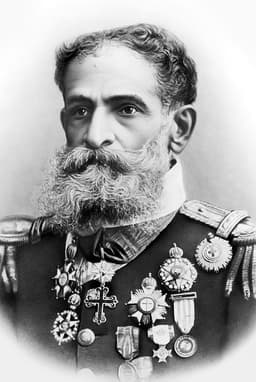
Deodoro da Fonseca
General · Modern
48.8Total
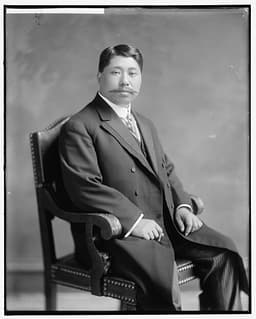
Huang Xing
General · Modern
57.5Total
Basic Information
Born
1827
1874
Died
1892
1916
Era
Modern
Modern
Nationality
Brazil
China
Occupation
General
General
Civilization
Western
Eastern
Score Comparison
Military (10%)
50.0
46.7
Political (20%)
45.1
53.8
Influence (20%)
54.1
62.0
Legacy (20%)
44.2
56.0
Leadership (15%)
57.6
62.0
Strategy (15%)
38.6
60.0
TOTAL
48.8
57.5
Deodoro da Fonseca — Complete Timeline
1889 AD
Proclamation of the Brazilian RepublicPolitical Action
Deodoro da Fonseca led a military coup that overthrew Emperor Pedro II on November 15, 1889. He proclaimed the Republic of the United States of Brazil, ending 67 years of imperial rule.
CoupRepublic
Impact: globalprogressive
1891 AD
Election as First President of BrazilPolitical Action◆ Major
Deodoro da Fonseca was elected the first President of Brazil by the Constituent Congress on February 25, 1891. He took office under the new republican constitution, but his rule was brief and authoritarian.
ElectionPresidency
Impact: national
Dissolution of the National CongressPolitical Action◆ Major
Facing political opposition, Deodoro da Fonseca dissolved the National Congress on November 3, 1891, and declared a state of siege. This authoritarian act triggered a naval revolt and his eventual resignation.
AuthoritarianismPolitical Crisis
Impact: nationaldestructive
Resignation from the PresidencyPolitical Action◆ Major
Deodoro da Fonseca resigned the presidency on November 23, 1891, after a naval rebellion threatened his government. He handed power to Vice President Floriano Peixoto, ending his 9-month rule.
ResignationPolitical Crisis
Impact: nationaltragic
Huang Xing — Complete Timeline
1905 AD
Co-founded the TongmenghuiPolitical Action◆ Major
Huang Xing co-founded the Tongmenghui (Revolutionary Alliance) in Tokyo with Sun Yat-sen. He became its military leader, organizing armed uprisings against the Qing dynasty.
TongmenghuiRevolutionMilitary
Impact: nationalconstructive
1911 AD
Led the Wuchang UprisingWar
Huang Xing led the Wuchang Uprising, which sparked the Xinhai Revolution. He commanded revolutionary forces against Qing troops, securing initial victories that led to the dynasty's collapse.
Xinhai RevolutionUprisingMilitary
Impact: nationalconstructive
1912 AD
Served as Minister of War in the RepublicPolitical Action◆ Major
Huang Xing served as Minister of War in the provisional government of the Republic of China. He worked to organize a national army and defend the republic against counter-revolutionary forces.
GovernmentMilitaryRepublic
Impact: nationalconstructive
1913 AD
Led the Second Revolution Against Yuan ShikaiWar◆ Major
Huang Xing led the Second Revolution, an armed uprising against President Yuan Shikai's authoritarian rule. The rebellion failed due to lack of coordination and military inferiority, forcing Huang into exile.
Second RevolutionYuan ShikaiExile
Impact: nationaltragic
1916 AD
Died in Exile in ShanghaiPolitical Action
Huang Xing died in Shanghai after returning from exile in Japan and the United States. His death marked the loss of a key military leader of the Chinese revolution, though his legacy endured.
DeathExileRevolution
Impact: nationaltragic
Expert Analysis
Huang Xing vs Deodoro da Fonseca
# The Republic’s Two Generals
On November 15, 1889, a portly Brazilian general with a drooping mustache marched into Rio de Janeiro and told Emperor Pedro II that his dynasty was over. The emperor, weary after fifty-eight years on the throne, simply replied, “If it is so, let it be so.” Across the world, twenty-two years later, in the muddy streets of Wuchang, another general—s lighter, younger, and burning with revolutionary fire—led a band of mutinous soldiers against the Qing dynasty. One man overthrew an empire with a whisper; the other helped bring down a millennia-old imperial system with a shout. Both became founding fathers of republics. Both ended their careers in bitterness. Their parallel journeys reveal how personality and circumstance can turn the same historical role into radically different destinies.
Origins
Manuel Deodoro da Fonseca was born in 1827 in Alagoas, a province of the Brazilian Empire, into a military family with deep roots in the colonial aristocracy. His father was a general; his brothers became officers. The young Deodoro grew up in a world where the emperor was a revered father figure, the army was a respected institution, and change came slowly, if at all. He attended military school, learned artillery, and fought in the long, brutal War of the Triple Alliance against Paraguay. By the 1880s, he was a decorated hero, loyal to the crown but increasingly frustrated with its neglect of the military.
Huang Xing was born in 1874 in Changsha, Hunan, at the twilight of the Qing dynasty. His family were scholars, not soldiers; his father had died when he was young. Huang Xing studied the Confucian classics, then traveled to Japan—the mecca for young Chinese reformers—where he encountered Western military science and revolutionary politics. Unlike Deodoro, who inherited his rank, Huang Xing had to forge his own path. He was a product of desperation: a generation that saw its country carved up by foreign powers and concluded that only violent change could save it.
Rise to Power
Deodoro da Fonseca’s rise was slow and reluctant. He did not seek the presidency; the presidency sought him. In the late 1880s, a small group of republican conspirators, led by the civilian Ruy Barbosa and the young officer Benjamin Constant, needed a figurehead—a general with prestige who could command the army’s loyalty. They chose Deodoro, who was initially hesitant. He had no deep republican convictions; he was a monarchist who felt the emperor had slighted the military. On November 15, 1889, he led a bloodless coup, but even then, he seemed uncertain. When asked what form the new government would take, he reportedly muttered, “I don’t know. Let’s see what happens.”
Huang Xing’s rise was the opposite: deliberate, dangerous, and driven by ideology. He co-founded the Tongmenghui with Sun Yat-sen in Tokyo in 1905, becoming its military commander. While Sun wrote manifestos and raised funds abroad, Huang Xing organized bombings, recruited soldiers, and led failed uprisings—one in 1908, another in 1910, each ending in massacre. By 1911, when the Wuchang Uprising erupted, Huang Xing rushed to the scene, took command of the revolutionary forces, and held the line against the Qing army for weeks. He did not stumble into power; he bled for it.
Leadership & Governance
As president, Deodoro da Fonseca was a disaster. He had no political program, no administrative experience, and no patience for democracy. His government lurched from crisis to crisis. When Congress refused to pass his budget, he dissolved it on November 3, 1891, declaring a state of siege. He ruled by decree for twenty days, until the navy—his own institution—revolted. Facing a warship aimed at the capital, he resigned on November 23, 1891, after just nine months in office. His leadership score of 70.0 reflects his personal magnetism, not his governance.
Huang Xing, by contrast, was a capable administrator. As Minister of War in the provisional government of 1912, he worked to merge the revolutionary armies into a national force, maintain order, and negotiate with the northern warlords. But his political skills were tested when Yuan Shikai, the former Qing general, seized the presidency. Huang Xing led the Second Revolution in 1913, a doomed uprising against Yuan’s dictatorship. It failed—badly. He fled into exile, his military score of 42.1 reflecting the reality that his bravery often outpaced his strategic planning.
Triumph & Tragedy
Deodoro’s triumph was the Proclamation of the Republic itself. For one day, he was the man who ended an empire. His tragedy was that he had no idea what to do next. He died in 1892, a year after resigning, isolated and embittered, his reputation tarnished by the dictatorship he had attempted.
Huang Xing’s triumph was the Wuchang Uprising, the spark that toppled the Qing. His tragedy was that the republic he helped create fell into the hands of Yuan Shikai, then into warlord chaos. He died in Shanghai in 1916, at just forty-two, worn out by exile, illness, and disappointment. He was buried with honors, but the dream he fought for was already dying.
Character & Destiny
Deodoro da Fonseca was a man of instinct, not intellect. He acted when pushed, led when chosen, and failed when left to his own devices. His political score of 77.9 is misleading—it reflects the historical weight of his actions, not his personal judgment. He was a symbol, not a statesman.
Huang Xing was a man of principle and action, but also of limits. He was a brilliant organizer and a courageous commander, but he lacked the ruthless cunning needed to survive in Chinese politics. His legacy score of 66.6 captures this: respected, but overshadowed by Sun Yat-sen, the “Father of the Nation.” Huang Xing was the sword; Sun was the voice.
Legacy
In Brazil, Deodoro da Fonseca is a footnote. His face appears on coins and in history textbooks, but few Brazilians remember him with affection. He is the accidental founder, the general who stumbled into a republic and then stumbled out. The real architect of Brazil’s early republic was his civilian successor, Marshal Floriano Peixoto.
In China, Huang Xing is remembered as a martyr and a co-founder, but he lives in Sun Yat-sen’s shadow. The Tongmenghui became the Kuomintang; Sun became the icon. Huang Xing, the man who actually led the battles, is often reduced to a supporting role. Yet among historians, he is recognized as the military architect of the 1911 Revolution—the general without whom Sun’s vision might have remained a dream.
Conclusion
Both men were generals who became founders of republics. Both saw their revolutions betrayed. But Deodoro da Fonseca was a conservative who stumbled into change, while Huang Xing was a radical who fought for it. One ended his career as a failed dictator; the other as a failed rebel. Their stories remind us that history is not made by the loudest voices or the strongest wills—it is made by the convergence of character, chance, and the peculiar weight of the moment. And sometimes, the men who break empires are not the ones best suited to build what comes next.
Rankings
🥇
Huang XingLeader
Mil: 46.7Pol: 53.8Inf: 62.0
57.5
🥈
Deodoro da Fonseca
Mil: 50.0Pol: 45.1Inf: 54.1
48.8
+8.7 behind
How This Comparison Works
Algorithm
Each figure is scored on 6 dimensions (0—100 scale) based on structured historical data: Military (10%), Political (20%), Influence (20%), Legacy (20%), Leadership (15%), Strategy (15%). The weighted total produces the final ranking.
Data Sources
Scores are computed from structured sub-indicators in the database. Scale factors adjust for era (Ancient ×0.85, Modern ×1.0) and civilization size (Eastern ×1.05, Other ×0.80) to account for differences in population and military scale.
Maximum 3 Figures
Comparisons are limited to 2—3 figures to ensure readability and statistical meaningfulness.
Error Margins
±5 points per dimension — Sub-scores are derived from historical records with inherent uncertainty. Two figures within 5 points on a dimension should be considered roughly equivalent in that area.
Total Score Accuracy
±3 points overall — The weighted combination of 6 dimensions produces a total score with approximately ±3 points of uncertainty. Differences of less than 3 points are not statistically significant— the figures are effectively tied.
Known Limitations
- Historical records are incomplete and uneven across civilizations
- Figures from oral-tradition societies may be underrepresented
- Occupation labels can misclassify multi-role figures
- Scores measure capability and impact, not moral character
- Quantitative scoring is a comparison tool, not absolute truth
Capability Radar
Military (10%) — Battles & Warfare
Battles
20
35
Win Rate
25
30
Expansion
10
20
Political (20%) — Governance & Reform
Reform
40
60
Diplomacy
25
55
Economy
15
30
Influence (20%) — Cultural & Global Reach
Cultural
20
40
Global
15
40
Legacy (20%) — Historical Impact
Historical
35
55
Longevity
20
45
Leadership (15%) — Power & Stability
Tenure
30
40
Stability
10
25
Strategy (15%) — Tactics & Innovation
Strategy
25
45
Tactics
20
40
Reform
15
50
Similar Comparisons
Comments & Discussion
马靴将军6/16/2026
德奥多罗是"宫廷政变专业户",黄兴是"革命爆破工兵"。一个兵不血刃逼宫成功,一个扛着炸药包打硬仗。黄兴要是活在1889年的巴西,估计会被德奥多罗那套"帝国变脸术"气笑——你们这叫革命?不过是换了个总理大臣的牌匾!不过话说回来,黄兴四次起义四次失败,德奥多罗一次政变就成功,这差距说明:有时候会做人比会打仗更重要。
DataSkeptic6/16/2026
The numbers tell a brutal story: Huang Xing led multiple uprisings with thousands of men, yet his success rate was near zero until the Wuchang Uprising, which was actually a cascade of accidents. Deodoro took power in a bloodless coup with barely 500 soldiers. If we're ranking republican founders by efficiency, Deodoro wins hands down. Huang Xing's claim to fame rests on a single lucky break, not sustained military competence. History's romance with "heroic failures" often overshadows cold, hard
文言痴6/16/2026
黄兴者,真丈夫也,武侯再世;德奥多罗不过沐猴而冠。试观黄兴于广州一役,身先士卒,断指犹战,何等壮烈!彼巴西将军者,但以肥硕之躯逼老朽退位,何功之有?况黄兴倡革命于积弱之邦,历十载艰险,虽败犹荣;德奥多罗仅掌权两年,便因肠胃病仓皇辞世,治国之才可知矣。史笔如铁,岂容混淆?我执黄兴为真国之栋梁!
RevisionistHeat6/16/2026
两位都是"不彻底的革命家"——黄兴给袁世凯当说客,德奥多罗解散议会搞独裁。一个向旧官僚妥协,一个把新宪法当废纸。最讽刺的是:黄兴帮孙中山打仗,最后却觉得孙太激进;德奥多罗推翻帝国,自己却成了事实上的独裁者。他们都陷入了"推翻旧王朝容易,建立新制度难"的经典困局。所谓的"共和之父",不过是被时代掣肘的悲剧人物罢了。
BarracksPhilosopher6/16/2026
Look at their last battles: Deodoro suffered from dysentery so bad he couldn't stand, yet still mounted his horse to confront mutinous troops. Huang Xing lost his nerve after the failed Nanjing campaign in 1913, fleeing to Japan like a broken man. One died in uniform, the other in exile. For all his revolutionary zeal, Huang lacked the psychological resilience that Deodoro showed in his final stand. True generalship isn't about winning every battle—it's about how you handle defeat. Deodoro under