Loading...
Deodoro da Fonseca vs Hideki Tojo
Hideki Tojo leads by 5.1 pts · 2 figures compared
…
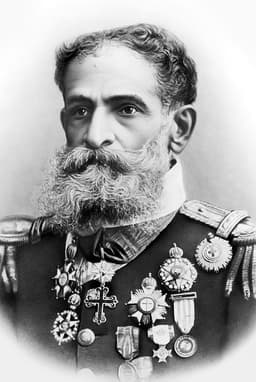
Deodoro da Fonseca
General · Modern
48.8Total
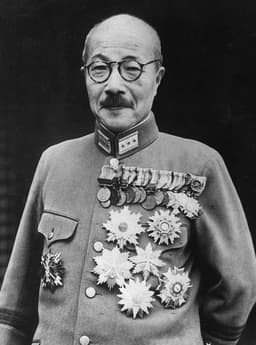
Hideki Tojo
General · Modern
53.9Total
Basic Information
Born
1827
1884
Died
1892
1948
Era
Modern
Modern
Nationality
Brazil
Japan
Occupation
General
General
Civilization
Western
Eastern
Score Comparison
Military (10%)
50.0
70.0
Political (20%)
45.1
48.0
Influence (20%)
54.1
55.0
Legacy (20%)
44.2
50.0
Leadership (15%)
57.6
53.2
Strategy (15%)
38.6
55.0
TOTAL
48.8
53.9
Deodoro da Fonseca — Complete Timeline
1889 AD
Proclamation of the Brazilian RepublicPolitical Action
Deodoro da Fonseca led a military coup that overthrew Emperor Pedro II on November 15, 1889. He proclaimed the Republic of the United States of Brazil, ending 67 years of imperial rule.
CoupRepublic
Impact: globalprogressive
1891 AD
Election as First President of BrazilPolitical Action◆ Major
Deodoro da Fonseca was elected the first President of Brazil by the Constituent Congress on February 25, 1891. He took office under the new republican constitution, but his rule was brief and authoritarian.
ElectionPresidency
Impact: national
Dissolution of the National CongressPolitical Action◆ Major
Facing political opposition, Deodoro da Fonseca dissolved the National Congress on November 3, 1891, and declared a state of siege. This authoritarian act triggered a naval revolt and his eventual resignation.
AuthoritarianismPolitical Crisis
Impact: nationaldestructive
Resignation from the PresidencyPolitical Action◆ Major
Deodoro da Fonseca resigned the presidency on November 23, 1891, after a naval rebellion threatened his government. He handed power to Vice President Floriano Peixoto, ending his 9-month rule.
ResignationPolitical Crisis
Impact: nationaltragic
Hideki Tojo — Complete Timeline
1941 AD
Attack on Pearl HarborWar
As Prime Minister, Hideki Tojo authorized the attack on the US naval base at Pearl Harbor, Hawaii. The surprise attack brought the United States into World War II. Tojo's decision was based on the belief that war with the US was inevitable due to resource embargoes and diplomatic failures.
World War IIPearl HarborUS-Japan War
Impact: globaldestructive
Appointment as Prime MinisterPolitical Action◆ Major
Hideki Tojo was appointed Prime Minister of Japan, replacing Fumimaro Konoe. He retained his position as Army Minister and later took on other portfolios, consolidating power. His appointment marked the ascendancy of the military faction in the Japanese government and the shift towards total war.
Prime MinisterMilitary GovernmentWorld War II
Impact: national
1942 AD
Fall of SingaporeWar◆ Major
Under Tojo's leadership, Japanese forces captured Singapore from the British in a swift campaign. The fall of Singapore was one of the worst British military defeats in history. It demonstrated Japanese military prowess and led to the occupation of a key strategic location in Southeast Asia.
World War IISingaporeJapanese Victory
Impact: global
1948 AD
Execution by the International Military Tribunal for the Far EastPolitical Action◆ Major
Hideki Tojo was found guilty of war crimes by the International Military Tribunal for the Far East and sentenced to death. He was executed by hanging on December 23, 1948. His trial and execution symbolized the Allied effort to hold Japanese leaders accountable for wartime atrocities.
War CrimesExecutionTokyo Trials
Impact: globaltragic
Expert Analysis
Hideki Tojo vs Deodoro da Fonseca
# The General and the Founder: Two Paths from Uniform to Power
On a November morning in 1948, Hideki Tojo knelt in a prison courtyard in Tokyo, a Buddhist priest chanting softly beside him. Within moments, the man who had led Japan into a war that consumed the Pacific was dead, hanged by the very international order he had defied. Fifty-seven years earlier, on another November day, Deodoro da Fonseca sat in a carriage in Rio de Janeiro, watching the sea. He had just resigned the presidency of Brazil, his dream of a strong republic shattered by a naval revolt. Two generals, two departures from power—one by execution, one by resignation. What drove such different endings? The answer lies not in their uniforms, but in the worlds they sought to command.
Origins
Born in 1884 to a samurai family, Hideki Tojo grew up in a Japan that was industrializing at a furious pace, its military elite dreaming of empire. His father, a lieutenant general, instilled in him a rigid sense of duty. Tojo was a product of the Imperial Japanese Army Academy, where discipline was absolute and ambition was channeled into service to the Emperor. He was a meticulous bureaucrat-soldier, nicknamed "the Razor" for his sharp, decisive mind. His era was one of rising militarism, where civilian governments faltered and the army seized control of national destiny.
Deodoro da Fonseca, born in 1827 in Alagoas, Brazil, came from a military family steeped in the wars of independence and the Paraguayan War. His father was a marshal; his brothers were officers. Brazil was an empire, ruled by the aging Emperor Pedro II, a constitutional monarch who had kept the country stable while slavery slowly crumbled. Fonseca was a veteran of battles, a man of action rather than ideology. He was also a figure of the late nineteenth century, when republicanism was sweeping Latin America and the old monarchies seemed destined for the dustbin of history.
Rise to Power
Tojo’s ascent was methodical, a ladder of staff appointments and commands. He served as chief of the Kwantung Army’s secret police in Manchuria, cracking down on dissent, then rose to become Army Minister in 1940. By October 1941, with Japan locked in a stalemate in China and facing American oil embargoes, Prime Minister Fumimaro Konoe resigned. Tojo, the hawk, was appointed in his place, retaining his army portfolio. He did not seize power; he was handed it by a political elite that had run out of options. The turning point came on December 7, 1941, when he authorized the attack on Pearl Harbor. In that single decision, Tojo transformed from a general into the architect of a Pacific war.
Fonseca’s rise was less calculated but more dramatic. A respected general with republican sympathies, he became a symbol of discontent with the empire. In November 1889, he led a bloodless military coup that deposed Pedro II and proclaimed the Republic. He was not a revolutionary by design; he was pushed by younger officers and republican intellectuals. The monarchy fell almost by accident, and Fonseca found himself at the head of a provisional government. In February 1891, he was elected the first president of Brazil by the Constituent Congress—a general who had stumbled into the presidency.
Leadership and Governance
Tojo ruled as a military dictator in all but name. He centralized power, merging the roles of Prime Minister and Army Minister, and later adding Home Minister to his portfolio. His leadership was defined by the war: he micromanaged campaigns, demanded total victory, and crushed dissent at home. The fall of Singapore in February 1942 was his greatest triumph—a lightning campaign that humiliated the British Empire. But his strategic vision was narrow. He saw the war as a test of national will, not a calculation of resources. He ignored the growing power of the United States, believing that Japanese spirit could overcome American steel. His political wisdom was zero: he purged moderates, silenced diplomats who urged negotiation, and drove Japan deeper into a conflict it could not win.
Fonseca governed as a military strongman in a civilian framework. He was not a dictator by instinct; he was a general who believed the army should guide the nation’s transition from monarchy to republic. But he lacked the patience for politics. When the Constituent Congress drafted a constitution that limited presidential power, Fonseca grew frustrated. In November 1891, he dissolved the National Congress and declared a state of siege, hoping to rule by decree. It was a catastrophic miscalculation. The navy, loyal to the old order, rebelled. Warships aimed their guns at Rio de Janeiro. Fonseca, isolated and exhausted, resigned after just nine months in office.
Triumph and Tragedy
Tojo’s triumph was the fall of Singapore—a victory that stunned the world and seemed to confirm Japanese invincibility. His tragedy was the war itself. By 1944, Japan was losing on all fronts. Tojo resigned in July 1944 after the fall of Saipan, but he could not escape responsibility. Captured by American forces, he attempted suicide but failed. At the International Military Tribunal for the Far East, he was found guilty of war crimes and sentenced to death. His final act was to accept the verdict, refusing to appeal, insisting he had acted for his country.
Fonseca’s triumph was the Proclamation of the Republic—a peaceful transition that ended sixty-seven years of monarchy. His tragedy was his presidency. He had wanted to build a strong, stable republic, but his authoritarian instincts alienated the very forces that had brought him to power. His resignation was a quiet, bitter end. He died in August 1892, a broken man, remembered as a founder but not as a leader.
Character and Destiny
Tojo was rigid, fanatical, and incapable of compromise. His personality mirrored the militarism of his era: he believed in hierarchy, sacrifice, and the supremacy of the state. This made him effective in war but disastrous in politics. He could not see that war was a means, not an end. His destiny was to be a symbol of Japan’s catastrophic overreach.
Fonseca was impulsive, proud, and indecisive. He was a man of the barracks, not the parliament. He believed in order but could not create it. His personality reflected the contradictions of Brazil’s transition: a republic born from a coup, led by a general who did not understand democracy. His destiny was to be a footnote, a first president who failed to govern.
Legacy
Tojo’s legacy is one of infamy. In Japan, he is a controversial figure—condemned for war crimes, yet sometimes defended as a patriot. Internationally, he is remembered as the face of Japanese aggression, a symbol of militarism and defeat. His leadership score of 81.2 reflects his effectiveness, but his total score of 70.2 is dragged down by the catastrophe he unleashed.
Fonseca’s legacy is more ambiguous. He is honored as the first president of Brazil, a founder of the republic. But his brief, chaotic rule is often forgotten. His political score of 77.9 suggests he was a skilled politician, but his military score of 35.9 reveals his weakness as a strategist. He is remembered in statues and street names, but his true legacy is the republic itself—a fragile institution that survived his failure.
Conclusion
Two generals, two nations, two centuries. Tojo and Fonseca both believed that military men could save their countries. Tojo led Japan into a war that destroyed it; Fonseca led Brazil into a republic that outlasted him. The difference was not in their uniforms but in their worlds. Tojo’s Japan was a powder keg of ambition and fear; Fonseca’s Brazil was a land of transition and possibility. One died on the gallows, a war criminal; the other died in his bed, a founder. History judges them not by their intentions, but by the outcomes they set in motion. And in the end, it is not the general who wins, but the peace that follows.
Rankings
🥇
Hideki TojoLeader
Mil: 70.0Pol: 48.0Inf: 55.0
53.9
🥈
Deodoro da Fonseca
Mil: 50.0Pol: 45.1Inf: 54.1
48.8
+5.1 behind
How This Comparison Works
Algorithm
Each figure is scored on 6 dimensions (0—100 scale) based on structured historical data: Military (10%), Political (20%), Influence (20%), Legacy (20%), Leadership (15%), Strategy (15%). The weighted total produces the final ranking.
Data Sources
Scores are computed from structured sub-indicators in the database. Scale factors adjust for era (Ancient ×0.85, Modern ×1.0) and civilization size (Eastern ×1.05, Other ×0.80) to account for differences in population and military scale.
Maximum 3 Figures
Comparisons are limited to 2—3 figures to ensure readability and statistical meaningfulness.
Error Margins
±5 points per dimension — Sub-scores are derived from historical records with inherent uncertainty. Two figures within 5 points on a dimension should be considered roughly equivalent in that area.
Total Score Accuracy
±3 points overall — The weighted combination of 6 dimensions produces a total score with approximately ±3 points of uncertainty. Differences of less than 3 points are not statistically significant— the figures are effectively tied.
Known Limitations
- Historical records are incomplete and uneven across civilizations
- Figures from oral-tradition societies may be underrepresented
- Occupation labels can misclassify multi-role figures
- Scores measure capability and impact, not moral character
- Quantitative scoring is a comparison tool, not absolute truth
Capability Radar
Military (10%) — Battles & Warfare
Battles
20
65
Win Rate
25
40
Expansion
10
70
Political (20%) — Governance & Reform
Reform
40
30
Diplomacy
25
35
Economy
15
25
Influence (20%) — Cultural & Global Reach
Cultural
20
30
Global
15
55
Legacy (20%) — Historical Impact
Historical
35
55
Longevity
20
40
Leadership (15%) — Power & Stability
Tenure
30
60
Stability
10
20
Strategy (15%) — Tactics & Innovation
Strategy
25
50
Tactics
20
55
Reform
15
45
Similar Comparisons
Comments & Discussion
RAZOR'S SHADOW6/16/2026
Tojo represents militarism's endgame - total war without exit strategy. Compare Tojo's Pearl Harbor gamble (killing 2,403 Americans) with Fonseca's peaceful transition from monarchy. Brazil's founding general resigned after a naval revolt; Tojo schemed to expand war even after Hiroshima. Fonseca was a reluctant dictator who stepped down; Tojo fought to the scaffold claiming "supreme sacrifice." The difference isn't uniform - it's the moral universe each served.
军国刺刀6/16/2026
把东条英机与丰塞卡并列简直是对巴西共和史的侮辱!东条指挥了南京大屠杀(30万亡灵)和巴丹死亡行军,而丰塞卡在1889年政变中未流一滴血就建立了共和国。更关键的是,东条作为战时首相强行通过《国家总动员法》剥夺所有公民自由;丰塞卡却在1891年因海军起义主动辞职。一个是战争罪犯,一个是创建者,根本没可比性。
COLD WARRIOR6/16/2026
Military historians miss the institutional context. Tojo's IJA was a parallel state with unchecked power - he controlled the Kwantung Army that started war with China in 1937. Fonseca's Brazilian Army was a national institution, not a rogue faction. Even after Deodoro's coup, he called elections and respected Congress for two years. Tojo never allowed elections, crushed opposition with Thought Police. Both were generals, but one was a fascist state's tool, the other a nation-builder.
实证主义者6/16/2026
数据不会说谎:东条领导下日军伤亡超过210万,日本GDP缩水60%;丰塞卡执政期间巴西咖啡出口增长40%,未发动任何国际战争。更有趣的是,丰塞卡以高票当选首任总统(1891年选举),而东条的东条内阁全靠军部胁迫天皇任命。别被军装迷惑了——一个是民主转型的军事领袖,一个是极权军政府的代理人。
BANDEIRANTE'S GHOST6/16/2026
Forget the body count comparisons. What defines these men is how they treated their own people. Tojo's Japan starved citizens on 5 million calories daily ration while hoarding rice for soldiers. Fonseca's Brazil faced a naval revolt (Revolta da Armada) that he ended by resigning rather than crushing with force. One general, despite dictatorial tendencies, put national unity over personal power. The other sacrificed his nation for imperial fantasy. That's the real metric.