Loading...
Deodoro da Fonseca vs Fuad Chehab
Fuad Chehab leads by 1.1 pts · 2 figures compared
…
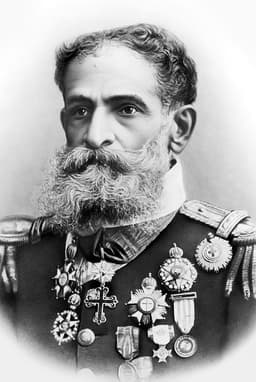
Deodoro da Fonseca
General · Modern
48.8Total
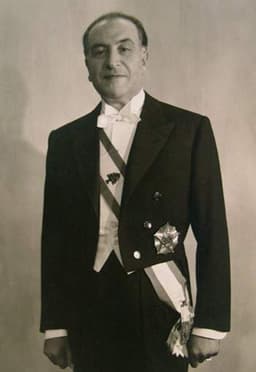
Fuad Chehab
General · Modern
49.9Total
Basic Information
Born
1827
1902
Died
1892
1973
Era
Modern
Modern
Nationality
Brazil
Lebanon
Occupation
General
General
Civilization
Western
Middle Eastern
Score Comparison
Military (10%)
50.0
10.2
Political (20%)
45.1
70.0
Influence (20%)
54.1
54.1
Legacy (20%)
44.2
44.2
Leadership (15%)
57.6
72.0
Strategy (15%)
38.6
30.3
TOTAL
48.8
49.9
Deodoro da Fonseca — Complete Timeline
1889 AD
Proclamation of the Brazilian RepublicPolitical Action
Deodoro da Fonseca led a military coup that overthrew Emperor Pedro II on November 15, 1889. He proclaimed the Republic of the United States of Brazil, ending 67 years of imperial rule.
CoupRepublic
Impact: globalprogressive
1891 AD
Election as First President of BrazilPolitical Action◆ Major
Deodoro da Fonseca was elected the first President of Brazil by the Constituent Congress on February 25, 1891. He took office under the new republican constitution, but his rule was brief and authoritarian.
ElectionPresidency
Impact: national
Dissolution of the National CongressPolitical Action◆ Major
Facing political opposition, Deodoro da Fonseca dissolved the National Congress on November 3, 1891, and declared a state of siege. This authoritarian act triggered a naval revolt and his eventual resignation.
AuthoritarianismPolitical Crisis
Impact: nationaldestructive
Resignation from the PresidencyPolitical Action◆ Major
Deodoro da Fonseca resigned the presidency on November 23, 1891, after a naval rebellion threatened his government. He handed power to Vice President Floriano Peixoto, ending his 9-month rule.
ResignationPolitical Crisis
Impact: nationaltragic
Fuad Chehab — Complete Timeline
1958 AD
Launched Chehabist reforms and modernizationReform◆ Major
President Chehab implemented a series of reforms known as Chehabism, including administrative modernization, economic planning, and strengthening state institutions. He established the Central Bank of Lebanon and the Civil Service Board.
ReformModernizationState Building
Impact: nationalconstructive
Elected President of LebanonPolitical Action◆ Major
Fuad Chehab was elected President of Lebanon on September 23, 1958, succeeding Camille Chamoun. His election ended the 1958 crisis and was supported by both Christian and Muslim factions seeking stability.
PresidencyElectionStabilization
Impact: nationalconstructive
Created the Deuxième Bureau intelligence agencyPolitical Action
Chehab expanded the role of the Deuxi
IntelligenceSecurityAuthoritarianism
Impact: national
1960 AD
Presided over the 1960s economic boomOther
Under Chehab's presidency, Lebanon experienced a period of economic growth and stability, with Beirut becoming a major financial and tourism hub. His policies attracted foreign investment and expanded the middle class.
Economic GrowthBeirutProsperity
Impact: nationalconstructive
1964 AD
Refused to amend constitution for a second termPolitical Action
Chehab declined to seek a second term as president, respecting the constitutional limit. He retired from politics in 1964, setting a precedent for peaceful transitions of power in Lebanon.
ConstitutionTerm LimitRetirement
Impact: nationalconstructive
Expert Analysis
Deodoro da Fonseca vs Fuad Chehab
### The General and the Republic: Two Paths from Uniform to Power
On a warm September day in 1958, Fuad Chehab took the oath of office in Beirut, inheriting a Lebanon torn apart by sectarian violence and the shadow of a regional crisis. Just over three decades earlier and an ocean away, on a sweltering November morning in 1891, Deodoro da Fonseca sat alone in the Catete Palace in Rio de Janeiro, his dream of a stable Brazilian republic crumbling as warships aimed their cannons at the capital. Both men were generals who became the first—or near-first—leaders of fragile republics. Both believed their nations needed order above all. Yet Chehab died in quiet retirement, his reforms still debated, while Fonseca resigned in disgrace, his brief presidency a cautionary tale. Why did one general forge a legacy of stability, while the other became a footnote in his own revolution?
**Origins**
Fuad Chehab was born in 1902 into a prominent Maronite Christian family in Lebanon, then part of the Ottoman Empire. His lineage traced back to the powerful Chehab dynasty that had ruled Mount Lebanon for centuries, but he grew up in an era of imperial collapse and French mandate rule. Educated at the military academy in Damascus, he absorbed the ethos of the French officer corps: discipline, neutrality, and a belief that the army stood above politics. Lebanon’s sectarian mosaic—Maronites, Sunni Muslims, Shia, Druze, and others—meant that any leader had to balance communities, not conquer them. Chehab learned early that survival required subtlety.
Deodoro da Fonseca, born in 1827 in Alagoas, Brazil, came from a military family in a very different world. The Brazilian Empire was a vast, slaveholding monarchy, the only one in the Americas. Fonseca’s father was a military officer, and young Deodoro followed his path, fighting in the Paraguayan War (1864–1870), where he gained a reputation for bravery but also for a hot temper. Unlike Chehab, who grew up amid the fragility of a multi-confessional society, Fonseca came of age in a rigid hierarchy of emperor, landowners, and slaves. The military, after the Paraguayan War, felt underappreciated and politicized. Fonseca saw himself as a savior, not a mediator.
**Rise to Power**
Chehab’s ascent was slow and reluctant. During the 1958 Lebanese crisis—a civil war pitting pro-Western Christian factions against Arab nationalist Muslims—the army under Chehab refused to take sides. While President Camille Chamoun called for U.S. Marines to land, Chehab kept his troops in their barracks, preserving the military’s reputation as a neutral arbiter. When Chamoun’s term ended, the warring factions turned to the one man they could trust: General Chehab. On September 23, 1958, he was elected president, not by force but by exhaustion. His power came from being everyone’s second choice.
Fonseca’s rise was a coup. On November 15, 1889, he led a small band of soldiers through the streets of Rio de Janeiro, deposing Emperor Pedro II without a fight. The old man abdicated calmly, and the republic was declared. Fonseca, a monarchist at heart, had been pushed by republican radicals like Benjamin Constant and Rui Barbosa. He was the figurehead, not the architect. Unlike Chehab, who stepped into a vacuum of trust, Fonseca seized a moment of ambition. He became the first president of Brazil in February 1891, but his authority rested on bayonets, not ballots.
**Leadership & Governance**
Chehab’s presidency (1958–1964) was defined by “Chehabism,” a philosophy of state-led modernization paired with strict neutrality. He launched economic development plans, built infrastructure, and created the *Deuxième Bureau*, an intelligence agency that monitored everyone—Christians, Muslims, leftists, rightists—to prevent any faction from dominating. Lebanon’s 1960s economic boom, with Beirut rising as a financial hub, owed much to his stability. But his methods were authoritarian beneath the surface: the *Deuxième Bureau* suppressed dissent, and his reforms never solved the deep sectarian divides. He refused to amend the constitution for a second term in 1964, a rare act of self-restraint that preserved his reputation.
Fonseca governed for less than two years. His presidency was a disaster of impatience. He faced a divided Congress, economic crisis, and the hostility of state governors who wanted autonomy. His solution was brute force: on November 3, 1891, he dissolved the National Congress and declared a state of siege. It was a classic military reflex—impose order by crushing opposition. But Brazil was not a barracks. A naval rebellion, led by Admiral Custódio de Melo, turned the guns of the fleet on Rio. Fonseca, isolated and outmaneuvered, resigned on November 23, 1891. He died less than a year later, a broken man.
**Triumph & Tragedy**
Chehab’s greatest moment was also his most tragic irony: he kept Lebanon peaceful by making it a police state. His triumph was the 1960s boom, when Beirut was called the “Paris of the Middle East.” His tragedy was that the stability was a mirage. After he left office, the sectarian pressures he contained exploded into the 1975–1990 civil war. The *Deuxième Bureau* became a symbol of repression.
Fonseca’s triumph was the republic itself—he ended the monarchy, a genuine break with the past. His tragedy was his own incompetence. He could lead a charge but not a cabinet. His resignation speech hinted at a man who knew he had failed: “I am tired of governing men who do not know how to obey.”
**Character & Destiny**
Chehab was cautious, calculating, and emotionally reserved. He saw leadership as a balancing act, not a crusade. His character matched Lebanon’s complexity: he could wait, listen, and maneuver. Fonseca was impulsive, proud, and blunt. He believed in honor and loyalty, but could not grasp that politics required compromise. Where Chehab’s patience preserved his legacy, Fonseca’s anger destroyed it. Their destinies reflected their nations: Lebanon needed a tightrope walker; Brazil needed a builder. Both got what they needed, but only one knew how to use it.
**Legacy**
Chehab is remembered in Lebanon as a symbol of a lost golden age—a time when the state worked, even if imperfectly. “Chehabism” remains a reference point for reformers. Fonseca is a footnote in Brazilian history, overshadowed by the republic’s later leaders. His statue in Rio stands, but few pause. One general left a philosophy; the other left a warning.
**Conclusion**
In the end, both men faced the same question: can a general govern a republic without breaking it? Chehab answered by bending the rules, not breaking them, and stepping aside when his time was up. Fonseca answered by wielding the sword until it broke in his hand. Their stories remind us that power, once taken, must be held with something more than force—with patience, with restraint, and with the wisdom to know when to let go.
Rankings
🥇
Fuad ChehabLeader
Mil: 10.2Pol: 70.0Inf: 54.1
49.9
🥈
Deodoro da Fonseca
Mil: 50.0Pol: 45.1Inf: 54.1
48.8
+1.1 behind
How This Comparison Works
Algorithm
Each figure is scored on 6 dimensions (0—100 scale) based on structured historical data: Military (10%), Political (20%), Influence (20%), Legacy (20%), Leadership (15%), Strategy (15%). The weighted total produces the final ranking.
Data Sources
Scores are computed from structured sub-indicators in the database. Scale factors adjust for era (Ancient ×0.85, Modern ×1.0) and civilization size (Eastern ×1.05, Other ×0.80) to account for differences in population and military scale.
Maximum 3 Figures
Comparisons are limited to 2—3 figures to ensure readability and statistical meaningfulness.
Error Margins
±5 points per dimension — Sub-scores are derived from historical records with inherent uncertainty. Two figures within 5 points on a dimension should be considered roughly equivalent in that area.
Total Score Accuracy
±3 points overall — The weighted combination of 6 dimensions produces a total score with approximately ±3 points of uncertainty. Differences of less than 3 points are not statistically significant— the figures are effectively tied.
Known Limitations
- Historical records are incomplete and uneven across civilizations
- Figures from oral-tradition societies may be underrepresented
- Occupation labels can misclassify multi-role figures
- Scores measure capability and impact, not moral character
- Quantitative scoring is a comparison tool, not absolute truth
Capability Radar
Military (10%) — Battles & Warfare
Battles
20
5
Win Rate
25
5
Expansion
10
5
Political (20%) — Governance & Reform
Reform
40
65
Diplomacy
25
60
Economy
15
50
Influence (20%) — Cultural & Global Reach
Cultural
20
30
Global
15
25
Legacy (20%) — Historical Impact
Historical
35
35
Longevity
20
30
Leadership (15%) — Power & Stability
Tenure
30
55
Stability
10
45
Strategy (15%) — Tactics & Innovation
Strategy
25
10
Tactics
20
10
Reform
15
20
Similar Comparisons
Comments & Discussion
General's Gamble6/16/2026
Fonseca’s problem wasn’t democracy, it was incompetence. He staged Brazil’s coup in 1889, then bungled everything from economic policy to naval loyalty within two years. He resigned rather than fire on his own fleet—a general who couldn’t command. Chehab, by contrast, spent decades as military chief before taking power, learning that force without diplomacy is pointless in a sectarian state. One was a rash instigator, the other a seasoned stabilizer.|zh|Fonseca的失败在于他根本不懂治理国家。他推翻帝制时一心只想建立共和国,却连经济
Peace Through Uniform6/16/2026
Chehab understood what Fonseca never did: in a fractured society, the general’s job is to heal, not crush. When Lebanon’s civil war erupted in 1958, Chehab didn’t deploy tanks—he negotiated a power-sharing pact that gave Sunnis more say. His “Chehabism” turned the army into a neutral arbiter. Fonseca’s Brazil? He spent his short presidency alienating everyone, even his fellow positivists. One left a constitution, the other left a mutiny.|
城墙将军6/16/2026
Chehab不是独裁者,他是黎巴嫩最后的稳定剂。1958年危机时,他宁可被骂软弱也不让军队屠城。他推行的权力分让方案保住了国家20年和平,而Fonseca的“强势”统治只撑了9个月就崩了。军装不是用来吓人的,是用来砌墙的。Chehab懂得这个道理,Fonseca一辈子没学会。
Data's Last Stand6/16/2026
Numbers don't lie: Fonseca's presidency lasted 9 months, during which Brazil's GDP contracted and inflation spiked. Chehab ruled for 6 years with an average GDP growth of 5% annually. The difference? Chehab invested in public works and social services, creating a Lebanese state that actually worked—for a while. Fonseca couldn't pay his own navy. One man brought statistics, the other brought chaos.
数据刀6/16/2026
别跟我谈理想,看数据。Fonseca当了9个月总统,通胀飙升,国库空得连海军工资都发不出。Chehab执政6年,黎巴嫩GDP年均增长5%,修路、建学校、统一军队,实实在在做事。Fonseca嘴里的共和国是个空壳,Chehab手里的政权是硬核。数据不会骗人,笑到最后的才是赢家。
Revisionist's Mirror6/16/2026
The textbooks call Fonseca a “founder,” but let’s