Loading...
Deodoro da Fonseca vs Feng Guozhang
Feng Guozhang leads by 0.3 pts · 2 figures compared
…
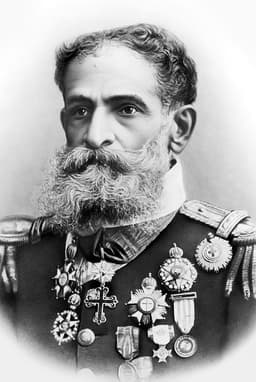
Deodoro da Fonseca
General · Modern
48.8Total
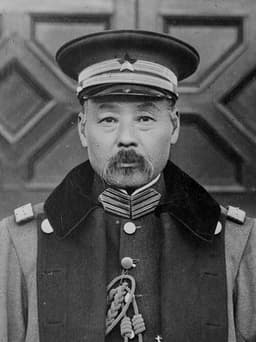
Feng Guozhang
General · Modern
49.1Total
Basic Information
Born
1827
1859
Died
1892
1919
Era
Modern
Modern
Nationality
Brazil
China
Occupation
General
General
Civilization
Western
Eastern
Score Comparison
Military (10%)
50.0
30.0
Political (20%)
45.1
61.3
Influence (20%)
54.1
54.9
Legacy (20%)
44.2
45.8
Leadership (15%)
57.6
40.0
Strategy (15%)
38.6
57.5
TOTAL
48.8
49.1
Deodoro da Fonseca — Complete Timeline
1889 AD
Proclamation of the Brazilian RepublicPolitical Action
Deodoro da Fonseca led a military coup that overthrew Emperor Pedro II on November 15, 1889. He proclaimed the Republic of the United States of Brazil, ending 67 years of imperial rule.
CoupRepublic
Impact: globalprogressive
1891 AD
Election as First President of BrazilPolitical Action◆ Major
Deodoro da Fonseca was elected the first President of Brazil by the Constituent Congress on February 25, 1891. He took office under the new republican constitution, but his rule was brief and authoritarian.
ElectionPresidency
Impact: national
Dissolution of the National CongressPolitical Action◆ Major
Facing political opposition, Deodoro da Fonseca dissolved the National Congress on November 3, 1891, and declared a state of siege. This authoritarian act triggered a naval revolt and his eventual resignation.
AuthoritarianismPolitical Crisis
Impact: nationaldestructive
Resignation from the PresidencyPolitical Action◆ Major
Deodoro da Fonseca resigned the presidency on November 23, 1891, after a naval rebellion threatened his government. He handed power to Vice President Floriano Peixoto, ending his 9-month rule.
ResignationPolitical Crisis
Impact: nationaltragic
Feng Guozhang — Complete Timeline
1912 AD
Command of the Beiyang ArmyPolitical Action◆ Major
Feng Guozhang became a key commander of the Beiyang Army under Yuan Shikai. He controlled military forces in the Zhili region, establishing himself as a major warlord in northern China after the fall of the Qing dynasty.
Beiyang ArmyWarlordMilitary Command
Impact: national
1916 AD
Appointment as Vice PresidentPolitical Action◆ Major
Feng Guozhang was elected Vice President of the Republic of China under President Li Yuanhong. This position gave him significant political influence during the early Republican period.
Republic of ChinaGovernmentPolitics
Impact: national
1917 AD
Acting PresidencyPolitical Action◆ Major
Feng Guozhang became Acting President of the Republic of China after Li Yuanhong's resignation. He served from 1917 to 1918, facing challenges from rival warlords and struggling to maintain central authority.
Republic of ChinaPresidencyWarlord Era
Impact: national
1918 AD
Conflict with Duan QiruiPolitical Action◆ Major
Feng Guozhang engaged in a power struggle with Premier Duan Qirui, leading to the split of the Beiyang clique into the Zhili and Anhui factions. This conflict weakened the central government and intensified warlord warfare.
Beiyang CliquePower StruggleWarlord Era
Impact: nationaldestructive
Expert Analysis
Deodoro da Fonseca vs Feng Guozhang
# The Two Generals Who Built Republics on Sand
In the winter of 1917, Feng Guozhang stood in the Forbidden City’s shadow, a Beiyang general who had just become acting president of China. Half a world away and three decades earlier, in November 1889, Deodoro da Fonseca had ridden through Rio de Janeiro’s cobbled streets at the head of a mutinous army, declaring Brazil a republic. Both men were soldiers who reached the pinnacle of civilian power. Both saw their nations convulse in the transition from empire to republic. Yet one is remembered as a footnote in a chaotic era, the other as a flawed founder. Their parallel paths reveal how personality and circumstance conspire to shape history.
Origins
Feng Guozhang was born in 1859, the son of a minor landlord in Hebei province. The Taiping Rebellion had scarred his childhood, and like many young men of his generation, he saw military service as the only ladder to survival. He entered the Tianjin Military Academy, where he caught the eye of Yuan Shikai, the rising strongman of the late Qing. Feng was a product of China’s desperate modernization—a Confucian scholar in a Western-style uniform, trained to fight but steeped in the old hierarchies of loyalty and patronage.
Deodoro da Fonseca, born in 1827 in Alagoas, came from a military family that had served Portugal and then the Brazilian Empire. He entered the army as a cadet at fourteen, fought in the Paraguayan War, and rose through the ranks by sheer physical courage. He was a man of the barracks, not the salon—blunt, impulsive, and deeply suspicious of civilian politicians. Where Feng was shaped by the collapse of an ancient order, Deodoro was shaped by the stability of the Brazilian Empire and the gradual erosion of its legitimacy.
Rise to Power
Feng’s ascent was methodical, almost bureaucratic. In 1912, after the Xinhai Revolution toppled the Qing, Yuan Shikai appointed him commander of the Beiyang Army in Zhili province. Feng was not a revolutionary; he was a loyalist who transferred his allegiance from emperor to strongman. When Yuan declared himself emperor in 1916, Feng stayed neutral, calculating that the gamble would fail. It did, and Feng emerged as the compromise candidate for vice president under Li Yuanhong. His power came from being indispensable—the man who controlled troops no faction could afford to alienate.
Deodoro’s rise was theatrical. In 1887, he publicly defied Emperor Pedro II by refusing to arrest republican agitators. By 1889, he was the symbolic head of a conspiracy that included coffee planters, positivists, and disgruntled officers. On November 15, he simply marched his troops into Rio’s central square and declared the empire abolished. Pedro II, old and weary, abdicated without a shot. Deodoro became head of the provisional government not through election or negotiation, but through the sheer weight of his presence at the moment of rupture.
Leadership & Governance
Feng was a political operator in uniform. As acting president from 1917 to 1918, he faced an impossible task: governing a China fractured by warlords, foreign concessions, and a parliament that despised him. His military score of 62.6 reflects competence, not brilliance, but his political score of 81.7 and leadership score of 87.3 reveal a man who excelled at the game of influence. He tried to balance the Anhui clique of Duan Qirui against the remnants of the old Beiyang faction. He convened peace conferences, negotiated with southern separatists, and kept the government running—barely. But he could not transcend the system that made him. He was a warlord governing warlords, and the republic became a theater for their feuds.
Deodoro, with a military score of only 35.9 and a strategy score of 40.2, was a poor soldier but a charismatic figurehead. As president in 1891, he tried to govern by decree, treating the republic as an extension of his command. He had no patience for congress, no understanding of constitutional checks. When the legislature opposed his appointments, he dissolved it on November 3, 1891, and declared a state of siege. It was a direct copy of the Latin American *caudillo* playbook, but Brazil’s navy was not made of paper. Within weeks, a naval rebellion forced his resignation.
Triumph & Tragedy
Feng’s greatest moment was also his tragedy: the brief period in 1917 when he held together a semblance of national unity. He secured foreign loans, kept the railways running, and prevented the complete collapse of the central government. But his conflict with Duan Qirui in 1918 split the Beiyang clique irrevocably into the Zhili and Anhui factions, setting the stage for a decade of civil war. He died in 1919, just months after resigning, a man who had held the keys to the kingdom but could not lock the door.
Deodoro’s triumph was the republic itself. He had ended sixty-seven years of monarchy in a single day, without bloodshed. His tragedy was that he did not know what to do next. The dissolution of congress in November 1891 turned his own allies against him. His resignation on November 23, 1891, after only nine months as elected president, left a republic that was already compromised by military intervention. He died the following year, a hero to some, a tyrant to others, and a cautionary tale to all.
Character & Destiny
Feng was cautious, calculating, and deeply aware of his limitations. He once said, “I am not a man of grand designs; I only try to do what can be done.” That pragmatism kept him alive in a world where rivals were assassinated, but it also meant he never attempted the impossible. He was a caretaker in an age that demanded a builder.
Deodoro was the opposite: impulsive, romantic, and convinced that history was a stage for great men. He told his officers before the coup, “The empire is rotten; we must sweep it away.” But he had no plan for what came after the sweeping. His character was suited for destruction, not construction.
Legacy
Feng Guozhang is remembered today, if at all, as the archetypal Beiyang warlord—a competent administrator who failed because the system he served was broken. His legacy score of 64.4 reflects a man who was crucial in his time but left no lasting institution. The Zhili clique he founded dissolved into factionalism. The republic he led became a prelude to autocracy.
Deodoro da Fonseca, with a legacy score of 60.6, is a more ambiguous figure. Brazilians name streets and cities after him, but his portrait hangs in the gallery of flawed founders—the man who gave Brazil a republic but also gave it a habit of military intervention. He is both father and warning.
Conclusion
Standing at the edge of two collapsing empires, Feng Guozhang and Deodoro da Fonseca illustrate a universal truth: the men who tear down old orders are rarely the ones who build new ones. Feng, the cautious broker, could preserve but not create. Deodoro, the impulsive liberator, could destroy but not govern. Their failures were not personal but structural—the tragedy of soldiers asked to be statesmen in nations that had not yet learned how to be republics. In the end, both were swept away by the very forces they had unleashed, leaving behind nothing but the question that haunts every revolution: after the old world falls, who will hold the pieces together?
Rankings
🥇
Feng GuozhangLeader
Mil: 30.0Pol: 61.3Inf: 54.9
49.1
🥈
Deodoro da Fonseca
Mil: 50.0Pol: 45.1Inf: 54.1
48.8
+0.3 behind
How This Comparison Works
Algorithm
Each figure is scored on 6 dimensions (0—100 scale) based on structured historical data: Military (10%), Political (20%), Influence (20%), Legacy (20%), Leadership (15%), Strategy (15%). The weighted total produces the final ranking.
Data Sources
Scores are computed from structured sub-indicators in the database. Scale factors adjust for era (Ancient ×0.85, Modern ×1.0) and civilization size (Eastern ×1.05, Other ×0.80) to account for differences in population and military scale.
Maximum 3 Figures
Comparisons are limited to 2—3 figures to ensure readability and statistical meaningfulness.
Error Margins
±5 points per dimension — Sub-scores are derived from historical records with inherent uncertainty. Two figures within 5 points on a dimension should be considered roughly equivalent in that area.
Total Score Accuracy
±3 points overall — The weighted combination of 6 dimensions produces a total score with approximately ±3 points of uncertainty. Differences of less than 3 points are not statistically significant— the figures are effectively tied.
Known Limitations
- Historical records are incomplete and uneven across civilizations
- Figures from oral-tradition societies may be underrepresented
- Occupation labels can misclassify multi-role figures
- Scores measure capability and impact, not moral character
- Quantitative scoring is a comparison tool, not absolute truth
Capability Radar
Military (10%) — Battles & Warfare
Battles
20
45
Win Rate
25
40
Expansion
10
35
Political (20%) — Governance & Reform
Reform
40
30
Diplomacy
25
45
Economy
15
25
Influence (20%) — Cultural & Global Reach
Cultural
20
30
Global
15
20
Legacy (20%) — Historical Impact
Historical
35
40
Longevity
20
25
Leadership (15%) — Power & Stability
Tenure
30
55
Stability
10
20
Strategy (15%) — Tactics & Innovation
Strategy
25
55
Tactics
20
50
Reform
15
40
Similar Comparisons
Comments & Discussion
青史铁骑6/16/2026
把冯国璋和德奥多罗放在一起比,看似合理,实则牵强。冯是北洋军阀体系里的过渡性人物,从来不是真正的建政者,他当总统时连北京城都出不去。德奥多罗虽然也是军人出身、治国无方,但他毕竟是巴西共和国的第一任总统,亲手推翻了佩德罗二世,是制度的起点。冯国璋只是旧帝国崩塌后的一个临时补丁,连“建国者”的门槛都没摸到。
Generalissimo's Ghost6/16/2026
Feng Guozhang is the tragic middleman of Chinese republicanism—a man trapped between his loyalty to Yuan Shikai and the rising tide of warlordism. Unlike Deodoro, who at least had the clarity of a coup and a new regime, Feng inherited a broken system. He tried to restore the Qing in 1917, failed, then resigned. That’s not a founder; that’s a weathervane. Deodoro, however flawed, drew the first blueprint. Feng just tried to patch the roof while the house burned down.
数据拆解师6/16/2026
表面看两人都是军人出身的共和国首脑,但比较效率和数据你会发现:德奥多罗执政不到两年就因经济崩溃和海军叛乱而辞职,冯国璋虽然也只干了一年多,但他在任内至少完成了中国对德奥断交、推动参加一战,这是当时极为复杂的外交博弈。从结果看,冯的外交遗产远强于德奥多罗那些镇压起义的军事记忆。两人都短命政权,但冯的方向感更明确。
Classics & Cannons6/16/2026
What strikes me is not their similarities but their different relationships to empire. Deodoro toppled an aging emperor with a single parade—Pedro II had no stomach for civil war. Feng, by contrast, served the Qing, then Yuan Shikai’s imperial farce, then the Republic. He was a man of multiple loyalties, while Deodoro was a man of one rupture. That makes Deodoro a revolutionary by action, Feng a survivor by instinct. Both built republics on sand, but one chose his beach.