Loading...
Deodoro da Fonseca vs Enomoto Takeaki
Enomoto Takeaki leads by 2.8 pts · 2 figures compared
…
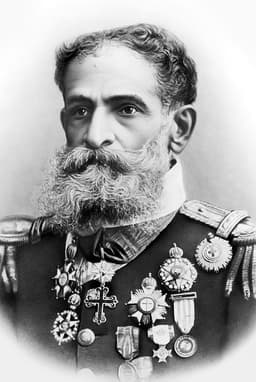
Deodoro da Fonseca
General · Modern
48.8Total
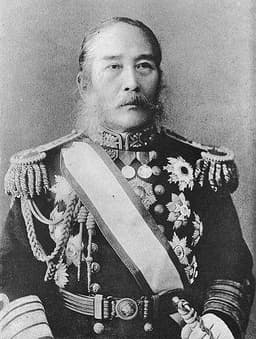
Enomoto Takeaki
General · Modern
51.6Total
Basic Information
Born
1827
1836
Died
1892
1908
Era
Modern
Modern
Nationality
Brazil
Japan
Occupation
General
General
Civilization
Western
Eastern
Score Comparison
Military (10%)
50.0
25.0
Political (20%)
45.1
54.7
Influence (20%)
54.1
54.1
Legacy (20%)
44.2
46.7
Leadership (15%)
57.6
68.0
Strategy (15%)
38.6
55.0
TOTAL
48.8
51.6
Deodoro da Fonseca — Complete Timeline
1889 AD
Proclamation of the Brazilian RepublicPolitical Action
Deodoro da Fonseca led a military coup that overthrew Emperor Pedro II on November 15, 1889. He proclaimed the Republic of the United States of Brazil, ending 67 years of imperial rule.
CoupRepublic
Impact: globalprogressive
1891 AD
Election as First President of BrazilPolitical Action◆ Major
Deodoro da Fonseca was elected the first President of Brazil by the Constituent Congress on February 25, 1891. He took office under the new republican constitution, but his rule was brief and authoritarian.
ElectionPresidency
Impact: national
Dissolution of the National CongressPolitical Action◆ Major
Facing political opposition, Deodoro da Fonseca dissolved the National Congress on November 3, 1891, and declared a state of siege. This authoritarian act triggered a naval revolt and his eventual resignation.
AuthoritarianismPolitical Crisis
Impact: nationaldestructive
Resignation from the PresidencyPolitical Action◆ Major
Deodoro da Fonseca resigned the presidency on November 23, 1891, after a naval rebellion threatened his government. He handed power to Vice President Floriano Peixoto, ending his 9-month rule.
ResignationPolitical Crisis
Impact: nationaltragic
Enomoto Takeaki — Complete Timeline
1868 AD
Led the Shogunate Fleet to HokkaidoWar
Enomoto commanded the shogunate's remaining naval forces, including eight warships, and sailed to Hokkaido. This fleet formed the core of the Republic of Ezo's military and allowed the loyalists to establish a base.
Naval CommandBoshin WarShogunate Loyalist
Impact: regional
Founded the Republic of EzoPolitical Action
After the shogunate's defeat, Enomoto led loyalist forces to Hokkaido and established the Republic of Ezo, an independent state with a Western-style government. He was elected president and organized a defense against imperial forces.
Boshin WarSeparatist StateShogunate Loyalist
Impact: national
1869 AD
Surrendered at the Battle of HakodateWar◆ Major
Enomoto's forces were defeated by the imperial army at the Battle of Hakodate. He surrendered the Republic of Ezo and was taken prisoner, ending the last organized resistance to the Meiji Restoration.
Boshin WarDefeatEnd of Resistance
Impact: nationaltragic
1885 AD
Served as Minister of Foreign Affairs in the Meiji GovernmentPolitical Action◆ Major
After being pardoned, Enomoto served as Japan's Minister of Foreign Affairs. He negotiated treaties with Western powers and worked to revise the unequal treaties imposed on Japan, contributing to Japan's diplomatic modernization.
DiplomacyTreaty RevisionMeiji Government
Impact: nationalconstructive
Expert Analysis
Deodoro da Fonseca vs Enomoto Takeaki
### The Last Samurai and the First President: Two Generals Who Forged New Nations
In the winter of 1869, on the snow-covered island of Hokkaido, a man in a Western-style naval uniform watched his fleet burn. Enomoto Takeaki, the last commander of the Tokugawa shogunate, had just surrendered the Republic of Ezo—a short-lived nation he had founded on the edge of Japan. Half a world away and twenty years later, another general, Deodoro da Fonseca, stood in the tropical heat of Rio de Janeiro and declared Brazil a republic, sending Emperor Pedro II into exile. Both were military men who turned to politics in times of revolutionary change. Both tried to build something new from the ruins of the old order. Yet one ended his life as a respected diplomat, the other as a failed president who resigned in disgrace. Why did their paths diverge so sharply?
### Origins: Samurai Loyalty and Colonial Ambition
Enomoto Takeaki was born in 1836 into a samurai family serving the Tokugawa shogunate, the military government that had ruled Japan for over 250 years. He was a child of a closed world—Japan’s isolationist Edo period—but his education was strikingly modern. The shogunate sent him to study naval science in the Netherlands, where he absorbed Western technology, law, and governance. He returned not as a reactionary but as a reformer who believed Japan could modernize without abandoning its traditions. His loyalty was to the shogun, not to the emperor, a distinction that would define his fate.
Deodoro da Fonseca, born in 1827 in Alagoas, Brazil, came from a military family in a country that had been a monarchy since independence from Portugal in 1822. Brazil was a slave-owning empire, vast and unstable, and the army was its most modern institution. Fonseca rose through the ranks fighting in wars against Argentina and Paraguay, earning a reputation as a brave but impulsive commander. Unlike Enomoto, he had no exposure to foreign ideas through study abroad; his worldview was shaped by barracks life and the growing republican sentiment among Brazilian officers. Both men were products of their eras—Enomoto of a dying feudal order, Fonseca of a colonial empire in transition.
### Rise to Power: The Fleet and the Coup
Enomoto’s rise was a story of defiance. After the shogunate’s defeat in the Boshin War of 1868–1869, most loyalists surrendered or died. Enomoto refused. He gathered eight warships—the core of the shogunate’s navy—and sailed north with 3,000 men to Hokkaido, the wild frontier of Japan. There, in December 1868, he founded the Republic of Ezo, a Western-style republic with a constitution, elections, and a president—himself. It was a stunning act of audacity: a samurai creating a democracy in the name of a lost cause.
Fonseca’s path was shorter and more violent. In 1889, after decades of political decay, Emperor Pedro II had lost support among the army and the coffee-growing elite. Fonseca, a popular general, was persuaded to lead a coup. On November 15, he marched his troops into Rio de Janeiro and proclaimed the republic. The emperor was deposed without bloodshed. Fonseca became head of a provisional government, and in February 1891, he was elected the first president of Brazil. Where Enomoto’s rise was a desperate gamble, Fonseca’s was a swift, almost effortless seizure of power.
### Leadership & Governance: Reform and Rupture
Enomoto’s Republic of Ezo lasted only seven months, but its governance was remarkable. He established a cabinet, a parliament, and a legal code based on French and American models. He tried to negotiate with the imperial government for autonomy, even offering to become a vassal state. His strategy was pragmatic: he knew his forces were outnumbered, but he hoped to buy time or win recognition from foreign powers. When that failed, he fought the Battle of Hakodate in June 1869, a desperate defense against the imperial army. After his surrender, he was imprisoned but later pardoned. The Meiji government, recognizing his talent, recruited him. By 1885, Enomoto was Japan’s Minister of Foreign Affairs, negotiating treaties with Western powers. His political wisdom, once used to resist the new order, now served it.
Fonseca’s presidency was a disaster. He was a soldier, not a statesman. Brazil’s new republic was deeply divided between centralists, who wanted a strong president, and federalists, who wanted power in the states. Fonseca tried to rule by decree, but his economic policies—printing money to cover debts—sparked inflation and unrest. In November 1891, facing a hostile Congress, he dissolved it and declared a state of siege. This was a coup within a coup. The navy, his own former comrades, rebelled. Within weeks, Fonseca resigned, his presidency a failure of just nine months.
### Triumph & Tragedy: The Last Stand and the Lost Republic
Enomoto’s greatest moment was also his most tragic. At the Battle of Hakodate, he led his men in a five-day siege against overwhelming odds. When the imperial army broke through, he chose surrender over suicide—a shocking decision for a samurai. He later wrote that he wanted to live to serve Japan. His tragedy was not defeat but the loss of his world: the shogunate, the samurai code, the old Japan.
Fonseca’s triumph was the proclamation of the republic itself. On November 15, 1889, he stood before the cheering crowds, a symbol of a new Brazil. But his tragedy came swiftly. He had no vision for the republic he created. His dissolution of Congress and his resignation left Brazil in chaos, leading to a civil war in 1893. He died in 1892, a broken man, remembered as the man who ended the empire but could not start a nation.
### Character & Destiny: The Pragmatist and the Hothead
Enomoto was a pragmatist. He studied in Europe, adopted Western ideas, and when his cause failed, he adapted. His surrender was calculated; his later service to the Meiji government was genuine. He believed in order and progress, not ideology. Fonseca was a hothead. He acted on impulse, dissolved Congress without a plan, and resigned when the navy turned against him. He was brave in battle but reckless in politics.
Their personalities shaped their fates. Enomoto’s flexibility allowed him to survive and thrive; Fonseca’s rigidity destroyed him. One built a republic that lasted months; the other destroyed a monarchy that had lasted 67 years. Yet both were men of their time—caught between tradition and modernity, loyalty and ambition.
### Legacy: The Forgotten Republic and the Unfinished Republic
Enomoto is remembered in Japan as a tragic hero, a “last samurai” who fought for a lost cause and then served his country. The Republic of Ezo is a footnote in history, but it was Japan’s first attempt at a Western-style republic. Fonseca is a controversial figure in Brazil. He is honored as the first president, but his failure is blamed for the instability that followed. His legacy is a warning: revolutions need leaders who can govern, not just overthrow.
### Conclusion
Two generals, two republics, two fates. Enomoto Takeaki and Deodoro da Fonseca both tried to create new nations from the ashes of old empires. Enomoto failed on the battlefield but succeeded in politics; Fonseca succeeded in revolution but failed in governance. Their stories remind us that history is not just about winners and losers, but about what people do with the moments they are given. Enomoto used his second chance; Fonseca wasted his first. In the end, the question is not whether you can seize power, but whether you can wield it wisely.
Rankings
🥇
Enomoto TakeakiLeader
Mil: 25.0Pol: 54.7Inf: 54.1
51.6
🥈
Deodoro da Fonseca
Mil: 50.0Pol: 45.1Inf: 54.1
48.8
+2.8 behind
How This Comparison Works
Algorithm
Each figure is scored on 6 dimensions (0—100 scale) based on structured historical data: Military (10%), Political (20%), Influence (20%), Legacy (20%), Leadership (15%), Strategy (15%). The weighted total produces the final ranking.
Data Sources
Scores are computed from structured sub-indicators in the database. Scale factors adjust for era (Ancient ×0.85, Modern ×1.0) and civilization size (Eastern ×1.05, Other ×0.80) to account for differences in population and military scale.
Maximum 3 Figures
Comparisons are limited to 2—3 figures to ensure readability and statistical meaningfulness.
Error Margins
±5 points per dimension — Sub-scores are derived from historical records with inherent uncertainty. Two figures within 5 points on a dimension should be considered roughly equivalent in that area.
Total Score Accuracy
±3 points overall — The weighted combination of 6 dimensions produces a total score with approximately ±3 points of uncertainty. Differences of less than 3 points are not statistically significant— the figures are effectively tied.
Known Limitations
- Historical records are incomplete and uneven across civilizations
- Figures from oral-tradition societies may be underrepresented
- Occupation labels can misclassify multi-role figures
- Scores measure capability and impact, not moral character
- Quantitative scoring is a comparison tool, not absolute truth
Capability Radar
Military (10%) — Battles & Warfare
Battles
20
40
Win Rate
25
35
Expansion
10
30
Political (20%) — Governance & Reform
Reform
40
30
Diplomacy
25
40
Economy
15
25
Influence (20%) — Cultural & Global Reach
Cultural
20
25
Global
15
20
Legacy (20%) — Historical Impact
Historical
35
40
Longevity
20
30
Leadership (15%) — Power & Stability
Tenure
30
35
Stability
10
20
Strategy (15%) — Tactics & Innovation
Strategy
25
50
Tactics
20
55
Reform
15
45
Similar Comparisons
Comments & Discussion
海舟遗臣6/16/2026
德川幕府败亡后,榎本武扬在北海道建立虾夷共和国,这是亚洲第一个试图移植半总统制与海军军校的试验场。他让法国军官训练士兵,用荷兰造船术武装舰队,却败于明治政府的西洋化军队。讽刺的是,投降后他被新政府重用为驻华公使,参与甲午战争谈判——一个曾经叛国者,最后成为帝国扩张的钥匙。这哪是忠诚?分明是职业军人对权力的服从性测试。
EnomotoEngineer6/16/2026
Data point: Enomoto’s Ezo Republic minted its own coins and operated a telegraph line—both firsts in non-Tokugawa Japan. Fonseca’s coup in 1889 required zero infrastructure innovation; he just bullied a senile emperor into exile. One built a prototype modern state on a frozen island; the other piggybacked on a 67-year-old empire. Who actually innovated under pressure? The samurai, not the marshal.
DeodoroDebunker6/16/2026
Let’s crunch the casualty rates: Fonseca’s 1891 naval revolt had zero mass battles, just some gunboat waving in Guanabara Bay. That’s a temper tantrum, not a civil war. Enomoto fought the Battle of Hakodate with 3,000 men against 7,000 Imperials—actual combat where he lost his flagship, Kaiyō Maru. Fonseca resigned because his own VP staged a bloodless coup. One lost a war; the other lost a meeting. Historians call them both “founders”? Farce.
旧邦新命6/16/2026
把两位放在天平两端:丰塞卡在巴西搞共和时,全国超过七成人口是文盲,他颁布宪法却无法落实联邦制,靠军队威胁议员。榎本武扬则在北海道尝试土地改革,给农民发放洋式农具,甚至引入西洋音乐教育儿童——他治理的虾夷共和国只有八个月寿命,却留下制度遗产。丰塞卡有二十三年时间构建共和国,最后只换得一场内战。谁算“建国者”?短命的理想主义,常比长命的暴政更有价值。