Loading...
Deodoro da Fonseca vs Ehud Barak
Ehud Barak leads by 11.1 pts · 2 figures compared
…
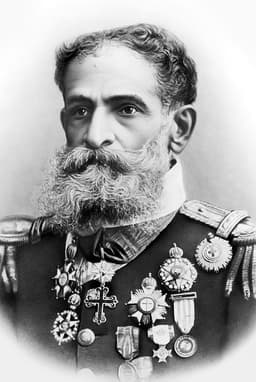
Deodoro da Fonseca
General · Modern
48.8Total
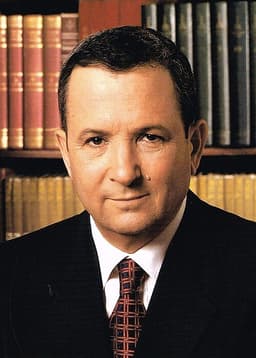
Ehud Barak
General · Modern
59.9Total
Basic Information
Born
1827
1942
Died
1892
—
Era
Modern
Modern
Nationality
Brazil
Israel
Occupation
General
General
Civilization
Western
Middle Eastern
Score Comparison
Military (10%)
50.0
63.3
Political (20%)
45.1
72.0
Influence (20%)
54.1
55.0
Legacy (20%)
44.2
52.0
Leadership (15%)
57.6
66.0
Strategy (15%)
38.6
61.2
TOTAL
48.8
59.9
Deodoro da Fonseca — Complete Timeline
1889 AD
Proclamation of the Brazilian RepublicPolitical Action
Deodoro da Fonseca led a military coup that overthrew Emperor Pedro II on November 15, 1889. He proclaimed the Republic of the United States of Brazil, ending 67 years of imperial rule.
CoupRepublic
Impact: globalprogressive
1891 AD
Election as First President of BrazilPolitical Action◆ Major
Deodoro da Fonseca was elected the first President of Brazil by the Constituent Congress on February 25, 1891. He took office under the new republican constitution, but his rule was brief and authoritarian.
ElectionPresidency
Impact: national
Dissolution of the National CongressPolitical Action◆ Major
Facing political opposition, Deodoro da Fonseca dissolved the National Congress on November 3, 1891, and declared a state of siege. This authoritarian act triggered a naval revolt and his eventual resignation.
AuthoritarianismPolitical Crisis
Impact: nationaldestructive
Resignation from the PresidencyPolitical Action◆ Major
Deodoro da Fonseca resigned the presidency on November 23, 1891, after a naval rebellion threatened his government. He handed power to Vice President Floriano Peixoto, ending his 9-month rule.
ResignationPolitical Crisis
Impact: nationaltragic
Ehud Barak — Complete Timeline
1973 AD
Awarded Medal of Distinguished ServiceOther
Barak received the Medal of Distinguished Service, Israel's highest military decoration, for his actions during the Yom Kippur War. He led a commando raid deep into Egyptian territory, destroying radar installations. This was part of a broader operation to open a supply route.
Military DecorationYom Kippur War
Impact: nationalconstructive
1976 AD
Led Operation Thunderbolt (Entebbe Raid)War◆ Major
As Chief of Staff, Barak planned and oversaw the Entebbe raid, a rescue of hostages hijacked by Palestinian and German militants in Uganda. Israeli commandos rescued 102 hostages. The operation was a major military success and boosted Israeli morale and international standing.
EntebbeHostage RescueCounterterrorism
Impact: globalconstructive
1991 AD
Appointed Chief of Staff of the IDFPolitical Action◆ Major
Barak was appointed the 14th Chief of Staff of the Israel Defense Forces. He served until 1995, overseeing military operations during the First Intifada and the Oslo Accords period. His tenure included the 1993 Operation Accountability in Lebanon.
Military CommandIDF
Impact: national
1999 AD
Elected Prime Minister of IsraelPolitical Action◆ Major
Barak was elected Prime Minister of Israel, defeating incumbent Benjamin Netanyahu. He campaigned on a platform of peace negotiations and domestic reform. His government pursued the Camp David Summit with Palestinians and withdrew from southern Lebanon.
ElectionPeace Process
Impact: regionalconstructive
2000 AD
Camp David Summit with ArafatPolitical Action
Barak participated in the Camp David Summit with Palestinian leader Yasser Arafat and U.S. President Bill Clinton. The summit aimed to reach a final status agreement but failed. Barak offered territorial concessions that were rejected. The failure contributed to the Second Intifada.
Peace NegotiationsCamp DavidIsraeli-Palestinian Conflict
Impact: global
Withdrew from Southern LebanonPolitical Action◆ Major
Barak ordered the unilateral withdrawal of Israeli forces from the security zone in southern Lebanon, ending 18 years of occupation. The withdrawal was completed in May 2000. Hezbollah claimed victory, and the move was criticized by some as a retreat under fire.
WithdrawalLebanonHezbollah
Impact: regional
Expert Analysis
Deodoro da Fonseca vs Ehud Barak
### The General and the Republic
In the summer of 2000, Ehud Barak sat across from Yasser Arafat at Camp David, a man who had once led the world’s most daring hostage rescue, now gambling everything on a handshake. Less than a century earlier, another general, Deodoro da Fonseca, had stood in a carriage in Rio de Janeiro, shouting “Long live the Republic!” as he deposed a beloved emperor. Both were soldiers who became heads of state. Both believed they could reshape their nations with a single, decisive stroke. Yet one ended his political career in bitter resignation, the other in ignominious collapse. Why did these two men—so similar in ambition, so different in outcome—meet such divergent fates?
### Origins
Ehud Barak was born in 1942 on Kibbutz Mishmar HaSharon, a child of socialist Zionism. His parents, Holocaust survivors from Lithuania, had come to build a new world. The young Barak was a prodigy—a pianist, a mathematician, a boy who could strip and reassemble a rifle blindfolded. He joined the Israeli Defense Forces at eighteen, and by his mid-thirties had become the most decorated soldier in Israeli history, earning the Medal of Distinguished Service in 1973 for a daring commando raid deep into Lebanon. His Israel was young, surrounded by enemies, and obsessed with survival. It bred men who believed that sheer will could overcome any obstacle.
Deodoro da Fonseca was born in 1827 in Alagoas, a province of the Brazilian Empire. His family had served the Portuguese crown for generations; his father was a military officer, and young Deodoro followed suit. Brazil in the nineteenth century was a monarchy in a continent of republics, a vast slaveholding empire ruled by the enlightened Pedro II. Fonseca rose through the ranks not through brilliance but through loyalty. He was a soldier of the old school—brave, conservative, and deeply suspicious of change. He fought in the War of the Triple Alliance, where he saw the horrors of industrial warfare, and returned a hero. But he was no intellectual. He read little, spoke less, and trusted only his uniform.
### Rise to Power
Barak’s path to power was a staircase of spectacular triumphs. In 1976, as a young colonel, he helped plan Operation Thunderbolt—the Entebbe Raid—where Israeli commandos flew 2,500 miles to rescue hostages from a hijacked Air France plane. He later served as head of Military Intelligence and, in 1991, was appointed Chief of Staff of the IDF. He was a man of relentless energy and cold precision, known for personally leading missions even as a general. When he entered politics in the late 1990s, he seemed invincible. In 1999, he defeated Benjamin Netanyahu in a landslide, promising peace with the Palestinians and reform at home.
Fonseca’s rise was slower, more accidental. He became a symbol of discontent within the Brazilian army, which felt humiliated by the emperor’s abolition of slavery in 1888—a move that angered the planter elite and the military’s officer corps. Fonseca was not a revolutionary. He was a figurehead, a man of prestige who could lend his name to the conspirators. On November 15, 1889, he led a small column of soldiers through the streets of Rio. The emperor, Pedro II, offered no resistance. Fonseca proclaimed the republic, and within hours, the monarchy was gone. He became the provisional president, a role he had never sought and hardly understood.
### Leadership & Governance
Barak governed like a general: he set objectives, drew up plans, and expected execution. He withdrew Israeli forces from southern Lebanon in 2000, ending an 18-year occupation, and then staked his entire political capital on the Camp David Summit with Arafat. He offered the Palestinians a state in Gaza and most of the West Bank, with East Jerusalem as its capital. It was a breathtaking proposal—but it failed. Barak had not prepared his public, nor had he built a coalition. He had assumed that his logic and his vision would carry the day. Instead, the second intifada erupted, and his government collapsed.
Fonseca governed as a bewildered autocrat. He had no political program, no party, no vision beyond “order.” His first months as president were marked by economic chaos and growing opposition from the Congress he had helped create. In February 1891, he was elected president by the Constituent Congress, but the victory was hollow. He could not manage the budget, could not control the governors, could not even command his own army. In November, he dissolved the National Congress and declared a state of siege. It was a desperate act, and it failed. A naval rebellion forced him to resign on November 23, 1891. He had ruled for less than two years.
### Triumph & Tragedy
Barak’s triumph was the Entebbe Raid—a moment of pure, surgical brilliance that saved lives and humiliated terrorists. His tragedy was Camp David. He had come closer to peace than any Israeli leader before him, but he had also misjudged his opponent and his own people. He returned home to a nation that blamed him for the violence that followed. He would never hold high office again.
Fonseca’s triumph was the proclamation of the republic—a bloodless revolution that ended 67 years of monarchy. His tragedy was his presidency. He had broken the old order but could not build a new one. He died in 1892, less than a year after his resignation, a broken and forgotten man.
### Character & Destiny
Barak was a man of immense competence and immense arrogance. He believed that intelligence and will could solve any problem. He had spent his life outthinking enemies, and he assumed he could outthink politics. He could not. His failure was not a failure of strategy but of empathy. He could not read Arafat, could not read his own people, could not read the room.
Fonseca was a man of honor and limitation. He had never wanted to be a revolutionary, and he was ill-suited to be a president. He was a soldier who believed in hierarchy and loyalty, but a republic required compromise and persuasion. He had neither the skills nor the temperament for the job. His tragedy was that he was the right man for a coup and the wrong man for a country.
### Legacy
Barak is remembered as a brilliant soldier and a flawed politician. His military achievements—the Entebbe Raid, the Lebanon withdrawal—remain part of Israel’s national mythology. But his political failure haunts the peace process. He showed that a general could offer peace, but not that a general could achieve it.
Fonseca is remembered as the founder of the Brazilian Republic, but his legacy is ambiguous. He is a statue in Rio, a name in textbooks, but few Brazilians think of him as a great leader. He was a transition, not a destination. The republic he founded would endure, but it would take decades to find its footing.
### Conclusion
Both men were soldiers who believed that the skills of war could be applied to peace. Barak had the vision but not the patience; Fonseca had the opportunity but not the vision. Their stories remind us that leadership is not about winning battles—it is about building consensus, understanding human nature, and accepting that the greatest victories are often the ones you never see. In the end, the general who could plan a raid from 2,500 miles away could not plan a peace in his own backyard, and the general who toppled an empire could not govern a republic. Their fates are a warning and a mystery: the skills that make a great soldier rarely make a great statesman.
Rankings
🥇
Ehud BarakLeader
Mil: 63.3Pol: 72.0Inf: 55.0
59.9
🥈
Deodoro da Fonseca
Mil: 50.0Pol: 45.1Inf: 54.1
48.8
+11.1 behind
How This Comparison Works
Algorithm
Each figure is scored on 6 dimensions (0—100 scale) based on structured historical data: Military (10%), Political (20%), Influence (20%), Legacy (20%), Leadership (15%), Strategy (15%). The weighted total produces the final ranking.
Data Sources
Scores are computed from structured sub-indicators in the database. Scale factors adjust for era (Ancient ×0.85, Modern ×1.0) and civilization size (Eastern ×1.05, Other ×0.80) to account for differences in population and military scale.
Maximum 3 Figures
Comparisons are limited to 2—3 figures to ensure readability and statistical meaningfulness.
Error Margins
±5 points per dimension — Sub-scores are derived from historical records with inherent uncertainty. Two figures within 5 points on a dimension should be considered roughly equivalent in that area.
Total Score Accuracy
±3 points overall — The weighted combination of 6 dimensions produces a total score with approximately ±3 points of uncertainty. Differences of less than 3 points are not statistically significant— the figures are effectively tied.
Known Limitations
- Historical records are incomplete and uneven across civilizations
- Figures from oral-tradition societies may be underrepresented
- Occupation labels can misclassify multi-role figures
- Scores measure capability and impact, not moral character
- Quantitative scoring is a comparison tool, not absolute truth
Capability Radar
Military (10%) — Battles & Warfare
Battles
20
65
Win Rate
25
70
Expansion
10
55
Political (20%) — Governance & Reform
Reform
40
50
Diplomacy
25
60
Economy
15
45
Influence (20%) — Cultural & Global Reach
Cultural
20
50
Global
15
55
Legacy (20%) — Historical Impact
Historical
35
55
Longevity
20
45
Leadership (15%) — Power & Stability
Tenure
30
55
Stability
10
40
Strategy (15%) — Tactics & Innovation
Strategy
25
70
Tactics
20
75
Reform
15
60
Similar Comparisons
Comments & Discussion
Camp David Ace6/16/2026
Stop romanticizing generals as statesmen. Barak walked into Camp David thinking he could negotiate with a terrorist org the way he planned a commando raid. That’s just bad strategy. Arafat wasn’t a target to be eliminated; he was a political adversary. Barak’s whole framework was flawed from jump—he didn’t even offer a full settlement freeze. Compare that with de Fonseca, who at least understood that a republic needed a complete break from monarchy. Barak’s half-measures in diplomacy mirror his
锄头将军6/16/2026
说德奥多罗是“共和国之父”简直搞笑。他推翻佩德罗二世时,巴西帝国正经历经济萧条和废奴危机,这位将军不过是搭了历史潮流的顺风车。他执政一年连宪法都没整明白,干脆搞独裁。比起巴拉克在智库里啃协议条款、走正规流程,德奥多罗就是个拿军刀砍政局的莽夫。真要说爱国者,还得看巴拉克那种用脑子打仗的人。
Mossad Proofreader6/16/2026
Fun fact: Barak’s Medal of Distinguished Service came from Operation Spring of Youth in 1973, where he disguised as a woman to assassinate PLO leaders in Beirut. That’s not just daring—it’s bonkers. But here’s the data: he was the most decorated soldier ever, yet his political tenure was a disaster. Approval ratings tanked from 70% to 30% in under two years. Compare that to de Fonseca, who at least kept his republic afloat for 15 months before resigning. What’s the correlation between commando s
史书锤子6/16/2026
别把巴拉克和德奥多罗放一起比,根本不是一个量级。德奥多罗推翻的是巴西帝国,一个延续67年的王朝,而他本人只是个平庸的官僚将军——资料显示他当首任总统期间,巴西GDP基本没变,通胀率却从6%飙到15%。巴拉克虽然政治失败,但至少推动了以色列的安全边境和科技腾飞,90年代GDP增长超50%。论实干,巴拉克碾压德奥多罗。