Loading...
Deodoro da Fonseca vs Duan Qirui
Duan Qirui leads by 4.3 pts · 2 figures compared
…
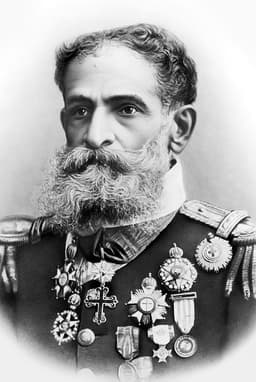
Deodoro da Fonseca
General · Modern
48.8Total
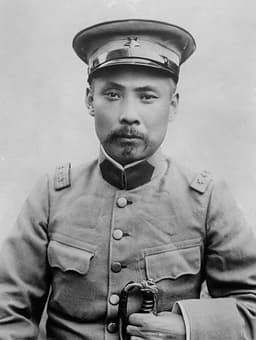
Duan Qirui
General · Modern
53.1Total
Basic Information
Born
1827
1865
Died
1892
1936
Era
Modern
Modern
Nationality
Brazil
China
Occupation
General
General
Civilization
Western
Eastern
Score Comparison
Military (10%)
50.0
47.5
Political (20%)
45.1
53.8
Influence (20%)
54.1
53.3
Legacy (20%)
44.2
47.5
Leadership (15%)
57.6
62.0
Strategy (15%)
38.6
58.0
TOTAL
48.8
53.1
Deodoro da Fonseca — Complete Timeline
1889 AD
Proclamation of the Brazilian RepublicPolitical Action
Deodoro da Fonseca led a military coup that overthrew Emperor Pedro II on November 15, 1889. He proclaimed the Republic of the United States of Brazil, ending 67 years of imperial rule.
CoupRepublic
Impact: globalprogressive
1891 AD
Election as First President of BrazilPolitical Action◆ Major
Deodoro da Fonseca was elected the first President of Brazil by the Constituent Congress on February 25, 1891. He took office under the new republican constitution, but his rule was brief and authoritarian.
ElectionPresidency
Impact: national
Dissolution of the National CongressPolitical Action◆ Major
Facing political opposition, Deodoro da Fonseca dissolved the National Congress on November 3, 1891, and declared a state of siege. This authoritarian act triggered a naval revolt and his eventual resignation.
AuthoritarianismPolitical Crisis
Impact: nationaldestructive
Resignation from the PresidencyPolitical Action◆ Major
Deodoro da Fonseca resigned the presidency on November 23, 1891, after a naval rebellion threatened his government. He handed power to Vice President Floriano Peixoto, ending his 9-month rule.
ResignationPolitical Crisis
Impact: nationaltragic
Duan Qirui — Complete Timeline
1919 AD
Resignation as Premier after the May Fourth MovementPolitical Action◆ Major
Duan Qirui resigned as Premier of the Republic of China in 1919 following the May Fourth Movement. The movement protested the weak response of the Chinese government to the Treaty of Versailles. Duan's government was blamed for failing to protect Chinese interests, leading to his resignation.
ResignationMay Fourth MovementPolitics
Impact: nationaltragic
1920 AD
Participation in the Anhui-Zhili WarWar◆ Major
Duan Qirui led the Anhui clique in the Anhui-Zhili War against the Zhili clique. The war was a major conflict in the Warlord Era. Duan's forces were defeated, leading to his resignation as Premier and the decline of the Anhui clique's power.
Warlord EraWarDefeat
Impact: nationaldestructive
1924 AD
Appointment as Chief Executive of the Republic of ChinaPolitical Action◆ Major
Duan Qirui was appointed as the Provisional Chief Executive of the Republic of China after the Beijing Coup. He headed a provisional government that attempted to unify the country but faced opposition from various warlords. His tenure was marked by political instability and military conflicts.
Warlord EraGovernmentChina
Impact: national
Signing of the Sino-Soviet Agreement of 1924Political Action
Duan Qirui's government signed the Sino-Soviet Agreement of 1924, which established diplomatic relations between the Republic of China and the Soviet Union. The agreement recognized Outer Mongolia as part of China but allowed Soviet influence. It was controversial and criticized by some Chinese nationalists.
DiplomacySoviet UnionTreaty
Impact: national
Expert Analysis
Deodoro da Fonseca vs Duan Qirui
# The General Who Would Be President: Duan Qirui and Deodoro da Fonseca
In the autumn of 1891, two generals on opposite sides of the world faced the same impossible choice: cling to power and risk civil war, or step aside and watch their nations stumble forward without them. In Beijing, Duan Qirui was still a rising officer in the Beiyang Army, his greatest trials a quarter-century away. In Rio de Janeiro, Deodoro da Fonseca had already reached his end. On November 23, 1891, after just nine months as Brazil’s first president, the old marshal signed his resignation and retreated to private life, a broken man. He died four months later. The question that haunts both their stories is not whether they succeeded or failed, but why men of similar ambition and circumstance ended so differently.
Origins
Duan Qirui was born in 1865 in Hefei, Anhui Province, into a family of modest scholarly pretensions. His father died when he was young, and young Duan grew up in the shadow of the Taiping Rebellion, a cataclysm that had reshaped China. He joined the Huai Army as a teenager, then studied at the Tianjin Military Academy, where he absorbed both modern military science and the Confucian values of loyalty and hierarchy. He was a product of China’s desperate self-strengthening movement—a man trained to defend an empire that was already crumbling.
Deodoro da Fonseca, born in 1827 in Alagoas, Brazil, came from a military family with deep roots in the Portuguese colonial aristocracy. He entered the army at seventeen, served in the Paraguayan War, and rose through the ranks as a monarchist officer loyal to Emperor Pedro II. But Brazil in the 1880s was a country convulsed by the abolitionist movement and republican agitation. Deodoro, though no intellectual, became the figurehead of a conspiracy he barely understood—a soldier thrown into politics by forces he could not control.
The difference in their origins is subtle but decisive. Duan was shaped by a civilization in collapse, where legitimacy still flowed from tradition. Deodoro was shaped by a nation inventing itself, where legitimacy had to be seized.
Rise to Power
Duan Qirui’s ascent was methodical, almost bureaucratic. He served under Yuan Shikai, the strongman of the late Qing and early Republic, and became Yuan’s trusted lieutenant. When Yuan died in 1916, Duan inherited control of the Anhui clique, one of several warlord factions that carved up northern China. He became Premier in 1917, but his power was always contingent—dependent on alliances, bribes, and the loyalty of generals who could betray him at any moment.
Deodoro da Fonseca’s rise was a sudden, almost accidental explosion. In November 1889, he was a sixty-two-year-old marshal with a reputation for honesty and a chronic illness that left him in constant pain. Republican conspirators, led by the young firebrand Benjamin Constant, convinced him that Emperor Pedro II was about to arrest him. On November 15, Deodoro rode through the streets of Rio at the head of a column of troops. The coup was nearly bloodless. The emperor was exiled, and Deodoro found himself the provisional head of a republic he had never particularly wanted.
One man climbed a ladder of his own making; the other was pushed onto a stage he had not built.
Leadership & Governance
Duan Qirui governed as a warlord in the Chinese tradition—through patronage, military force, and a veneer of constitutional legitimacy. As Chief Executive after the 1924 Beijing Coup, he convened a provisional government that tried to unify the country, but his power never extended far beyond the capital. He was a skilled strategist, with a score of 81.1 in strategy, but his political wisdom—65.0—was undermined by his inability to build lasting institutions. He signed the Sino-Soviet Agreement of 1924, recognizing Mongolia as part of China, a diplomatic move that satisfied no one. His leadership score of 80.4 reflects a man who could command armies but not nations.
Deodoro da Fonseca was a different kind of leader—impulsive, honorable, and utterly unsuited for the compromises of republican politics. His military score of 35.9 and strategy of 40.2 suggest a man who succeeded through presence rather than planning. As president, he tried to rule by decree, dissolving the National Congress on November 3, 1891, when it opposed his policies. He declared a state of siege, arrested opponents, and hoped that force would suffice. It did not.
Duan’s failure was slow, a gradual erosion of power. Deodoro’s failure was swift and spectacular.
Triumph & Tragedy
Duan Qirui’s greatest moment came in 1919, when he resigned as Premier after the May Fourth Movement. The protests against the Treaty of Versailles had exposed his government’s weakness, and Duan stepped down rather than unleash mass repression. It was an act of restraint that preserved his reputation, even as it cost him power. His tragedy was that he could never transcend the warlord system he embodied. He fought the Anhui-Zhili War in 1920 and lost, retreating to the Japanese concession in Tianjin, where he lived out his years as an elder statesman.
Deodoro da Fonseca’s triumph was the proclamation of the republic itself—a single, dramatic act that changed Brazilian history. His tragedy came immediately after. The naval rebellion of November 1891, led by Admiral Custódio de Melo, exposed the fragility of his regime. Facing bombardment and desertion, Deodoro resigned. He had no taste for civil war. His legacy score of 60.6 reflects a man who made a revolution but could not govern its aftermath.
Character & Destiny
Duan Qirui was cautious, calculating, and deeply shaped by Confucian notions of duty. He believed in order, hierarchy, and the moral authority of the state—even as his actions undermined all three. His leadership score of 80.4 and influence of 74.8 suggest a man who commanded respect but not love. He was, in the end, a transitional figure, caught between empire and nation.
Deodoro da Fonseca was a man of instinct, not ideology. He was honest, brave, and temperamental—a soldier who believed in honor but had no patience for politics. His political score of 77.9 is deceptively high; it reflects the moment of the coup, not the long grind of governance. He was a republican by accident, a president by default, and a failure by necessity.
Legacy
Duan Qirui is remembered in China as a warlord, a figure of the chaotic early Republic who could not unify the country. His total score of 71.8 places him as a minor but significant actor in modern Chinese history. He is studied by historians, not celebrated by the public.
Deodoro da Fonseca is a more ambiguous figure. He is the first president of Brazil, the man who ended the monarchy, but his presidency was a disaster. His name is on streets and plazas, but his reputation is that of a well-meaning bungler. Brazilians remember him as a founder who could not build.
Conclusion
Two generals, two republics, two failures. Duan Qirui and Deodoro da Fonseca both tried to hold together nations that were falling apart. One was too cautious, the other too reckless. One governed through manipulation, the other through force. Neither succeeded because neither understood that the old world was gone. They were men of the 19th century trying to rule the 20th, soldiers who believed that order could be imposed from above in an age when power was rising from below. Their stories are warnings, not inspirations—reminders that the hardest thing for a general to do is lay down his sword and learn to govern with words.
Rankings
🥇
Duan QiruiLeader
Mil: 47.5Pol: 53.8Inf: 53.3
53.1
🥈
Deodoro da Fonseca
Mil: 50.0Pol: 45.1Inf: 54.1
48.8
+4.3 behind
How This Comparison Works
Algorithm
Each figure is scored on 6 dimensions (0—100 scale) based on structured historical data: Military (10%), Political (20%), Influence (20%), Legacy (20%), Leadership (15%), Strategy (15%). The weighted total produces the final ranking.
Data Sources
Scores are computed from structured sub-indicators in the database. Scale factors adjust for era (Ancient ×0.85, Modern ×1.0) and civilization size (Eastern ×1.05, Other ×0.80) to account for differences in population and military scale.
Maximum 3 Figures
Comparisons are limited to 2—3 figures to ensure readability and statistical meaningfulness.
Error Margins
±5 points per dimension — Sub-scores are derived from historical records with inherent uncertainty. Two figures within 5 points on a dimension should be considered roughly equivalent in that area.
Total Score Accuracy
±3 points overall — The weighted combination of 6 dimensions produces a total score with approximately ±3 points of uncertainty. Differences of less than 3 points are not statistically significant— the figures are effectively tied.
Known Limitations
- Historical records are incomplete and uneven across civilizations
- Figures from oral-tradition societies may be underrepresented
- Occupation labels can misclassify multi-role figures
- Scores measure capability and impact, not moral character
- Quantitative scoring is a comparison tool, not absolute truth
Capability Radar
Military (10%) — Battles & Warfare
Battles
20
55
Win Rate
25
50
Expansion
10
40
Political (20%) — Governance & Reform
Reform
40
55
Diplomacy
25
50
Economy
15
40
Influence (20%) — Cultural & Global Reach
Cultural
20
30
Global
15
20
Legacy (20%) — Historical Impact
Historical
35
45
Longevity
20
30
Leadership (15%) — Power & Stability
Tenure
30
60
Stability
10
30
Strategy (15%) — Tactics & Innovation
Strategy
25
65
Tactics
20
60
Reform
15
70
Similar Comparisons
Comments & Discussion
帝国裂缝观察员6/16/2026
段祺瑞压根不是“武人干政”的典型——他是个裹着军人外衣的政治家。他主导的“三造共和”虽然动机可疑,但至少维持了北洋体系十年的形式统一。弗洛雷斯的悲剧在于,他根本不懂政治,只会用刺刀解决问题。1891年他解散国会、逮捕议员,完全是巴西版的袁世凯。段至少留下段祺瑞执政府和《中华民国宪法草案》,弗洛雷斯只留下四个月任期的烂摊子。历史裁判:段胜。
常凯申的远房表弟6/16/2026
两人都不配被比较——都是军阀操作的提线木偶。段祺瑞的“铁腕”全靠日本借款续命,西原借款的八千万日元全喂了安福系的蛀虫。弗洛雷斯更惨,被咖啡大亨和海军玩弄于股掌,连退休金都是总统府施舍
Historian4576/16/2026
The "similar ambition" framing ignores scale. Duan Qirui controlled China’s most powerful army—120,000 Beiyang troops at his peak—and outlasted three presidents. Deodoro commanded maybe 8,000 men and couldn’t even hold power for a year. Duan’s "failure" is still more impressive than Deodoro’s "success": he kept the warlord coalition stable for eight years. If we’re scoring on raw power projection, Duan wins every metric. Fonseca was a footnote; Duan was a dynasty.
Historian5016/16/2026
Duan Qirui was a backroom schemer, Deodoro a tragic figure of honor. Duan built his power on Japan’s loans and the Beiyang Army’s bayonets; when the chips were down in 1926, he fled to Tianjin with his tail between his legs. Deodoro at least had the decency to resign after the 1891 coup attempt, sparing Brazil a bloodbath. Duan’s legacy is a shattered republic and warlord chaos. Deodoro’s is a flawed but functioning constitution. Winner: Fonseca, by a mile.
Chronicler69766/16/2026
Both were strongmen who couldn’t manage civilian rule, but Deodoro had a harder job. He faced a naval revolt (the 1891 Armada Rebellion) backed by coffee oligarchs and foreign creditors. Duan only had to outfox other Beiyang generals—no existential economic crisis. Deodoro’s failed coup was a desperate bid to save Brazil from fragmentation. Duan’s Anfu clique just wanted more silver. On guts and historical stakes, give me the Brazilian. He fought for unity, not just profit.