Loading...
Denis Sassou-Nguesso vs Prem Tinsulanonda
Prem Tinsulanonda leads by 7.8 pts · 2 figures compared
…
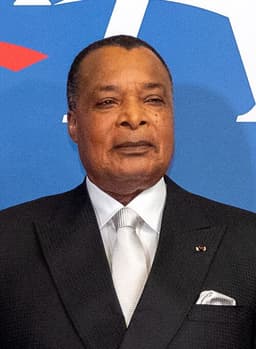
Denis Sassou-Nguesso
General · Modern
49.4Total
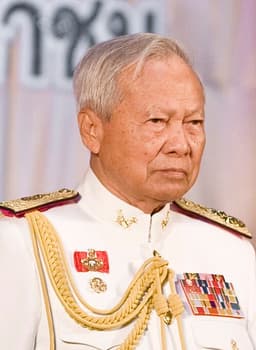
Prem Tinsulanonda
General · Modern
57.2Total
Basic Information
Born
1943
1920
Died
—
—
Era
Modern
Modern
Nationality
Congo Republic
Thailand
Occupation
General
General
Civilization
Other
Eastern
Score Comparison
Military (10%)
10.2
50.0
Political (20%)
68.0
59.3
Influence (20%)
51.8
54.9
Legacy (20%)
46.7
47.5
Leadership (15%)
62.0
78.0
Strategy (15%)
42.3
60.0
TOTAL
49.4
57.2
Denis Sassou-Nguesso — Complete Timeline
1979 AD
Seized Power in CoupPolitical Action
Denis Sassou-Nguesso, a military officer, became President of the People's Republic of the Congo after a coup that ousted President Joachim Yhombi-Opango. He led the Congolese Party of Labour (PCT).
Coup d'étatCongoMilitary Rule
Impact: national
1990 AD
Transition to Multi-Party PoliticsReform◆ Major
Under pressure, Sassou-Nguesso's government introduced multi-party politics, ending the one-party Marxist-Leninist system. A national conference was held in 1991, leading to a transition to civilian rule.
Political ReformDemocracyCongo
Impact: national
1992 AD
Lost Presidential ElectionPolitical Action◆ Major
Sassou-Nguesso lost the 1992 presidential election to Pascal Lissouba. This was the first multi-party election in the country since independence, and Sassou-Nguesso peacefully handed over power.
ElectionDemocracyCongo
Impact: national
1997 AD
Returned to Power via Civil WarWar
Sassou-Nguesso's militia, backed by Angolan troops, captured Brazzaville, overthrowing President Pascal Lissouba. This ended a four-month civil war and returned Sassou-Nguesso to the presidency.
Civil WarCongoPower Struggle
Impact: nationaldestructive
2002 AD
Won Controversial Re-electionsPolitical Action◆ Major
Sassou-Nguesso won the 2002 presidential election with over 89% of the vote. The election was boycotted by major opposition candidates and criticized as neither free nor fair.
ElectionCongoControversy
Impact: national
2015 AD
Constitutional Referendum to Extend TermPolitical Action◆ Major
Sassou-Nguesso's government held a constitutional referendum that removed the age limit and two-term limit for the presidency. The change allowed him to run for re-election in 2016 and potentially remain in power.
Constitutional ReformCongoPower Consolidation
Impact: national
Prem Tinsulanonda — Complete Timeline
1980 AD
Appointed Prime Minister after a coupPolitical Action◆ Major
Prem Tinsulanonda was appointed Prime Minister of Thailand by the military after a coup. He served for over eight years, overseeing a period of political stability and economic growth.
Prime MinisterMilitary RuleStability
Impact: national
1981 AD
Survived a coup attemptPolitical Action◆ Major
Prem survived a coup attempt by military officers loyal to the 'Young Turks' faction. The coup failed due to lack of support and the loyalty of key military units, allowing Prem to remain in power.
Coup AttemptPolitical CrisisMilitary
Impact: national
1988 AD
Resigned as Prime MinisterPolitical Action◆ Major
Prem resigned as Prime Minister after the general election, handing over power to a civilian government led by Chatichai Choonhavan. His resignation marked a rare peaceful transition of power in Thai politics.
ResignationDemocratic TransitionPeaceful
Impact: nationalconstructive
2016 AD
Appointed Regent of ThailandPolitical Action
After the death of King Bhumibol, Prem was appointed Regent of Thailand until the ascension of King Maha Vajiralongkorn. He served as a key figure in the transition of the monarchy.
RegentMonarchyTransition
Impact: national
Expert Analysis
Prem Tinsulanonda vs Denis Sassou-Nguesso
# The General and the Survivor: Prem Tinsulanonda and Denis Sassou-Nguesso
In the summer of 1997, as the Congo Republic burned, two generals faced opposite fates. In Brazzaville, Denis Sassou-Nguesso watched his militia roll into the capital, reclaiming a presidency he had lost five years earlier. In Bangkok, Prem Tinsulanonda had long since retired from office, a respected elder statesman whose quiet authority would soon be called upon to steady a kingdom in mourning. One man seized power through war; the other let power slip through his fingers by choice. Both were soldiers who became rulers, yet their paths could not have diverged more sharply. Why did one become a symbol of stability and the other a symbol of survival?
Origins
Prem Tinsulanonda was born in 1920 in Songkhla, southern Thailand, into a family of modest means but deep loyalty to the monarchy. He entered military academy at a time when Thailand was still Siam, a kingdom cautiously navigating colonialism. The young Prem absorbed a culture where the military was not a force for conquest but for protection of the throne. Denis Sassou-Nguesso, born in 1943 in Edou, a village in what was then French Equatorial Africa, came of age in a world of colonial rebellion and Cold War tension. His early years saw the Congo lurch from French rule to independence in 1960, then spiral into coups and Marxist revolution. Prem was shaped by tradition; Sassou-Nguesso by upheaval.
Rise to Power
Prem’s ascent was gradual and institutional. He rose through the ranks of the Thai army, serving in the Korean War and later commanding forces against communist insurgencies. His moment came in 1980, when a military coup ousted the civilian government and the generals turned to Prem—a man known for integrity and caution—to serve as prime minister. He accepted reluctantly, a pattern that would define his career. Sassou-Nguesso’s rise was abrupt and violent. In 1979, as a young officer in the Congolese military, he seized power in a coup that ousted the previous Marxist regime. He was 36 years old, and the People's Republic of the Congo was his to command.
Leadership & Governance
Prem governed Thailand for eight years, from 1980 to 1988, with a style that historians describe as "semi-democratic." He allowed elections, tolerated opposition, and gradually ceded power to civilian politicians. His strategy was survival through balance—keeping the military factions in check while letting democracy breathe. When a 1981 coup attempt by the "Young Turks" faction failed, it was not because Prem crushed them, but because he had built enough support among other generals and the monarchy to isolate the rebels. He was a political craftsman, not a warrior.
Sassou-Nguesso governed the Congo with an iron grip, first as a Marxist-Leninist from 1979 to 1992, then as a pragmatic autocrat after 1997. His early years saw nationalizations and alignment with the Soviet bloc. In 1990, under pressure from collapsing communism, he introduced multi-party politics—a reform he clearly did not believe in. When he lost the 1992 election to Pascal Lissouba, he accepted defeat, but only temporarily. Five years later, his militia, backed by Angolan troops, fought its way back into Brazzaville, plunging the country into civil war. Sassou-Nguesso’s governance was a cycle of adaptation and force.
Triumph & Tragedy
Prem’s greatest triumph was his resignation. In 1988, after a general election, he handed power to Chatichai Choonhavan, a civilian politician. For a military-appointed leader to step down voluntarily was almost unheard of in Thai politics. It was a quiet revolution. His tragedy came later, in the 2000s, when the kingdom descended into political crisis. Prem, then a privy councillor and regent, was accused of meddling in politics—a charge that tarnished his reputation as a neutral arbiter.
Sassou-Nguesso’s triumph was his return. The 1997 civil war victory made him one of Africa’s most resilient strongmen. His tragedy was the cost: thousands dead, the economy shattered, and a country divided. His 2002 re-election with 89% of the vote, boycotted by the opposition, was a hollow victory. In 2015, he changed the constitution to remove term limits, ensuring he could rule for life. Triumph became entrenchment.
Character & Destiny
Prem was cautious, self-effacing, and deeply loyal to the Thai monarchy. He once said, "I do not seek power, but I will not run from duty." His personality made him a bridge between military and civilian rule, but also a figure of ambiguity—was he a democrat or a general in civilian clothes? Sassou-Nguesso was calculating, ruthless, and adaptable. He survived by shifting ideologies, from Marxism to multipartyism to autocracy. His character was that of a survivor, not a builder. Prem’s destiny was to be remembered as a stabilizer; Sassou-Nguesso’s as a survivor who never let go.
Legacy
Today, Prem is remembered in Thailand as a respected elder, though his later political involvement complicated his image. He died in 2019 at age 98, having served as regent after King Bhumibol’s death in 2016. His legacy is one of peaceful transition and institutional continuity. Sassou-Nguesso, still president in 2025 at age 81, leaves a legacy of endurance—but at what cost? The Congo remains poor, divided, and dependent on oil. His name is synonymous with longevity, not progress.
Conclusion
These two generals, born worlds apart, show us that power is not just about strength but about timing and temperament. Prem knew when to step back; Sassou-Nguesso knew when to strike. One built a bridge; the other built a fortress. In the end, history judges not just what leaders achieve, but what they leave behind. Prem left a kingdom stable; Sassou-Nguesso left a country waiting.
Rankings
🥇
Prem TinsulanondaLeader
Mil: 50.0Pol: 59.3Inf: 54.9
57.2
🥈
Denis Sassou-Nguesso
Mil: 10.2Pol: 68.0Inf: 51.8
49.4
+7.8 behind
How This Comparison Works
Algorithm
Each figure is scored on 6 dimensions (0—100 scale) based on structured historical data: Military (10%), Political (20%), Influence (20%), Legacy (20%), Leadership (15%), Strategy (15%). The weighted total produces the final ranking.
Data Sources
Scores are computed from structured sub-indicators in the database. Scale factors adjust for era (Ancient ×0.85, Modern ×1.0) and civilization size (Eastern ×1.05, Other ×0.80) to account for differences in population and military scale.
Maximum 3 Figures
Comparisons are limited to 2—3 figures to ensure readability and statistical meaningfulness.
Error Margins
±5 points per dimension — Sub-scores are derived from historical records with inherent uncertainty. Two figures within 5 points on a dimension should be considered roughly equivalent in that area.
Total Score Accuracy
±3 points overall — The weighted combination of 6 dimensions produces a total score with approximately ±3 points of uncertainty. Differences of less than 3 points are not statistically significant— the figures are effectively tied.
Known Limitations
- Historical records are incomplete and uneven across civilizations
- Figures from oral-tradition societies may be underrepresented
- Occupation labels can misclassify multi-role figures
- Scores measure capability and impact, not moral character
- Quantitative scoring is a comparison tool, not absolute truth
Capability Radar
Military (10%) — Battles & Warfare
Battles
5
20
Win Rate
5
25
Expansion
5
10
Political (20%) — Governance & Reform
Reform
30
55
Diplomacy
50
60
Economy
30
50
Influence (20%) — Cultural & Global Reach
Cultural
20
30
Global
20
30
Legacy (20%) — Historical Impact
Historical
30
40
Longevity
40
35
Leadership (15%) — Power & Stability
Tenure
70
65
Stability
20
60
Strategy (15%) — Tactics & Innovation
Strategy
5
30
Tactics
5
30
Reform
10
35
Similar Comparisons
Comments & Discussion
SenatorSiam6/16/2026
Prem is overrated as a “stabilizer”—he was a military dictator who rigged elections and crushed dissent. His 1980s coup and subsequent rule kept Thailand under a monarchist boot, while Sassou-Nguesso at least had the balls to fight for power in a civil war. Prem’s “retirement” was a PR move; he still pulled strings from the Privy Council. Give me a survivor who owns his brutality over a puppet in a general’s uniform any day.
元帅与茅屋6/16/2026
Prem就是个守旧的军头,靠君主制当靠山,连政变都不敢正面干,而Sassou-Nguesso至少在现代战场上亮过刀。Prem退位后装圣人,实际上背后操控泰国政治二十年,这不比刚果的公开战斗更虚伪?数据上看,Sassou-Nguesso执政期比Prem长,但刚果在1990年代GDP缩水40%,稳定?不过是强迫的沉默罢了。
LogosLegion6/16/2026
Without crunching the numbers, this comparison reeks of Western bias equating “stability” with quiet authoritarianism. Prem’s Thailand saw uneven growth but also a 1980s debt crisis and 1992 Black May massacre he enabled. Sassou-Nguesso’s Congo—oil-rich yet 75% of people live on under $2 a day—survived civil war but is a textbook resource-curse state. Both failed economically; one just looked prettier in suits.
血色与茉莉6/16/2026
别给Prem镀金花了。他作为枢密院主席,1992年默许军方屠杀抗议学生,这叫稳定?Sassou-Nguesso从枪杆子里夺回权力,虽然刚果1997年内战死了上万人,但至少没玩虚伪的“民主过渡”把戏。Prem的泰国在他退位后仍被军事政变搞乱,而Sassou-Nguesso的刚果靠着石油和铁腕保持了20年表面和平。谁更诚实?一目了然。
MonkishMilitarist6/16/2026
Prem’s genius was in knowing when to step back—he retired in 1988, handing power to an elected government, unlike Sassou-Nguesso who clung on through wars. As a classics scholar of leadership, I’d argue Prem embodied the Confucian ideal of retiring after service: he became a stabilizing elder, not a war-mongering survivalist. Sassou-Nguesso’s 1979-1992 term ended in electoral loss, then he came back via AK-47s in 1997. That’s not survival; that’s a relapse.