Loading...
Denis Sassou-Nguesso vs Julius Caesar
Julius Caesar leads by 33.4 pts · 2 figures compared
…
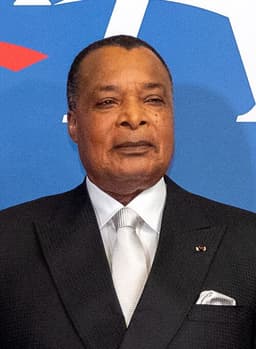
Denis Sassou-Nguesso
General · Modern
49.4Total

Julius Caesar
General · Ancient
82.8Total
Basic Information
Born
1943
-100
Died
—
-44
Era
Modern
Ancient
Nationality
Congo Republic
Roman Republic
Occupation
General
General
Civilization
Other
Western
Score Comparison
Military (10%)
10.2
88.0
Political (20%)
68.0
78.0
Influence (20%)
51.8
85.0
Legacy (20%)
46.7
82.0
Leadership (15%)
62.0
80.0
Strategy (15%)
42.3
85.0
TOTAL
49.4
82.8
Denis Sassou-Nguesso — Complete Timeline
1979 AD
Seized Power in CoupPolitical Action
Denis Sassou-Nguesso, a military officer, became President of the People's Republic of the Congo after a coup that ousted President Joachim Yhombi-Opango. He led the Congolese Party of Labour (PCT).
Coup d'étatCongoMilitary Rule
Impact: national
1990 AD
Transition to Multi-Party PoliticsReform◆ Major
Under pressure, Sassou-Nguesso's government introduced multi-party politics, ending the one-party Marxist-Leninist system. A national conference was held in 1991, leading to a transition to civilian rule.
Political ReformDemocracyCongo
Impact: national
1992 AD
Lost Presidential ElectionPolitical Action◆ Major
Sassou-Nguesso lost the 1992 presidential election to Pascal Lissouba. This was the first multi-party election in the country since independence, and Sassou-Nguesso peacefully handed over power.
ElectionDemocracyCongo
Impact: national
1997 AD
Returned to Power via Civil WarWar
Sassou-Nguesso's militia, backed by Angolan troops, captured Brazzaville, overthrowing President Pascal Lissouba. This ended a four-month civil war and returned Sassou-Nguesso to the presidency.
Civil WarCongoPower Struggle
Impact: nationaldestructive
2002 AD
Won Controversial Re-electionsPolitical Action◆ Major
Sassou-Nguesso won the 2002 presidential election with over 89% of the vote. The election was boycotted by major opposition candidates and criticized as neither free nor fair.
ElectionCongoControversy
Impact: national
2015 AD
Constitutional Referendum to Extend TermPolitical Action◆ Major
Sassou-Nguesso's government held a constitutional referendum that removed the age limit and two-term limit for the presidency. The change allowed him to run for re-election in 2016 and potentially remain in power.
Constitutional ReformCongoPower Consolidation
Impact: national
Julius Caesar — Complete Timeline
58 BC
Gallic WarsWar◆ Major
Caesar, as proconsul of Gaul, launched a series of campaigns that conquered all of Gaul (modern France, Belgium, and parts of Switzerland). He fought numerous battles, including against the Helvetii, the Belgae, and the Gallic chieftain Vercingetorix. The wars brought immense wealth and a loyal army to Caesar.
Gallic WarsConquestRoman Expansion
Impact: regional
49 BC
Crossing the RubiconPolitical Action◆ Major
Caesar led Legio XIII across the Rubicon River into Italy, defying the Roman Senate's order to disband his army. This act triggered a civil war against Pompey and the Optimates, ultimately leading to Caesar's dictatorship and the end of the Roman Republic.
Roman Civil WarEnd of RepublicPower Struggle
Impact: global
48 BC
Battle of PharsalusWar◆ Major
Caesar's outnumbered army defeated the larger forces of Pompey the Great at Pharsalus in Greece. Caesar's tactical use of a reserve line to counter Pompey's cavalry charge proved decisive. Pompey fled to Egypt, where he was assassinated, leaving Caesar as the undisputed master of the Roman world.
Roman Civil WarBattleDecisive Victory
Impact: regional
44 BC
Appointment as Dictator for LifePolitical Action◆ Major
The Roman Senate appointed Caesar dictator perpetuo (dictator for life), granting him unprecedented personal power. This move concentrated military, legislative, and judicial authority in one person, effectively ending the Roman Republic's traditional system of checks and balances and alarming many senators.
DictatorshipEnd of RepublicPower Consolidation
Impact: regionaldestructive
Assassination on the Ides of MarchPolitical Action◆ Major
A group of Roman senators, led by Marcus Junius Brutus and Gaius Cassius Longinus, stabbed Caesar to death at a meeting of the Senate in the Theatre of Pompey. The assassination was intended to restore the Republic, but instead triggered another civil war that led to the rise of the Roman Empire.
AssassinationRoman PoliticsEnd of Republic
Impact: globaldestructive
Expert Analysis
denis-sassou-nguesso-vs-julius-caesar
# The Dictator's Two Faces
On a raw March morning in 44 BCE, Julius Caesar fell beneath twenty-three dagger strokes in the Senate chamber of Rome, his blood pooling on the marble floor where he had once stood as the most powerful man in the Mediterranean. Nearly two thousand years later, in 1997, Denis Sassou-Nguesso watched from a military command post as his militia, backed by Angolan tanks, rolled into Brazzaville, crushing his rival and reclaiming a presidency he had lost five years earlier. One died at the peak of his ambition, betrayed by those he trusted. The other still rules today, having outlasted every challenger. Why did these two generals—both men who seized power through violence and transformed their nations—meet such different fates?
Origins
Caesar was born into the chaos of a dying republic. The year was 100 BCE, and Rome was tearing itself apart—slave revolts, civil wars, and the collapse of old aristocratic norms. His family, the Julii, claimed descent from Venus herself, but they were politically marginal, and Caesar’s father died when he was sixteen. He grew up in a world where ambition was the only currency that mattered, where a man could rise by eloquence, military glory, and ruthless political calculation. His education was Greek philosophy and Roman law; his playground was the Forum, where he watched rivals destroy each other with accusations and armies.
Sassou-Nguesso was born in 1943 in Oyo, a small town in what was then French Equatorial Africa. The Congo was a colony, its people subjects of a distant empire. He grew up in a world where power came from the barrel of a gun and the favor of foreign patrons. There was no republican tradition, no civic culture of debate—only the colonial administration and the emerging independence movements that would soon tear across Africa. He joined the French army, learned to fight, and returned to a newly independent Congo that was already sliding into coups and chaos. His education was military discipline and survival; his playground was the barracks.
Rise to Power
Caesar’s path was a masterclass in strategic patience. He served as a military tribune, then quaestor, then aedile, spending his own borrowed fortune on gladiatorial games to win the love of the Roman mob. He forged the First Triumvirate with Pompey and Crassus, the two most powerful men in Rome, and then extracted the governorship of Gaul as his reward. For eight years, from 58 to 50 BCE, he conquered a territory larger than Italy itself, building an army loyal to him alone. When the Senate ordered him to disband his legions, he crossed the Rubicon River in 49 BCE—an act of war against his own republic. He defeated Pompey, crushed his enemies, and made himself dictator.
Sassou-Nguesso’s rise was faster and cruder. In 1979, he was a military officer in a Marxist-Leninist state that had already seen several coups. When President Marien Ngouabi was assassinated, the ruling party needed a new strongman. Sassou-Nguesso seized the moment, taking power not through battlefield genius but through factional maneuvering within a single-party system. He became president of the People’s Republic of the Congo at age thirty-six, inheriting a bankrupt economy and a population traumatized by political violence. There was no Rubicon moment—only a quiet, bloodless transition from one uniformed ruler to another.
Leadership & Governance
Caesar governed with a vision that still shapes the West. He reformed the calendar, creating the Julian calendar we use today with only minor adjustments. He granted citizenship to provincials, expanded the Senate to include Gauls and Spaniards, and launched massive public works to employ Rome’s poor. His military genius was legendary—at Alesia in 52 BCE, he defeated a Gallic army three times his size by building a ring of fortifications around both the besieged city and the relief force outside. He was brutal when necessary, crucifying pirates and slaughtering tribes that resisted, but he was also merciful, pardoning rivals like Cicero and Brutus. His fatal flaw was his belief that his genius could transcend the republic’s institutions.
Sassou-Nguesso governed with a narrower vision: survival. He maintained power through a blend of patronage, ethnic favoritism, and foreign backing. In 1990, when the Soviet Union collapsed and his Marxist ideology lost its patron, he reluctantly introduced multi-party politics. In 1992, he lost the election to Pascal Lissouba—a rare moment of democratic transition in Africa. But Sassou-Nguesso did not accept defeat. He retreated to his northern stronghold, built a militia from his Mbochi ethnic group, and waited. In 1997, with Angolan troops and French support, he returned to Brazzaville in a civil war that killed thousands. His subsequent elections, winning over 89% of the vote in 2002, were boycotted by the opposition and widely considered fraudulent. In 2015, he changed the constitution to remove term limits—a move that Caesar never needed, because the Senate had already made him dictator for life.
Triumph & Tragedy
Caesar’s greatest moment was his triumph—literally. In 46 BCE, he celebrated four triumphs in Rome for his victories in Gaul, Egypt, Pontus, and Africa, parading captives and treasures through the streets. His greatest tragedy was the Ides of March, 44 BCE, when sixty senators, many of them men he had pardoned, stabbed him to death. He was fifty-five years old, at the height of his power, and he died because he had centralized power so completely that the republic’s defenders saw no other way to stop him.
Sassou-Nguesso’s greatest moment was his return in 1997, when he reclaimed the presidency he had lost. His greatest tragedy is less dramatic but more enduring: he has presided over a country rich in oil where most people live in poverty, where corruption is endemic, and where political opponents are routinely jailed. He has outlived Caesar by decades, but his legacy is a nation that has never known peaceful democratic transition.
Character & Destiny
Caesar was driven by an insatiable hunger for glory. He wept at the statue of Alexander the Great because Alexander had conquered the world by age thirty, while Caesar felt he had done nothing. He took risks that bordered on recklessness—crossing the Rubicon, pardoning enemies, dismissing his bodyguard. He believed in his own star. That belief made him great and killed him.
Sassou-Nguesso is driven by a more primal instinct: the will to endure. He has no grand vision, no cultural reforms, no calendar named after him. He is a survivor in a continent where leaders are often overthrown or assassinated. He has learned to adapt—from Marxist to capitalist, from one-party ruler to elected autocrat. His caution has kept him alive.
Legacy
Caesar’s legacy is the Roman Empire, which his adopted son Octavian built on the ruins of the republic. His name became a title—Kaiser, Tsar—for emperors and dictators for two millennia. His writings, especially his *Commentaries on the Gallic War*, are still read as masterpieces of military literature. He is remembered as both a tyrant and a visionary, the man who killed the republic and created the empire.
Sassou-Nguesso’s legacy is less certain. He is still in power, still rewriting constitutions, still clinging to a presidency that he first seized forty-four years ago. He will be remembered, if at all, as a typical African strongman—a man who mastered the art of survival but left his country no better than he found it. His scores, in the cold calculus of historical assessment, are middling: a military rating of 19.9 against Caesar’s 88, a leadership score of 72 against Caesar’s 82. He is, by any measure, a lesser figure.
Conclusion
The difference between these two men is not just time and place—it is the difference between ambition that built an empire and ambition that merely preserved a throne. Caesar, for all his flaws, transformed the world. Sassou-Nguesso has only transformed himself. One died for his vision; the other lives for his power. History remembers both, but it remembers them very differently. The Ides of March was a tragedy; the endless presidency is a cautionary tale.
Rankings
🥇
Julius CaesarLeader
Mil: 88.0Pol: 78.0Inf: 85.0
82.8
🥈
Denis Sassou-Nguesso
Mil: 10.2Pol: 68.0Inf: 51.8
49.4
+33.4 behind
How This Comparison Works
Algorithm
Each figure is scored on 6 dimensions (0—100 scale) based on structured historical data: Military (10%), Political (20%), Influence (20%), Legacy (20%), Leadership (15%), Strategy (15%). The weighted total produces the final ranking.
Data Sources
Scores are computed from structured sub-indicators in the database. Scale factors adjust for era (Ancient ×0.85, Modern ×1.0) and civilization size (Eastern ×1.05, Other ×0.80) to account for differences in population and military scale.
Maximum 3 Figures
Comparisons are limited to 2—3 figures to ensure readability and statistical meaningfulness.
Error Margins
±5 points per dimension — Sub-scores are derived from historical records with inherent uncertainty. Two figures within 5 points on a dimension should be considered roughly equivalent in that area.
Total Score Accuracy
±3 points overall — The weighted combination of 6 dimensions produces a total score with approximately ±3 points of uncertainty. Differences of less than 3 points are not statistically significant— the figures are effectively tied.
Known Limitations
- Historical records are incomplete and uneven across civilizations
- Figures from oral-tradition societies may be underrepresented
- Occupation labels can misclassify multi-role figures
- Scores measure capability and impact, not moral character
- Quantitative scoring is a comparison tool, not absolute truth
Capability Radar
Military (10%) — Battles & Warfare
Battles
5
95
Win Rate
5
92
Expansion
5
97
Political (20%) — Governance & Reform
Reform
30
90
Diplomacy
50
85
Economy
30
82
Influence (20%) — Cultural & Global Reach
Cultural
20
88
Global
20
94
Legacy (20%) — Historical Impact
Historical
30
95
Longevity
40
96
Leadership (15%) — Power & Stability
Tenure
70
75
Stability
20
60
Strategy (15%) — Tactics & Innovation
Strategy
5
94
Tactics
5
96
Reform
10
88
Similar Comparisons
Comments & Discussion
Emperor's Shadow6/17/2026
Calling this a comparison is like comparing a thunderstorm to a leaky faucet. Caesar conquered Gaul with legions that invented modern warfare; Sassou-Nguesso won a coup with Angolan loaner tanks. The real difference isn't fate—it's scale. Caesar's assassination changed the world. If Sassou-Nguesso fell tomorrow, Brazzaville might shrug. That's not a dictator's two faces; that's one man who rewrote history and another who just held a chair. Power isn't the same as significance.
数据拆解者6/17/2026
这对比数据上全是硬伤。凯撒被刺时罗马人口超百万,直接卷入地中海全球贸易网,他的死引发十年内战,影响到庞培、西塞罗等历史巨人。而萨苏-恩格索1997年政变中刚果才300万人,人均GDP不到500美元,他的政权更替除了法国和安哥拉几乎无人关注。把两人并列就像拿纽约证交所对比村里猪肉摊——规模差了两个文明层级。别被“独裁者”这个词骗了,统计学上根本没法平等对比。
Paradox of Blood6/17/2026
Here's the uncomfortable truth Caesar's fans ignore: he got what he earned. March 15 wasn't a tragedy—it was the bill for crossing the Rubicon. He broke the Republic's rules and sixty senators wrote the receipt in blood. But Sassou-Nguesso understood something Caesar never did: family. He put his son Denis-Christel in charge of the economy, his clan controls security, and they backed Angolan tanks with their own flesh. Caesar trusted Brutus. Sassou-Nguesso trusts blood. That's why one died and o
青铜剑与石油钻6/17/2026
拿罗马和刚果对比,你们这些学院派真会偷懒。凯撒面对的是制度化腐败的元老院,他有西塞罗、加图这样的对手,要辩论要写《高卢战记》给自己造势。萨苏-恩格索呢?1979年靠军变上台,1997年靠安哥拉坦克夺回政权,对手是谁?帕斯卡·利苏巴?一个连银行都管不住的前总理。我没说凯撒更伟大,但至少他的独裁是帝国主义的顶点,萨苏不过是非洲雨林里一个会说法语的军阀。别拿楚河汉界当太平洋比了。
Tribune of the Forgotten6/17/2026
我最烦这种把凯撒当偶像的论调。凯撒杀了上百万高卢人,把奴隶制推向高峰,还把罗马彻底变成帝国机器。萨苏-恩格索至少是非洲第一代独立领导人的继承者,他统治的刚果虽然穷,但没像凯撒那样搞种族灭绝。说两人都是