Loading...
Denis Sassou-Nguesso vs Deodoro da Fonseca
Denis Sassou-Nguesso leads by 0.6 pts · 2 figures compared
…
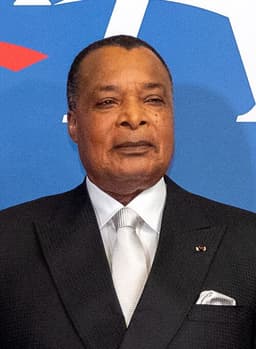
Denis Sassou-Nguesso
General · Modern
49.4Total
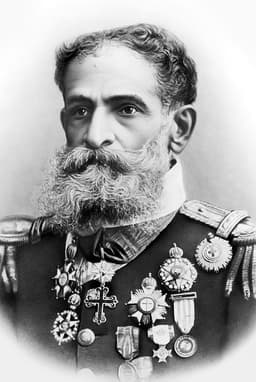
Deodoro da Fonseca
General · Modern
48.8Total
Basic Information
Born
1943
1827
Died
—
1892
Era
Modern
Modern
Nationality
Congo Republic
Brazil
Occupation
General
General
Civilization
Other
Western
Score Comparison
Military (10%)
10.2
50.0
Political (20%)
68.0
45.1
Influence (20%)
51.8
54.1
Legacy (20%)
46.7
44.2
Leadership (15%)
62.0
57.6
Strategy (15%)
42.3
38.6
TOTAL
49.4
48.8
Denis Sassou-Nguesso — Complete Timeline
1979 AD
Seized Power in CoupPolitical Action
Denis Sassou-Nguesso, a military officer, became President of the People's Republic of the Congo after a coup that ousted President Joachim Yhombi-Opango. He led the Congolese Party of Labour (PCT).
Coup d'étatCongoMilitary Rule
Impact: national
1990 AD
Transition to Multi-Party PoliticsReform◆ Major
Under pressure, Sassou-Nguesso's government introduced multi-party politics, ending the one-party Marxist-Leninist system. A national conference was held in 1991, leading to a transition to civilian rule.
Political ReformDemocracyCongo
Impact: national
1992 AD
Lost Presidential ElectionPolitical Action◆ Major
Sassou-Nguesso lost the 1992 presidential election to Pascal Lissouba. This was the first multi-party election in the country since independence, and Sassou-Nguesso peacefully handed over power.
ElectionDemocracyCongo
Impact: national
1997 AD
Returned to Power via Civil WarWar
Sassou-Nguesso's militia, backed by Angolan troops, captured Brazzaville, overthrowing President Pascal Lissouba. This ended a four-month civil war and returned Sassou-Nguesso to the presidency.
Civil WarCongoPower Struggle
Impact: nationaldestructive
2002 AD
Won Controversial Re-electionsPolitical Action◆ Major
Sassou-Nguesso won the 2002 presidential election with over 89% of the vote. The election was boycotted by major opposition candidates and criticized as neither free nor fair.
ElectionCongoControversy
Impact: national
2015 AD
Constitutional Referendum to Extend TermPolitical Action◆ Major
Sassou-Nguesso's government held a constitutional referendum that removed the age limit and two-term limit for the presidency. The change allowed him to run for re-election in 2016 and potentially remain in power.
Constitutional ReformCongoPower Consolidation
Impact: national
Deodoro da Fonseca — Complete Timeline
1889 AD
Proclamation of the Brazilian RepublicPolitical Action
Deodoro da Fonseca led a military coup that overthrew Emperor Pedro II on November 15, 1889. He proclaimed the Republic of the United States of Brazil, ending 67 years of imperial rule.
CoupRepublic
Impact: globalprogressive
1891 AD
Election as First President of BrazilPolitical Action◆ Major
Deodoro da Fonseca was elected the first President of Brazil by the Constituent Congress on February 25, 1891. He took office under the new republican constitution, but his rule was brief and authoritarian.
ElectionPresidency
Impact: national
Dissolution of the National CongressPolitical Action◆ Major
Facing political opposition, Deodoro da Fonseca dissolved the National Congress on November 3, 1891, and declared a state of siege. This authoritarian act triggered a naval revolt and his eventual resignation.
AuthoritarianismPolitical Crisis
Impact: nationaldestructive
Resignation from the PresidencyPolitical Action◆ Major
Deodoro da Fonseca resigned the presidency on November 23, 1891, after a naval rebellion threatened his government. He handed power to Vice President Floriano Peixoto, ending his 9-month rule.
ResignationPolitical Crisis
Impact: nationaltragic
Expert Analysis
Deodoro da Fonseca vs Denis Sassou-Nguesso
# The General as President: Two Paths from Barracks to Power
On a November morning in 1891, Brazil’s first president, a grizzled general named Deodoro da Fonseca, sat alone in his office in Rio de Janeiro, staring at a resignation letter. Just two years earlier, he had led a bloodless coup that toppled an emperor and inaugurated a republic. Now, after only nine months in office, he was abandoning the presidency, undone by his own authoritarian impulses. Half a world away and nearly a century later, another general, Denis Sassou-Nguesso of the Republic of Congo, would face no such moment of surrender. When he lost power in 1992, he simply waited five years, raised an army, and took it back by force. What separates a general who surrenders power from one who claws his way back? The answer lies not in the uniform they wore, but in the worlds they governed.
Origins
Manuel Deodoro da Fonseca was born in 1827 in Alagoas, a poor province of the Brazilian Empire, into a military family with a tradition of service. The empire he grew up in was a sprawling, slaveholding monarchy, the only one in the Americas, and its army was a conservative institution that saw itself as the guarantor of order. Fonseca rose through the ranks fighting in the Paraguayan War, a brutal conflict that forged a generation of officers who believed the military should modernize Brazil—by force if necessary. He was a man of the 19th century, shaped by positivism and the conviction that progress required strong, enlightened leadership.
Denis Sassou-Nguesso was born in 1943 in the village of Edou, in what was then French Equatorial Africa. His world was one of colonial exploitation, ethnic rivalries, and Cold War maneuvering. The Congo that emerged from French rule in 1960 was a patchwork of competing factions, with oil wealth concentrated in the hands of a few. Sassou-Nguesso joined the army, trained in French and Soviet military academies, and watched as one coup followed another. He learned early that in postcolonial Africa, power was not a trust to be held but a prize to be seized.
Rise to Power
Fonseca’s path to power was accidental. He did not plot to overthrow the emperor; he was drafted into the role. In November 1889, a conspiracy of republican officers and civilian intellectuals needed a figurehead—a respected general who could lend legitimacy to their coup. Fonseca, ill and reluctant, was persuaded to lead the revolt. On November 15, he marched his troops through Rio, and Emperor Pedro II abdicated without a shot. Fonseca became head of the provisional government not because he wanted the presidency, but because no one else could hold the army together.
Sassou-Nguesso’s rise was deliberate. In 1979, at the age of 36, he seized power in a coup that ousted the previous military ruler. He was not a reluctant figurehead but an ambitious officer who understood that in Congo, the presidency was the only game worth playing. He quickly consolidated control, transforming the country into a Marxist-Leninist one-party state, with himself as the unchallenged leader. Where Fonseca stumbled into history, Sassou-Nguesso marched straight toward it.
Leadership & Governance
Fonseca governed as a soldier, not a statesman. His brief presidency was a series of missteps. He ruled by decree, alienated the civilian politicians who had supported the republic, and when the Constituent Congress produced a constitution that limited his powers, he simply dissolved the legislature on November 3, 1891. It was a classic military reflex—when politics becomes messy, crush it. But Brazil was not a barracks. A naval rebellion forced his hand, and within weeks he resigned, muttering that he was “tired of governing men who did not know how to be governed.”
Sassou-Nguesso, by contrast, proved a master of political survival. He understood that power required more than guns. When the Cold War ended and pressure for democracy mounted, he did not fight. In 1990, he announced a transition to multi-party politics, ending the Marxist-Leninist system. He lost the 1992 election to Pascal Lissouba, but he did not disappear. He retreated, regrouped, and waited. In 1997, with Angolan troops backing his militia, he stormed Brazzaville and overthrew Lissouba. He then won controversial elections in 2002 with over 89% of the vote, and in 2015, he changed the constitution to remove term limits. He learned what Fonseca never did: that a general must sometimes wear a civilian mask.
Triumph & Tragedy
Fonseca’s greatest triumph was the republic itself. He ended the Brazilian Empire, a dynasty that had ruled for 67 years, and did so with almost no bloodshed. His tragedy was that he could not govern what he had created. He was a liberator who became a liability, a man who could destroy a throne but not build a democracy.
Sassou-Nguesso’s triumph is longevity. He has ruled Congo for over four decades, surviving the collapse of the Soviet Union, civil war, and international condemnation. His tragedy is the cost. The 1997 civil war killed thousands, and his governance has been marked by corruption, repression, and the squandering of oil wealth. He is a survivor, but survival has come at a price.
Character & Destiny
Fonseca was a man of honor and limits. He resigned because he could not bear to plunge Brazil into civil war. He was authoritarian by instinct but not by conviction—when his back was against the wall, he chose peace over power. Sassou-Nguesso is a man of iron will and no limits. He has never chosen peace over power. He has chosen power, always, and let peace come as it may.
Their scores reflect this. Fonseca’s Military score of 35.9 suggests a general who was more figure than fighter; his Political score of 77.9 shows a man who understood the moment but not the mechanics of governance. Sassou-Nguesso’s Leadership score of 72.0 and Political score of 61.2 reveal a different kind of talent: not the skill to build institutions, but the cunning to outlast every rival.
Legacy
Fonseca is remembered as a flawed founder, a necessary if imperfect figure in Brazil’s journey from empire to republic. His face is on the national currency, but his name is not revered. Sassou-Nguesso’s legacy is still being written, but it is unlikely to be kind. He has outlasted every opponent, but history may judge him as a man who held his country back, who chose his own survival over his people’s prosperity.
Conclusion
In the end, the difference between these two generals is not one of ability but of context. Fonseca governed a country with institutions, a press, and a civil society that could push back. Sassou-Nguesso governed a country where the state was the prize and power was the only law. One resigned because he could not bear the cost of staying; the other returned because he could not imagine leaving. The uniform was the same. The world was not.
Rankings
🥇
Denis Sassou-NguessoLeader
Mil: 10.2Pol: 68.0Inf: 51.8
49.4
🥈
Deodoro da Fonseca
Mil: 50.0Pol: 45.1Inf: 54.1
48.8
+0.6 behind
How This Comparison Works
Algorithm
Each figure is scored on 6 dimensions (0—100 scale) based on structured historical data: Military (10%), Political (20%), Influence (20%), Legacy (20%), Leadership (15%), Strategy (15%). The weighted total produces the final ranking.
Data Sources
Scores are computed from structured sub-indicators in the database. Scale factors adjust for era (Ancient ×0.85, Modern ×1.0) and civilization size (Eastern ×1.05, Other ×0.80) to account for differences in population and military scale.
Maximum 3 Figures
Comparisons are limited to 2—3 figures to ensure readability and statistical meaningfulness.
Error Margins
±5 points per dimension — Sub-scores are derived from historical records with inherent uncertainty. Two figures within 5 points on a dimension should be considered roughly equivalent in that area.
Total Score Accuracy
±3 points overall — The weighted combination of 6 dimensions produces a total score with approximately ±3 points of uncertainty. Differences of less than 3 points are not statistically significant— the figures are effectively tied.
Known Limitations
- Historical records are incomplete and uneven across civilizations
- Figures from oral-tradition societies may be underrepresented
- Occupation labels can misclassify multi-role figures
- Scores measure capability and impact, not moral character
- Quantitative scoring is a comparison tool, not absolute truth
Capability Radar
Military (10%) — Battles & Warfare
Battles
5
20
Win Rate
5
25
Expansion
5
10
Political (20%) — Governance & Reform
Reform
30
40
Diplomacy
50
25
Economy
30
15
Influence (20%) — Cultural & Global Reach
Cultural
20
20
Global
20
15
Legacy (20%) — Historical Impact
Historical
30
35
Longevity
40
20
Leadership (15%) — Power & Stability
Tenure
70
30
Stability
20
10
Strategy (15%) — Tactics & Innovation
Strategy
5
25
Tactics
5
20
Reform
10
15
Similar Comparisons
Comments & Discussion
SABRE-BRAND GENERAL6/16/2026
Deodoro was a paper tiger who couldn't handle real heat. He literally dissolved Congress and then cried when people pushed back—resigned after nine months like a petulant child. Meanwhile, Sassou-Nguesso lost an election in '92, vanished for five years, and rolled back into Brazzaville with militias. One couldn't stomach an uprising; the other engineered a comeback. That's the difference between a classical coup plotter and a hardened warlord. Deodoro would've been eaten alive in Congolese polit
STATS OVER SYMBOLS6/16/2026
Let's talk numbers: Deodoro's "reign" lasted 284 days. He inherited a unified Brazil with functioning institutions and still choked. Sassou-Nguesso held power from 1979, lost it cleanly in '92, then retook it in '97 and stays president as of 2024—that's over 40 years combined. One couldn't survive a single budget cycle; the other survived electoral defeat and a civil war. Deodoro was a transitional figure, a speed bump in history. Sassou is a survivalist with real staying power.
STRUCTURAL DETERMINIST6/16/2026
Comparing these two is like comparing a firecracker to a landmine—different eras, different institutional soils. Deodoro governed post-empire Brazil where civil society had teeth; the oligarchs of São Paulo could simply refuse to cooperate. Congo under Sassou had no such counterweights—no independent courts, no press, no rival economic centers. Deodoro's authoritarianism failed because Brazil had competing power centers. Sassou's succeeded because he dismantled them first. The man doesn't make t
POSITIVISM POSTMORTEM6/16/2026
Deodoro actually believed in something—Auguste Comte's "Order and Progress" was literally on his flag. He thought the military could scientifically engineer a modern republic. Sassou just wants power. Full stop. Deodoro quoted philosophers; Sassou cut deals with Elf Aquitaine. One was a tragically naive reformer who couldn't stomach the brutality his ideology required. The other is a pure pragmatist who never flinched. Deodoro died in disgrace two years after resigning; Sassou is still in charge
德奥多罗的悲剧6/16/2026
德奥多罗是19世纪最后一位理想主义军人总统,他