Loading...
Colin Powell vs Prem Tinsulanonda
Colin Powell leads by 1.3 pts · 2 figures compared
…

Colin Powell
General · Modern
58.5Total
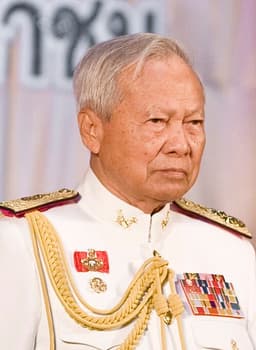
Prem Tinsulanonda
General · Modern
57.2Total
Basic Information
Born
1937
1920
Died
—
—
Era
Modern
Modern
Nationality
United States
Thailand
Occupation
General
General
Civilization
Western
Eastern
Score Comparison
Military (10%)
25.0
50.0
Political (20%)
68.0
59.3
Influence (20%)
68.0
54.9
Legacy (20%)
52.0
47.5
Leadership (15%)
72.0
78.0
Strategy (15%)
50.0
60.0
TOTAL
58.5
57.2
Colin Powell — Complete Timeline
1987 AD
Appointed National Security AdvisorPolitical Action◆ Major
Powell was appointed National Security Advisor by President Ronald Reagan in November 1987, serving until January 1989. He coordinated foreign policy and national security matters, including arms control negotiations with the Soviet Union and the Iran-Iraq War, becoming the first African American in this role.
National SecurityReagan AdministrationForeign Policy
Impact: global
1989 AD
Became Chairman of the Joint Chiefs of StaffOther◆ Major
On October 1, 1989, Powell became the 12th Chairman of the Joint Chiefs of Staff, the first African American to hold the position. He oversaw U.S. military operations during the invasion of Panama (1989) and the Gulf War (1990-1991), becoming a highly visible public figure.
Military LeadershipGulf WarFirst African American
Impact: global
1990 AD
Developed the Powell DoctrineOther◆ Major
During the Gulf War planning, Powell articulated the Powell Doctrine, which stated that U.S. military force should only be used as a last resort, with overwhelming force, clear objectives, and an exit strategy. This doctrine influenced U.S. military interventions for the next decade.
Military DoctrineGulf WarStrategic Thinking
Impact: global
2001 AD
Appointed Secretary of StatePolitical Action◆ Major
On January 20, 2001, Powell was confirmed as the 65th U.S. Secretary of State under President George W. Bush, becoming the first African American to hold the office. He advocated for diplomacy and multilateralism, but his influence waned after the September 11 attacks.
DiplomacyBush AdministrationFirst African American
Impact: global
2003 AD
Presented Iraq WMD Case to the UN Security CouncilOther◆ Major
On February 5, 2003, Powell addressed the UN Security Council, presenting evidence that Iraq possessed weapons of mass destruction. The intelligence later proved to be inaccurate, damaging Powell's reputation and becoming a major controversy that he later called a 'blot' on his record.
Iraq WarUN SpeechControversy
Impact: globaldestructive
2004 AD
Resigned as Secretary of StateOther◆ Major
Powell resigned as Secretary of State on November 15, 2004, after President Bush's re-election. His departure was widely seen as a result of policy disagreements with Vice President Cheney and Secretary of Defense Rumsfeld, particularly over the conduct of the Iraq War.
ResignationIraq WarBush Administration
Impact: national
Prem Tinsulanonda — Complete Timeline
1980 AD
Appointed Prime Minister after a coupPolitical Action◆ Major
Prem Tinsulanonda was appointed Prime Minister of Thailand by the military after a coup. He served for over eight years, overseeing a period of political stability and economic growth.
Prime MinisterMilitary RuleStability
Impact: national
1981 AD
Survived a coup attemptPolitical Action◆ Major
Prem survived a coup attempt by military officers loyal to the 'Young Turks' faction. The coup failed due to lack of support and the loyalty of key military units, allowing Prem to remain in power.
Coup AttemptPolitical CrisisMilitary
Impact: national
1988 AD
Resigned as Prime MinisterPolitical Action◆ Major
Prem resigned as Prime Minister after the general election, handing over power to a civilian government led by Chatichai Choonhavan. His resignation marked a rare peaceful transition of power in Thai politics.
ResignationDemocratic TransitionPeaceful
Impact: nationalconstructive
2016 AD
Appointed Regent of ThailandPolitical Action
After the death of King Bhumibol, Prem was appointed Regent of Thailand until the ascension of King Maha Vajiralongkorn. He served as a key figure in the transition of the monarchy.
RegentMonarchyTransition
Impact: national
Expert Analysis
Prem Tinsulanonda vs Colin Powell
# The General Who Served Two Kings
On a sweltering April morning in 1981, General Prem Tinsulanonda sat in his Bangkok office, a cup of tea cooling untouched before him. Outside, tanks rolled through the streets—not in his defense, but to unseat him. The coup plotters, young military officers who had once been his allies, believed they could end his premiership in a single morning. They were wrong. Half a world away and sixteen years later, another general stood before the United Nations Security Council, a vial of what he claimed was anthrax in his hand. Colin Powell, the most admired military man in America, was about to make the case for war. Both men were generals who became statesmen. One would leave power with his reputation intact; the other would watch his legacy crumble in the dust of Baghdad.
Origins
Prem Tinsulanonda was born in 1920 in Songkhla, a coastal province in southern Thailand, into a family of modest means. His father was a schoolteacher, his mother a homemaker. The young Prem grew up under the shadow of absolute monarchy, watching King Rama VII struggle with the forces of modernization and military coups. By the time he graduated from the Chulachomklao Royal Military Academy, Thailand had already experienced a dozen coups. Instability was the water he swam in.
Colin Powell arrived in 1937 in Harlem, New York, the son of Jamaican immigrants. His father worked as a shipping clerk, his mother as a seamstress. The Depression-era Bronx where Powell grew up was a world away from Bangkok's dusty barracks, but it taught him a similar lesson: survival required adaptability. Powell discovered the Army as a path to dignity and advancement in a country still segregated by race. He joined ROTC at City College, a decision that would define his life.
Rise to Power
Prem's ascent was slow, deliberate, and deeply tied to the Thai military's internal politics. He served in the Korean War as a young officer, but his real education came in the 1960s and 1970s, when he navigated the shifting alliances of Thai generals who treated power like a game of musical chairs. By 1980, when a coup brought him to the premiership, Prem was 60 years old—a man who had learned that patience, not brilliance, wins in Bangkok.
Powell's rise was faster and more spectacular. He served two tours in Vietnam, where he witnessed the collapse of American strategy firsthand. Unlike Prem, who climbed through factional loyalty, Powell climbed through bureaucratic competence. He caught the eye of powerful mentors—Casper Weinberger, Frank Carlucci—who saw in him a rare combination of military discipline and political savvy. By 1989, at age 52, he became the youngest Chairman of the Joint Chiefs of Staff in American history, and the first African American to hold the post.
Leadership & Governance
Prem governed Thailand from 1980 to 1988 with the instincts of a tightrope walker. He understood that Thai democracy was a fragile plant growing in a garden of generals. His strategy was to give the military enough power to feel secure, but not enough to overthrow him. He survived the 1981 coup attempt not by crushing his enemies, but by outwaiting them—King Bhumibol Adulyadej's quiet support proved decisive. Prem's political wisdom was simple: never appear to want power too much. He dressed modestly, spoke softly, and let others take credit.
Powell's leadership was built on the opposite principle: clarity, force, and the projection of competence. As Chairman of the Joint Chiefs, he oversaw the 1991 Gulf War, a campaign that seemed to prove his doctrine of overwhelming force. His political wisdom, however, was more fragile than it appeared. The Powell Doctrine—use military force only as a last resort, with clear objectives and an exit strategy—sounded wise, but it assumed that policymakers would listen. They did not.
Triumph & Tragedy
Prem's greatest moment was also his quietest: in 1988, after eight years in power, he resigned. He called an election, watched a civilian government take over, and stepped aside. In a country where generals typically clung to power until ousted by other generals, this was revolutionary. His tragedy was less dramatic—a slow decline into irrelevance, watching successors undo his careful balancing act.
Powell's triumph was the Gulf War, where he became the face of American military might. His tragedy was the Iraq War. In February 2003, he stood before the UN Security Council and made the case for invasion based on intelligence he had been told was solid. It was not. The speech destroyed his credibility and haunted him until his death. The general who had built his career on trust found himself trusted no more.
Character & Destiny
Prem's character was shaped by Thai Buddhism and the monarchy. He believed in harmony, hierarchy, and the virtue of invisibility. "A leader who is seen too much is a leader who will fall," he once told an aide. His destiny was to serve the king, not himself.
Powell's character was shaped by the American dream and the military's meritocracy. He believed in achievement, visibility, and the power of a good reputation. "I can't tell you how many times I've been wrong," he said in his memoir, "but I can tell you how many times I've admitted it: not enough." His destiny was to rise higher than any Black American before him—and to fall farther.
Legacy
Today, Prem Tinsulanonda is remembered in Thailand as a stabilizing force, a regent who held the kingdom together after King Bhumibol's death in 2016. His legacy is the peaceful transition he engineered, a rare achievement in Thai politics.
Colin Powell's legacy is more contested. He is remembered as a trailblazer, a man of dignity, and a cautionary tale. The UN speech is his epitaph. Two generals, two paths, two outcomes. One chose silence and survived; the other chose speech and was destroyed.
Conclusion
What separates these two men is not talent or ambition—both had those in abundance. It is the relationship between the general and the state they served. Prem served a monarchy that transcended politics, allowing him to step back. Powell served a democracy that demanded he step forward, even when the ground was unstable. In the end, the general who learned to disappear left the deeper mark. The one who learned to speak was silenced by his own words.
Rankings
🥇
Colin PowellLeader
Mil: 25.0Pol: 68.0Inf: 68.0
58.5
🥈
Prem Tinsulanonda
Mil: 50.0Pol: 59.3Inf: 54.9
57.2
+1.3 behind
How This Comparison Works
Algorithm
Each figure is scored on 6 dimensions (0—100 scale) based on structured historical data: Military (10%), Political (20%), Influence (20%), Legacy (20%), Leadership (15%), Strategy (15%). The weighted total produces the final ranking.
Data Sources
Scores are computed from structured sub-indicators in the database. Scale factors adjust for era (Ancient ×0.85, Modern ×1.0) and civilization size (Eastern ×1.05, Other ×0.80) to account for differences in population and military scale.
Maximum 3 Figures
Comparisons are limited to 2—3 figures to ensure readability and statistical meaningfulness.
Error Margins
±5 points per dimension — Sub-scores are derived from historical records with inherent uncertainty. Two figures within 5 points on a dimension should be considered roughly equivalent in that area.
Total Score Accuracy
±3 points overall — The weighted combination of 6 dimensions produces a total score with approximately ±3 points of uncertainty. Differences of less than 3 points are not statistically significant— the figures are effectively tied.
Known Limitations
- Historical records are incomplete and uneven across civilizations
- Figures from oral-tradition societies may be underrepresented
- Occupation labels can misclassify multi-role figures
- Scores measure capability and impact, not moral character
- Quantitative scoring is a comparison tool, not absolute truth
Capability Radar
Military (10%) — Battles & Warfare
Battles
35
20
Win Rate
40
25
Expansion
20
10
Political (20%) — Governance & Reform
Reform
40
55
Diplomacy
70
60
Economy
30
50
Influence (20%) — Cultural & Global Reach
Cultural
55
30
Global
65
30
Legacy (20%) — Historical Impact
Historical
60
40
Longevity
45
35
Leadership (15%) — Power & Stability
Tenure
65
65
Stability
55
60
Strategy (15%) — Tactics & Innovation
Strategy
55
30
Tactics
45
30
Reform
60
35
Similar Comparisons
Comments & Discussion
GENERAL SAWBLADE6/16/2026
Prem knew how to play the long game because he understood Thai political chess—where the king is the ultimate king. Powell, for all his military brilliance, got played by Cheney and Rumsfeld. One refused to take power when it was offered; the other lent his credibility to a WMD lie. That anthrax vial wasn't just bad intel—it was Powell's Vietnam.|
铁马冰河6/16/2026
一个是九世王的盾牌,四次政变都稳如泰山;一个是五角大楼的脸面,一瓶洗衣粉毁了一世英名。Prem的智慧在于分清什么是场面什么才是权力。Powell输就输在他以为参加内阁会议和指挥作战是一回事。|
THE DATA SKEPTIC6/16/2026
Let's be real: Powell didn't walk into that UN presentation alone. Forty intelligence agencies signed off on those WMD claims. Prem's advantage? He ruled at a time when facts still mattered more than narratives. One man's Iraq disaster was a systemic failure; the other's survived because Thai politics was small enough for personal trust to override institutional rot.|
暗箭难防6/16/2026
说Prem清廉?他掌权二十多年,军方和地方势力盘根错节谁也不敢碰。Powell至少愿意为他人的错误买单,这才是真军人。要我说,Prem更像一个穿着军装的政客,而Powell是一个披着西装的上将。两种活法,两套标准。|
CLASSICS CORNER6/16/2026
Both men inherited crisis systems—Thailand's perpetual coup cycle and America's imperial overreach. Powell quoted Thucydides but acted like Machiavelli's fool: he forgot that credibility is the general's only non-renewable resource. Prem, quieter, absorbed Sun Tzu: the supreme art of war is to subdue the enemy without fighting. One general lost his reputation in a speech; the other secured his by staying silent at the right moments.|
骑墙不下马6/16/2026
你拿Powell和Prem比,简直是把CIA局长和省委书记放在一起聊。Prem的泰国是个围城,城门能关能开;Powell的美国是个棋盘,每走一步都要被放大镜审视。Prem输得起,Powell输不起。这就是为什么一个退休后还能当摄政王,另一个只能写回忆录。|