Loading...
Colin Powell vs Huang Xing
Colin Powell leads by 1.0 pts · 2 figures compared
…

Colin Powell
General · Modern
58.5Total
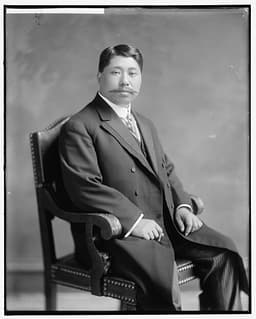
Huang Xing
General · Modern
57.5Total
Basic Information
Born
1937
1874
Died
—
1916
Era
Modern
Modern
Nationality
United States
China
Occupation
General
General
Civilization
Western
Eastern
Score Comparison
Military (10%)
25.0
46.7
Political (20%)
68.0
53.8
Influence (20%)
68.0
62.0
Legacy (20%)
52.0
56.0
Leadership (15%)
72.0
62.0
Strategy (15%)
50.0
60.0
TOTAL
58.5
57.5
Colin Powell — Complete Timeline
1987 AD
Appointed National Security AdvisorPolitical Action◆ Major
Powell was appointed National Security Advisor by President Ronald Reagan in November 1987, serving until January 1989. He coordinated foreign policy and national security matters, including arms control negotiations with the Soviet Union and the Iran-Iraq War, becoming the first African American in this role.
National SecurityReagan AdministrationForeign Policy
Impact: global
1989 AD
Became Chairman of the Joint Chiefs of StaffOther◆ Major
On October 1, 1989, Powell became the 12th Chairman of the Joint Chiefs of Staff, the first African American to hold the position. He oversaw U.S. military operations during the invasion of Panama (1989) and the Gulf War (1990-1991), becoming a highly visible public figure.
Military LeadershipGulf WarFirst African American
Impact: global
1990 AD
Developed the Powell DoctrineOther◆ Major
During the Gulf War planning, Powell articulated the Powell Doctrine, which stated that U.S. military force should only be used as a last resort, with overwhelming force, clear objectives, and an exit strategy. This doctrine influenced U.S. military interventions for the next decade.
Military DoctrineGulf WarStrategic Thinking
Impact: global
2001 AD
Appointed Secretary of StatePolitical Action◆ Major
On January 20, 2001, Powell was confirmed as the 65th U.S. Secretary of State under President George W. Bush, becoming the first African American to hold the office. He advocated for diplomacy and multilateralism, but his influence waned after the September 11 attacks.
DiplomacyBush AdministrationFirst African American
Impact: global
2003 AD
Presented Iraq WMD Case to the UN Security CouncilOther◆ Major
On February 5, 2003, Powell addressed the UN Security Council, presenting evidence that Iraq possessed weapons of mass destruction. The intelligence later proved to be inaccurate, damaging Powell's reputation and becoming a major controversy that he later called a 'blot' on his record.
Iraq WarUN SpeechControversy
Impact: globaldestructive
2004 AD
Resigned as Secretary of StateOther◆ Major
Powell resigned as Secretary of State on November 15, 2004, after President Bush's re-election. His departure was widely seen as a result of policy disagreements with Vice President Cheney and Secretary of Defense Rumsfeld, particularly over the conduct of the Iraq War.
ResignationIraq WarBush Administration
Impact: national
Huang Xing — Complete Timeline
1905 AD
Co-founded the TongmenghuiPolitical Action◆ Major
Huang Xing co-founded the Tongmenghui (Revolutionary Alliance) in Tokyo with Sun Yat-sen. He became its military leader, organizing armed uprisings against the Qing dynasty.
TongmenghuiRevolutionMilitary
Impact: nationalconstructive
1911 AD
Led the Wuchang UprisingWar
Huang Xing led the Wuchang Uprising, which sparked the Xinhai Revolution. He commanded revolutionary forces against Qing troops, securing initial victories that led to the dynasty's collapse.
Xinhai RevolutionUprisingMilitary
Impact: nationalconstructive
1912 AD
Served as Minister of War in the RepublicPolitical Action◆ Major
Huang Xing served as Minister of War in the provisional government of the Republic of China. He worked to organize a national army and defend the republic against counter-revolutionary forces.
GovernmentMilitaryRepublic
Impact: nationalconstructive
1913 AD
Led the Second Revolution Against Yuan ShikaiWar◆ Major
Huang Xing led the Second Revolution, an armed uprising against President Yuan Shikai's authoritarian rule. The rebellion failed due to lack of coordination and military inferiority, forcing Huang into exile.
Second RevolutionYuan ShikaiExile
Impact: nationaltragic
1916 AD
Died in Exile in ShanghaiPolitical Action
Huang Xing died in Shanghai after returning from exile in Japan and the United States. His death marked the loss of a key military leader of the Chinese revolution, though his legacy endured.
DeathExileRevolution
Impact: nationaltragic
Expert Analysis
Huang Xing vs Colin Powell
# The General and the Revolutionary: Colin Powell and Huang Xing
On an autumn morning in 1911, a forty-seven-year-old Chinese revolutionary named Huang Xing stood before a makeshift army in Wuchang, his uniform stained with gunpowder and mud, rallying men to overthrow an empire that had ruled for nearly three centuries. Half a world away and nearly eight decades later, in the winter of 1991, another general—Colin Powell—sat in the Pentagon, orchestrating a war that would liberate Kuwait and redefine American military power. Both men rose from humble origins to command armies and shape nations. Yet one became a global icon of measured power; the other died in exile, his revolution unfinished. Why did their paths diverge so sharply?
Origins
Colin Powell was born in 1937 in Harlem, New York, to Jamaican immigrants who worked as a shipping clerk and a seamstress. His world was the Bronx, public schools, and the unspoken expectation that hard work and a uniform could earn respect. He joined the Reserve Officers' Training Corps at City College almost by accident—a young man searching for direction. The army became his university, his church, his ladder. The Cold War, Vietnam, and the rise of a post-imperial America provided the stage.
Huang Xing was born in 1874 in Hunan province, China, into a scholarly family that had seen better days. He passed the imperial civil service exams as a young man, the traditional path to power, but the crumbling Qing Dynasty offered little future. Instead, he traveled to Japan to study military science, absorbing not just tactics but the revolutionary fervor sweeping through Chinese student circles. His world was one of collapse and possibility—an ancient empire rotting from within, foreign powers carving up its coast, and a generation of young men determined to forge a new nation.
Rise to Power
Powell’s ascent was methodical, almost bureaucratic. He served two tours in Vietnam, survived a helicopter crash, and earned a Bronze Star and a Purple Heart. But his real talent was not combat—it was navigating the corridors of Washington. By the 1980s, he had become a protégé of Caspar Weinberger and Frank Carlucci, rising through the ranks of the National Security Council. His breakthrough came in 1987, when President Ronald Reagan appointed him National Security Advisor. At fifty, he was the youngest man ever to hold the post. The path was linear: staff officer, commander, advisor, chairman.
Huang Xing’s rise was explosive and clandestine. In 1905, at thirty-one, he co-founded the Tongmenghui (Revolutionary Alliance) in Tokyo alongside Sun Yat-sen. While Sun became the movement’s philosopher and fundraiser, Huang became its military architect—training students, smuggling weapons, and organizing uprisings that failed again and again. Each defeat taught him something: how to recruit, how to evade police, how to keep hope alive in exile. When the Wuchang Uprising finally succeeded in October 1911, it was Huang who rushed to the front to command the revolutionary forces. He did not plan the spark, but he knew how to fan it into flame.
Leadership & Governance
Powell governed by consensus and clarity. As Chairman of the Joint Chiefs of Staff from 1989 to 1993, he articulated the "Powell Doctrine": overwhelming force, clear objectives, and an exit strategy. He was the face of the Gulf War, a conflict that seemed to validate everything he believed—precision, restraint, and the careful calibration of military power. Politically, he was a pragmatist who served both Republican and Democratic presidents, earning a reputation for integrity that transcended partisanship. His leadership score of seventy-nine reflects a man who inspired trust across divides.
Huang Xing led by sacrifice and example. In battle, he was fearless—leading charges, sleeping in the mud, sharing rations with soldiers. As Minister of War in the provisional government of 1912, he tried to build a national army from scratch, but the republic was already fracturing. His political score of sixty-two hints at the tragedy: he was a brilliant organizer of revolution but a poor manager of peace. The compromises needed to hold the new republic together eluded him, and his loyalty to Sun Yat-sen sometimes meant deferring to a leader whose idealism outpaced his practicality.
Triumph & Tragedy
Powell’s greatest moment came in 1991, when he stood before the world as the architect of Operation Desert Storm. The victory was swift, clean, and almost bloodless on the American side. He became the most admired man in America—a symbol of competence and restraint. But his tragedy was slow and corrosive. In 2003, as Secretary of State, he presented flawed intelligence to the United Nations to justify the Iraq War. It was the worst mistake of his career, and he later called it a "blot" on his record. The man who had built his reputation on clear thinking had been drawn into a war of murky purpose.
Huang Xing’s triumph was the Wuchang Uprising itself—a rebellion that toppled a dynasty and gave birth to the Republic of China. For a few months in 1911 and 1912, he was the military strongman of the new order. But his tragedy unfolded quickly. The Second Revolution of 1913, an armed uprising against the authoritarian president Yuan Shikai, failed miserably. Huang fled into exile, first to Japan, then to the United States, watching from afar as Yuan dismantled the republic he had helped create. He returned to Shanghai in 1916, exhausted and ill, and died that October at forty-two—younger than Powell was when he first became Chairman.
Character & Destiny
Powell was cautious, disciplined, and deeply aware of how he was perceived. He understood that as a Black man in a predominantly white institution, he had to be twice as good and half as angry. This shaped his leadership: he avoided confrontation, built coalitions, and never let his ego outrun his judgment. His strategy score of seventy-two reflects a general who thought carefully about ends and means. But caution had its price. When the Iraq War came, he failed to resist the pressure from a president and a vice president who were not cautious at all.
Huang Xing was passionate, impulsive, and fiercely loyal to his comrades. He believed in action over deliberation, in sacrifice over strategy. His military score of forty-two is low for a general, but it misses the point: he was not a commander of standing armies but a catalyst of revolutionary violence. He inspired men to die for a cause, but he could not build the institutions that would sustain victory. His strategy score of fifty-seven suggests a man who fought battles he could not win and trusted allies who would betray him.
Legacy
Colin Powell died in 2021, leaving behind a complex legacy. He is remembered as a pathbreaker—the first African American Chairman of the Joint Chiefs, the first African American Secretary of State—and as a man of decency in a brutal profession. But the Iraq War stain remains. His total score of sixty-nine places him among the notable figures of his era, but not the titans. He was a soldier-diplomat who lived long enough to see his reputation tarnished.
Huang Xing’s legacy is more straightforward but no less contested. He is remembered in China as one of the founding fathers of the republic, a hero of the Xinhai Revolution. His total score of sixty-four reflects a life cut short, a promise unfulfilled. Yet his influence endures: every time a Chinese leader speaks of revolution or national renewal, Huang Xing’s ghost hovers in the background. He was the sword that Sun Yat-sen could never wield himself.
Conclusion
What separates these two generals is not just time or geography but the nature of the worlds they inhabited. Powell operated within a stable, powerful state; his challenge was to use that power wisely. Huang Xing operated within a collapsing empire; his challenge was to build a state from nothing. One succeeded and was undone by his own caution. One failed and was vindicated by history’s judgment. Their stories remind us that leadership is never just about the man—it is about the moment. And the moment, as both learned too late, is never entirely under anyone’s control.
Rankings
🥇
Colin PowellLeader
Mil: 25.0Pol: 68.0Inf: 68.0
58.5
🥈
Huang Xing
Mil: 46.7Pol: 53.8Inf: 62.0
57.5
+1.0 behind
How This Comparison Works
Algorithm
Each figure is scored on 6 dimensions (0—100 scale) based on structured historical data: Military (10%), Political (20%), Influence (20%), Legacy (20%), Leadership (15%), Strategy (15%). The weighted total produces the final ranking.
Data Sources
Scores are computed from structured sub-indicators in the database. Scale factors adjust for era (Ancient ×0.85, Modern ×1.0) and civilization size (Eastern ×1.05, Other ×0.80) to account for differences in population and military scale.
Maximum 3 Figures
Comparisons are limited to 2—3 figures to ensure readability and statistical meaningfulness.
Error Margins
±5 points per dimension — Sub-scores are derived from historical records with inherent uncertainty. Two figures within 5 points on a dimension should be considered roughly equivalent in that area.
Total Score Accuracy
±3 points overall — The weighted combination of 6 dimensions produces a total score with approximately ±3 points of uncertainty. Differences of less than 3 points are not statistically significant— the figures are effectively tied.
Known Limitations
- Historical records are incomplete and uneven across civilizations
- Figures from oral-tradition societies may be underrepresented
- Occupation labels can misclassify multi-role figures
- Scores measure capability and impact, not moral character
- Quantitative scoring is a comparison tool, not absolute truth
Capability Radar
Military (10%) — Battles & Warfare
Battles
35
35
Win Rate
40
30
Expansion
20
20
Political (20%) — Governance & Reform
Reform
40
60
Diplomacy
70
55
Economy
30
30
Influence (20%) — Cultural & Global Reach
Cultural
55
40
Global
65
40
Legacy (20%) — Historical Impact
Historical
60
55
Longevity
45
45
Leadership (15%) — Power & Stability
Tenure
65
40
Stability
55
25
Strategy (15%) — Tactics & Innovation
Strategy
55
45
Tactics
45
40
Reform
60
50
Similar Comparisons
Comments & Discussion
HuangOverPowder6/16/2026
As a military historian, I’ve got to say—this comparison is apples and oranges. Powell was a staff officer who won a set-piece conflict against a third-rate army, then spent the rest of his career managing image and optics. Huang Xing was a frontline commander in the trenches of revolutionary warfare, losing battles but changing history. Powell’s Desert Storm was a logistical ballet; Huang’s Wuchang uprising was a kamikaze charge that actually ended a dynasty. One had UN mandates and CNN coverag
数据铁面6/16/2026
别看黄兴被捧成革命英雄,他和鲍威尔根本不在一个量级。数据上铁证如山:鲍威尔领导了压倒性成功的沙漠风暴,以数百人伤亡推翻伊拉克军事实力,而黄兴指挥的阳夏保卫战呢?黄兴自己承认“兵站不足,士无固志”,战死无算,武汉还是丢了。黄兴打赢过哪场决定性战役?连孙中山后期都架空他。讲历史不能只靠眼泪—得看结果。鲍威尔是能打胜仗的将军,黄兴不过是革命宣传中一尊悲情塑像。
ClassicusGlobe6/16/2026
The fatal flaw of this comparison is temporal hubris. Powell operated in a fixed, modernist world—NATO, the UN, television cameras—where strategy was a known game. Huang Xing fought in the twilight of the Confucian cosmopolis, where loyalty was fluid, communication took weeks, and the enemy was a decaying empire with still-considerable teeth. The classical mind would say that Huang's heroism lies not in his victories (he had few) but in his willingness to act when the old world was crumbling. Po
夏虫冰语6/16/2026
作为一个历史爱好者的直觉告诉我,把黄兴和鲍威尔放一起比本身就是个伪命题。鲍威尔是从纽约贫民窟爬到顶层的典范,他的美国梦有制度保障—一个稳定的官僚机器需要他这样的技术官僚。黄兴呢?他面对的是个连军饷都发不出的末代帝国,同盟会内山头林立,他都得靠私人情面拉队伍。鲍威尔能退休写回忆录,黄兴却在革命后被迫流亡日本,最后病死他乡。这不是个人能力差距—是土壤不同。你让鲍威尔去1911年的湖南,他连县城都出不了。