Loading...
Colin Powell vs Hideki Tojo
Colin Powell leads by 4.6 pts · 2 figures compared
…

Colin Powell
General · Modern
58.5Total
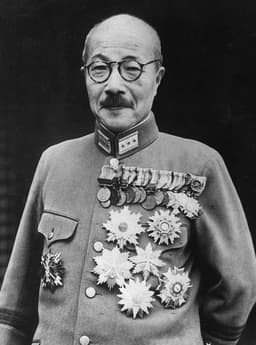
Hideki Tojo
General · Modern
53.9Total
Basic Information
Born
1937
1884
Died
—
1948
Era
Modern
Modern
Nationality
United States
Japan
Occupation
General
General
Civilization
Western
Eastern
Score Comparison
Military (10%)
25.0
70.0
Political (20%)
68.0
48.0
Influence (20%)
68.0
55.0
Legacy (20%)
52.0
50.0
Leadership (15%)
72.0
53.2
Strategy (15%)
50.0
55.0
TOTAL
58.5
53.9
Colin Powell — Complete Timeline
1987 AD
Appointed National Security AdvisorPolitical Action◆ Major
Powell was appointed National Security Advisor by President Ronald Reagan in November 1987, serving until January 1989. He coordinated foreign policy and national security matters, including arms control negotiations with the Soviet Union and the Iran-Iraq War, becoming the first African American in this role.
National SecurityReagan AdministrationForeign Policy
Impact: global
1989 AD
Became Chairman of the Joint Chiefs of StaffOther◆ Major
On October 1, 1989, Powell became the 12th Chairman of the Joint Chiefs of Staff, the first African American to hold the position. He oversaw U.S. military operations during the invasion of Panama (1989) and the Gulf War (1990-1991), becoming a highly visible public figure.
Military LeadershipGulf WarFirst African American
Impact: global
1990 AD
Developed the Powell DoctrineOther◆ Major
During the Gulf War planning, Powell articulated the Powell Doctrine, which stated that U.S. military force should only be used as a last resort, with overwhelming force, clear objectives, and an exit strategy. This doctrine influenced U.S. military interventions for the next decade.
Military DoctrineGulf WarStrategic Thinking
Impact: global
2001 AD
Appointed Secretary of StatePolitical Action◆ Major
On January 20, 2001, Powell was confirmed as the 65th U.S. Secretary of State under President George W. Bush, becoming the first African American to hold the office. He advocated for diplomacy and multilateralism, but his influence waned after the September 11 attacks.
DiplomacyBush AdministrationFirst African American
Impact: global
2003 AD
Presented Iraq WMD Case to the UN Security CouncilOther◆ Major
On February 5, 2003, Powell addressed the UN Security Council, presenting evidence that Iraq possessed weapons of mass destruction. The intelligence later proved to be inaccurate, damaging Powell's reputation and becoming a major controversy that he later called a 'blot' on his record.
Iraq WarUN SpeechControversy
Impact: globaldestructive
2004 AD
Resigned as Secretary of StateOther◆ Major
Powell resigned as Secretary of State on November 15, 2004, after President Bush's re-election. His departure was widely seen as a result of policy disagreements with Vice President Cheney and Secretary of Defense Rumsfeld, particularly over the conduct of the Iraq War.
ResignationIraq WarBush Administration
Impact: national
Hideki Tojo — Complete Timeline
1941 AD
Attack on Pearl HarborWar
As Prime Minister, Hideki Tojo authorized the attack on the US naval base at Pearl Harbor, Hawaii. The surprise attack brought the United States into World War II. Tojo's decision was based on the belief that war with the US was inevitable due to resource embargoes and diplomatic failures.
World War IIPearl HarborUS-Japan War
Impact: globaldestructive
Appointment as Prime MinisterPolitical Action◆ Major
Hideki Tojo was appointed Prime Minister of Japan, replacing Fumimaro Konoe. He retained his position as Army Minister and later took on other portfolios, consolidating power. His appointment marked the ascendancy of the military faction in the Japanese government and the shift towards total war.
Prime MinisterMilitary GovernmentWorld War II
Impact: national
1942 AD
Fall of SingaporeWar◆ Major
Under Tojo's leadership, Japanese forces captured Singapore from the British in a swift campaign. The fall of Singapore was one of the worst British military defeats in history. It demonstrated Japanese military prowess and led to the occupation of a key strategic location in Southeast Asia.
World War IISingaporeJapanese Victory
Impact: global
1948 AD
Execution by the International Military Tribunal for the Far EastPolitical Action◆ Major
Hideki Tojo was found guilty of war crimes by the International Military Tribunal for the Far East and sentenced to death. He was executed by hanging on December 23, 1948. His trial and execution symbolized the Allied effort to hold Japanese leaders accountable for wartime atrocities.
War CrimesExecutionTokyo Trials
Impact: globaltragic
Expert Analysis
Hideki Tojo vs Colin Powell
# The General Who Chose War and the General Who Chose Caution
On a December morning in 1941, Hideki Tojo stood before the Japanese Diet and declared that the Empire had no choice but to fight the United States. The attack on Pearl Harbor was already underway, and within hours, the Pacific would be engulfed in flame. Half a century later, in 2003, Colin Powell stood before the United Nations Security Council, holding up a vial of what he claimed was evidence of Iraqi weapons of mass destruction. Both men were generals who reached the highest echelons of political power. One launched a war that destroyed his nation; the other became the reluctant face of a war he privately doubted. What drove them to such different fates?
Origins
Hideki Tojo was born in 1884 into a samurai family, steeped in the martial traditions of imperial Japan. His father, a lieutenant general in the Imperial Army, instilled in him the belief that military discipline and national expansion were sacred duties. Tojo grew up in an era when Japan was rapidly modernizing but also embracing a militaristic nationalism that saw war as the highest expression of national spirit. He was a mediocre student but a relentless worker, earning the nickname "Razor" for his sharp, uncompromising mind.
Colin Powell was born in 1937 in Harlem, New York, to Jamaican immigrant parents. His upbringing was shaped by the Great Depression and the civil rights movement. For Powell, the military was not a path to empire but a ladder of opportunity. He joined the ROTC at City College and discovered a natural talent for leadership. Where Tojo saw the military as the soul of the nation, Powell saw it as a meritocratic institution that could transcend racial divisions. The difference in their worlds was not just geography—it was the difference between a culture that worshipped victory at any cost and one that, at least in theory, valued restraint.
Rise to Power
Tojo's ascent was methodical and ruthless. He served as a military attaché in Germany, studied the Nazi Blitzkrieg, and returned to Japan convinced that total war was inevitable. By 1940, he was Army Minister, and when Prime Minister Konoe resigned in 1941, Tojo seized the opportunity. He was appointed Prime Minister while retaining his Army portfolio, effectively fusing military and political authority. His rise was not a democratic triumph but a coup of circumstance—Japan was already committed to expansion in China and Southeast Asia, and Tojo embodied the militarist faction's belief that only decisive action could secure the nation's destiny.
Powell's rise was equally impressive but followed a different logic. He served two tours in Vietnam, where he learned the bitter lesson of limited war. He later held key Pentagon posts under Presidents Reagan and George H.W. Bush, and in 1989 became the first African American Chairman of the Joint Chiefs of Staff. His path was marked by careful navigation of bureaucratic politics and a reputation for integrity. Where Tojo seized power by aligning with extremists, Powell gained influence by being the calm, competent voice in rooms full of heated debate.
Leadership & Governance
As Prime Minister, Tojo ruled with an iron fist. He centralized control over the military, suppressed dissent, and pushed Japan deeper into war. His military strategy was aggressive: the attack on Pearl Harbor in 1941 was designed to cripple the US Pacific Fleet, and the fall of Singapore in 1942 was a stunning victory that humiliated the British Empire. But Tojo's governance was brittle. He micromanaged campaigns, ignored intelligence that warned of American recovery, and refused to consider surrender even as the tide turned. His leadership style was that of a drill sergeant, not a statesman.
Powell's leadership was defined by caution and consensus. As Chairman of the Joint Chiefs, he oversaw the 1991 Gulf War, where he advocated for overwhelming force and clear exit strategies—a doctrine that became known as the Powell Doctrine. He believed that war should be a last resort, and when waged, should be waged decisively. As Secretary of State under George W. Bush, he was the most popular figure in the administration, but his influence waned as neoconservatives pushed for the 2003 invasion of Iraq. Powell's tragedy was that he lent his credibility to a war he knew was based on flawed intelligence.
Triumph & Tragedy
Tojo's greatest triumph was the early string of victories that created the Greater East Asia Co-Prosperity Sphere. For a brief moment, Japan seemed invincible. But his tragedy was total: by 1945, Japan was in ruins, atomic bombs had fallen on Hiroshima and Nagasaki, and Tojo himself attempted suicide before being captured. In 1948, he was executed by the International Military Tribunal for the Far East, a symbol of militarism that had brought his nation to catastrophe.
Powell's triumph was the peaceful end of the Cold War and his role in the Gulf War, which restored Kuwait's sovereignty. But his tragedy was Iraq. His 2003 UN speech, which he later called a "blot" on his record, became the emblem of a war that spiraled into chaos. He resigned as Secretary of State in 2005, his reputation tarnished by a conflict he had helped legitimate.
Character & Destiny
Tojo was a man of rigid conviction. He believed that Japan's destiny was to dominate Asia, and that any hesitation was weakness. His personality was authoritarian, his worldview binary. This made him decisive in victory but blind in defeat. He could not imagine surrender because his entire identity was built on the samurai code of death before dishonor.
Powell was a man of pragmatism. He had seen the horrors of Vietnam and knew that war's consequences were unpredictable. His caution saved lives in the Gulf War but failed him in the Iraq debate, where he chose loyalty to the administration over his own doubts. His character was that of a soldier who served his country, but also a politician who served his party.
Legacy
Tojo is remembered as a war criminal, a figure of infamy in the West and a complex, often vilified figure in Japan. His legacy is a warning about the dangers of militarism and unchecked executive power. Powell is remembered as a trailblazer—a Black general who broke barriers, a diplomat who sought peace. But his legacy is also shadowed by the Iraq War, a reminder that even the most careful leaders can be swept into disaster.
Conclusion
Two generals, two centuries, two paths to power. Tojo chose war and was consumed by it. Powell chose caution and was haunted by the one war he could not prevent. Their stories remind us that leadership is not just about strategy or strength—it is about the courage to say no when the drums of war beat loudest. One man could not stop fighting. The other could not stop a fight he should have refused. History judges them not by their rank, but by the weight of their choices.
Rankings
🥇
Colin PowellLeader
Mil: 25.0Pol: 68.0Inf: 68.0
58.5
🥈
Hideki Tojo
Mil: 70.0Pol: 48.0Inf: 55.0
53.9
+4.6 behind
How This Comparison Works
Algorithm
Each figure is scored on 6 dimensions (0—100 scale) based on structured historical data: Military (10%), Political (20%), Influence (20%), Legacy (20%), Leadership (15%), Strategy (15%). The weighted total produces the final ranking.
Data Sources
Scores are computed from structured sub-indicators in the database. Scale factors adjust for era (Ancient ×0.85, Modern ×1.0) and civilization size (Eastern ×1.05, Other ×0.80) to account for differences in population and military scale.
Maximum 3 Figures
Comparisons are limited to 2—3 figures to ensure readability and statistical meaningfulness.
Error Margins
±5 points per dimension — Sub-scores are derived from historical records with inherent uncertainty. Two figures within 5 points on a dimension should be considered roughly equivalent in that area.
Total Score Accuracy
±3 points overall — The weighted combination of 6 dimensions produces a total score with approximately ±3 points of uncertainty. Differences of less than 3 points are not statistically significant— the figures are effectively tied.
Known Limitations
- Historical records are incomplete and uneven across civilizations
- Figures from oral-tradition societies may be underrepresented
- Occupation labels can misclassify multi-role figures
- Scores measure capability and impact, not moral character
- Quantitative scoring is a comparison tool, not absolute truth
Capability Radar
Military (10%) — Battles & Warfare
Battles
35
65
Win Rate
40
40
Expansion
20
70
Political (20%) — Governance & Reform
Reform
40
30
Diplomacy
70
35
Economy
30
25
Influence (20%) — Cultural & Global Reach
Cultural
55
30
Global
65
55
Legacy (20%) — Historical Impact
Historical
60
55
Longevity
45
40
Leadership (15%) — Power & Stability
Tenure
65
60
Stability
55
20
Strategy (15%) — Tactics & Innovation
Strategy
55
50
Tactics
45
55
Reform
60
45
Similar Comparisons
Comments & Discussion
No comments yet. Be the first to share your thoughts!