Loading...
Colin Powell vs Deodoro da Fonseca
Colin Powell leads by 9.7 pts · 2 figures compared
…

Colin Powell
General · Modern
58.5Total
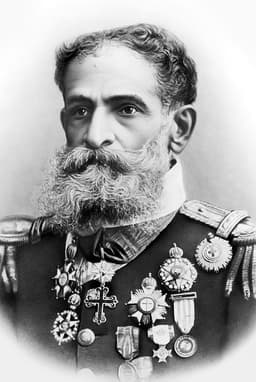
Deodoro da Fonseca
General · Modern
48.8Total
Basic Information
Born
1937
1827
Died
—
1892
Era
Modern
Modern
Nationality
United States
Brazil
Occupation
General
General
Civilization
Western
Western
Score Comparison
Military (10%)
25.0
50.0
Political (20%)
68.0
45.1
Influence (20%)
68.0
54.1
Legacy (20%)
52.0
44.2
Leadership (15%)
72.0
57.6
Strategy (15%)
50.0
38.6
TOTAL
58.5
48.8
Colin Powell — Complete Timeline
1987 AD
Appointed National Security AdvisorPolitical Action◆ Major
Powell was appointed National Security Advisor by President Ronald Reagan in November 1987, serving until January 1989. He coordinated foreign policy and national security matters, including arms control negotiations with the Soviet Union and the Iran-Iraq War, becoming the first African American in this role.
National SecurityReagan AdministrationForeign Policy
Impact: global
1989 AD
Became Chairman of the Joint Chiefs of StaffOther◆ Major
On October 1, 1989, Powell became the 12th Chairman of the Joint Chiefs of Staff, the first African American to hold the position. He oversaw U.S. military operations during the invasion of Panama (1989) and the Gulf War (1990-1991), becoming a highly visible public figure.
Military LeadershipGulf WarFirst African American
Impact: global
1990 AD
Developed the Powell DoctrineOther◆ Major
During the Gulf War planning, Powell articulated the Powell Doctrine, which stated that U.S. military force should only be used as a last resort, with overwhelming force, clear objectives, and an exit strategy. This doctrine influenced U.S. military interventions for the next decade.
Military DoctrineGulf WarStrategic Thinking
Impact: global
2001 AD
Appointed Secretary of StatePolitical Action◆ Major
On January 20, 2001, Powell was confirmed as the 65th U.S. Secretary of State under President George W. Bush, becoming the first African American to hold the office. He advocated for diplomacy and multilateralism, but his influence waned after the September 11 attacks.
DiplomacyBush AdministrationFirst African American
Impact: global
2003 AD
Presented Iraq WMD Case to the UN Security CouncilOther◆ Major
On February 5, 2003, Powell addressed the UN Security Council, presenting evidence that Iraq possessed weapons of mass destruction. The intelligence later proved to be inaccurate, damaging Powell's reputation and becoming a major controversy that he later called a 'blot' on his record.
Iraq WarUN SpeechControversy
Impact: globaldestructive
2004 AD
Resigned as Secretary of StateOther◆ Major
Powell resigned as Secretary of State on November 15, 2004, after President Bush's re-election. His departure was widely seen as a result of policy disagreements with Vice President Cheney and Secretary of Defense Rumsfeld, particularly over the conduct of the Iraq War.
ResignationIraq WarBush Administration
Impact: national
Deodoro da Fonseca — Complete Timeline
1889 AD
Proclamation of the Brazilian RepublicPolitical Action
Deodoro da Fonseca led a military coup that overthrew Emperor Pedro II on November 15, 1889. He proclaimed the Republic of the United States of Brazil, ending 67 years of imperial rule.
CoupRepublic
Impact: globalprogressive
1891 AD
Election as First President of BrazilPolitical Action◆ Major
Deodoro da Fonseca was elected the first President of Brazil by the Constituent Congress on February 25, 1891. He took office under the new republican constitution, but his rule was brief and authoritarian.
ElectionPresidency
Impact: national
Dissolution of the National CongressPolitical Action◆ Major
Facing political opposition, Deodoro da Fonseca dissolved the National Congress on November 3, 1891, and declared a state of siege. This authoritarian act triggered a naval revolt and his eventual resignation.
AuthoritarianismPolitical Crisis
Impact: nationaldestructive
Resignation from the PresidencyPolitical Action◆ Major
Deodoro da Fonseca resigned the presidency on November 23, 1891, after a naval rebellion threatened his government. He handed power to Vice President Floriano Peixoto, ending his 9-month rule.
ResignationPolitical Crisis
Impact: nationaltragic
Expert Analysis
Deodoro da Fonseca vs Colin Powell
# The General and the Emperor-Maker
In November 1891, a weary old man in Rio de Janeiro signed his resignation and vanished from power, having held the presidency of Brazil for less than a year. In November 1989, another man stood before the world’s cameras in Washington, D.C., and explained why the United States had just invaded Panama. The first, Deodoro da Fonseca, had overthrown an emperor only to prove incapable of governing a republic. The second, Colin Powell, had risen from the streets of Harlem to become the most powerful soldier in the world. Both were generals who entered politics. One crashed; the other soared. Why?
Origins
Deodoro da Fonseca was born in 1827 in Alagoas, a poor northeastern province of the Brazilian Empire. His family belonged to the military caste, and he entered the army young, fighting in the long, brutal War of the Triple Alliance against Paraguay. That war forged him: he emerged a decorated hero, a man who believed the army was the only institution that could save Brazil from chaos. He was a creature of the 19th century, when officers often saw themselves as guardians of the nation rather than servants of the state.
Colin Powell, born in 1937 in New York City, was the son of Jamaican immigrants. He grew up in a world of modest means but fierce ambition, attending City College and joining the ROTC because it was affordable. He went to Vietnam, served in Korea, and rose through a military that was itself transforming—becoming more professional, more integrated, more cautious after the disaster of Vietnam. Where Fonseca’s worldview was shaped by battlefield glory, Powell’s was shaped by the sobering lessons of limited war.
Rise to Power
Fonseca’s path to power ran through a coup. In 1889, the Brazilian Empire under Pedro II was stable but stagnant. A group of young officers, inspired by positivism and republicanism, plotted a takeover. They needed a figurehead—a respected general who could give the movement legitimacy. Fonseca, by then a marshal, agreed. On November 15, 1889, he led his troops into Rio and declared the republic. He did not want to be president at first. But when the first elections were held in 1891, the Constituent Congress chose him anyway.
Powell’s rise was slower, more deliberate, and entirely within the system. He served in Vietnam, where he learned the cost of unclear objectives. He held staff positions, commanded troops, and eventually became National Security Advisor under President Reagan. In 1989, he was appointed Chairman of the Joint Chiefs of Staff—the first African American to hold that position. He did not seize power; he earned it.
Leadership & Governance
Here the two men diverge most sharply. Fonseca was a general, not a politician. He had no patience for congresses, parties, or debate. When the new Brazilian Congress blocked his reforms, he simply dissolved it on November 3, 1891, and declared a state of siege. It was the act of a man who believed that order mattered more than democracy. But he had no plan for what came next. The navy rebelled; the economy faltered; his own allies abandoned him. Twenty days later, he resigned.
Powell governed nothing directly, but his influence on policy was immense. He crafted the Powell Doctrine: use overwhelming force, have clear objectives, and get out fast. He managed the Gulf War in 1991 with surgical precision, building a global coalition and then stepping back from politics—until he became Secretary of State in 2001. There, his political skills were tested. He argued for diplomacy over invasion in Iraq, but ultimately presented the flawed case for war to the United Nations. It was his greatest failure, and it came not from authoritarianism, but from misplaced loyalty.
Triumph & Tragedy
Fonseca’s triumph was the proclamation of the republic itself. For a moment, he was the father of a new Brazil. His tragedy was that he could not govern it. He died in 1892, a year after resigning, a broken man who had seen his dream turn to chaos.
Powell’s triumph was the Gulf War—a clean victory that restored Kuwait and proved American military power could be used judiciously. His tragedy was the Iraq War. His 2003 UN speech, based on intelligence that later proved false, haunted him for the rest of his life. He called it a “blot” on his record.
Character & Destiny
Fonseca was impulsive, proud, and old-fashioned. He believed in honor and force, not compromise. When politics required patience, he gave orders. When democracy demanded debate, he silenced it. His character was suited to revolution, not governance.
Powell was cautious, diplomatic, and deeply institutional. He believed in process, in consensus, in the chain of command. He was a man who could navigate Washington’s corridors as easily as the Pentagon’s. His character was suited to the modern state, where power is exercised through persuasion, not decrees.
Legacy
Fonseca is remembered in Brazil as a founder, but a flawed one. His statue stands in Rio, but his presidency is a cautionary tale: the general who could break an empire but not build a republic.
Powell is remembered as a pioneer—the first Black chairman, the first Black secretary of state—but also as a tragic figure, a man of integrity who was used by a dishonest administration. His name is invoked in debates about war and peace, about when to fight and when to doubt.
Conclusion
The difference between them is not simply skill or luck. It is the difference between two worlds. Fonseca lived in an era when generals could still become dictators overnight, when the army was the state. Powell lived in an era when power was diffused through institutions, media, and public opinion. One tried to command history; the other tried to manage it. Both failed in their own ways, but only one understood that in a democracy, a general must eventually learn to follow.
Rankings
🥇
Colin PowellLeader
Mil: 25.0Pol: 68.0Inf: 68.0
58.5
🥈
Deodoro da Fonseca
Mil: 50.0Pol: 45.1Inf: 54.1
48.8
+9.7 behind
How This Comparison Works
Algorithm
Each figure is scored on 6 dimensions (0—100 scale) based on structured historical data: Military (10%), Political (20%), Influence (20%), Legacy (20%), Leadership (15%), Strategy (15%). The weighted total produces the final ranking.
Data Sources
Scores are computed from structured sub-indicators in the database. Scale factors adjust for era (Ancient ×0.85, Modern ×1.0) and civilization size (Eastern ×1.05, Other ×0.80) to account for differences in population and military scale.
Maximum 3 Figures
Comparisons are limited to 2—3 figures to ensure readability and statistical meaningfulness.
Error Margins
±5 points per dimension — Sub-scores are derived from historical records with inherent uncertainty. Two figures within 5 points on a dimension should be considered roughly equivalent in that area.
Total Score Accuracy
±3 points overall — The weighted combination of 6 dimensions produces a total score with approximately ±3 points of uncertainty. Differences of less than 3 points are not statistically significant— the figures are effectively tied.
Known Limitations
- Historical records are incomplete and uneven across civilizations
- Figures from oral-tradition societies may be underrepresented
- Occupation labels can misclassify multi-role figures
- Scores measure capability and impact, not moral character
- Quantitative scoring is a comparison tool, not absolute truth
Capability Radar
Military (10%) — Battles & Warfare
Battles
35
20
Win Rate
40
25
Expansion
20
10
Political (20%) — Governance & Reform
Reform
40
40
Diplomacy
70
25
Economy
30
15
Influence (20%) — Cultural & Global Reach
Cultural
55
20
Global
65
15
Legacy (20%) — Historical Impact
Historical
60
35
Longevity
45
20
Leadership (15%) — Power & Stability
Tenure
65
30
Stability
55
10
Strategy (15%) — Tactics & Innovation
Strategy
55
25
Tactics
45
20
Reform
60
15
Similar Comparisons
Comments & Discussion
POWELL’S PETARD6/16/2026
Powell’s the classic case of the staff officer who makes it look easy. Fonseca was a field commander who actually led his troops in the mud of Paraguay—scars included. Powell oversaw Panama’s invasion from a leather chair in the Pentagon, clean and clinical. Powell built his career with briefings and memos; Fonseca built his commanding exhausted soldiers. They both broke into politics. Only one got bruised by reality when the crowds stopped cheering, though—guess which. My money’s on the man who
老帝国炮兵6/16/2026
丰塞卡打仗时,鲍威尔还没出生呢。这位老将军在三重同盟战争里用血换来的威望,不是五角大楼会议室里堆出来的。鲍威尔是系统里混出来的;丰塞卡是从破烂工棚里杀出来的。他们俩从军到从政那条路完全相反——一个踩着报告升天,一个骑着战马摔地。啥叫才不配位?1891年那个共和国的烂摊子,硬塞给一个只会打歼灭战的将军,不崩才怪。
THE LENS OF LATINIDAD6/16/2026
Let’s be honest: what doomed Fonseca wasn’t just his temper—it was his era. Back then, Brazil’s military still thought they could crown a man and fix a country. Powell knew 20th-century PR: he smiled, he nodded, he let civilians take the heat. Fonseca tried to be both emperor and president, and nobody buys that outside of a monarchy. Powell was smarter about the game—he made sure the headlines never blamed him for the Panamanian dead. That’s not courage, that’s survival.
数据铁砧6/16/2026
数字说话:丰塞卡三个月换两届内阁,国会否决法案后直接拔枪解散议会,这操作放今天早就弹劾十轮了。鲍威尔在参谋长联席会议主席任内处理了1989年边境冲突、柏林墙倒塌、两场区域维稳行动,硬是一个丑闻没沾上。丰塞卡的致命伤不是他没能力,是他不知道游戏规则变了;鲍威尔懂权力不是来自刀枪,而是来自谁最后还能坐在摄影机前不倒。
CAESAR’S GHOST6/16/2026
Two men, two systems. Fonseca inherited an empire he helped kill, but he couldn’t run what he built because he didn’t understand civilians run the show now. Powell carefully navigated the war on drugs, the Gulf War, even the Somalia pullout—and never once imagined he could replace the president. That’s the difference: Fonseca thought he *was* the state. Powell knew he was just its employee. One took a throne, the other took orders. History doesn’t forgive confusion between the two.