Loading...
This comparison has not been analyzed yet.
One-time AI generation (~1 minute). Scores and timeline are already available below.
Childeric III vs Edgar the Peaceful
Edgar the Peaceful leads by 9.6 pts · 2 figures compared
…

Childeric III
Emperor · Medieval
43.9Total
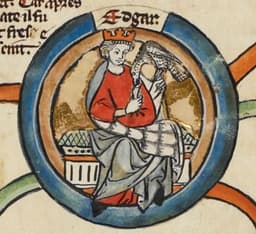
Edgar the Peaceful
Emperor · Medieval
53.5Total
Basic Information
Born
717
943
Died
754
975
Era
Medieval
Medieval
Nationality
Frankish Empire
England
Occupation
Emperor
Emperor
Civilization
Western
Western
Score Comparison
Military (10%)
15.7
21.2
Political (20%)
39.4
65.0
Influence (20%)
60.0
56.4
Legacy (20%)
35.0
49.2
Leadership (15%)
55.3
78.0
Strategy (15%)
43.4
35.7
TOTAL
43.9
53.5
Childeric III — Complete Timeline
743 AD
Elevation to KingshipPolitical Action◆ Major
Childeric III was placed on the throne by the mayors of the palace, Pepin the Short and Carloman, after a seven-year interregnum. He was the last Merovingian king, serving as a figurehead while real power rested with the Carolingian mayors.
MerovingianSuccessionFigurehead
Impact: regional
751 AD
Deposition by Pepin the ShortPolitical Action
Childeric III was deposed by Pepin the Short, the mayor of the palace, with the approval of Pope Zachary. Childeric was tonsured and confined to a monastery, ending the Merovingian dynasty. Pepin was then crowned king of the Franks, beginning the Carolingian dynasty.
MerovingianDepositionCarolingian
Impact: regional
Tonsure and ImprisonmentPolitical Action◆ Major
After his deposition, Childeric III was tonsured (his hair cut short, symbolizing loss of royal status) and imprisoned in the monastery of Saint-Bertin or Saint-Omer. His son Theuderic was also imprisoned, ensuring the end of the Merovingian bloodline's claim to power.
MerovingianImprisonmentEnd of Dynasty
Impact: regionaltragic
Edgar the Peaceful — Complete Timeline
959 AD
Coronation as King of EnglandPolitical Action◆ Major
Edgar succeeded his brother Eadwig as King of England. His reign was marked by stability and the consolidation of monastic reform under Dunstan.
Impact: nationalconstructive
970 AD
Naval defense reformsReform
Edgar organized a standing navy and divided England into naval districts to defend against Viking raids. This created a period of peace and security along the coasts.
Impact: nationalconstructive
Council of WinchesterCultural◆ Major
Edgar convened the Council of Winchester, which established the Regularis Concordia, a code for monastic life. This standardized Benedictine practices across England.
Impact: nationalconstructive
This comparison has not been analyzed yet.
One-time AI generation (~1 minute). Scores and timeline are already available below.
Rankings
🥇
Edgar the PeacefulLeader
Mil: 21.2Pol: 65.0Inf: 56.4
53.5
🥈
Childeric III
Mil: 15.7Pol: 39.4Inf: 60.0
43.9
+9.6 behind
How This Comparison Works
Algorithm
Each figure is scored on 6 dimensions (0—100 scale) based on structured historical data: Military (10%), Political (20%), Influence (20%), Legacy (20%), Leadership (15%), Strategy (15%). The weighted total produces the final ranking.
Data Sources
Scores are computed from structured sub-indicators in the database. Scale factors adjust for era (Ancient ×0.85, Modern ×1.0) and civilization size (Eastern ×1.05, Other ×0.80) to account for differences in population and military scale.
Maximum 3 Figures
Comparisons are limited to 2—3 figures to ensure readability and statistical meaningfulness.
Error Margins
±5 points per dimension — Sub-scores are derived from historical records with inherent uncertainty. Two figures within 5 points on a dimension should be considered roughly equivalent in that area.
Total Score Accuracy
±3 points overall — The weighted combination of 6 dimensions produces a total score with approximately ±3 points of uncertainty. Differences of less than 3 points are not statistically significant— the figures are effectively tied.
Known Limitations
- Historical records are incomplete and uneven across civilizations
- Figures from oral-tradition societies may be underrepresented
- Occupation labels can misclassify multi-role figures
- Scores measure capability and impact, not moral character
- Quantitative scoring is a comparison tool, not absolute truth
Capability Radar
Military (10%) — Battles & Warfare
Battles
4
10
Win Rate
9
10
Expansion
14
10
Political (20%) — Governance & Reform
Reform
0
70
Diplomacy
5
70
Economy
0
65
Influence (20%) — Cultural & Global Reach
Cultural
0
40
Global
0
20
Legacy (20%) — Historical Impact
Historical
5
45
Longevity
5
40
Leadership (15%) — Power & Stability
Tenure
5
65
Stability
5
75
Strategy (15%) — Tactics & Innovation
Strategy
15
15
Tactics
18
10
Reform
22
20
Similar Comparisons
Comments & Discussion
No comments yet. Be the first to share your thoughts!