Loading...
Edgar the Peaceful vs Kublai Khan
Kublai Khan leads by 20.8 pts · 2 figures compared
…
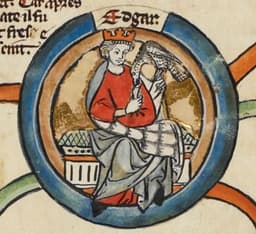
Edgar the Peaceful
Emperor · Medieval
53.5Total
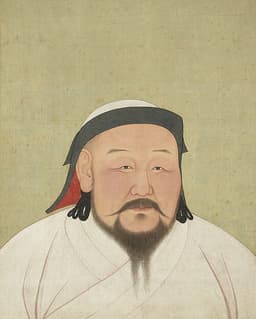
Kublai Khan
Emperor · Medieval
74.3Total
Basic Information
Born
943
1215
Died
975
1294
Era
Medieval
Medieval
Nationality
England
Mongolia
Occupation
Emperor
Emperor
Civilization
Western
Eastern
Score Comparison
Military (10%)
21.2
77.5
Political (20%)
65.0
79.2
Influence (20%)
56.4
75.0
Legacy (20%)
49.2
70.0
Leadership (15%)
78.0
72.0
Strategy (15%)
35.7
76.0
TOTAL
53.5
74.3
Edgar the Peaceful — Complete Timeline
959 AD
Coronation as King of EnglandPolitical Action◆ Major
Edgar succeeded his brother Eadwig as King of England. His reign was marked by stability and the consolidation of monastic reform under Dunstan.
Impact: nationalconstructive
970 AD
Naval defense reformsReform
Edgar organized a standing navy and divided England into naval districts to defend against Viking raids. This created a period of peace and security along the coasts.
Impact: nationalconstructive
Council of WinchesterCultural◆ Major
Edgar convened the Council of Winchester, which established the Regularis Concordia, a code for monastic life. This standardized Benedictine practices across England.
Impact: nationalconstructive
Kublai Khan — Complete Timeline
1260 AD
Adoption of Tibetan Buddhism as State ReligionCultural◆ Major
Kublai Khan appointed the Tibetan lama Drog
Tibetan BuddhismReligionMongol-Tibet Relations
Impact: regional
1271 AD
Proclamation of the Yuan DynastyPolitical Action◆ Major
Kublai Khan officially proclaimed the Yuan dynasty, adopting a Chinese-style dynastic name. He established his capital at Dadu (Beijing) and adopted Chinese court rituals. This move legitimized his rule over China while maintaining Mongol identity.
Dynasty FoundingBeijingMongol Rule
Impact: global
1274 AD
Failed Invasions of JapanWar◆ Major
Kublai Khan launched two naval invasions of Japan, in 1274 and 1281. Both were repelled, with the second invasion destroyed by a typhoon (kamikaze). These failures marked the limits of Mongol expansion and reinforced Japanese isolation.
Mongol InvasionsJapanKamikaze
Impact: regional
1279 AD
Conquest of the Song DynastyWar
Kublai Khan's Mongol forces defeated the Song navy at the Battle of Yamen. The last Song emperor drowned, ending the Song dynasty. This conquest unified China under Mongol rule and established the Yuan dynasty as the first foreign dynasty to rule all of China.
Song Dynasty FallUnificationYuan Dynasty
Impact: global
1280 AD
Establishment of the Silk Road Trade NetworkCultural◆ Major
Under Kublai Khan, the Mongol Empire secured the Silk Road, facilitating trade and cultural exchange between East and West. Marco Polo visited his court. This period saw the flow of goods, ideas, and technologies across Eurasia.
Silk RoadTradeCultural Exchange
Impact: globalconstructive
Expert Analysis
Kublai Khan vs Edgar the Peaceful
# The Emperor and the Peacemaker
History rarely offers a pairing as improbable as Kublai Khan and Edgar the Peaceful. One commanded the largest land empire ever assembled, his horsemen thundering from Korea to Hungary. The other ruled a small island kingdom, remembered chiefly for the quiet stability of his reign. Yet both wore crowns in the same medieval millennium, and both shaped the civilizations they governed in ways that still echo. What separates the conqueror from the consolidator is not merely scale, but the forces of geography, opportunity, and character that drove them down such different paths.
Origins
Kublai Khan was born in 1215, grandson of the legendary Genghis Khan, into a world of constant motion and warfare. The Mongol steppe bred warriors who measured wealth in horses and honor in conquest. From childhood, Kublai breathed air thick with the dust of campaigns and the stories of uncles and cousins who had shattered kingdoms from Persia to Russia. Yet he was also the son of Sorghaghtani Beki, a Nestorian Christian princess who valued education and diplomacy—a rare blend in a culture that prized the sword above the scroll.
Edgar the Peaceful, born in 943, inherited a very different inheritance. England in the tenth century was a patchwork of rival kingdoms, still reeling from generations of Viking raids. His grandfather, Alfred the Great, had barely saved Wessex from Danish conquest. Edgar’s father, Edmund I, was murdered; his brother, Eadwig, ruled briefly and chaotically. Edgar grew up in the shadow of violence, but also in the light of a nascent English identity, shaped by monastic scribes and the slow work of building a unified kingdom from fragments.
The difference in their origins is not just one of scale, but of purpose. Kublai was born to expand; Edgar was born to heal.
Rise to Power
Kublai’s path to supreme power was a brutal contest. When his elder brother Möngke became Great Khan in 1251, Kublai was given command of the Mongol campaigns in China. He proved an able administrator and a patient strategist, learning Chinese governance and surrounding himself with Confucian advisers. But after Möngke’s death in 1259, Kublai faced his younger brother Ariq Böke in a four-year civil war for the khanship. It was a war fought not just with swords, but with legitimacy: Kublai presented himself as a civilized ruler who could govern settled peoples, while Ariq Böke clung to the old steppe ways. By 1264, Kublai had won, but the empire was fractured, and he would never again command the full loyalty of all Mongols.
Edgar’s rise was quieter, but no less political. He became king in 959 at age sixteen, after his brother Eadwig died under mysterious circumstances. Edgar did not conquer England; he inherited it, and his genius lay in what he did with that inheritance. He immediately recalled the exiled reformer Dunstan from Flanders, making him Archbishop of Canterbury. Together, they set about standardizing monastic life, codifying laws, and building a kingdom that worked not through terror, but through order.
Where Kublai fought for his throne against blood, Edgar inherited his throne and made it stronger by sharing power.
Leadership & Governance
Kublai Khan’s rule was a study in paradox. He adopted Chinese court rituals, built a magnificent capital at Dadu (modern Beijing), and proclaimed the Yuan Dynasty in 1271, taking a Chinese-style name for his reign. He patronized Buddhism, Daoism, and Islam alike, and employed Persian, Chinese, and European officials. Yet he also maintained Mongol customs, kept his nomadic cavalry ready, and never fully trusted his Chinese subjects. His military score of 88 reflects his conquest of the Song Dynasty in 1279, when his fleet crushed the last Song navy at the Battle of Yamen and the boy-emperor drowned—a victory that unified China for the first time in centuries.
Edgar’s governance was more modest, but arguably more lasting. His political score of 67.6 masks a profound achievement: he created the conditions for peace. The Council of Winchester in 970 produced the Regularis Concordia, a code that unified monastic practice across England. He reformed coinage, standardized weights and measures, and—most famously—organized a standing navy, dividing England into naval districts to patrol against Viking raids. His military score of 30 is not a mark of weakness; it is a testament to a ruler who made war unnecessary.
Kublai built an empire through conquest; Edgar built a kingdom through consensus.
Triumph & Tragedy
Kublai’s greatest triumph was the conquest of the Song Dynasty in 1279, a campaign that took decades and required immense resources. He also secured the Silk Road trade network in 1280, linking China to the Middle East and Europe, enabling the flow of goods, ideas, and travelers like Marco Polo. But his tragedies were equally grand. The failed invasions of Japan in 1274 and 1281 were catastrophic: the first was repelled by Japanese defenses, the second destroyed by a typhoon—the *kamikaze*, or “divine wind,” that the Japanese believed protected their islands. Thousands of Mongol and Korean soldiers drowned, and the failure marked the limit of Mongol power.
Edgar’s triumphs were quieter. His reign saw no great battles, no dramatic conquests. But he died in 975 at the age of thirty-two, leaving a kingdom that was more unified, more peaceful, and more prosperous than it had been for generations. His tragedy was his early death, which left his young son Edward the Martyr to inherit a throne that would soon be stained by murder and civil war.
Kublai’s failures were spectacular; Edgar’s tragedy was that his success could not outlast him.
Character & Destiny
Kublai was a man of immense ambition and pragmatic intelligence. He could be ruthless—he executed Song loyalists and enslaved prisoners—but he could also be generous, patronizing scholars and building hospitals. His adoption of Tibetan Buddhism as the state religion in 1260, appointing the lama Phagpa as his imperial preceptor, was a political masterstroke that tied Tibet to the Mongol court for centuries. Yet his character also contained a fatal flaw: he could not stop expanding. The invasions of Japan, Vietnam, and Burma drained his treasury and killed his soldiers, driven by a conqueror’s restlessness that no amount of territory could satisfy.
Edgar was a different kind of ruler. He was called “the Peaceful” not because he was passive, but because he understood that power could be exercised through law and ritual as effectively as through war. His character was shaped by the monastic reformers he championed, men who believed that order on earth reflected order in heaven. He was not weak; he was wise enough to know that a kingdom defended by a navy and governed by a code did not need to prove itself on the battlefield.
Kublai’s destiny was to expand until he broke; Edgar’s was to consolidate until he died.
Legacy
Kublai Khan’s legacy is immense and ambiguous. He founded the Yuan Dynasty, which ruled China for less than a century but left lasting marks on Chinese governance, art, and trade. The Silk Road flourished under his protection, linking East and West as never before. Yet his empire fragmented after his death, and the Mongols were eventually driven from China, remembered as foreign conquerors. His influence score of 78 and legacy score of 75 reflect a ruler who changed the world but could not make his changes permanent.
Edgar’s legacy is smaller in scale but more durable. The Regularis Concordia shaped English monasticism for generations. His naval reforms laid the groundwork for England’s future as a maritime power. And his reign set a standard of peaceful governance that later English kings would invoke as a golden age. His influence score of 74.9 rivals Kublai’s, a remarkable achievement for a king who ruled a fraction of the territory.
Conclusion
Standing at the edge of Kublai Khan’s empire, one sees the horizon stretching endlessly—a world of possibilities, of conquest, of trade routes that bind continents. Standing in Edgar’s England, one sees a smaller horizon, but one that is settled, ordered, and safe. Both visions are necessary. The conqueror opens doors; the peacemaker furnishes the rooms. Kublai Khan built a bridge across Asia; Edgar the Peaceful built a home for his people. Which is more lasting? The bridge still stands in memory, but the home—the idea of a unified England, governed by law and defended by the sea—survives to this day. Perhaps the greatest empires are not those that stretch the farthest, but those that hold the tightest.
Rankings
🥇
Kublai KhanLeader
Mil: 77.5Pol: 79.2Inf: 75.0
74.3
🥈
Edgar the Peaceful
Mil: 21.2Pol: 65.0Inf: 56.4
53.5
+20.8 behind
How This Comparison Works
Algorithm
Each figure is scored on 6 dimensions (0—100 scale) based on structured historical data: Military (10%), Political (20%), Influence (20%), Legacy (20%), Leadership (15%), Strategy (15%). The weighted total produces the final ranking.
Data Sources
Scores are computed from structured sub-indicators in the database. Scale factors adjust for era (Ancient ×0.85, Modern ×1.0) and civilization size (Eastern ×1.05, Other ×0.80) to account for differences in population and military scale.
Maximum 3 Figures
Comparisons are limited to 2—3 figures to ensure readability and statistical meaningfulness.
Error Margins
±5 points per dimension — Sub-scores are derived from historical records with inherent uncertainty. Two figures within 5 points on a dimension should be considered roughly equivalent in that area.
Total Score Accuracy
±3 points overall — The weighted combination of 6 dimensions produces a total score with approximately ±3 points of uncertainty. Differences of less than 3 points are not statistically significant— the figures are effectively tied.
Known Limitations
- Historical records are incomplete and uneven across civilizations
- Figures from oral-tradition societies may be underrepresented
- Occupation labels can misclassify multi-role figures
- Scores measure capability and impact, not moral character
- Quantitative scoring is a comparison tool, not absolute truth
Capability Radar
Military (10%) — Battles & Warfare
Battles
10
95
Win Rate
10
90
Expansion
10
95
Political (20%) — Governance & Reform
Reform
70
88
Diplomacy
70
85
Economy
65
90
Influence (20%) — Cultural & Global Reach
Cultural
40
85
Global
20
85
Legacy (20%) — Historical Impact
Historical
45
90
Longevity
40
80
Leadership (15%) — Power & Stability
Tenure
65
90
Stability
75
80
Strategy (15%) — Tactics & Innovation
Strategy
15
92
Tactics
10
85
Reform
20
88
Similar Comparisons
Comments & Discussion
The Khan's Advocate6/16/2026
People underestimate Kublai because they compare him to Genghis. But as a military historian, I'd argue his campaigns against the Song Dynasty were far more logistically impressive—over 40 years of siege warfare across rivers and mountains, requiring a navy the Mongols didn't have. Edgar pacified a few squabbling earls. Kublai conquered a civilization of 60 million people and integrated it. That's not just larger; it's a different species of ambition.
数据侦探6/16/2026
这个对比根本是搞笑。你把一个元朝皇帝跟一个连骑兵都没有的英格兰国王放在一起?Edgar的“和平”纯粹因为没被维京人盯上——他统治下只爆发过两场小规模战役,而Kublai打了五十多场大战。数据不会骗人:蒙古帝国面积是英格蘭的350倍,人口差了两个数量级。说什么“塑造文明”,Edgar连个像样的硬币铸造改革都没搞成,省省吧。
The Latinist6/16/2026
We're being seduced by scale again. Edgar's true legacy isn't territorial—it's the monastic reform. He backed Dunstan and Æthelwold to enforce the Regularis Concordia, standardizing worship across England for the first time since the Roman withdrawal. That's cultural consolidation of a kind Kublai, despite his Tibetan Buddhist patronage, never achieved. One unified liturgy; the other a patchwork of faiths. I know which leaves deeper marks.
江湖野史6/16/2026
别吹什么“和平者”了,Edgar的绰号就是个公关话术。历史记载显示他23岁就下令屠杀威尔士的Dyfed部落,还把诺森布里亚的贵族集体流放。这叫peaceful?屁!不过是因为他没像维京人那样烧教堂,就被修道士吹成圣人。反观Kublai,人家大大方方承认自己杀过人,还修运河发福利,至少不虚伪。老实说,我真想看看Edgar在襄阳城下能撑几天。