Loading...
Edgar the Peaceful vs Napoleon Bonaparte
Napoleon Bonaparte leads by 17.4 pts · 2 figures compared
…
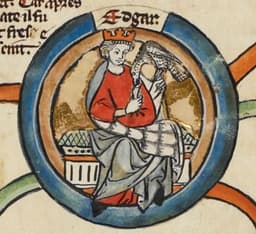
Edgar the Peaceful
Emperor · Medieval
53.5Total

Napoleon Bonaparte
General · Modern
70.9Total
Basic Information
Born
943
1769
Died
975
1821
Era
Medieval
Modern
Nationality
England
France
Occupation
Emperor
General
Civilization
Western
Western
Score Comparison
Military (10%)
21.2
94.0
Political (20%)
65.0
72.0
Influence (20%)
56.4
40.0
Legacy (20%)
49.2
80.0
Leadership (15%)
78.0
78.0
Strategy (15%)
35.7
90.0
TOTAL
53.5
70.9
Edgar the Peaceful — Complete Timeline
959 AD
Coronation as King of EnglandPolitical Action◆ Major
Edgar succeeded his brother Eadwig as King of England. His reign was marked by stability and the consolidation of monastic reform under Dunstan.
Impact: nationalconstructive
970 AD
Naval defense reformsReform
Edgar organized a standing navy and divided England into naval districts to defend against Viking raids. This created a period of peace and security along the coasts.
Impact: nationalconstructive
Council of WinchesterCultural◆ Major
Edgar convened the Council of Winchester, which established the Regularis Concordia, a code for monastic life. This standardized Benedictine practices across England.
Impact: nationalconstructive
Napoleon Bonaparte — Complete Timeline
1799 AD
Coup of 18 BrumaireOther◆ Major
Napoleon Bonaparte, with support from his brother Lucien and key political figures, overthrew the Directory in a bloodless coup. He established the Consulate with himself as First Consul, effectively becoming the ruler of France. This event ended the French Revolution's most unstable period.
French RevolutionCoupRise to Power
Impact: regional
1804 AD
Promulgation of the Napoleonic CodeOther◆ Major
Napoleon enacted the Civil Code of the French, known as the Napoleonic Code, a comprehensive set of laws that replaced the fragmented feudal legal systems. The code established legal equality, protected property rights, and secularized law. It became the basis for legal systems in many European and world countries.
Legal ReformNapoleonic CodeCivil Law
Impact: globalconstructive
1805 AD
Battle of AusterlitzWar◆ Major
Napoleon's Grande Arm
Napoleonic WarsBattleDecisive Victory
Impact: global
1812 AD
Invasion of RussiaWar◆ Major
Napoleon led the Grande Arm
Napoleonic WarsInvasionDisaster
Impact: globaldestructive
1815 AD
Battle of WaterlooWar◆ Major
Napoleon's French army was defeated by the combined forces of the Duke of Wellington's Anglo-Allied army and Gebhard Leberecht von Bl
Napoleonic WarsBattleFinal Defeat
Impact: globaldestructive
Expert Analysis
Napoleon Bonaparte vs Edgar the Peaceful
# The Emperor and the Peacemaker
In the winter of 1812, Napoleon Bonaparte watched his Grande Armée burn its own eagles rather than let them fall into Russian hands, retreating through snow that would swallow half a million men. Nine centuries earlier, on a quiet English shore, King Edgar the Peaceful sailed his royal fleet in a ceremonial circuit each year, demonstrating a naval power so absolute that not a single Viking raid troubled his reign. One man conquered continents and lost everything; the other barely left his island and gave his people a generation of peace. What made these two rulers—both crowned in their twenties, both ambitious in utterly different ways—follow such divergent paths?
Origins
Napoleon was born in 1769 on Corsica, an island that had become French property only months before his birth. His family were minor Italian nobility, speaking Corsican dialect in a home where French was a foreign tongue. This outsider status burned in him. At military school in Brienne, classmates mocked his accent and poverty; he responded by devouring books on artillery and military history, already calculating how to conquer the world that had humiliated him.
Edgar the Peaceful, born in 943, could not have been more different. He was a grandson of Alfred the Great, inheriting a kingdom that had been painfully unified through generations of Wessex kings fighting Vikings. His older brother Eadwig had nearly destroyed that unity through reckless rule. Edgar grew up in monasteries, tutored by monks who taught him that a king’s duty was not glory but order. Where Napoleon learned to fight, Edgar learned to administer.
Rise to Power
Napoleon’s ascent was a rocket. In 1795, at twenty-six, he saved the revolutionary government from a royalist uprising with a “whiff of grapeshot”—cannon fire into a Parisian crowd. By 1796 he commanded the Army of Italy, winning six victories in twelve months. Each triumph made him more indispensable. In 1799 he overthrew the government in a coup, becoming First Consul. By 1804 he crowned himself Emperor, taking the crown from the Pope’s hands and placing it on his own head.
Edgar’s rise was a whisper. When his brother Eadwig died in 959, Edgar was sixteen. He did not seize power; he inherited a kingdom in disarray, with nobles who had supported his brother’s disastrous reign. Edgar’s first act was not a battle but a negotiation. He recalled the exiled reformer Dunstan from Flanders, making him Archbishop of Canterbury. His power came not from conquest but from consensus—a skill Napoleon never mastered.
Leadership & Governance
Napoleon governed through genius and terror. His Napoleonic Code standardized French law, abolished feudalism, and established meritocracy in government. But he also created a secret police, censored newspapers, and restored slavery in French colonies. His military reforms were revolutionary: he organized armies into corps that could march separately and fight together, used artillery as a mobile striking force, and promoted officers based on talent, not birth. “I am the state,” he declared, and he meant it.
Edgar governed through patience and structure. The Council of Winchester in 970 produced the Regularis Concordia, a code that standardized monastic life across England, ending decades of chaotic local practice. His naval reforms divided England into districts responsible for ship-building and maintenance, creating a standing fleet that made Viking raids unprofitable. Edgar did not need to fight Vikings because his navy made them unable to land. He was called “the Peaceful” not because he avoided conflict, but because he organized peace so thoroughly that conflict became unnecessary.
Triumph & Tragedy
Napoleon’s greatest triumph was Austerlitz in 1805, where he destroyed a combined Russian and Austrian army, ending the Holy Roman Empire. His greatest tragedy was the Russian campaign of 1812, where hubris led him to invade a country he could not conquer, losing 400,000 men. He was exiled to Elba, escaped, ruled for a Hundred Days, then was defeated at Waterloo in 1815—a battle he might have won if his generals had followed orders or the rain had stopped an hour earlier.
Edgar’s triumph was invisible: no great battles, no dramatic conquests. His tragedy was his death at thirty-two in 975, leaving a kingdom so peaceful that his sons—Edward the Martyr and the disastrous Ethelred the Unready—inherited no experience of crisis. Within thirty years, the Danes would conquer England. Edgar’s peace died with him because he had built no institutions to survive his own competence.
Character & Destiny
Napoleon’s character was his destiny. His boundless ambition drove him to reform France and conquer Europe, but also to invade Russia, refuse compromise, and fight until he had no army left. “I am not a man,” he said, “but a thing.” He saw himself as an engine of history, and engines cannot stop. His exile on Saint Helena, dictating memoirs to justify his life, was the only peace he ever knew.
Edgar’s character was his kingdom’s salvation. He was not a warrior but a manager, not a conqueror but an organizer. He understood that power comes not from winning battles but from making battles unnecessary. His nickname, “the Peaceful,” was not a compliment to his temperament but a description of his achievement: he gave England seventeen years without war.
Legacy
Napoleon’s legacy is everywhere. His legal code governs much of Europe. His military tactics are still studied. His name means ambition, genius, and the price of both. He is remembered as a titan who reshaped the world, for better and worse.
Edgar’s legacy is nearly forgotten. The Regularis Concordia was replaced by Norman reforms after 1066. His navy disappeared under his son. His peace left no monuments, only a quiet memory. He is remembered, if at all, as a footnote between the Viking Age and the Norman Conquest.
Conclusion
Stand before Napoleon’s tomb at Les Invalides, and you feel the weight of a man who tried to conquer time itself. Stand before Edgar’s empty grave—his body was moved and lost centuries ago—and you feel the lightness of a king who knew that peace, not glory, was the greatest gift a ruler could give. Napoleon changed the world and died alone on a rock in the Atlantic. Edgar kept his world unchanged and died in his bed, surrounded by a kingdom that did not know how lucky it had been. Perhaps the true measure of a leader is not how much they transform, but how much they preserve.
Rankings
🥇
Napoleon BonaparteLeader
Mil: 94.0Pol: 72.0Inf: 40.0
70.9
🥈
Edgar the Peaceful
Mil: 21.2Pol: 65.0Inf: 56.4
53.5
+17.4 behind
How This Comparison Works
Algorithm
Each figure is scored on 6 dimensions (0—100 scale) based on structured historical data: Military (10%), Political (20%), Influence (20%), Legacy (20%), Leadership (15%), Strategy (15%). The weighted total produces the final ranking.
Data Sources
Scores are computed from structured sub-indicators in the database. Scale factors adjust for era (Ancient ×0.85, Modern ×1.0) and civilization size (Eastern ×1.05, Other ×0.80) to account for differences in population and military scale.
Maximum 3 Figures
Comparisons are limited to 2—3 figures to ensure readability and statistical meaningfulness.
Error Margins
±5 points per dimension — Sub-scores are derived from historical records with inherent uncertainty. Two figures within 5 points on a dimension should be considered roughly equivalent in that area.
Total Score Accuracy
±3 points overall — The weighted combination of 6 dimensions produces a total score with approximately ±3 points of uncertainty. Differences of less than 3 points are not statistically significant— the figures are effectively tied.
Known Limitations
- Historical records are incomplete and uneven across civilizations
- Figures from oral-tradition societies may be underrepresented
- Occupation labels can misclassify multi-role figures
- Scores measure capability and impact, not moral character
- Quantitative scoring is a comparison tool, not absolute truth
Capability Radar
Military (10%) — Battles & Warfare
Battles
10
95
Win Rate
10
90
Expansion
10
95
Political (20%) — Governance & Reform
Reform
70
95
Diplomacy
70
80
Economy
65
85
Influence (20%) — Cultural & Global Reach
Cultural
40
85
Global
20
90
Legacy (20%) — Historical Impact
Historical
45
95
Longevity
40
90
Leadership (15%) — Power & Stability
Tenure
65
85
Stability
75
70
Strategy (15%) — Tactics & Innovation
Strategy
15
95
Tactics
10
98
Reform
20
92
Similar Comparisons
Comments & Discussion
CorsicanCannon6/16/2026
Napoleon’s military genius is undeniable, but his strategic vision was fatally flawed for a ruler. His 1812 invasion of Russia ignored logistics and climate, while Edgar the Peaceful, nine centuries earlier, mastered naval deterrence so thoroughly that his reign saw zero Viking raids. Napoleon conquered, then bled out; Edgar sat on his island, sailed his fleet, and let geography do the work. Tactics versus strategy—Edgar understood power better.
平海龙6/16/2026
拿破仑像个急于证明自己的暴发户,一辈子用炮弹写简历;埃德加则是个低调的赢家,连海军巡查都搞得像度假。一个烧掉鹰旗逃回巴黎,一个让维京人连岸都不敢靠。谁更牛?不用多说了吧。
DataSkeptic426/16/2026
The Napoleon-versus-Edgar comparison is skewed by survivorship bias. We have reams on Napoleon’s campaigns but barely 40 contemporary documents on Edgar’s reign. His “peace” might just be a chronicler’s fiction—Viking raids were down in the 960s anyway due to Scandinavian infighting. Without hard data on Edgar’s military spending or battle stats, calling him “peaceful” is a medieval PR gloss, not a fact.
史实翻新6/16/2026
就凭一本《盎格鲁-撒克逊编年史》里的几句好话,就吹埃德加是和平大师?别忘了,他那年代记录全靠僧侣, Vikings不打仗也可能只是天气烂或内讧。拿破仑至少有半打战役报告能查,埃德加连艘船的具体数都没有。粉丝们,少点滤镜,多点怀疑。
ClassicsQuill6/16/2026
Edgar’s “peace” was a fragile construct built on monastic reform and a tax-funded fleet—hardly Napoleon’s continental empire. Yet the contrast illuminates: where Napoleon imposed his will through blood and iron, Edgar manipulated church and noble factions, even staging a delayed coronation for maximum theatrical effect. Both were ambitious, but Edgar’s ambition was institutional, not ego-driven. That’s why his peace lasted—and Napoleon’s glory crumbled.
古史新解6/16/2026
拿破仑拿人当棋子,埃德加拿规矩当武器。一个把欧洲画成个人棋盘,结果败给莫斯科的冬天;另一个靠修道院和船队织成一张网,让维京人自己绕路。野心这东西,不一定要用枪炮写出来。埃德加式的平静,背后是更狠的算计。
ReconCritic6/16/2026
The analysis romanticizes Edgar as a “peacemaker,” ignoring that his reign was built on Alfred’s defensive innovations and his brother’s failures. Napoleon at least innovated—his corps system and meritocracy reshaped warfare. Edgar