Loading...
Chen Qun vs Zhao Kuangyin
Zhao Kuangyin leads by 15.6 pts · 2 figures compared
…
Chen Qun
Politician · Ancient
55.9Total
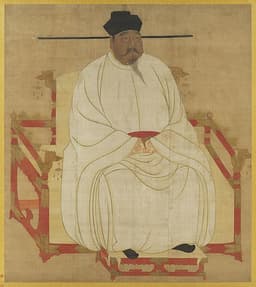
Zhao Kuangyin
Emperor · Medieval
71.5Total
Basic Information
Born
160
927
Died
237
976
Era
Ancient
Medieval
Nationality
China
China
Occupation
Politician
Emperor
Civilization
Eastern
Eastern
Score Comparison
Military (10%)
10.0
78.0
Political (20%)
72.0
84.0
Influence (20%)
40.0
68.0
Legacy (20%)
75.0
65.0
Leadership (15%)
72.0
74.0
Strategy (15%)
45.5
68.0
TOTAL
55.9
71.5
Chen Qun — Complete Timeline
220 AD
Proposed the Nine-rank SystemReform◆ Major
Chen Qun proposed the Nine-rank system for civil service appointments to Cao Pi, the first emperor of Wei. This system ranked candidates based on family background and personal merit, replacing the earlier recommendation system and becoming the standard for official selection in China for centuries.
Civil Service ReformWei DynastyBureaucracy
Impact: nationalconstructive
Advised Cao Pi on Legal CodeReform
Chen Qun assisted Cao Pi in drafting the new legal code for the Wei dynasty. He advocated for clearer laws and more consistent punishments, contributing to the legal framework that helped stabilize Wei's early rule.
Legal ReformWei DynastyLaw
Impact: nationalconstructive
226 AD
Served as Minister over the MassesPolitical Action
Chen Qun was appointed Minister over the Masses (Sikong) under Emperor Cao Rui of Wei. In this high-ranking position, he oversaw civil administration and continued to refine the implementation of the Nine-rank system, solidifying its role in Wei governance.
AppointmentWei DynastyGovernment
Impact: nationalconstructive
Zhao Kuangyin — Complete Timeline
960 AD
Founded Song dynastyPolitical Action
Zhao Kuangyin, a general of Later Zhou, was proclaimed emperor by his troops at Chenqiao. He established the Song dynasty, ending the Five Dynasties period and beginning a new era of Chinese history.
Song dynastyFoundingChenqiao
Impact: globalconstructive
961 AD
Removed military power from generalsPolitical Action◆ Major
Zhao Kuangyin invited senior generals to a banquet and persuaded them to retire peacefully. This 'removal of military power over wine' prevented military coups and centralized control.
Song dynastyMilitary reformCentralization
Impact: nationalconstructive
963 AD
Unified southern ChinaWar◆ Major
Zhao Kuangyin launched campaigns to conquer the southern kingdoms, including Jingnan, Later Shu, and Southern Tang. By his death, most of China was reunified under Song rule.
Song unificationConquestSouthern kingdoms
Impact: national
Expert Analysis
Chen Qun vs Zhao Kuangyin
The Emperor and the Bureaucrat
On a spring evening in 961, a victorious general-turned-emperor gathered his most trusted commanders for a feast in the capital of Kaifeng. Wine flowed freely, laughter echoed through the hall, and the mood was celebratory. But as the night deepened, Emperor Zhao Kuangyin dismissed the servants, refilled his own cup, and spoke with a heavy sigh: "I cannot sleep peacefully at night." His generals, men who had fought beside him for years, froze. The emperor had just revealed the eternal curse of power—the fear that those who help you rise might one day help you fall. Across the centuries, another Chinese statesman, Chen Qun, had faced a different kind of challenge: not how to seize power, but how to structure it so that talent, not birth or brute force, would govern an empire. One man sought to disarm his friends; the other sought to empower strangers. Their paths diverged, yet both reshaped China's destiny.
Origins
Zhao Kuangyin was born in 927 into a military family during the twilight of the Tang dynasty, a time when warlords carved China into competing kingdoms. His father was a general who served the Later Han, and young Zhao grew up riding horses, practicing archery, and learning the brutal arithmetic of war. The world he knew was one of shifting loyalties, where a sword spoke louder than a scholar's brush. By contrast, Chen Qun entered the world in 160, when the Han dynasty was still nominally intact but rotting from within. His family were minor officials, literate and connected to the Confucian bureaucracy that had sustained Chinese civilization for centuries. While Zhao learned to command men in battle, Chen learned to parse legal texts and debate governance. Their eras demanded different virtues: Zhao's required cunning and courage; Chen's required patience and precision.
Rise to Power
Zhao Kuangyin's ascent was swift and dramatic. In 960, as a general of the Later Zhou dynasty, he was ordered north to repel a Khitan invasion. But before he reached the frontier, his own troops halted at Chenqiao, draped a yellow imperial robe over his shoulders, and proclaimed him emperor. Whether he orchestrated this "mutiny" or merely accepted it, Zhao understood that power seized by the sword must be secured by the mind. He founded the Song dynasty that same year, inheriting a fractured land of rival kingdoms.
Chen Qun's rise was quieter, yet no less decisive. He served under Cao Cao, the warlord who controlled northern China, but his moment came in 220, when Cao Cao's son, Cao Pi, prepared to overthrow the last Han emperor. Chen Qun advised Cao Pi not only on the legal code but on a revolutionary idea: a system to recruit officials based on merit, not noble blood. The Nine-rank System, as it became known, graded candidates from nine levels of talent and assigned them to posts accordingly. It was a bureaucrat's quiet coup—a way to ensure that brains, not swords, would run the state.
Leadership & Governance
Zhao Kuangyin's leadership was defined by a single, brilliant act of strategic restraint. In 961, a year after founding the Song, he invited his senior generals to a banquet. Over cups of wine, he reminded them of the dangers of military ambition—how they themselves had made him emperor, and how future soldiers might do the same to their own commanders. Then he offered them a deal: retire to their estates, enjoy wealth and leisure, and leave the army's command to civilian officials. They agreed. This "removal of military power over a cup of wine" was bloodless, elegant, and transformative. Zhao prioritized stability over conquest, disarming his own sword-wielding allies to prevent the coups that had plagued China for decades.
Chen Qun's governance was equally transformative but operated on a different plane. As Minister over the Masses under Emperor Cao Rui from 226 onward, he refined the Nine-rank System into a national institution. It required local officials to submit evaluations of candidates, who were then ranked by central authorities. The system was imperfect—noble families often manipulated it—but it planted the seed of a meritocratic civil service that would outlast the Three Kingdoms. Chen Qun also pushed for clearer laws and consistent punishments, arguing that a state could not function if justice was arbitrary. Where Zhao Kuangyin built stability through disarmament, Chen Qun built it through procedure.
Triumph & Tragedy
Zhao Kuangyin's greatest triumph was the unification of southern China. Beginning in 963, he launched campaigns against the kingdoms of Jingnan, Later Shu, and Southern Tang, absorbing them into the Song realm through a combination of military pressure and diplomatic persuasion. By his death in 976, he had brought most of China under one rule for the first time in decades. Yet his greatest achievement—the peaceful removal of military power—also contained the seeds of tragedy. The Song dynasty, for all its cultural brilliance, would become notoriously weak militarily, unable to resist invasions from the north. Zhao's solution to internal rebellion left the empire vulnerable to external threats.
Chen Qun's tragedy was subtler. His Nine-rank System, designed to select the best talent, gradually ossified into a tool of aristocratic privilege. Over centuries, the "nine ranks" became hereditary, with high-ranking families dominating the top tiers. The system he created to break the grip of birth instead reinforced it. He died in 237, likely unaware of this slow betrayal of his vision.
Character & Destiny
Zhao Kuangyin was a pragmatist who understood human nature. He knew that power corrupts, but he also knew that fear can be redirected. His banquet gambit showed a leader who preferred persuasion to bloodshed, even when he held all the cards. Chen Qun was an idealist who believed in systems. He thought that if the rules were clear and the evaluations fair, good governance would follow. Both men were products of their times—Zhao of an age that demanded strong hands, Chen of an age that demanded sharp minds. Their characters shaped their outcomes: Zhao's realism built a dynasty; Chen's idealism built a bureaucracy.
Legacy
Zhao Kuangyin is remembered as Song Taizu, the founder of one of China's most culturally brilliant dynasties. His decision to subordinate the military to civilian control set the tone for Song governance, fostering an era of poetry, painting, and commerce. But it also left China exposed. His score of 82.3 in leadership reflects a ruler who mastered the art of power without the will to expand it.
Chen Qun's legacy is more diffuse but arguably more enduring. The Nine-rank System, despite its flaws, became the ancestor of China's imperial examination system, which would select officials by merit for over a millennium. His political score of 69.8 understates his influence; his influence score of 92.4 captures it. He is not a household name, but every Chinese bureaucrat who ever passed an exam owes him a debt.
Conclusion
Standing at the crossroads of Chinese history, Zhao Kuangyin and Chen Qun represent two faces of governance: the conqueror who learns to build, and the builder who learns to organize. One disarmed his friends to protect his throne; the other armed his state with a paper-and-ink system that would outlast every dynasty. Their lives remind us that power is not merely about swords or scrolls, but about the choices made in quiet moments—a banquet, a policy proposal, a sigh in the night. In the end, both men understood something profound: that an empire's strength lies not in its weapons or its laws alone, but in the delicate balance between them.
Rankings
🥇
Zhao KuangyinLeader
Mil: 78.0Pol: 84.0Inf: 68.0
71.5
🥈
Chen Qun
Mil: 10.0Pol: 72.0Inf: 40.0
55.9
+15.6 behind
How This Comparison Works
Algorithm
Each figure is scored on 6 dimensions (0—100 scale) based on structured historical data: Military (10%), Political (20%), Influence (20%), Legacy (20%), Leadership (15%), Strategy (15%). The weighted total produces the final ranking.
Data Sources
Scores are computed from structured sub-indicators in the database. Scale factors adjust for era (Ancient ×0.85, Modern ×1.0) and civilization size (Eastern ×1.05, Other ×0.80) to account for differences in population and military scale.
Maximum 3 Figures
Comparisons are limited to 2—3 figures to ensure readability and statistical meaningfulness.
Error Margins
±5 points per dimension — Sub-scores are derived from historical records with inherent uncertainty. Two figures within 5 points on a dimension should be considered roughly equivalent in that area.
Total Score Accuracy
±3 points overall — The weighted combination of 6 dimensions produces a total score with approximately ±3 points of uncertainty. Differences of less than 3 points are not statistically significant— the figures are effectively tied.
Known Limitations
- Historical records are incomplete and uneven across civilizations
- Figures from oral-tradition societies may be underrepresented
- Occupation labels can misclassify multi-role figures
- Scores measure capability and impact, not moral character
- Quantitative scoring is a comparison tool, not absolute truth
Capability Radar
Military (10%) — Battles & Warfare
Battles
19
75
Win Rate
22
85
Expansion
25
75
Political (20%) — Governance & Reform
Reform
85
90
Diplomacy
50
85
Economy
60
80
Influence (20%) — Cultural & Global Reach
Cultural
70
70
Global
65
60
Legacy (20%) — Historical Impact
Historical
80
80
Longevity
85
75
Leadership (15%) — Power & Stability
Tenure
40
65
Stability
65
85
Strategy (15%) — Tactics & Innovation
Strategy
31
80
Tactics
32
70
Reform
36
90
Similar Comparisons
Comments & Discussion
SwordToBrush6/16/2026
Zhao wins for pure audacity: drinking his generals under the table then disarming them with tears? That's Machiavellian genius three centuries before Machiavelli. But Chen Qun's Nine-Rank System is the real unsung hero. It gatekept nepotism for 400 years. Try finding a single barbarian horde that respected your 'drunken poetry party' strategy.
铁骑书生6/16/2026
赵匡胤杯酒释兵权是高超政治手腕,但别神化他。陈群的九品中正制才是魏晋南北朝稳定的根基。没有这套官僚选拔体系,中国早就碎成欧洲那样了。赵匡胤解决了眼前的军阀,陈群解决了后世的乱源。高下立判。
DataSkeptic426/16/2026
Let's talk numbers. Zhao's 'peaceful' takeover of Later Zhou resulted in zero recorded civilian deaths in Kaifeng. Chen Qun's system? By 300 AD, 90% of high offices were held by elite families. So one man saved lives in real-time, while the other's "meritocracy" became a hereditary farce. I'll take the bloodless coup over a 200-year bureaucratic scam.
史学侦探6/16/2026
你们忽略关键差异:赵匡胤面对着五代的核威胁——兵变!陈群面对的是东汉的慢性毒——外戚宦官。赵用制度(枢密院三衙)收兵权,陈用制度(九品中正)收用人权。但结果呢?赵的宋朝军弱三百年,陈的九品造就士族门阀。两人都是救火队员,火灭了,水淹了房子。
ClassicsPhil6/16/2026
Zhao Kuangyin's 'Removing Military Power Over Wine' is China's founding myth of enlightened despotism. Chen Qun lacks this drama, but his subtlety is deeper. He realized that a collapsing dynasty needs viral institutional immunity, not a miracle cure. Zhao performed triage; Chen prescribed long-term therapy. History laughs: Zhao's cure lasted 167 years. Chen's "failure" still influences China's civil service exams today.