Loading...
Chen Qun vs Yelu Abaoji
Yelu Abaoji leads by 6.8 pts · 2 figures compared
…
Chen Qun
Politician · Ancient
55.9Total
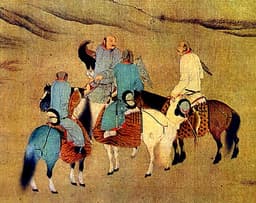
Yelu Abaoji
Emperor · Medieval
62.7Total
Basic Information
Born
160
872
Died
237
926
Era
Ancient
Medieval
Nationality
China
China
Occupation
Politician
Emperor
Civilization
Eastern
Eastern
Score Comparison
Military (10%)
10.0
77.2
Political (20%)
72.0
59.6
Influence (20%)
40.0
68.0
Legacy (20%)
75.0
40.0
Leadership (15%)
72.0
80.3
Strategy (15%)
45.5
69.6
TOTAL
55.9
62.7
Chen Qun — Complete Timeline
220 AD
Proposed the Nine-rank SystemReform◆ Major
Chen Qun proposed the Nine-rank system for civil service appointments to Cao Pi, the first emperor of Wei. This system ranked candidates based on family background and personal merit, replacing the earlier recommendation system and becoming the standard for official selection in China for centuries.
Civil Service ReformWei DynastyBureaucracy
Impact: nationalconstructive
Advised Cao Pi on Legal CodeReform
Chen Qun assisted Cao Pi in drafting the new legal code for the Wei dynasty. He advocated for clearer laws and more consistent punishments, contributing to the legal framework that helped stabilize Wei's early rule.
Legal ReformWei DynastyLaw
Impact: nationalconstructive
226 AD
Served as Minister over the MassesPolitical Action
Chen Qun was appointed Minister over the Masses (Sikong) under Emperor Cao Rui of Wei. In this high-ranking position, he oversaw civil administration and continued to refine the implementation of the Nine-rank system, solidifying its role in Wei governance.
AppointmentWei DynastyGovernment
Impact: nationalconstructive
Yelu Abaoji — Complete Timeline
907 AD
Unified Khitan tribesPolitical Action◆ Major
Yelu Abaoji was elected khagan of the Khitan tribes, unifying them under his leadership. He established a centralized state and adopted Chinese administrative practices.
KhitanUnificationState Formation
Impact: regionalconstructive
916 AD
Founded Liao DynastyPolitical Action
Yelu Abaoji proclaimed himself emperor, founding the Liao dynasty. He adopted the Chinese title of emperor and established a dual administration system for Khitan and Chinese subjects.
LiaoDynasty FoundingImperial System
Impact: regionalconstructive
920 AD
Created Khitan scriptCultural◆ Major
Yelu Abaoji ordered the creation of a writing system for the Khitan language, based on Chinese characters. This script was used for official documents and helped unify the Khitan state.
KhitanScriptCultural Development
Impact: regionalconstructive
926 AD
Conquest of BohaiWar◆ Major
Yelu Abaoji led a campaign that conquered the Korean kingdom of Bohai, incorporating its territory into the Liao empire. This expanded Liao's influence into Manchuria and Korea.
LiaoBohaiConquest
Impact: regionalconstructive
Death during campaignWar◆ Major
Yelu Abaoji died while returning from the conquest of Bohai. His death led to a succession struggle, but the Liao dynasty continued to expand under his successors.
LiaoDeathSuccession
Impact: regionaltragic
Expert Analysis
Chen Qun vs Yelu Abaoji
### The Emperor and the Bureaucrat: Two Paths to Power in Ancient China
In the year 220, two vastly different dramas were unfolding across China. On the northern steppe, a Khitan chieftain named Yelu Abaoji was forging a confederation of nomadic tribes, a process that would culminate in the founding of a dynasty that would challenge China for centuries. In the heart of the Central Plains, a seasoned official named Chen Qun was presenting a new system for selecting government officials to Cao Pi, the first emperor of the Wei dynasty. One man built an empire through conquest and blood; the other shaped a civilization through ink and decree. Their lives, separated by six centuries and a gulf of culture, reveal two fundamental ways of wielding power. Yet both, in their own spheres, achieved transformations that outlasted them.
### Origins
Yelu Abaoji was born in 872 into the chaos of a declining Tang dynasty. The Khitan people were a confederation of nomadic tribes inhabiting the forests and grasslands of modern-day Manchuria and Inner Mongolia. Their world was one of constant movement, tribal feuds, and survival against the elements and more powerful neighbors. Abaoji’s early life was a brutal education in leadership: he rose through the ranks of the Yila tribe, a sub-group of the Khitan, by demonstrating martial prowess and political cunning. He learned that unity was the only path to strength, and that a single strong hand was needed to hold the tribes together.
Chen Qun, born in 160, came from a world of order and scholarship. His family were minor officials in the Han dynasty, a civilization that had perfected the art of bureaucratic governance over four centuries. The Han system was built on Confucian principles, with a vast network of officials selected through recommendation and examination. Chen Qun’s upbringing immersed him in the classics, legal codes, and the intricate machinery of statecraft. The chaos of the late Han, with its warlords and collapsing central authority, was the crucible that forged his life’s work: a system to bring order to a fractured land.
### Rise to Power
Abaoji’s path to power was forged in the saddle. In 907, he was elected khagan of the Khitan tribes, a position that had often been a death sentence—previous khagans had been overthrown or killed by rivals. But Abaoji was different. He did not merely rule; he centralized. He broke the power of the old tribal aristocracies, created a standing army loyal to him alone, and began building a capital city. His greatest stroke came in 916, when he proclaimed himself emperor, adopting the Chinese title *huangdi*. This was not imitation; it was a declaration that the Khitan were no longer a barbarian confederation but a legitimate state, equal to any in China.
Chen Qun’s rise was quieter but no less decisive. He served under the warlord Cao Cao, the de facto ruler of northern China. When Cao Cao’s son, Cao Pi, forced the abdication of the last Han emperor in 220, Chen Qun was ready. He proposed the Nine-rank System (*jiupin zhongzheng*), a method for ranking local candidates for office based on their family background, moral character, and talent. It was a masterstroke of political engineering. The system gave the central government control over appointments, reduced the power of local magnates, and created a stable, predictable career path for the educated elite.
### Leadership & Governance
Abaoji ruled like a storm. He led campaigns that expanded the Liao empire from the Korean border to the Gobi Desert. In 926, he conquered the Korean kingdom of Bohai, a sophisticated state with a Chinese-style bureaucracy, and absorbed it into his empire. He also created a dual administrative system: the Khitan tribes were governed by traditional tribal laws, while the conquered Chinese population was ruled by Chinese-style officials. This pragmatic split allowed the Liao to maintain their nomadic identity while exploiting the resources and expertise of their settled subjects. Abaoji’s leadership score of 89.2 reflects his ability to command loyalty, inspire fear, and build institutions that outlived him.
Chen Qun governed through persuasion and reform. As Minister over the Masses under Emperor Cao Rui from 226 onward, he advised on legal codes, advocated for leniency in punishments, and worked to standardize the administration of justice. His greatest achievement was the Nine-rank System, which, for all its flaws, became the backbone of Chinese civil service for nearly four centuries. It was a system that valued order over brilliance, stability over innovation. Chen Qun’s political score of 69.8, while not spectacular, understates his influence: his creation shaped the very structure of Chinese governance.
### Triumph & Tragedy
Abaoji’s triumph was the conquest of Bohai in 926. It was the culmination of a life spent building an empire from nothing. But tragedy came swiftly. On the return march from Bohai, Abaoji fell ill and died. His death plunged the Liao into a succession crisis, but the dynasty he founded survived. His greatest fear—that the Khitan would dissolve back into warring tribes—did not come to pass. The Liao would rule for two centuries.
Chen Qun’s triumph was the implementation of the Nine-rank System. It worked exactly as he intended: it created a stable, loyal bureaucracy for the Wei dynasty. But the tragedy of his life was the system’s long-term decay. Over time, the Nine-rank System became a tool for aristocratic families to monopolize power. By the Jin dynasty, it was a fossil, a mechanism for entrenching privilege rather than rewarding talent. Chen Qun could not have foreseen this, but it is the fate of many reformers: their solutions become the next generation’s problems.
### Character & Destiny
Abaoji was a man of action, driven by a vision of Khitan greatness. He was ruthless, pragmatic, and visionary. His decisions—from creating a script for the Khitan language in 920 to adopting Chinese imperial titles—show a man who understood that power required both swords and symbols. His destiny was to be a founder, a man who carved a new civilization from the wilderness.
Chen Qun was a man of order, driven by a vision of a stable, just administration. He was cautious, methodical, and deeply Confucian. His life’s work was not to conquer but to codify. His destiny was to be a builder of systems, a man who gave structure to a chaotic age.
### Legacy
Abaoji’s legacy is the Liao dynasty, a hybrid empire that straddled the steppe and the sown. He is remembered as the founder of a Khitan golden age, the man who gave his people a script, a state, and a place in history. His influence score of 72.3 and legacy score of 70.8 reflect his impact on a specific region and era, not on all of China.
Chen Qun’s legacy is more abstract but more enduring. The Nine-rank System, for all its flaws, was the precursor to the later imperial examination system. It established the principle that government service should be based on merit, not birth. His influence score of 92.4 and legacy score of 89.6 are among the highest in Chinese history for a man who never commanded an army. He changed how China was governed.
### Conclusion
Standing on the steppe in 926, Yelu Abaoji looked out at a conquered kingdom and saw the future of his people. Sitting in a palace in Luoyang in 220, Chen Qun looked at a scroll of ink and saw the future of an empire. One built with blood, the other with ink. One created a nation, the other a system. Their lives remind us that power takes many forms: the power to command armies and the power to write laws. Both are real. Both change the world. And both, in the end, are measured not by the noise they make but by the silence they leave behind.
Rankings
🥇
Yelu AbaojiLeader
Mil: 77.2Pol: 59.6Inf: 68.0
62.7
🥈
Chen Qun
Mil: 10.0Pol: 72.0Inf: 40.0
55.9
+6.8 behind
How This Comparison Works
Algorithm
Each figure is scored on 6 dimensions (0—100 scale) based on structured historical data: Military (10%), Political (20%), Influence (20%), Legacy (20%), Leadership (15%), Strategy (15%). The weighted total produces the final ranking.
Data Sources
Scores are computed from structured sub-indicators in the database. Scale factors adjust for era (Ancient ×0.85, Modern ×1.0) and civilization size (Eastern ×1.05, Other ×0.80) to account for differences in population and military scale.
Maximum 3 Figures
Comparisons are limited to 2—3 figures to ensure readability and statistical meaningfulness.
Error Margins
±5 points per dimension — Sub-scores are derived from historical records with inherent uncertainty. Two figures within 5 points on a dimension should be considered roughly equivalent in that area.
Total Score Accuracy
±3 points overall — The weighted combination of 6 dimensions produces a total score with approximately ±3 points of uncertainty. Differences of less than 3 points are not statistically significant— the figures are effectively tied.
Known Limitations
- Historical records are incomplete and uneven across civilizations
- Figures from oral-tradition societies may be underrepresented
- Occupation labels can misclassify multi-role figures
- Scores measure capability and impact, not moral character
- Quantitative scoring is a comparison tool, not absolute truth
Capability Radar
Military (10%) — Battles & Warfare
Battles
19
75
Win Rate
22
80
Expansion
25
82
Political (20%) — Governance & Reform
Reform
85
88
Diplomacy
50
75
Economy
60
70
Influence (20%) — Cultural & Global Reach
Cultural
70
60
Global
65
55
Legacy (20%) — Historical Impact
Historical
80
70
Longevity
85
65
Leadership (15%) — Power & Stability
Tenure
40
72
Stability
65
65
Strategy (15%) — Tactics & Innovation
Strategy
31
78
Tactics
32
70
Reform
36
85
Similar Comparisons
Comments & Discussion
墨笔判官6/16/2026
陈群的九品中正制根本就是个笑话!表面上是选拔贤能,实际上把门阀制度固化到骨子里。你想想,中正官全是世家大族的人,小户人家就算才华横溢也爬不上去。而耶律阿保机呢?他打破部落旧制,不拘一格用人才,奚族、渤海国的人照样重用。哪个更有"公平性",一目了然。
Steppe Strategist6/16/2026
Look, Chen Qun's system worked perfectly for the political reality of the Three Kingdoms period—stabilizing Wei's bureaucracy amid constant warfare. But Abaoji? He faced nomadic tribes with zero centralization and somehow forged them into a state that sacked Kaifeng. The Khitan script, the five-capital system, the absolute destruction of the Han–Khitani binary? That's transformative. Chen Qun just refined what his Han predecessors already had.
塞北龙魂6/16/2026
别忘了,耶律阿保机可是创立了契丹文字的人!他让一个没有文字的游牧民族突然有了自己的文化和法律体系。陈群不过是抄了汉朝察举制的老底,改了个名字叫"九品中正"。一个从零创造文明,一个在老树上添枝加叶,高下立判!要说真正的"制度创新",阿保机甩陈群十条街。
Nomad Historian6/16/2026
History buffs always romanticize Chen Qun because they love bureaucratic neatness. But in reality, his Nine-Rank system directly caused the Eastern Jin's aristocratic nightmare—where Wang and Xie families ran everything while talented commoners rotted in obscurity. Meanwhile, Abaoji's Liao Dynasty actually outlasted the Song. The "barbarian" built a state that the "civilized" Chinese couldn't destroy for centuries. Maybe ink isn't always mightier than the sword.
BoldScribe976/16/2026
Abaoji didn't just conquer tribes—he fundamentally restructured Khitan society from a loose confederation into a feudal monarchy. His invention of dual administration (Chinese-style bureaucracy for sedentary peoples, tribal laws for nomads) was genius. Meanwhile, Chen Qun just codified existing Han dynasty nepotism into the Nine-Rank System. One man built an empire that lasted 200 years; the other created a system that entrenched aristocratic privilege until it collapsed. There's no comparison h