Loading...
Chen Qun vs Dinh Tien Hoang
Dinh Tien Hoang leads by 4.5 pts · 2 figures compared
…
Chen Qun
Politician · Ancient
55.9Total
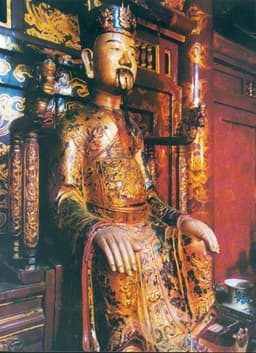
Dinh Tien Hoang
Emperor · Medieval
60.4Total
Basic Information
Born
160
924
Died
237
979
Era
Ancient
Medieval
Nationality
China
Vietnam
Occupation
Politician
Emperor
Civilization
Eastern
Eastern
Score Comparison
Military (10%)
10.0
60.0
Political (20%)
72.0
72.0
Influence (20%)
40.0
65.0
Legacy (20%)
75.0
40.0
Leadership (15%)
72.0
77.2
Strategy (15%)
45.5
58.0
TOTAL
55.9
60.4
Chen Qun — Complete Timeline
220 AD
Proposed the Nine-rank SystemReform◆ Major
Chen Qun proposed the Nine-rank system for civil service appointments to Cao Pi, the first emperor of Wei. This system ranked candidates based on family background and personal merit, replacing the earlier recommendation system and becoming the standard for official selection in China for centuries.
Civil Service ReformWei DynastyBureaucracy
Impact: nationalconstructive
Advised Cao Pi on Legal CodeReform
Chen Qun assisted Cao Pi in drafting the new legal code for the Wei dynasty. He advocated for clearer laws and more consistent punishments, contributing to the legal framework that helped stabilize Wei's early rule.
Legal ReformWei DynastyLaw
Impact: nationalconstructive
226 AD
Served as Minister over the MassesPolitical Action
Chen Qun was appointed Minister over the Masses (Sikong) under Emperor Cao Rui of Wei. In this high-ranking position, he oversaw civil administration and continued to refine the implementation of the Nine-rank system, solidifying its role in Wei governance.
AppointmentWei DynastyGovernment
Impact: nationalconstructive
Dinh Tien Hoang — Complete Timeline
968 AD
Defeat of the Twelve WarlordsWar
Dinh Bo Linh, later known as Dinh Tien Hoang, unified Vietnam by defeating the Twelve Warlords who had divided the country after the collapse of Chinese rule. He established the Dinh dynasty and became the first emperor of an independent Vietnam.
UnificationDinh DynastyVietnamese Independence
Impact: nationalconstructive
Establishment of the Dinh DynastyPolitical Action◆ Major
Dinh Tien Hoang founded the Dinh dynasty and declared himself Emperor. He moved the capital to Hoa Lu and implemented administrative reforms to consolidate power. This marked the beginning of a new era of Vietnamese independence after centuries of Chinese domination.
Dynasty FoundingCapital MoveAdministrative Reform
Impact: nationalconstructive
979 AD
Assassination of Dinh Tien HoangPolitical Action◆ Major
Dinh Tien Hoang and his crown prince were assassinated by a court official while sleeping. The murder plunged the Dinh dynasty into chaos, leading to a succession crisis and eventual takeover by Le Hoan. The assassination ended the short-lived Dinh dynasty.
AssassinationSuccession CrisisEnd of Dinh Dynasty
Impact: nationaltragic
Expert Analysis
Chen Qun vs Dinh Tien Hoang
### The Emperor and the Bureaucrat: Two Paths to Order from Chaos
In the year 968, a warlord named Dinh Bo Linh declared himself Emperor of a land that had not known its own ruler for a thousand years. Half a world away, in the year 220, a scholar-official named Chen Qun proposed a system for selecting civil servants that would shape Chinese governance for centuries. One man built a throne with his sword; the other built a bureaucracy with his inkbrush. Both sought to impose order on chaos, but their tools, their goals, and their fates could not have been more different. What drove a warrior to seize a crown and a politician to craft a ranking system? The answers lie in the soil of their times and the fire of their ambitions.
### Origins: A Land Divided, an Empire in Flux
Dinh Tien Hoang was born in 924 in what is now northern Vietnam, a land that had chafed under Chinese domination for a millennium. His childhood unfolded amid the collapse of the Tang dynasty, a vacuum that spawned local strongmen. The young Dinh grew up not in a palace but in a village, learning to fight and lead in a world where power was measured by the sword. His era was one of fracture: the “Twelve Warlords” had carved the country into rival fiefs, each claiming a piece of a broken whole. For Dinh, order was a distant dream, and unity a prize to be taken.
Chen Qun, born in 160, entered a China that was still nominally unified under the Han dynasty, but the cracks were already showing. He was a child of the scholar-gentry class, raised on the Confucian classics and the ideal of a harmonious state run by virtuous officials. His world was not one of battlefields but of court intrigues and philosophical debates. The Han was dying, and the Three Kingdoms were rising—a time of war, yes, but also of intense intellectual ferment. For Chen, order was a system to be designed, a ladder of merit to be built.
### Rise to Power: The Sword and the Seal
Dinh’s path was brutal and direct. Between 965 and 968, he waged a relentless campaign against the Twelve Warlords, crushing them one by one. He did not negotiate; he conquered. His victory at the Battle of Hoa Lu was a turning point, a moment when the scattered pieces of Vietnam fell into his hands. He took the title “Dinh Tien Hoang”—the “First Emperor of Dinh”—and moved the capital to Hoa Lu, a natural fortress of limestone mountains and rivers. His power rested on fear and loyalty, earned through blood.
Chen Qun’s rise was slower, more strategic. He served under the warlord Cao Cao, then his son Cao Pi, who would become the first emperor of the Wei dynasty. Chen’s great moment came in 220, when he proposed the Nine-rank System to Cao Pi. This was not a call to arms but a call to order: a method for evaluating candidates for office based on their moral character, talent, and family background. The system was a compromise between meritocracy and aristocracy, a way to staff a new dynasty with capable men. Chen did not seize power; he shaped it, advising on legal codes and serving as Minister over the Masses under Emperor Cao Rui.
### Leadership & Governance: The Warlord’s Grip and the Bureaucrat’s Blueprint
As emperor, Dinh Tien Hoang ruled with an iron fist. He centralized authority, imposed harsh laws, and built a military state. His capital at Hoa Lu was a fortress, not a city of culture. He rewarded his generals and suppressed dissent, but he never had the chance to build lasting institutions. His reign was a desperate holding action, a warrior’s attempt to keep what he had taken. His political score of 90.2 reflects his success in uniting Vietnam, but his military score of 62.0 and strategy score of 60.0 suggest a man who relied more on brute force than on subtle tactics.
Chen Qun’s governance was the opposite. He was a builder of systems, not walls. The Nine-rank System was his masterpiece: it created nine grades of officials, from the highest ministers to the lowest clerks, and established a process for evaluating them. This system would be adopted by later dynasties, including the Jin and Sui, and would influence Chinese civil service for over 700 years. Chen also helped draft a new legal code for Wei, advocating for clarity and consistency. His political score of 69.8 is modest, but his influence score of 92.4 and legacy score of 89.6 reveal his true power: he changed how China was governed.
### Triumph & Tragedy: The Assassin’s Blade and the Enduring System
Dinh’s greatest triumph was the unification of Vietnam, a feat that ended centuries of division. His tragedy came swiftly. In 979, he and his crown prince were assassinated in their sleep by a court official, a man named Do Thich, who had supposedly been driven mad by a dream. The murder plunged the Dinh dynasty into chaos; within a year, a new ruler, Le Hoan, would seize power, and Dinh’s line was extinguished. His legacy was a brief, brilliant flame—a unified Vietnam, but one that would need another founder.
Chen Qun’s triumph was quieter but more durable. He saw his Nine-rank System implemented and refined during his lifetime, and he served as a trusted advisor until his death in 237. His tragedy was that the system he created would eventually calcify into a tool of aristocratic privilege, favoring family connections over merit. But that was a corruption of his vision, not its failure. He died in his bed, respected and mourned, his name synonymous with bureaucratic reform.
### Character & Destiny: The Warrior’s Pride and the Scholar’s Patience
Dinh Tien Hoang was a man of action, driven by a fierce will to unify his homeland. He trusted his sword more than his advisors, and that pride may have cost him his life. He slept without guards, confident in his power, and an assassin’s blade proved him wrong. His destiny was shaped by the chaos of his time: he could not afford to be patient, for the warlords would not wait.
Chen Qun was a man of patience, a planner who understood that systems outlast individuals. He did not seek personal glory but the stability of a well-ordered state. His character was suited to his era: the Three Kingdoms were a time of upheaval, but also of opportunity for those who could think beyond the battlefield. He knew that a single emperor might fall, but a good system could endure.
### Legacy: A Name in Stone, a System in Practice
Dinh Tien Hoang is remembered as the father of Vietnamese independence, a national hero whose statue stands in Hoa Lu. His name is carved into history, but his dynasty was ephemeral. His legacy is symbolic: he proved that Vietnam could rule itself, but he left no institutions to sustain that rule.
Chen Qun’s legacy is practical. The Nine-rank System was not perfect, but it was a crucial step toward the imperial examination system that would define Chinese governance for centuries. His name is less famous than Dinh’s, but his influence is woven into the fabric of Chinese history. He is remembered not as a conqueror but as a creator.
### Conclusion: Two Kinds of Order
The contrast between Dinh Tien Hoang and Chen Qun is the contrast between the sword and the seal. One built a nation through conquest, only to see it crumble with his death. The other built a system through patience, and saw it shape an empire for generations. Both sought order in a disordered world, but their tools reflected their times and their characters. Dinh’s story is a warning: even the strongest warrior cannot protect his legacy from a single assassin. Chen’s story is a lesson: the quiet work of a bureaucrat can outlast the loudest battle. In the end, history remembers both—but it learns more from the one who built a ladder than from the one who built a throne.
Rankings
🥇
Dinh Tien HoangLeader
Mil: 60.0Pol: 72.0Inf: 65.0
60.4
🥈
Chen Qun
Mil: 10.0Pol: 72.0Inf: 40.0
55.9
+4.5 behind
How This Comparison Works
Algorithm
Each figure is scored on 6 dimensions (0—100 scale) based on structured historical data: Military (10%), Political (20%), Influence (20%), Legacy (20%), Leadership (15%), Strategy (15%). The weighted total produces the final ranking.
Data Sources
Scores are computed from structured sub-indicators in the database. Scale factors adjust for era (Ancient ×0.85, Modern ×1.0) and civilization size (Eastern ×1.05, Other ×0.80) to account for differences in population and military scale.
Maximum 3 Figures
Comparisons are limited to 2—3 figures to ensure readability and statistical meaningfulness.
Error Margins
±5 points per dimension — Sub-scores are derived from historical records with inherent uncertainty. Two figures within 5 points on a dimension should be considered roughly equivalent in that area.
Total Score Accuracy
±3 points overall — The weighted combination of 6 dimensions produces a total score with approximately ±3 points of uncertainty. Differences of less than 3 points are not statistically significant— the figures are effectively tied.
Known Limitations
- Historical records are incomplete and uneven across civilizations
- Figures from oral-tradition societies may be underrepresented
- Occupation labels can misclassify multi-role figures
- Scores measure capability and impact, not moral character
- Quantitative scoring is a comparison tool, not absolute truth
Capability Radar
Military (10%) — Battles & Warfare
Battles
19
70
Win Rate
22
75
Expansion
25
65
Political (20%) — Governance & Reform
Reform
85
70
Diplomacy
50
65
Economy
60
60
Influence (20%) — Cultural & Global Reach
Cultural
70
65
Global
65
55
Legacy (20%) — Historical Impact
Historical
80
75
Longevity
85
70
Leadership (15%) — Power & Stability
Tenure
40
60
Stability
65
55
Strategy (15%) — Tactics & Innovation
Strategy
31
70
Tactics
32
65
Reform
36
60
Similar Comparisons
Comments & Discussion
Dragon-Tamer's Ghost6/16/2026
Dinh was a brute, not a builder. Any warlord can hack through a dozen rivals with a rusty blade. Real civilizing happens when you design a system to select officials by merit instead of birth. Chen Qun's nine-rank system was the first serious attempt to institutionalize talent over blood. Dinh's "unification" was just primitive strongman politics dressed up in stolen Chinese court robes. He's the blueprint for every tin-pot dictator who confuses conquest with leadership.
Dao-Sword Bureaucrat6/16/2026
Here's the irony: Chen Qun's system was meant to find the best minds, but it quickly decayed into hereditary privilege for the same aristocratic clans he supposedly bypassed. Dinh at least was honest about power being personal. He killed the tiger, literally and metaphorically, then built wooden palisades and called it an empire. Give me the guy who fights his own battles over the backroom schemer who writes rules he expects others to follow.
九品刺客6/16/2026
说得好听是“九品中正制”,说白了就是门阀的遮羞布。陈群设计的这套东西,表面上公平,实际上早就给汝颍士族预留了位置。丁部领虽然粗野,但他直接干掉十一个割据势力,从乱局中打出一个王朝。陈群把官场变成圈子游戏,丁部领把战场变成权力证明。你选谁?
Iron-Fist Unifier6/16/2026
Dinh didn't just beat twelve warlords—he executed the tiger that terrorized his village. That's not just brute force; that's political theater designed to project invincibility. He understood that perception of power is often more important than the power itself. Chen Qun understood bureaucracy, sure, but Dinh understood people. In a world of chaos, you need someone who can command loyalty through fear and awe, not just point to a ranking system.
南国铁鞭6/16/2026
丁先皇最牛的地方不是打仗,而是他在位期间居然废了死刑,用铜鼎油锅吓住犯人。这招比陈群的官员考评制度直接多了。北宋那些文官整天搞什么门第评品,丁部领在蛮荒之地自己定规矩,把庙号制度都带进大越。你们夸陈群懂制度,我说他是躲在朝堂里写本子,丁先皇才是真刀真枪在乱世里盖章的人。