Loading...
Cesare Borgia vs Sitiveni Rabuka
Cesare Borgia leads by 8.5 pts · 2 figures compared
…
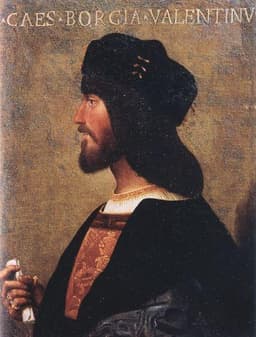
Cesare Borgia
General · Medieval
60.2Total
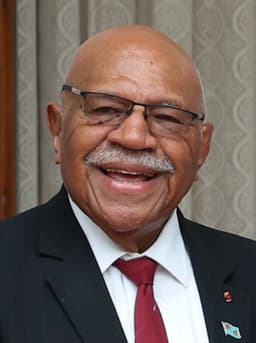
Sitiveni Rabuka
General · Modern
51.7Total
Basic Information
Born
1475
1948
Died
1507
—
Era
Medieval
Modern
Nationality
Italy
Fiji
Occupation
General
General
Civilization
Western
Other
Score Comparison
Military (10%)
67.5
10.2
Political (20%)
68.0
60.0
Influence (20%)
68.0
53.3
Legacy (20%)
40.0
46.7
Leadership (15%)
64.0
85.0
Strategy (15%)
66.3
39.6
TOTAL
60.2
51.7
Cesare Borgia — Complete Timeline
1493 AD
Appointment as CardinalPolitical Action◆ Major
Cesare Borgia was appointed cardinal by his father, Pope Alexander VI. This position gave him significant power within the Church and access to papal resources. He used his cardinalate to advance his family's political interests in Italy.
CardinalNepotismPapacy
Impact: regional
1498 AD
Resignation from the CardinalatePolitical Action◆ Major
Cesare Borgia resigned as cardinal to pursue a military and political career. He became the first person to voluntarily leave the College of Cardinals. This move allowed him to focus on conquering territories in the Romagna region of Italy.
ResignationMilitaryRomagna
Impact: regional
1499 AD
Conquest of the RomagnaWar◆ Major
Cesare Borgia, with French support, launched a campaign to conquer the cities of the Romagna. He captured Imola, Forl
ConquestRomagnaMachiavelli
Impact: regional
1503 AD
Fall from PowerPolitical Action
After the death of Pope Alexander VI, Cesare Borgia lost his political support. He was captured by his enemies and imprisoned in Spain. His territories in Italy quickly collapsed. This sudden fall demonstrated the fragility of his power base.
FallImprisonmentCollapse
Impact: regionaltragic
1507 AD
Death in BattleWar
Cesare Borgia was killed in a skirmish near Viana, Navarre, while serving as a mercenary captain. His death ended any chance of restoring his former power. He died at age 31, having failed to regain his Italian territories.
DeathMercenaryNavarre
tragic
Sitiveni Rabuka — Complete Timeline
1987 AD
1987 Fijian Coup d'étatPolitical Action
Rabuka, as a colonel in the Fijian military, led a coup overthrowing the elected government of Timoci Bavadra. The coup was motivated by ethnic Fijian opposition to Indo-Fijian political influence. Rabuka declared Fiji a republic.
CoupMilitary InterventionEthnic Tension
Impact: nationaldestructive
1992 AD
1992 Election as Prime MinisterPolitical Action◆ Major
Rabuka transitioned from military leader to civilian politician, winning the 1992 general election as leader of the Fijian Political Party. He became Prime Minister, serving until 1999.
ElectionCivilian GovernmentPolitical Transition
Impact: national
1997 AD
1997 Constitution ReformReform◆ Major
Rabuka's government oversaw the adoption of a new constitution that removed ethnic-based voting and provided for a multi-ethnic government. The constitution aimed to reduce ethnic tensions and promote national unity.
ConstitutionReformEthnic Reconciliation
Impact: nationalconstructive
1999 AD
1999 General Election DefeatPolitical Action◆ Major
Rabuka's government was defeated in the general election by the Labour Party led by Mahendra Chaudhry. Rabuka stepped down as Prime Minister, marking the end of his first period in power.
Election DefeatGovernment ChangeChaudhry
Impact: national
2022 AD
2022 Return as Prime MinisterPolitical Action◆ Major
Rabuka led the People's Alliance to victory in the 2022 general election, forming a coalition government. He became Prime Minister again, 23 years after his previous tenure, promising democratic reforms.
ElectionReturn to PowerCoalition Government
Impact: national
Expert Analysis
Sitiveni Rabuka vs Cesare Borgia
### The Prince and the Peacemaker: Cesare Borgia and Sitiveni Rabuka
History has a curious way of juxtaposing figures who, despite inhabiting vastly different worlds, grapple with the same elemental forces: power, ambition, and the brutal arithmetic of survival. Imagine two men, separated by five centuries and half a globe. One, a cardinal in Renaissance Italy, who shed his crimson robes for a suit of armor, carving a kingdom from the chaotic heart of the Papal States with a blend of charm, poison, and cold steel. The other, a colonel in the South Pacific, who overthrew his own government in a bloodless coup, then spent decades trying to piece democracy back together. Cesare Borgia and Sitiveni Rabuka: one became the blueprint for Machiavelli’s ruthless ideal, the other a living paradox of a dictator who learned to love the ballot box. What drove these divergent paths, and what does it tell us about the nature of leadership itself?
### Origins
Cesare Borgia was born in 1475 into the most scandalous family of the Italian Renaissance. His father, Rodrigo Borgia, later Pope Alexander VI, was a master of nepotism and political intrigue. Cesare was groomed for the church not out of piety, but as a tool of dynastic ambition. At eighteen, in 1493, he was made a cardinal—a prince of the Church before he could grow a beard. Yet the Borgias were Spaniards in Italy, outsiders who clawed for respect. This bred in Cesare a ruthless pragmatism, a belief that power was a zero-sum game. His world was a mosaic of warring city-states, where loyalty was a currency that could be debased overnight.
Sitiveni Rabuka, born in 1948, came from a different universe entirely. He was a Fijian of chiefly lineage from the island of Cakaudrove, raised in a society where communal bonds and respect for tradition were paramount. Fiji, a British colony until 1970, was a fragile experiment in multi-ethnic democracy, with indigenous Fijians and Indo-Fijian descendants of indentured laborers sharing a tense coexistence. Rabuka was a product of the military, a disciplined institution that offered a path upward for indigenous Fijians. His upbringing instilled a sense of duty to his people, but also a deep-seated fear: that the Indo-Fijian majority might one day rule permanently. Where Borgia saw opportunity in chaos, Rabuka saw a threat to a way of life.
### Rise to Power
Cesare Borgia’s rise was a study in calculated violence. In 1498, he did the unthinkable: he resigned his cardinalate, the first man ever to do so voluntarily. He traded the Vatican for the battlefield, securing French support through a strategic marriage. By 1499, he was sweeping through the Romagna, a region of rebellious cities and petty lords. His campaign was a masterclass in psychological warfare. He captured Imola and Forlì, then turned on his own mercenary captains when they became liabilities. In 1502, he lured his treacherous allies to the town of Senigallia and had them strangled. Machiavelli, then a Florentine diplomat watching from the wings, was awed. Here was a prince who acted with “cruelty well used”—swift, decisive, and final.
Rabuka’s rise was quieter, then explosive. In 1987, as a colonel, he watched with alarm as a coalition government, led by the Indo-Fijian-supported Timoci Bavadra, took power. To Rabuka and many indigenous Fijians, this was a usurpation of their ancestral rights. On May 14, he walked into Parliament in civilian clothes, ordered the prime minister and his cabinet into a van, and declared martial law. It was a coup with hardly a shot fired. Unlike Borgia, Rabuka did not seize power for personal glory. He saw himself as a reluctant guardian, a man who broke the law to preserve what he believed was a higher one. The coup made him a pariah internationally, but a hero to many at home.
### Leadership & Governance
Borgia governed as a Renaissance warlord. His short-lived duchy in Romagna was a laboratory of order imposed by terror. He appointed a ruthless administrator, Ramiro de Lorca, to pacify the region, then, when the people grew weary of Lorca’s cruelty, Borgia had him executed and displayed in the town square—a theatrical gesture that signaled both justice and absolute control. His military strategy was brilliant but brittle. He relied on alliances with France and on his father’s papal support. When Alexander VI died in 1503, the house of cards collapsed. Borgia’s political score of 54.0 reflects this fragility: he could conquer, but he could not build a lasting foundation.
Rabuka’s governance was a journey of transformation. After the 1987 coup, he ruled as a military strongman, but he quickly realized that raw force could not govern a nation. In 1992, he won election as prime minister, donning the suit of a civilian politician. His greatest achievement came in 1997, when he oversaw a new constitution that abolished ethnic-based voting, creating a multi-racial electoral system. This was a stunning reversal for a man who had seized power on ethnic grounds. His leadership score of 77.4 speaks to his ability to adapt, to listen, and to compromise. Yet his strategy score of 44.6 suggests a man who often improvised, reacting to events rather than shaping them.
### Triumph & Tragedy
Borgia’s triumph was the conquest of Romagna—a moment when he seemed poised to unite Italy. His tragedy was the death of his father. In 1503, as Alexander VI lay dying, Cesare was himself gravely ill with fever. He recovered, but his enemies did not. The new pope, Julius II, was a Borgia nemesis. Cesare was captured, imprisoned, and eventually exiled. He died in 1507, at thirty-one, in a minor skirmish near Viana, Navarre, fighting as a mercenary for his brother-in-law. The man who had inspired *The Prince* ended his life as a hired sword, his grand ambitions reduced to a footnote.
Rabuka’s triumph was the 1997 constitution, a document that gave Fiji a chance at lasting peace. His tragedy came in 1999, when his government was defeated in a landslide by the Labour Party, led by Indo-Fijian Mahendra Chaudhry. Rabuka stepped down gracefully, a rare act in coup-prone regions. But his legacy was tarnished when another coup, in 2000, undid much of his work. He spent two decades in the political wilderness, a cautionary tale of how a single act of illegitimacy can haunt a leader forever. Then, in 2022, at seventy-four, Rabuka returned, leading the People’s Alliance to victory and becoming prime minister again. It was a redemption arc that Borgia could never have imagined.
### Character & Destiny
Cesare Borgia was a creature of his era—the Renaissance, where morality was a mask and power was the only truth. His personality was forged in the crucible of the Borgia court: ambitious, brilliant, and utterly without sentiment. He believed he could bend history to his will, and for a few years, he did. But his destiny was to be a meteor, not a star. His downfall was not just political; it was spiritual. He had no capacity for trust, no vision beyond conquest. Machiavelli admired him, but even Machiavelli knew that Borgia’s methods were unsustainable without a foundation of legitimacy.
Rabuka’s character was more complex. He was a man of contradictions: a coup leader who became a democrat, a nationalist who embraced multiculturalism. He was driven by a deep sense of duty to his people, but also by a capacity for self-reflection. When he realized his 1987 coup had set a dangerous precedent, he tried to undo it. His destiny was shaped by the smallness of Fiji—a place where everyone knows everyone, where reconciliation is not just a word but a necessity. Borgia died alone, surrounded by enemies. Rabuka, in his old age, is surrounded by a nation that has, grudgingly, forgiven him.
### Legacy
Cesare Borgia’s legacy is a paradox. He failed utterly as a ruler, yet he lives on as a symbol. Machiavelli’s *The Prince*, written partly in his shadow, became a handbook for realpolitik. His name is synonymous with ruthlessness, but also with the terrifying clarity of a man who saw the world as it is. His influence score of 67.0 is a testament to his afterlife in political thought.
Sitiveni Rabuka’s legacy is still being written. He is remembered as a coup leader, but also as the man who gave Fiji a multi-racial constitution and then returned to lead it again, older and wiser. His legacy score of 61.2 reflects a mixed verdict: he broke democracy, but he also helped mend it. In a world hungry for redemption stories, Rabuka offers a rare one—a reminder that leaders can change, and that history is not a straight line, but a circle.
### Conclusion
Standing at the edge of the Romagna, Cesare Borgia once looked out at a land he believed was his. In Suva, Sitiveni Rabuka stood in Parliament, a man who had once shut its doors, now opening them again. One died with a sword in his hand, the other lives with a gavel. Their stories are a meditation on power: that it corrupts, but also that it can educate; that it can destroy, but also that it can redeem. Borgia taught us what happens when ambition has no limits. Rabuka teaches us what happens when a man learns to limit his own. In the end, the prince and the peacemaker are not so different. They both tried to shape their worlds. One failed brilliantly. The other succeeded, slowly, painfully, and humanly.
Rankings
🥇
Cesare BorgiaLeader
Mil: 67.5Pol: 68.0Inf: 68.0
60.2
🥈
Sitiveni Rabuka
Mil: 10.2Pol: 60.0Inf: 53.3
51.7
+8.5 behind
How This Comparison Works
Algorithm
Each figure is scored on 6 dimensions (0—100 scale) based on structured historical data: Military (10%), Political (20%), Influence (20%), Legacy (20%), Leadership (15%), Strategy (15%). The weighted total produces the final ranking.
Data Sources
Scores are computed from structured sub-indicators in the database. Scale factors adjust for era (Ancient ×0.85, Modern ×1.0) and civilization size (Eastern ×1.05, Other ×0.80) to account for differences in population and military scale.
Maximum 3 Figures
Comparisons are limited to 2—3 figures to ensure readability and statistical meaningfulness.
Error Margins
±5 points per dimension — Sub-scores are derived from historical records with inherent uncertainty. Two figures within 5 points on a dimension should be considered roughly equivalent in that area.
Total Score Accuracy
±3 points overall — The weighted combination of 6 dimensions produces a total score with approximately ±3 points of uncertainty. Differences of less than 3 points are not statistically significant— the figures are effectively tied.
Known Limitations
- Historical records are incomplete and uneven across civilizations
- Figures from oral-tradition societies may be underrepresented
- Occupation labels can misclassify multi-role figures
- Scores measure capability and impact, not moral character
- Quantitative scoring is a comparison tool, not absolute truth
Capability Radar
Military (10%) — Battles & Warfare
Battles
55
5
Win Rate
60
5
Expansion
55
5
Political (20%) — Governance & Reform
Reform
40
50
Diplomacy
55
45
Economy
35
40
Influence (20%) — Cultural & Global Reach
Cultural
55
30
Global
60
20
Legacy (20%) — Historical Impact
Historical
70
40
Longevity
65
30
Leadership (15%) — Power & Stability
Tenure
45
55
Stability
30
35
Strategy (15%) — Tactics & Innovation
Strategy
60
10
Tactics
65
10
Reform
50
5
Similar Comparisons
Comments & Discussion
No comments yet. Be the first to share your thoughts!