Loading...
Afonso de Albuquerque vs Cesare Borgia
Afonso de Albuquerque leads by 19.4 pts · 2 figures compared
…
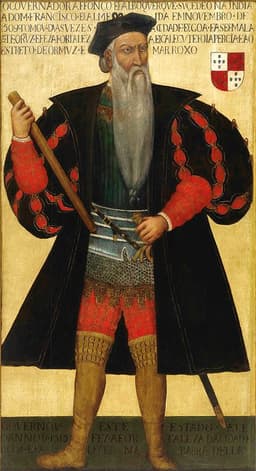
Afonso de Albuquerque
General · Medieval
79.6Total
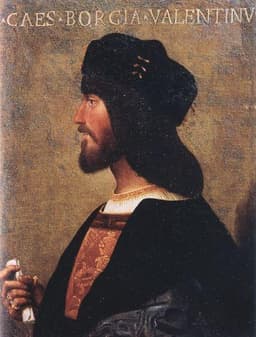
Cesare Borgia
General · Medieval
60.2Total
Basic Information
Born
1453
1475
Died
1515
1507
Era
Medieval
Medieval
Nationality
Portugal
Italy
Occupation
General
General
Civilization
Western
Western
Score Comparison
Military (10%)
77.5
67.5
Political (20%)
88.0
68.0
Influence (20%)
80.0
68.0
Legacy (20%)
75.0
40.0
Leadership (15%)
78.0
64.0
Strategy (15%)
82.0
66.3
TOTAL
79.6
60.2
Afonso de Albuquerque — Complete Timeline
1503 AD
First voyage to IndiaWar◆ Major
Afonso de Albuquerque led a fleet to India, establishing the first Portuguese fort at Cochin. This voyage laid the foundation for Portuguese control of the Indian Ocean trade.
ExplorationColonialismIndia
Impact: global
1510 AD
Conquest of GoaWar◆ Major
Albuquerque captured Goa from the Sultan of Bijapur. He made Goa the capital of Portuguese India, a position it held for over 400 years.
ConquestColonialismIndia
Impact: regional
1511 AD
Conquest of MalaccaWar◆ Major
Albuquerque led a Portuguese fleet to capture the strategic port of Malacca. This gave Portugal control of the spice trade route between the Indian Ocean and the Pacific.
ConquestSpice TradeSoutheast Asia
Impact: global
1513 AD
Siege of AdenWar
Albuquerque attempted to capture Aden in Yemen but failed. This failure prevented Portugal from controlling the entrance to the Red Sea and limited their influence in the region.
SiegeFailureRed Sea
Impact: regional
1515 AD
Death at seaOther◆ Major
Afonso de Albuquerque died at sea off the coast of Goa, possibly from illness or poison. His death left the Portuguese Empire in the Indian Ocean without its most capable leader.
DeathLeadershipEmpire
Impact: regionaltragic
Cesare Borgia — Complete Timeline
1493 AD
Appointment as CardinalPolitical Action◆ Major
Cesare Borgia was appointed cardinal by his father, Pope Alexander VI. This position gave him significant power within the Church and access to papal resources. He used his cardinalate to advance his family's political interests in Italy.
CardinalNepotismPapacy
Impact: regional
1498 AD
Resignation from the CardinalatePolitical Action◆ Major
Cesare Borgia resigned as cardinal to pursue a military and political career. He became the first person to voluntarily leave the College of Cardinals. This move allowed him to focus on conquering territories in the Romagna region of Italy.
ResignationMilitaryRomagna
Impact: regional
1499 AD
Conquest of the RomagnaWar◆ Major
Cesare Borgia, with French support, launched a campaign to conquer the cities of the Romagna. He captured Imola, Forl
ConquestRomagnaMachiavelli
Impact: regional
1503 AD
Fall from PowerPolitical Action
After the death of Pope Alexander VI, Cesare Borgia lost his political support. He was captured by his enemies and imprisoned in Spain. His territories in Italy quickly collapsed. This sudden fall demonstrated the fragility of his power base.
FallImprisonmentCollapse
Impact: regionaltragic
1507 AD
Death in BattleWar
Cesare Borgia was killed in a skirmish near Viana, Navarre, while serving as a mercenary captain. His death ended any chance of restoring his former power. He died at age 31, having failed to regain his Italian territories.
DeathMercenaryNavarre
tragic
Expert Analysis
Afonso de Albuquerque vs Cesare Borgia
# The Prince and the Empire Builder
On a winter morning in 1507, a small band of mercenaries found themselves trapped in a skirmish near the Spanish town of Viana. Their leader, a man who had once terrified the Italian peninsula, fought with desperate courage until a spear pierced his armor. Cesare Borgia died in the mud, forgotten by the allies who had abandoned him, his grand ambitions reduced to a footnote in a ditch. Just eight years earlier and a continent away, another man stood on the deck of a Portuguese caravel, watching the Indian coast rise from the horizon. Afonso de Albuquerque was about to begin a campaign that would reshape the world’s trade routes and establish an empire that would last four centuries. Two generals, two fates, one question: why did one become a cautionary tale and the other a legend?
Origins
Cesare Borgia was born in 1475 into the most corrupt and ambitious family in Renaissance Italy. His father, Rodrigo Borgia, would become Pope Alexander VI, and from infancy Cesare was groomed for ecclesiastical power. The Borgias were Spanish by origin, but they had mastered the art of Italian politics—poison, bribery, and betrayal were family heirlooms. Cesare was intelligent, ruthless, and strikingly handsome, but he was also a creature of his father’s shadow. He had no kingdom, no army of his own, only the borrowed authority of the papacy.
Afonso de Albuquerque was born in 1453 near Lisbon, into a Portuguese noble family with a tradition of naval service. Portugal was a small kingdom on the edge of Europe, but it was driven by a singular obsession: finding a sea route to India. Albuquerque grew up in the court of King Afonso V, learning mathematics, navigation, and the arts of war. Unlike Borgia, whose power came from family connection, Albuquerque’s would come from competence. Portugal had no tolerance for courtly intrigue when there were oceans to cross and spices to seize.
Rise to Power
Cesare Borgia’s rise was both swift and artificial. In 1493, at just eighteen years old, he was appointed cardinal by his father. The appointment was pure nepotism, but it gave him control over the Church’s vast wealth and political machinery. Yet Cesare was not content with the cardinal’s purple. In 1498, he did something unprecedented: he resigned his cardinalate to pursue military glory. He became the first man in history to voluntarily leave the College of Cardinals, trading a scepter for a sword. With French support and papal gold, he began his campaign to conquer the Romagna—a patchwork of petty states in central Italy.
Albuquerque’s rise was slower and harder. In 1503, at age fifty, he led his first fleet to India. There was no father to appoint him, no inherited throne. He had to prove himself against the monsoon winds, the hostile sultanates, and the Portuguese captains who resented his authority. His first voyage succeeded in establishing a fort at Cochin, but it was only a beginning. Albuquerque understood something his rivals did not: controlling the Indian Ocean meant controlling the world’s most valuable trade.
Leadership & Governance
Cesare Borgia ruled through terror. He conquered the Romagna with a mixture of French cavalry and Italian mercenaries, but his true weapon was psychological. He would invite his enemies to peace talks, then strangle them. He installed his own men as governors, then executed them when they became too popular. Machiavelli, who observed Borgia’s methods firsthand, would later write that Cesare “did everything that a prudent and virtuous man ought to do to secure his power.” But Borgia’s governance was a house of cards—it depended entirely on his father’s survival.
Albuquerque ruled through systems. When he captured Goa in 1510, he did not simply plunder it. He made it the capital of Portuguese India, encouraging Portuguese men to marry local women, establishing hospitals, and minting coins. When he took Malacca in 1511, he understood its strategic value as the choke point of the spice trade. He built fortresses, organized fleets, and created a network of alliances with local rulers. Albuquerque’s leadership was not about inspiring fear but about building institutions that would outlast him.
Triumph & Tragedy
Cesare Borgia’s greatest moment came in 1502, when he stood at the height of his power. He had conquered the Romagna, crushed his enemies, and seemed poised to create a Borgia kingdom in central Italy. But in 1503, Pope Alexander VI died, and the entire edifice collapsed. Cesare’s enemies rose against him. He was captured, imprisoned, and eventually escaped to Navarre, where he became a mercenary captain. His death in 1507 was not a glorious battlefield end but a squalid skirmish.
Albuquerque’s triumph was the conquest of Malacca in 1511, which gave Portugal control of the spice trade for a century. But his tragedy came later. In 1513, he failed to capture Aden, the gateway to the Red Sea. This failure meant that Muslim traders could still reach Europe through Egypt, limiting Portugal’s monopoly. Worse, Albuquerque’s enemies at court turned the king against him. In 1515, while returning from a campaign, he died at sea, possibly poisoned. He died believing he had failed, not knowing that his empire would endure for generations.
Character & Destiny
Cesare Borgia was driven by ambition without patience, courage without wisdom. He could destroy but not build. His personality was that of a predator—quick, ruthless, and ultimately solitary. When his father died, he had no allies, no loyal followers, only terrified subjects waiting to rebel. Machiavelli used Borgia as a model for *The Prince*, but he also noted that Cesare’s downfall came because he could not control fortune.
Albuquerque was driven by vision tempered by discipline. He could be brutal—he ordered the massacre of Muslim prisoners in Goa—but he also knew when to show mercy. He built alliances with Hindu rulers against Muslim sultans, understanding that empire required local cooperation. His personality was that of a builder, not a destroyer. He died believing he had failed, but his successors would complete his vision.
Legacy
Cesare Borgia’s legacy is ironic. He failed as a ruler, but he succeeded as a symbol. His life became the template for Machiavelli’s *The Prince*, a book that would influence leaders from Napoleon to Mussolini. Today, people remember Borgia as a villain, a poisoner, a monster—but they remember him.
Albuquerque’s legacy is more concrete. He established the Portuguese Empire in the East, creating a network of fortresses and trade routes that lasted until the twentieth century. He is remembered as a hero in Portugal, the “Caesar of the East,” the man who made Portugal a global power. His methods—naval supremacy, strategic bases, local alliances—became the model for European colonialism.
Conclusion
Standing at the end of their stories, one sees two different paths to power. Cesare Borgia built his castle on sand, trusting in his father’s protection and his own ruthlessness. Afonso de Albuquerque built his fortress on rock, trusting in systems, institutions, and the enduring power of trade. Borgia’s story is a warning about the limits of individual ambition. Albuquerque’s is a testament to what can be achieved when genius serves a larger purpose. In the end, the prince died in a ditch, and the empire builder died at sea—but one of them left behind an empire, and the other left behind a book. History has a way of choosing its favorites.
Rankings
🥇
Afonso de AlbuquerqueLeader
Mil: 77.5Pol: 88.0Inf: 80.0
79.6
🥈
Cesare Borgia
Mil: 67.5Pol: 68.0Inf: 68.0
60.2
+19.4 behind
How This Comparison Works
Algorithm
Each figure is scored on 6 dimensions (0—100 scale) based on structured historical data: Military (10%), Political (20%), Influence (20%), Legacy (20%), Leadership (15%), Strategy (15%). The weighted total produces the final ranking.
Data Sources
Scores are computed from structured sub-indicators in the database. Scale factors adjust for era (Ancient ×0.85, Modern ×1.0) and civilization size (Eastern ×1.05, Other ×0.80) to account for differences in population and military scale.
Maximum 3 Figures
Comparisons are limited to 2—3 figures to ensure readability and statistical meaningfulness.
Error Margins
±5 points per dimension — Sub-scores are derived from historical records with inherent uncertainty. Two figures within 5 points on a dimension should be considered roughly equivalent in that area.
Total Score Accuracy
±3 points overall — The weighted combination of 6 dimensions produces a total score with approximately ±3 points of uncertainty. Differences of less than 3 points are not statistically significant— the figures are effectively tied.
Known Limitations
- Historical records are incomplete and uneven across civilizations
- Figures from oral-tradition societies may be underrepresented
- Occupation labels can misclassify multi-role figures
- Scores measure capability and impact, not moral character
- Quantitative scoring is a comparison tool, not absolute truth
Capability Radar
Military (10%) — Battles & Warfare
Battles
85
55
Win Rate
80
60
Expansion
95
55
Political (20%) — Governance & Reform
Reform
80
40
Diplomacy
85
55
Economy
80
35
Influence (20%) — Cultural & Global Reach
Cultural
70
55
Global
85
60
Legacy (20%) — Historical Impact
Historical
85
70
Longevity
80
65
Leadership (15%) — Power & Stability
Tenure
70
45
Stability
65
30
Strategy (15%) — Tactics & Innovation
Strategy
95
60
Tactics
90
65
Reform
75
50
Similar Comparisons
Comments & Discussion
TheRealMachiavelli6/16/2026
Machiavelli literally wrote *The Prince* based on Borgia, and even he admitted Borgia's failure came from luck, not skill. Albuquerque succeeded *because* he had a supportive king and a distant, decentralized enemy. Borgia had to outmaneuver the French, the Medici, and his own unstable family. Put Albuquerque in Borgia's shoes in 1501 Italy, and he'd be just another dead condottiero.|
战略观察家6/16/2026
数据不会说谎:阿尔布开克统治东方仅四年,就建立了从霍尔木兹到马六甲的堡垒链,年税收超过葡萄牙本土。而波吉亚在罗马涅折腾两年,没能控制一条稳定的贸易路线。一个用海军基地和条约建帝国,一个用刺杀和联姻建空中楼阁——历史偏爱懂供应链的人。|
大历史爱好者6/16/2026
说到底是时代背景的差异。阿尔布开克赶上了胡椒和香料的超暴利时代,以一船利润200%的回报支撑起印度洋帝国;波吉亚的意大利全是碎片化城市国家,没有可持续的经济引擎。换个角度:给波吉亚十艘克拉克帆船和通行印度洋的条约,他可能也能当阿尔布开克——只是他生在陆战赌场里。|
BorgiaFanboy6/16/2026
Let's be honest, Albuquerque was a logistics god, Borgia was a personality cult with a papal credit card. Borgia burned through his father's favor and mercenary gold chasing a personal kingdom; Albuquerque built a maritime empire with five ships, relentless planning, and a total disregard for his own survival. The difference isn't luck—it's that one understood empires are built on supply chains, not poison rings.|
怀疑派史学家6/16/2026
必须指出:后世对阿尔布开克的“伟人叙事”选择性失明。他在马六甲屠杀了数千穆斯林商人,在果阿强迫改宗,后世吹成帝国蓝图。波吉亚至少在塞尼加利亚用了计谋而非屠城。不是褒贬谁,但“帝国建筑者”这个标签,往往掩盖了更血腥的数据——阿尔布开克的遗产是400年殖民压迫的第一块砖。