Loading...
Cesare Borgia vs Muhammadu Buhari
Cesare Borgia leads by 8.7 pts · 2 figures compared
…
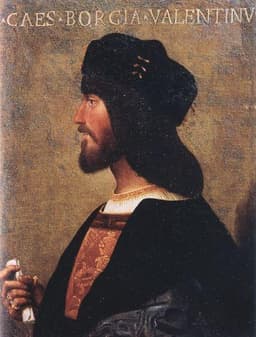
Cesare Borgia
General · Medieval
60.2Total
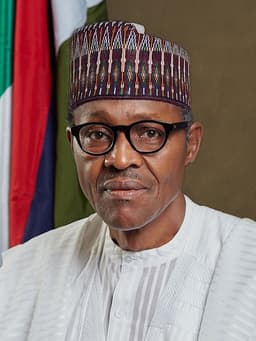
Muhammadu Buhari
General · Modern
51.5Total
Basic Information
Born
1475
1942
Died
1507
—
Era
Medieval
Modern
Nationality
Italy
Nigeria
Occupation
General
General
Civilization
Western
Other
Score Comparison
Military (10%)
67.5
22.6
Political (20%)
68.0
68.0
Influence (20%)
68.0
53.3
Legacy (20%)
40.0
43.3
Leadership (15%)
64.0
72.0
Strategy (15%)
66.3
41.0
TOTAL
60.2
51.5
Cesare Borgia — Complete Timeline
1493 AD
Appointment as CardinalPolitical Action◆ Major
Cesare Borgia was appointed cardinal by his father, Pope Alexander VI. This position gave him significant power within the Church and access to papal resources. He used his cardinalate to advance his family's political interests in Italy.
CardinalNepotismPapacy
Impact: regional
1498 AD
Resignation from the CardinalatePolitical Action◆ Major
Cesare Borgia resigned as cardinal to pursue a military and political career. He became the first person to voluntarily leave the College of Cardinals. This move allowed him to focus on conquering territories in the Romagna region of Italy.
ResignationMilitaryRomagna
Impact: regional
1499 AD
Conquest of the RomagnaWar◆ Major
Cesare Borgia, with French support, launched a campaign to conquer the cities of the Romagna. He captured Imola, Forl
ConquestRomagnaMachiavelli
Impact: regional
1503 AD
Fall from PowerPolitical Action
After the death of Pope Alexander VI, Cesare Borgia lost his political support. He was captured by his enemies and imprisoned in Spain. His territories in Italy quickly collapsed. This sudden fall demonstrated the fragility of his power base.
FallImprisonmentCollapse
Impact: regionaltragic
1507 AD
Death in BattleWar
Cesare Borgia was killed in a skirmish near Viana, Navarre, while serving as a mercenary captain. His death ended any chance of restoring his former power. He died at age 31, having failed to regain his Italian territories.
DeathMercenaryNavarre
tragic
Muhammadu Buhari — Complete Timeline
1983 AD
1983 Nigerian coup d'étatPolitical Action
Major General Muhammadu Buhari led a military coup that overthrew the civilian government of President Shehu Shagari. Buhari cited corruption and economic mismanagement as justifications, and he became the head of state.
CoupMilitary RuleCorruption
Impact: nationaldestructive
1984 AD
War Against Indiscipline (WAI)Reform◆ Major
Buhari launched the War Against Indiscipline, a campaign to enforce discipline and order in Nigerian society. It included harsh penalties for minor offenses, such as queue-jumping, and was criticized for human rights abuses.
DisciplineSocial PolicyHuman Rights
Impact: nationaldestructive
1985 AD
Overthrow by Ibrahim BabangidaPolitical Action◆ Major
Buhari was overthrown in a palace coup led by his Chief of Army Staff, Ibrahim Babangida. Babangida cited Buhari's authoritarian style and failure to address the economy as reasons for the coup.
CoupOverthrowBabangida
Impact: national
2015 AD
Anti-corruption campaignReform◆ Major
Buhari launched a high-profile anti-corruption campaign, targeting government officials and recovering stolen assets. The campaign was praised internationally but criticized for being selective and politically motivated.
Anti-CorruptionReformGovernance
Impact: nationalconstructive
Election as President of NigeriaPolitical Action
Buhari won the 2015 Nigerian presidential election, defeating incumbent Goodluck Jonathan. This was the first time an opposition candidate had defeated a sitting president in Nigeria's history, marking a democratic milestone.
ElectionDemocracyOpposition Victory
Impact: nationalprogressive
Expert Analysis
Muhammadu Buhari vs Cesare Borgia
### The Prince and the General: Cesare Borgia and Muhammadu Buhari
On a blood-soaked field near the Spanish town of Viana in March 1507, a lone figure in armor fought to the death, surrounded by enemies. He was Cesare Borgia, once the most feared man in Italy, now a mercenary captain betrayed by fortune. Nearly five centuries later, in a different world entirely, another general stood before the cameras in Abuja, Nigeria, having just won a democratic election that shocked the continent. Muhammadu Buhari had returned from the political wilderness to claim a presidency he had first seized by force thirty-two years earlier. One died in obscurity, cut down in a skirmish; the other died in old age, a twice-elected head of state. What separates a cautionary tale from a second act? The answer lies not in the men themselves, but in the worlds they inherited.
### Origins
Cesare Borgia was born in 1475 into the corrupt, brilliant heart of Renaissance Italy. His father, Rodrigo Borgia, later Pope Alexander VI, saw the Church not as a spiritual institution but as a dynastic engine. Cesare was raised in a world where poison, bribery, and assassination were legitimate political tools. His education was superb—law, theology, and statecraft—but his moral education was nonexistent. His era was one of fractured city-states, foreign invasions, and a papacy that fought wars like any secular prince.
Muhammadu Buhari was born in 1942 in Daura, northern Nigeria, to a Fulani Muslim family. His father was a farmer and a chief, deeply rooted in traditional authority. Nigeria was then a British colony, but independence was imminent. Buhari’s world was one of post-colonial hope, ethnic tension, and military coups that seemed to offer order amid chaos. He joined the army at twenty, trained in Britain and India, and rose through a system where a young officer could—and often did—seize power overnight.
### Rise to Power
Cesare Borgia’s path was forged by his father’s ambition. In 1493, at just eighteen, he was made a cardinal—a position of immense power, but one that chafed against his warrior instincts. For five years he wore the scarlet robe, but in 1498 he did the unthinkable: he resigned the cardinalate, the first man ever to do so voluntarily. It was a calculated gamble. With French support and papal gold, he launched his campaign to carve a personal kingdom from the chaos of the Romagna. His rise was swift, brutal, and entirely dependent on his father’s survival.
Buhari’s rise was faster still. On December 31, 1983, Major General Muhammadu Buhari led a coup that toppled the civilian government of Shehu Shagari. Nigeria’s democracy, only four years old, had been plagued by corruption and economic collapse. Buhari’s justification was the same used by coup-makers across Africa: the civilians had failed, and the army must save the nation. He was forty-one, commanding a country of eighty million.
### Leadership & Governance
Borgia governed as Machiavelli’s living textbook. His conquest of the Romagna was a masterpiece of speed and deception. He appointed able administrators, crushed local rebellions with theatrical cruelty—his lieutenant Ramiro de Lorca was publicly bisected to pacify a province—and built a centralized state where none had existed. His military strategy was pragmatic: use French allies to win, then turn on them when convenient. But his political wisdom was brittle. It rested entirely on his father’s papacy and French favor, not on popular loyalty or institutional strength.
Buhari’s first rule (1984–1985) was a different kind of authoritarianism. He launched the “War Against Indiscipline,” a campaign that jailed petty criminals, forced civil servants to queue in straight lines, and punished lateness with public humiliation. It was moralistic, austere, and deeply unpopular with a population that saw it as humiliating rather than reforming. His anti-corruption efforts were genuine but selective, targeting political rivals while protecting allies. His leadership style was rigid, suspicious, and isolated. Unlike Borgia, Buhari never cultivated a network of dependents; he ruled through fear and distance.
### Triumph & Tragedy
Borgia’s greatest moment came in 1502, when he crushed a conspiracy of his own captains at Senigallia. He invited them to a banquet, then arrested and executed them. It was a stroke of cold brilliance. His tragedy followed in 1503: Pope Alexander VI died, and the entire edifice collapsed. Borgia was captured, imprisoned, and eventually escaped, but he never recovered his power. He died four years later in a pointless skirmish, fighting for a king who barely remembered his name.
Buhari’s triumph came not in his first rule but in his second. In 2015, he won the presidency in a free and fair election, defeating an incumbent—a first in Nigerian history. It was a stunning redemption for a man who had been overthrown in 1985 and exiled from power for three decades. His tragedy was that his second term, like his first, was marked by economic stagnation, a failing war against Boko Haram, and a health crisis that left him frequently absent. The anti-corruption campaign that had won him adulation slowed to a crawl. He left office in 2023 with his reputation tarnished, but alive and free.
### Character & Destiny
Cesare Borgia was a man of immense talent and no restraint. He was charismatic, ruthless, and utterly convinced of his own destiny. His fatal flaw was not cruelty but dependency: he never built a power base that could survive his father. He gambled everything on a single card and lost. Destiny, for Borgia, was a trap: the Renaissance rewarded brilliance but punished the absence of luck.
Muhammadu Buhari was a man of integrity and rigidity. He was incorruptible personally but inflexible politically. His character—austere, stubborn, suspicious—served him well in a coup but poorly in a democracy. Destiny gave him a second chance that Borgia never had. Nigeria’s flawed but resilient democracy allowed him to return, to be tested again, and to be judged by voters rather than by assassins. He was not a great leader, but he was a survivor.
### Legacy
Cesare Borgia’s legacy is paradoxical. He failed utterly in his own time, but he inspired Machiavelli’s *The Prince*, a book that shaped modern politics. His name became synonymous with poison and ambition, yet his methods—centralization, ruthlessness, pragmatism—are studied in war colleges today. He is remembered as a warning and a template.
Muhammadu Buhari’s legacy is still contested. To his supporters, he was a man of principle who fought corruption and gave Nigeria its first democratic transfer of power. To his critics, he was a failed authoritarian who returned to do more of the same, only slower. His War Against Indiscipline is a memory; his anti-corruption campaign, a promise unfulfilled. But he proved that a former military ruler could submit to the ballot box—a lesson Borgia never learned.
### Conclusion
Both men were generals who sought to impose order on chaos. Borgia tried to build a kingdom with a sword and a papal bull; Buhari tried to build a nation with a decree and a queue. One died in the mud of Navarre, the other in a hospital bed in Abuja. The difference between them is not talent or ambition—Borgia had more of both. It is the age they inhabited. Borgia’s world had no institutions, only men; Buhari’s world, for all its flaws, had a constitution that outlasted him. The prince fell because he had nothing to hold onto but his father’s hand. The general survived because, in the end, he let go.
Rankings
🥇
Cesare BorgiaLeader
Mil: 67.5Pol: 68.0Inf: 68.0
60.2
🥈
Muhammadu Buhari
Mil: 22.6Pol: 68.0Inf: 53.3
51.5
+8.7 behind
How This Comparison Works
Algorithm
Each figure is scored on 6 dimensions (0—100 scale) based on structured historical data: Military (10%), Political (20%), Influence (20%), Legacy (20%), Leadership (15%), Strategy (15%). The weighted total produces the final ranking.
Data Sources
Scores are computed from structured sub-indicators in the database. Scale factors adjust for era (Ancient ×0.85, Modern ×1.0) and civilization size (Eastern ×1.05, Other ×0.80) to account for differences in population and military scale.
Maximum 3 Figures
Comparisons are limited to 2—3 figures to ensure readability and statistical meaningfulness.
Error Margins
±5 points per dimension — Sub-scores are derived from historical records with inherent uncertainty. Two figures within 5 points on a dimension should be considered roughly equivalent in that area.
Total Score Accuracy
±3 points overall — The weighted combination of 6 dimensions produces a total score with approximately ±3 points of uncertainty. Differences of less than 3 points are not statistically significant— the figures are effectively tied.
Known Limitations
- Historical records are incomplete and uneven across civilizations
- Figures from oral-tradition societies may be underrepresented
- Occupation labels can misclassify multi-role figures
- Scores measure capability and impact, not moral character
- Quantitative scoring is a comparison tool, not absolute truth
Capability Radar
Military (10%) — Battles & Warfare
Battles
55
10
Win Rate
60
10
Expansion
55
5
Political (20%) — Governance & Reform
Reform
40
30
Diplomacy
55
25
Economy
35
20
Influence (20%) — Cultural & Global Reach
Cultural
55
25
Global
60
25
Legacy (20%) — Historical Impact
Historical
70
30
Longevity
65
20
Leadership (15%) — Power & Stability
Tenure
45
45
Stability
30
15
Strategy (15%) — Tactics & Innovation
Strategy
60
15
Tactics
65
15
Reform
50
20
Similar Comparisons
Comments & Discussion
No comments yet. Be the first to share your thoughts!