Loading...
Cesare Borgia vs Francisco Morazan
Cesare Borgia leads by 2.2 pts · 2 figures compared
…
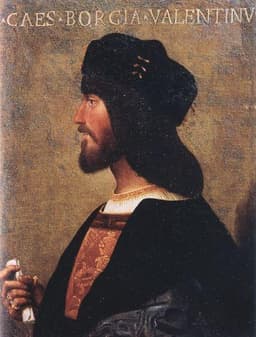
Cesare Borgia
General · Medieval
60.2Total
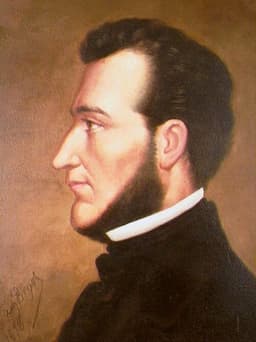
Francisco Morazan
General · Modern
58.0Total
Basic Information
Born
1475
1792
Died
1507
1842
Era
Medieval
Modern
Nationality
Italy
Honduras
Occupation
General
General
Civilization
Western
Western
Score Comparison
Military (10%)
67.5
52.5
Political (20%)
68.0
60.0
Influence (20%)
68.0
62.0
Legacy (20%)
40.0
50.0
Leadership (15%)
64.0
68.0
Strategy (15%)
66.3
55.0
TOTAL
60.2
58.0
Cesare Borgia — Complete Timeline
1493 AD
Appointment as CardinalPolitical Action◆ Major
Cesare Borgia was appointed cardinal by his father, Pope Alexander VI. This position gave him significant power within the Church and access to papal resources. He used his cardinalate to advance his family's political interests in Italy.
CardinalNepotismPapacy
Impact: regional
1498 AD
Resignation from the CardinalatePolitical Action◆ Major
Cesare Borgia resigned as cardinal to pursue a military and political career. He became the first person to voluntarily leave the College of Cardinals. This move allowed him to focus on conquering territories in the Romagna region of Italy.
ResignationMilitaryRomagna
Impact: regional
1499 AD
Conquest of the RomagnaWar◆ Major
Cesare Borgia, with French support, launched a campaign to conquer the cities of the Romagna. He captured Imola, Forl
ConquestRomagnaMachiavelli
Impact: regional
1503 AD
Fall from PowerPolitical Action
After the death of Pope Alexander VI, Cesare Borgia lost his political support. He was captured by his enemies and imprisoned in Spain. His territories in Italy quickly collapsed. This sudden fall demonstrated the fragility of his power base.
FallImprisonmentCollapse
Impact: regionaltragic
1507 AD
Death in BattleWar
Cesare Borgia was killed in a skirmish near Viana, Navarre, while serving as a mercenary captain. His death ended any chance of restoring his former power. He died at age 31, having failed to regain his Italian territories.
DeathMercenaryNavarre
tragic
Francisco Morazan — Complete Timeline
1824 AD
Abolition of slavery in Central AmericaReform◆ Major
As a key leader in the liberal movement, Moraz
AbolitionSlaveryLiberal Reform
Impact: regionalprogressive
1827 AD
Battle of La TrinidadWar◆ Major
Morazán led a liberal army to victory against conservative forces at La Trinidad, Honduras. This battle was a key turning point in the Central American civil war, allowing Morazán to consolidate power and eventually become president of the federation.
BattleLiberal VictoryCivil War
Impact: regional
1830 AD
Presidency of the Federal Republic of Central AmericaPolitical Action
Morazán was elected president of the Federal Republic of Central America, a union of Guatemala, El Salvador, Honduras, Nicaragua, and Costa Rica. He pursued liberal reforms including separation of church and state, free trade, and land reform, facing opposition from conservatives.
Federal RepublicLiberal ReformsCentral America
Impact: regionalconstructive
1842 AD
Execution by firing squadPolitical Action
After a failed attempt to restore the Federal Republic, Moraz
ExecutionEnd of FederationLiberal Defeat
Impact: regionaltragic
Expert Analysis
Francisco Morazan vs Cesare Borgia
# The Prince and the Reformer: Two Visions of Power in a Fractured World
On a September morning in 1507, Cesare Borgia fell dead in a muddy ditch near Viana, Navarre, struck down by a spear in a skirmish so minor that history nearly forgot it. Thirty-five years later, on a September morning in 1842, Francisco Morazán stood before a firing squad in San José, Costa Rica, and reportedly told his executioners, “I die with the satisfaction of having served my country.” One man died fighting for a cause he never fully articulated; the other died for a dream he could not make real. Both were generals, both were reformers in their own fashion, and both saw their life’s work shattered by forces they could not control. But between the Italian cardinal’s dagger and the Honduran reformer’s pen lies a chasm not merely of centuries, but of moral imagination.
Origins
Cesare Borgia was born into the Vatican’s most notorious family in 1475, the son of Rodrigo Borgia, who would become Pope Alexander VI. The Renaissance papacy was a theater of ambition, and Cesare learned its script early. Made a cardinal at eighteen, he wielded ecclesiastical power as a political weapon. But the Church was a cage for a man who dreamed of swords. In 1498, he did what no cardinal had done before: he resigned his red hat to become a military commander. This was not a renunciation of faith—it was a recognition that in Italy, God’s will was written in blood and steel.
Francisco Morazán was born in 1792 in Tegucigalpa, Honduras, into a world already cracking apart. The Spanish empire was dying, and the air was thick with Enlightenment ideas—liberty, equality, the rights of man. His family was of Basque descent, comfortable but not aristocratic, and his education was haphazard, pieced together from smuggled books and the conversations of liberal exiles. Where Borgia inherited power, Morazán had to invent it. The difference between a prince born to the purple and a reformer born to the frontier would shape everything that followed.
Rise to Power
Borgia’s ascent was swift and brutal. With French support, he launched his campaign to conquer the Romagna in 1499, capturing Imola, Forlì, and a string of cities that had long defied papal authority. He was a master of speed and surprise, and his reputation for ruthlessness preceded him. Machiavelli, who observed him closely, would later write that Borgia understood that “it is much safer to be feared than loved.” The Borgia method was simple: conquer, consolidate, destroy all opposition without mercy, and install loyal lieutenants. By 1502, he had carved out a personal state that stretched across central Italy.
Morazán’s rise followed a different logic. In 1824, the Federal Republic of Central America—a union of Guatemala, El Salvador, Honduras, Nicaragua, and Costa Rica—was born from the wreckage of Spanish rule. Morazán was not its founder, but he became its champion. The conservative landowners and clergy wanted a centralized state that preserved their privileges; the liberals wanted federalism, free trade, and reform. In 1827, Morazán won the Battle of La Trinidad in Honduras, a victory that made him the military leader of the liberal cause. By 1830, he was president of the federation. Unlike Borgia, who seized power through assassination and intrigue, Morazán was elected. His authority came from ballots, not blood.
Leadership & Governance
Borgia governed as a Renaissance prince: personally, absolutely, and without sentiment. He appointed his most capable general, Vitellozzo Vitelli, then had him strangled when he became a threat. He pacified the Romagna by installing a brutal but effective governor, Ramiro de Lorca, then executed him to win popular favor. Machiavelli admired this cold calculus. “Cesare Borgia was considered cruel,” he wrote, “but his cruelty restored order to the Romagna.” Borgia’s military strategy was aggressive and adaptive—his score of 72 in strategy reflects a man who could read a battlefield and a political situation with equal precision. But his leadership score of 44.5 tells a darker story: he inspired fear, not loyalty. When his father died in 1503, his support evaporated overnight.
Morazán governed as a liberal reformer: through laws, institutions, and ideals. He abolished slavery in 1824, before most of the Americas. He promoted public education, separated church and state, and tried to build a national identity for Central America. His military score of 65.4 is solid but unspectacular—he was a competent commander, not a genius. His leadership score of 76.7, however, reveals a man who could inspire devotion. Soldiers followed him through defeat after defeat because they believed in the republic. But his political score of 72.0 also shows his limits: he was better at proclaiming ideals than building the coalitions needed to sustain them.
Triumph & Tragedy
Borgia’s greatest moment was also the beginning of his end. In 1502, he captured Urbino and Camerino, and seemed poised to unite all of central Italy under his rule. He was the most feared man in Italy, and Machiavelli would later hold him up as the model for the ideal prince. But his triumph was built on a single foundation: his father’s papacy. When Alexander VI died in 1503, Borgia was caught between the new pope, Julius II, and his old enemies. He was arrested, imprisoned, and eventually forced into exile. His fall was as swift as his rise.
Morazán’s tragedy was slower and more poignant. He held the Federal Republic together through civil wars, coups, and the relentless opposition of conservative forces. In 1839, the federation finally collapsed when Guatemala seceded. Morazán fought on, trying to restore the union by force, but the dream was already dead. In 1842, he invaded Costa Rica, was captured, and was executed. His last words, according to tradition, were: “I am not ashamed to die for my country. I leave it to my children.”
Character & Destiny
Borgia was a man of action, not reflection. He was handsome, charismatic, and utterly devoid of sentiment. He believed that power was its own justification. His personality was shaped by the conviction that the world was a game of winners and losers, and he intended to win. But this worldview had a fatal flaw: it left no room for loyalty, friendship, or the slow work of building institutions. When his luck ran out, he had nothing to fall back on.
Morazán was a man of principle, perhaps to a fault. He believed in liberty, equality, and progress, and he was willing to die for those beliefs. But his idealism sometimes blinded him to political realities. He could not compromise with conservatives, nor could he build the kind of personal following that might have sustained his government through crises. He was a reformer in a world that was not ready for reform.
Legacy
Borgia’s legacy is paradoxical. He failed utterly—his state collapsed, his name became a byword for cruelty, and he died in obscurity. Yet Machiavelli’s *The Prince* immortalized him as the archetype of the ruthless, effective ruler. His political score of 54.0 and legacy score of 60.0 reflect a man who was more influential as an idea than as a historical actor. He haunts the imagination of every leader who wonders whether the ends justify the means.
Morazán’s legacy is more tangible. He is remembered as the “Simón Bolívar of Central America,” a hero of liberal reform and regional unity. His legacy score of 68.9 and influence score of 76.2 show a man who shaped the political identity of an entire region. Streets, schools, and even a Honduran currency bear his name. But his dream of a united Central America remains unfulfilled—a reminder that even the noblest ideals cannot always overcome the forces of division.
Conclusion
Cesare Borgia and Francisco Morazán lived three centuries apart, but they faced the same question: How does one impose order on a fractured world? Borgia answered with the sword, Morazán with the law. Borgia built a state on fear and watched it crumble; Morazán built a dream on hope and watched it shatter. In the end, both died violently, their ambitions unfulfilled. But their stories endure because they illuminate a tension that runs through all of history: the tension between power and principle, between what is necessary and what is right. Borgia taught us that power without principle is brittle. Morazán taught us that principle without power is fragile. The challenge—for every leader, in every age—is to hold both in the same hand.
Rankings
🥇
Cesare BorgiaLeader
Mil: 67.5Pol: 68.0Inf: 68.0
60.2
🥈
Francisco Morazan
Mil: 52.5Pol: 60.0Inf: 62.0
58.0
+2.2 behind
How This Comparison Works
Algorithm
Each figure is scored on 6 dimensions (0—100 scale) based on structured historical data: Military (10%), Political (20%), Influence (20%), Legacy (20%), Leadership (15%), Strategy (15%). The weighted total produces the final ranking.
Data Sources
Scores are computed from structured sub-indicators in the database. Scale factors adjust for era (Ancient ×0.85, Modern ×1.0) and civilization size (Eastern ×1.05, Other ×0.80) to account for differences in population and military scale.
Maximum 3 Figures
Comparisons are limited to 2—3 figures to ensure readability and statistical meaningfulness.
Error Margins
±5 points per dimension — Sub-scores are derived from historical records with inherent uncertainty. Two figures within 5 points on a dimension should be considered roughly equivalent in that area.
Total Score Accuracy
±3 points overall — The weighted combination of 6 dimensions produces a total score with approximately ±3 points of uncertainty. Differences of less than 3 points are not statistically significant— the figures are effectively tied.
Known Limitations
- Historical records are incomplete and uneven across civilizations
- Figures from oral-tradition societies may be underrepresented
- Occupation labels can misclassify multi-role figures
- Scores measure capability and impact, not moral character
- Quantitative scoring is a comparison tool, not absolute truth
Capability Radar
Military (10%) — Battles & Warfare
Battles
55
55
Win Rate
60
60
Expansion
55
40
Political (20%) — Governance & Reform
Reform
40
70
Diplomacy
55
45
Economy
35
50
Influence (20%) — Cultural & Global Reach
Cultural
55
45
Global
60
35
Legacy (20%) — Historical Impact
Historical
70
50
Longevity
65
40
Leadership (15%) — Power & Stability
Tenure
45
55
Stability
30
30
Strategy (15%) — Tactics & Innovation
Strategy
60
55
Tactics
65
50
Reform
50
45
Similar Comparisons
Comments & Discussion
Il Duca della Disillusione6/16/2026
Morazán vs Borgia? The only thing they share is a tragic end. Borgia was a Machiavellian prince who weaponized the Church for territorial greed—pure Renaissance gangsterism with a papal seal. Morazán, meanwhile, was a Central American reformer who abolished slavery and championed federalism centuries too early. One died in a ditch for a forgotten skirmish; the other faced a firing squad with his head held high for a dream. Rome's ghost still haunts Europe; Tegucigalpa's hero is barely a footnote
数据考古学家6/16/2026
拿博尔吉亚跟莫拉桑比?一个靠毒药和教廷关系打下的短命帝国,另一个拿命赌联邦制。博尔吉亚的势力范围撑死了是意大利中部几个城邦,莫拉桑可是把中美洲五国捏在一起十年。你说谁更猛?光是莫拉桑在1830年代搞的教育改革和土地法案,放到当时任何欧洲国家都得算激进派。博尔吉亚?他除了给马基雅维利当素材,还留下啥?毁掉教皇名声算一个吧。
The Prince's Scrivener6/16/2026
Let's be precise: Borgia's military record is vastly overrated by Machiavelli's fanfiction. His victories came from French mercenaries and papal gold, not strategy. He lost badly at Fossalta in 1499 despite having Swiss pikes. Morazán, however, consistently outmaneuvered larger Guatemalan forces at El Guayabal and La Arada using terrain and morale. The "Renaissance prince" was a paper tiger; the Honduran reformer actually built a functioning republic—briefly. I'll take a failed president over a
孤鹰守夜人6/16/2026
博尔吉亚的阴暗面不能光用“文艺复兴政治”洗白。他派人勒死亲妹夫,毒杀佣兵队长,甚至传言杀了他哥胡安——这种人还配跟莫拉桑放一块比?莫拉桑再失败,至少立法禁止宗教法庭干涉世俗法庭,推出免费小学教育。博尔吉亚呢?挥霍教廷国库养私兵,最后被西班牙人放逐死在野外。一将功成万骨枯,这枯骨里还掺着自己血亲。真比诚意?没得比。
Cartographer of Lost Federatio6/16/2026
Look at the maps: Borgia's Duchy of Romagna lasted four years before the papacy reassumed control. Morazán's Federal Republic of Central America endured from 1824 to 1840—sixteen years of constitutional experiments, postal services, and literacy campaigns. Borgia's "reforms" were just centralization for personal