Loading...
Cesare Borgia vs Yitzhak Rabin
Yitzhak Rabin leads by 6.2 pts · 2 figures compared
…
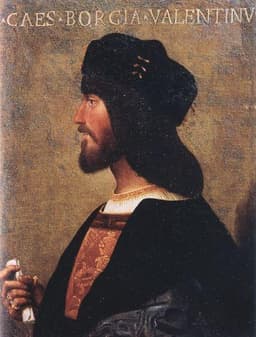
Cesare Borgia
General · Medieval
60.2Total
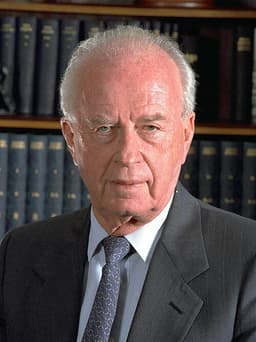
Yitzhak Rabin
General · Modern
66.4Total
Basic Information
Born
1475
1922
Died
1507
—
Era
Medieval
Modern
Nationality
Italy
Israel
Occupation
General
General
Civilization
Western
Middle Eastern
Score Comparison
Military (10%)
67.5
61.7
Political (20%)
68.0
82.0
Influence (20%)
68.0
68.0
Legacy (20%)
40.0
55.0
Leadership (15%)
64.0
78.0
Strategy (15%)
66.3
55.0
TOTAL
60.2
66.4
Cesare Borgia — Complete Timeline
1493 AD
Appointment as CardinalPolitical Action◆ Major
Cesare Borgia was appointed cardinal by his father, Pope Alexander VI. This position gave him significant power within the Church and access to papal resources. He used his cardinalate to advance his family's political interests in Italy.
CardinalNepotismPapacy
Impact: regional
1498 AD
Resignation from the CardinalatePolitical Action◆ Major
Cesare Borgia resigned as cardinal to pursue a military and political career. He became the first person to voluntarily leave the College of Cardinals. This move allowed him to focus on conquering territories in the Romagna region of Italy.
ResignationMilitaryRomagna
Impact: regional
1499 AD
Conquest of the RomagnaWar◆ Major
Cesare Borgia, with French support, launched a campaign to conquer the cities of the Romagna. He captured Imola, Forl
ConquestRomagnaMachiavelli
Impact: regional
1503 AD
Fall from PowerPolitical Action
After the death of Pope Alexander VI, Cesare Borgia lost his political support. He was captured by his enemies and imprisoned in Spain. His territories in Italy quickly collapsed. This sudden fall demonstrated the fragility of his power base.
FallImprisonmentCollapse
Impact: regionaltragic
1507 AD
Death in BattleWar
Cesare Borgia was killed in a skirmish near Viana, Navarre, while serving as a mercenary captain. His death ended any chance of restoring his former power. He died at age 31, having failed to regain his Italian territories.
DeathMercenaryNavarre
tragic
Yitzhak Rabin — Complete Timeline
1967 AD
Chief of Staff during the Six-Day WarWar
As Chief of Staff of the Israel Defense Forces, Rabin commanded the Israeli military during the Six-Day War against Egypt, Jordan, and Syria. Israel captured the Sinai Peninsula, Gaza Strip, West Bank, East Jerusalem, and Golan Heights, reshaping the region.
Six-Day WarTerritorial ExpansionMilitary Victory
Impact: global
1993 AD
Signing of the Oslo AccordsPolitical Action
As prime minister, Rabin signed the Oslo Accords with PLO Chairman Yasser Arafat on the White House lawn. The agreement established the Palestinian Authority and set a framework for Palestinian self-governance in the West Bank and Gaza Strip.
Peace ProcessPalestiniansOslo
Impact: globalconstructive
1995 AD
Assassination at Peace RallyPolitical Action
Rabin was assassinated by Israeli extremist Yigal Amir after a peace rally in Tel Aviv. The assassination shocked Israel and the world, derailing the Oslo peace process and leading to a period of political instability.
AssassinationPeace ProcessPolitical Violence
Impact: globaltragic
Expert Analysis
Yitzhak Rabin vs Cesare Borgia
# The Prince and the Peacemaker
On a September evening in 1995, Yitzhak Rabin stood on the White House lawn, shaking hands with his sworn enemy. The cameras captured a moment that seemed impossible: an Israeli prime minister and a Palestinian leader, bound by a document that promised to end decades of bloodshed. Four hundred years earlier, another man had stood at a different crossroads of power and violence—Cesare Borgia, the Italian cardinal who shed his robes for armor, who burned through the Romagna like a wildfire, who became the very model of ruthless ambition. One died by an assassin’s bullet at a peace rally, the other in an obscure skirmish in Navarre. Both sought to forge order from chaos. Why did their paths diverge so completely?
Origins
Cesare Borgia was born in 1475 into a family that understood power as a possession to be seized, not a trust to be earned. His father, Rodrigo Borgia, became Pope Alexander VI in 1492, and young Cesare was made a cardinal at eighteen—not for piety, but for politics. The Borgias were Spaniards in Italy, outsiders who clawed their way to dominance through bribery, marriage, and murder. Cesare grew up in a world where the Church was a battlefield and the Pope was a warlord.
Yitzhak Rabin was born in 1922 in Jerusalem, then part of British Mandate Palestine. His parents were Labor Zionists, Russian Jews who had fled persecution and dreamed of a homeland. Rabin grew up on a kibbutz, where the values were collective labor, self-defense, and the belief that Jews must shape their own destiny. Where Borgia inherited a papal throne, Rabin inherited a movement—and a war.
Rise to Power
Borgia’s rise was a study in audacity. In 1498, he did what no cardinal had done before: he resigned his position. The Church could no longer contain his ambition. With French backing, he launched his campaign into the Romagna in 1499, capturing Imola, Forlì, and a string of cities that had long defied papal authority. He was not merely conquering; he was building a state. Machiavelli, watching from Florence, would later write that Borgia possessed “the spirit of a prince” and that his methods, however brutal, were precisely what Italy needed.
Rabin’s rise was slower, more deliberate. He was not born to power but earned it through competence. As Chief of Staff during the Six-Day War of 1967, he commanded the Israel Defense Forces in a stunning victory that captured the Sinai, Gaza, the West Bank, and the Golan Heights. But unlike Borgia, Rabin did not rest on conquest. He understood that military triumph was not the same as security—and that the territories won in 1967 would become a burden, not a prize.
Leadership & Governance
Borgia governed through terror and calculation. He installed his own men in conquered cities, crushed rebellions with spectacular cruelty, and employed his infamous enforcer, Ramiro de Lorca, to pacify the Romagna—only to have de Lorca executed himself, his body left in two pieces in the town square, as a lesson in loyalty. Borgia understood that fear could be a tool, but he also knew when to reward. He was a strategist, not a tyrant. Machiavelli admired him precisely because he combined force with cunning.
Rabin governed through consensus and contradiction. As prime minister, he was a security hawk who became a peacemaker. He authorized the expulsion of Hamas activists, then negotiated with the PLO. He built settlements, then froze them. His leadership was not about grand gestures but about incremental steps, each one painful, each one necessary. Where Borgia ruled by fear, Rabin ruled by trust—and by the quiet authority of a man who had proven himself on the battlefield.
Triumph & Tragedy
Borgia’s triumph was the Romagna. By 1503, he had created a unified state in central Italy, a feat that had eluded popes and princes for generations. His tragedy came swiftly. In August 1503, Pope Alexander VI died, possibly poisoned. Without his father’s protection, Borgia’s alliances collapsed. He was captured, imprisoned, and eventually exiled. In 1507, at age thirty-one, he was killed in a minor skirmish near Viana, Navarre, fighting as a mercenary for the King of Navarre. The man who had inspired *The Prince* died an anonymous death.
Rabin’s triumph was the Oslo Accords. On September 13, 1993, he stood beside Yasser Arafat and signed a document that recognized the PLO as the legitimate representative of the Palestinian people. It was a moment of profound courage. His tragedy came two years later, on November 4, 1995, when an Israeli extremist named Yigal Amir shot him in the back at a peace rally in Tel Aviv. Rabin died with the words of the song “Song for Peace” still in his pocket.
Character & Destiny
Cesare Borgia was a man of action, not reflection. He was brilliant, ruthless, and ultimately alone. His personality was forged in a world where trust was a weakness and betrayal was a strategy. He could not adapt when his father died because he had built his entire power structure on a single foundation. Machiavelli said that Borgia’s only mistake was allowing Julius II to become pope—a miscalculation, not a moral failing.
Yitzhak Rabin was a man of duty, not charisma. He was blunt, awkward, and deeply private. He did not seek peace out of idealism but out of realism. He understood that Israel could not forever rule over millions of Palestinians. His personality—stoic, pragmatic, stubborn—allowed him to make peace with an enemy, but it also made him a target. The assassin’s bullet was not random; it was the price of leadership.
Legacy
Borgia’s legacy is abstract, intellectual. He became the blueprint for Machiavelli’s ideal prince—the ruler who must learn how not to be good. His name is synonymous with cunning, ambition, and the dark arts of statecraft. But his actual achievement—the state he built in the Romagna—crumbled within months of his death. He left no dynasty, no nation, only a cautionary tale.
Rabin’s legacy is concrete, unfinished. He left a peace process that stalled, a nation divided, and a memory that still haunts Israeli politics. He is remembered not for what he completed but for what he attempted. His assassination did not end the conflict, but it made peace seem possible—and its absence feel like a betrayal.
Conclusion
Borgia and Rabin lived four centuries apart, in worlds that could not be more different. One was a prince who never learned to trust; the other was a soldier who learned to forgive. One died in obscurity, the other in a blaze of meaning. And yet both faced the same fundamental question: how do you create order in a world of chaos? Borgia answered with force, Rabin with compromise. History has judged them both, but the judgment is not final. The Prince remains a lesson in power; the Peacemaker remains a challenge to conscience. Which one we choose to follow says more about us than about them.
Rankings
🥇
Yitzhak RabinLeader
Mil: 61.7Pol: 82.0Inf: 68.0
66.4
🥈
Cesare Borgia
Mil: 67.5Pol: 68.0Inf: 68.0
60.2
+6.2 behind
How This Comparison Works
Algorithm
Each figure is scored on 6 dimensions (0—100 scale) based on structured historical data: Military (10%), Political (20%), Influence (20%), Legacy (20%), Leadership (15%), Strategy (15%). The weighted total produces the final ranking.
Data Sources
Scores are computed from structured sub-indicators in the database. Scale factors adjust for era (Ancient ×0.85, Modern ×1.0) and civilization size (Eastern ×1.05, Other ×0.80) to account for differences in population and military scale.
Maximum 3 Figures
Comparisons are limited to 2—3 figures to ensure readability and statistical meaningfulness.
Error Margins
±5 points per dimension — Sub-scores are derived from historical records with inherent uncertainty. Two figures within 5 points on a dimension should be considered roughly equivalent in that area.
Total Score Accuracy
±3 points overall — The weighted combination of 6 dimensions produces a total score with approximately ±3 points of uncertainty. Differences of less than 3 points are not statistically significant— the figures are effectively tied.
Known Limitations
- Historical records are incomplete and uneven across civilizations
- Figures from oral-tradition societies may be underrepresented
- Occupation labels can misclassify multi-role figures
- Scores measure capability and impact, not moral character
- Quantitative scoring is a comparison tool, not absolute truth
Capability Radar
Military (10%) — Battles & Warfare
Battles
55
65
Win Rate
60
70
Expansion
55
50
Political (20%) — Governance & Reform
Reform
40
65
Diplomacy
55
85
Economy
35
60
Influence (20%) — Cultural & Global Reach
Cultural
55
55
Global
60
70
Legacy (20%) — Historical Impact
Historical
70
75
Longevity
65
60
Leadership (15%) — Power & Stability
Tenure
45
70
Stability
30
40
Strategy (15%) — Tactics & Innovation
Strategy
60
75
Tactics
65
60
Reform
50
55
Similar Comparisons
Comments & Discussion
罗马帝师6/16/2026
意大利人看到这种对比只会苦笑。波吉亚的时代,意大利是教皇国、法国、西班牙的棋盘,他靠毒药和刺客勉强拼凑了一个短期霸权。而拉宾处在现代民族国家的框架里,有国际法和联合国背书。拿一个雇佣兵式的暴君去比一个法理上合法的政治家,这不公平。环境决定手段,手段决定结局。
ClassicistCato6/16/2026
Funny that we remember Borgia as a master strategist when he was utterly destroyed by a pope’s illness and a rebellion he didn’t see coming. Rabin understood that power in a democracy is fragile—one bullet from a zealot can undo years of diplomacy. Both were assassinated, but Rabin’s death transformed him into an icon, while Borgia’s was a footnote. Moral: timing is everything, but so is the cause you serve.
MachiavelliBorgia6/16/2026
Machiavelli worshipped Cesare Borgia as “the Prince” incarnate, but let’s be honest—Borgia failed. His entire power collapsed when his father died, because he built nothing but a house of terror. Rabin actually succeeded in bending history toward peace, even if it cost him his life. Borgia’s ruthlessness won him a valley; Rabin’s courage won him a legacy that still echoes. Read beyond Chapter 7 of *The Prince*, people.
巴以冷眼6/16/2026
拿拉宾跟波吉亚比?这简直是对和平的侮辱。波吉亚毒杀亲信、睡自己妹妹,靠教皇爸爸的权术横行意大利,他一死帝国立刻碎成一地渣。拉宾从军人到总理,赌上性命签《奥斯陆协议》,把枪杆子换成橄榄枝,结果被自己人暗杀。一个为权力屠杀,一个为和平捐躯——历史会记住谁,还用说吗?
SkepticalSam6/16/2026
Let’s not romanticize Rabin’s handshake as pure statesmanship. The Oslo Accords were a chaotic gamble, and Rabin himself called Palestinians the “Scourge of the Lord” in private. Meanwhile, Borgia at least delivered stability to the Romagna through cold pragmatism. Both men used violence to enforce order; Rabin just had better PR. One died in a siege, one at a rally—both failed to secure their visions.