Loading...
Cesare Borgia vs Shi Dakai
Cesare Borgia leads by 0.6 pts · 2 figures compared
…
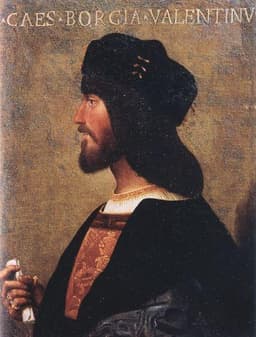
Cesare Borgia
General · Medieval
60.2Total
Shi Dakai
General · Modern
59.6Total
Basic Information
Born
1475
1831
Died
1507
1863
Era
Medieval
Modern
Nationality
Italy
China
Occupation
General
General
Civilization
Western
Eastern
Score Comparison
Military (10%)
67.5
76.0
Political (20%)
68.0
45.0
Influence (20%)
68.0
56.7
Legacy (20%)
40.0
54.0
Leadership (15%)
64.0
72.0
Strategy (15%)
66.3
68.1
TOTAL
60.2
59.6
Cesare Borgia — Complete Timeline
1493 AD
Appointment as CardinalPolitical Action◆ Major
Cesare Borgia was appointed cardinal by his father, Pope Alexander VI. This position gave him significant power within the Church and access to papal resources. He used his cardinalate to advance his family's political interests in Italy.
CardinalNepotismPapacy
Impact: regional
1498 AD
Resignation from the CardinalatePolitical Action◆ Major
Cesare Borgia resigned as cardinal to pursue a military and political career. He became the first person to voluntarily leave the College of Cardinals. This move allowed him to focus on conquering territories in the Romagna region of Italy.
ResignationMilitaryRomagna
Impact: regional
1499 AD
Conquest of the RomagnaWar◆ Major
Cesare Borgia, with French support, launched a campaign to conquer the cities of the Romagna. He captured Imola, Forl
ConquestRomagnaMachiavelli
Impact: regional
1503 AD
Fall from PowerPolitical Action
After the death of Pope Alexander VI, Cesare Borgia lost his political support. He was captured by his enemies and imprisoned in Spain. His territories in Italy quickly collapsed. This sudden fall demonstrated the fragility of his power base.
FallImprisonmentCollapse
Impact: regionaltragic
1507 AD
Death in BattleWar
Cesare Borgia was killed in a skirmish near Viana, Navarre, while serving as a mercenary captain. His death ended any chance of restoring his former power. He died at age 31, having failed to regain his Italian territories.
DeathMercenaryNavarre
tragic
Shi Dakai — Complete Timeline
1851 AD
Jintian UprisingWar◆ Major
Shi Dakai joined the Taiping Rebellion at its inception in Jintian, Guangxi. As a core leader, he helped organize the rebel forces and was appointed Wing King, becoming one of the key military commanders of the Taiping Heavenly Kingdom.
Taiping RebellionUprisingMilitary Command
Impact: national
1854 AD
Battle of XiangtanWar◆ Major
Shi Dakai led Taiping forces to a major victory at Xiangtan, Hunan, defeating Qing imperial troops. This battle secured Taiping control over key territories in the Yangtze River valley and demonstrated his military skill.
Taiping RebellionBattleVictory
Impact: regional
1856 AD
Tianjing IncidentPolitical Action
Shi Dakai returned to Tianjing (Nanjing) after the internal purge of the Eastern King Yang Xiuqing and the murder of the Northern King Wei Changhui. He condemned the violence and was forced to flee, leading to a split in Taiping leadership.
Taiping RebellionInternal ConflictPurge
Impact: nationaltragic
1858 AD
Campaign in Zhejiang and FujianWar
Shi Dakai led a separate Taiping army into Zhejiang and Fujian provinces, capturing several cities. This campaign expanded Taiping influence into southeastern China but also isolated his forces from the main Taiping base.
Taiping RebellionCampaignExpansion
Impact: regional
1863 AD
Battle of Baishui RiverWar◆ Major
Shi Dakai's army was trapped and defeated by Qing forces at the Baishui River in Sichuan. He was captured and executed shortly after, marking the end of his military career and a significant loss for the Taiping cause.
Taiping RebellionBattleDefeatDeath
Impact: nationaltragic
Expert Analysis
Shi Dakai vs Cesare Borgia
# The Prince and the Wing King
On a spring morning in 1507, a thirty-one-year-old mercenary captain fell dead in a minor skirmish near Viana, Navarre, his body stripped and left naked in the mud. Three hundred and fifty years later and half a world away, a thirty-two-year-old rebel king knelt by a river in Sichuan, watching his five thousand followers be slaughtered before he too met the executioner's blade. Cesare Borgia and Shi Dakai—one the son of a pope, the other the son of a farmer—both rose to dizzying heights of power, both commanded armies with genius, and both died young, betrayed by the very forces they had sought to master. Their stories, separated by centuries and continents, ask a haunting question: why does brilliance so often end in blood?
Origins
Cesare Borgia was born into the most corrupt and ambitious family in Renaissance Italy. His father, Rodrigo Borgia, became Pope Alexander VI in 1492, and from the moment Cesare could walk, he was groomed for power. The Borgias were Spanish outsiders in an Italian game, and they played it without mercy. Cesare was made a cardinal at eighteen—a position of immense spiritual and political authority that he never wanted. He chafed under the red robes, dreaming of swords and states.
Shi Dakai came from a world of rice paddies and Confucian examinations. Born in 1831 in Guangxi province, his family was Hakka, a marginalized ethnic group in southern China. Unlike Borgia, who inherited power, Shi Dakai earned his place through scholarship and martial skill. When Hong Xiuquan, a failed examination candidate turned messianic prophet, launched the Taiping Rebellion in 1851, Shi Dakai was among the first to join. He was twenty years old, literate, and already a natural leader.
The difference in their origins explains everything. Borgia was born into a system he could manipulate; Shi Dakai was born into a system he had to destroy.
Rise to Power
Cesare Borgia's rise was engineered by his father. In 1498, he did what no cardinal had ever done: he resigned his ecclesiastical office to become a secular prince. Pope Alexander VI annulled his son's vows, arranged a French marriage, and secured French troops for Cesare's campaigns. By 1499, Cesare was marching into the Romagna, a patchwork of petty lordships that had long defied papal authority.
His military score of 72 and strategy score of 72 reflect genuine talent, but his political score of 54 reveals a man who relied more on his father's power than his own cunning. Cesare conquered Imola and Forlì with shocking speed, but he was always fighting with French swords and papal gold.
Shi Dakai's rise was a story of meritocracy in chaos. His military score of 84.6 and strategy score of 81.6 place him among history's great commanders. At Xiangtan in 1854, he crushed Qing forces with a brilliant feigned retreat, luring the imperial army into a trap. The Taiping Heavenly Kingdom, which had declared its capital at Nanjing, made him the "Wing King"—a title earned through blood and victory.
But here lies the fatal difference: Borgia rose because his father willed it; Shi Dakai rose because the rebellion needed him. One was an appointment, the other a necessity.
Leadership & Governance
Cesare Borgia ruled through terror and calculation. In the Romagna, he appointed a brutal lieutenant, Ramiro de Lorqua, to pacify the region with executions and torture. Once order was established, Cesare had Ramiro cut in two and left in the public square—a message that the cruelty was the state's, not his. Machiavelli, who observed Cesare's methods firsthand, would later write in *The Prince* that a ruler must be both lion and fox. Cesare was the model.
Shi Dakai governed differently. The Taiping ideology was a bizarre fusion of Christian millenarianism and Chinese utopianism, demanding land redistribution, equality of the sexes, and the abolition of private property. Shi Dakai was no theologian, but he was an administrator who kept his territories functioning. Where Borgia ruled by fear, Shi Dakai ruled by loyalty. His leadership score of 76.6 reflects a commander whom men followed willingly, not reluctantly.
Yet both systems had fatal flaws. Borgia's power depended entirely on his father's papacy. Shi Dakai's power depended on the increasingly paranoid Hong Xiuquan, who after the Tianjing Incident of 1856—a bloody purge that killed the Eastern King and nearly destroyed the rebellion—trusted no one, not even his most capable general.
Triumph & Tragedy
Cesare Borgia's greatest moment came in 1502, when he tricked his rebellious captains into a trap at Senigallia and had them strangled. It was a masterpiece of deception, and for a brief moment, he seemed poised to unite all of central Italy under his rule. Then, in 1503, his father died. The papal election went to Julius II, a Borgia enemy. Cesare was captured, imprisoned, and stripped of everything.
Shi Dakai's triumph was the Xiangtan victory; his tragedy was loyalty. After the Tianjing Incident, he could have seized power for himself. Instead, he returned to Nanjing to plead for unity, then left on a doomed campaign to open a new front in Sichuan. At the Baishui River in 1863, his army was surrounded. To save his remaining men, he surrendered—only to watch them executed anyway. He was sliced to death by the slow death of *lingchi*, the thousand cuts.
Character & Destiny
Cesare Borgia was a man of ice and fire. He could charm and kill in the same breath. His ambition was boundless, but his vision was personal: he wanted a kingdom for himself. Shi Dakai was a man of principle and grief. He believed in the Taiping cause, even as it devoured itself. His loyalty to Hong Xiuquan was both his greatest virtue and his fatal flaw.
Machiavelli wrote that Cesare Borgia failed only because of "the malice of fortune"—the simultaneous illness of himself and his father. But fortune is not the whole story. Cesare built his power on a single pillar: papal favor. When it collapsed, so did he. Shi Dakai, by contrast, built on the shifting sands of a millenarian revolution, and when the revolution turned inward, no amount of military genius could save him.
Legacy
Cesare Borgia's total score of 60.4 and legacy score of 60.0 understate his historical importance. He became the archetype of the ruthless Renaissance prince, immortalized by Machiavelli. For centuries, "Borgia" was a byword for poison and depravity. Today, historians see him more clearly: a brilliant failure whose methods outlived his achievements.
Shi Dakai's total score of 71.4 and legacy score of 65.9 reflect a different kind of survival. In China, he is remembered as a tragic hero—a brilliant general undone by loyalty to a mad cause. The Taiping Rebellion killed twenty million people, the bloodiest civil war in human history. Shi Dakai was not its architect, but its finest soldier. His legend endures in folk songs and Communist historiography, which sees him as a proto-revolutionary martyr.
Conclusion
Cesare Borgia and Shi Dakai never knew each other's worlds. One lived in the marble palaces of Renaissance Italy, the other in the bamboo groves of Qing China. One sought power for its own sake; the other sought justice within a twisted vision of heaven on earth. Both died young, both died violently, and both left behind the same terrible lesson: that history does not reward brilliance—it rewards timing, luck, and the cold willingness to betray even those you love.
The Prince and the Wing King. One became a symbol of cunning; the other, a symbol of sacrifice. In the end, the difference between them is the difference between a man who would kill for a throne and a man who would die for a dream.
Rankings
🥇
Cesare BorgiaLeader
Mil: 67.5Pol: 68.0Inf: 68.0
60.2
🥈
Shi Dakai
Mil: 76.0Pol: 45.0Inf: 56.7
59.6
+0.6 behind
How This Comparison Works
Algorithm
Each figure is scored on 6 dimensions (0—100 scale) based on structured historical data: Military (10%), Political (20%), Influence (20%), Legacy (20%), Leadership (15%), Strategy (15%). The weighted total produces the final ranking.
Data Sources
Scores are computed from structured sub-indicators in the database. Scale factors adjust for era (Ancient ×0.85, Modern ×1.0) and civilization size (Eastern ×1.05, Other ×0.80) to account for differences in population and military scale.
Maximum 3 Figures
Comparisons are limited to 2—3 figures to ensure readability and statistical meaningfulness.
Error Margins
±5 points per dimension — Sub-scores are derived from historical records with inherent uncertainty. Two figures within 5 points on a dimension should be considered roughly equivalent in that area.
Total Score Accuracy
±3 points overall — The weighted combination of 6 dimensions produces a total score with approximately ±3 points of uncertainty. Differences of less than 3 points are not statistically significant— the figures are effectively tied.
Known Limitations
- Historical records are incomplete and uneven across civilizations
- Figures from oral-tradition societies may be underrepresented
- Occupation labels can misclassify multi-role figures
- Scores measure capability and impact, not moral character
- Quantitative scoring is a comparison tool, not absolute truth
Capability Radar
Military (10%) — Battles & Warfare
Battles
55
75
Win Rate
60
70
Expansion
55
75
Political (20%) — Governance & Reform
Reform
40
50
Diplomacy
55
45
Economy
35
40
Influence (20%) — Cultural & Global Reach
Cultural
55
55
Global
60
40
Legacy (20%) — Historical Impact
Historical
70
60
Longevity
65
45
Leadership (15%) — Power & Stability
Tenure
45
55
Stability
30
35
Strategy (15%) — Tactics & Innovation
Strategy
60
80
Tactics
65
85
Reform
50
60
Similar Comparisons
Comments & Discussion
Steel-Niche6/16/2026
This comparison is a fantasy. Shi Dakai was a brilliant military tactician who never lost a major battle until the fatal river crossing—a record Cesare Borgia couldn't match. Borgia's "genius" was just his father's papal gold and French mercenaries. Without Alexander VI's treasury, Cesare crumbled in months. Shi led tens of thousands on foot across half of China, fighting epic battles against Qing armies. Borgia? He got lucky with nepotism and died in a random skirmish no one remembers.
老枪兵6/16/2026
把曾国藩和左宗棠的对手跟一个小国雇佣兵头子放一起,太离谱。石达开在宝庆之战以三万疲惫之师硬扛曾国藩十万湘军,还能全身而退。博尔吉亚那种靠老爹教皇身份和法国雇佣兵打意大利小城邦的,战术含金量几何?让他来中国面对左宗棠的反间计和粮食断供,三天就完了。不是同一维度的历史人物。