Loading...
Cesare Borgia vs Ramon Castilla
Cesare Borgia leads by 0.5 pts · 2 figures compared
…
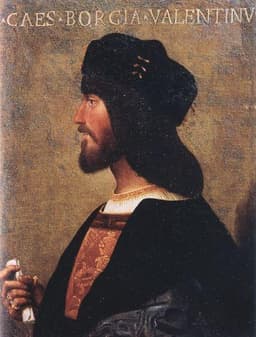
Cesare Borgia
General · Medieval
60.2Total
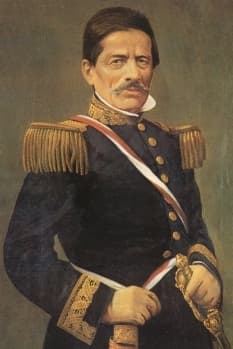
Ramon Castilla
General · Modern
59.7Total
Basic Information
Born
1475
1797
Died
1507
1867
Era
Medieval
Modern
Nationality
Italy
Peru
Occupation
General
General
Civilization
Western
Western
Score Comparison
Military (10%)
67.5
40.0
Political (20%)
68.0
72.0
Influence (20%)
68.0
56.7
Legacy (20%)
40.0
52.0
Leadership (15%)
64.0
78.0
Strategy (15%)
66.3
60.0
TOTAL
60.2
59.7
Cesare Borgia — Complete Timeline
1493 AD
Appointment as CardinalPolitical Action◆ Major
Cesare Borgia was appointed cardinal by his father, Pope Alexander VI. This position gave him significant power within the Church and access to papal resources. He used his cardinalate to advance his family's political interests in Italy.
CardinalNepotismPapacy
Impact: regional
1498 AD
Resignation from the CardinalatePolitical Action◆ Major
Cesare Borgia resigned as cardinal to pursue a military and political career. He became the first person to voluntarily leave the College of Cardinals. This move allowed him to focus on conquering territories in the Romagna region of Italy.
ResignationMilitaryRomagna
Impact: regional
1499 AD
Conquest of the RomagnaWar◆ Major
Cesare Borgia, with French support, launched a campaign to conquer the cities of the Romagna. He captured Imola, Forl
ConquestRomagnaMachiavelli
Impact: regional
1503 AD
Fall from PowerPolitical Action
After the death of Pope Alexander VI, Cesare Borgia lost his political support. He was captured by his enemies and imprisoned in Spain. His territories in Italy quickly collapsed. This sudden fall demonstrated the fragility of his power base.
FallImprisonmentCollapse
Impact: regionaltragic
1507 AD
Death in BattleWar
Cesare Borgia was killed in a skirmish near Viana, Navarre, while serving as a mercenary captain. His death ended any chance of restoring his former power. He died at age 31, having failed to regain his Italian territories.
DeathMercenaryNavarre
tragic
Ramon Castilla — Complete Timeline
1824 AD
Battle of AyacuchoWar
Castilla fought as a junior officer in the decisive Battle of Ayacucho, which ended Spanish rule in Peru. This victory secured Peruvian independence and marked the end of the Spanish Empire in South America, shaping Castilla's nationalist views.
Peruvian War of IndependenceBattleLiberation
Impact: regional
1845 AD
First Presidency of PeruPolitical Action◆ Major
Castilla was elected President of Peru in 1845, serving until 1851. His first term focused on economic development, including the guano boom, and infrastructure projects such as railroads and ports, modernizing the Peruvian state.
PresidencyEconomic DevelopmentGuano
Impact: nationalconstructive
1854 AD
Abolition of Slavery in PeruReform◆ Major
During his second presidency, Castilla issued a decree abolishing slavery in Peru on December 3, 1854. This reform freed approximately 25,000 slaves and was part of a broader liberal agenda, though it faced opposition from slave-owning elites.
AbolitionSlaveryHuman Rights
Impact: nationalprogressive
Abolition of Indigenous TributeReform◆ Major
Castilla also abolished the indigenous tribute tax in 1854, which had been a burden on native communities since colonial times. This measure aimed to integrate indigenous peoples into the Peruvian state as equal citizens, though its implementation was uneven.
Indigenous RightsTax ReformCitizenship
Impact: nationalprogressive
1855 AD
Second Presidency and Guano BoomPolitical Action◆ Major
Castilla served a second term from 1855 to 1862, during the peak of the guano export boom. He used guano revenues to fund public works, pay off foreign debt, and modernize the military, but also faced criticism for corruption and over-reliance on a single resource.
PresidencyGuanoModernization
Impact: nationalconstructive
1860 AD
Constitutional Reform of 1860Reform◆ Major
Castilla oversaw the adoption of a new constitution in 1860, which established a centralized republic with a strong executive. The constitution remained in effect until 1920 and shaped Peru's political structure, though it limited regional autonomy.
ConstitutionPolitical ReformCentralization
Impact: nationalconstructive
Expert Analysis
Ramon Castilla vs Cesare Borgia
### The Prince and the President
In the winter of 1507, a lone figure in armor fell in a muddy skirmish near the Spanish town of Viana, his body so riddled with wounds that it was barely recognizable. He was Cesare Borgia, once the most feared man in Italy, dead at thirty-one, his dreams of a unified kingdom rotting with him in the mud. Three and a half centuries later, in the Pacific coastal city of Lima, an old general in a frock coat signed a decree that freed thousands of souls. When Ramón Castilla died in 1867, he was mourned as the father of his nation. Both were generals. Both seized power in turbulent times. Yet one left a legacy of terror and a cautionary tale, the other a republic and a model of reform. What separates a prince from a president, a catastrophe from a triumph? The answer lies not in their swords, but in their choices.
### Origins
Cesare Borgia was born in 1475 into the most scandalous family of Renaissance Italy. His father, Rodrigo Borgia, became Pope Alexander VI in 1492, and Cesare was raised in the Vatican’s gilded halls, where piety was a mask and power the only sacrament. At eighteen, he was made a cardinal—a position of immense ecclesiastical authority. But Cesare never wanted the church. He was a man of action, not prayer. In 1498, he did the unthinkable: he resigned his cardinalate, becoming the first man in history to voluntarily leave the College of Cardinals. He wanted a sword, not a scepter.
Ramón Castilla was born in 1797 in a very different world: the waning Spanish Empire in Peru. His family was of modest colonial gentry, and young Ramón grew up hearing the distant thunder of revolutions. South America was convulsing into independence, and Castilla, barely a teenager, enlisted in the royalist army. He fought for Spain at first—as many did, out of habit or fear—but by 1821 he had switched sides, joining the patriots. His world was not a papal court of intrigue but a battlefield of ideology, where men fought for nations, not dynasties.
Their eras shaped them: Cesare was a creature of the late Middle Ages, when politics was a family business and God was a political tool. Castilla was a child of the modern age, when nationalism and reform were the rising tides.
### Rise to Power
Cesare Borgia’s rise was a rocket launched by his father’s blessing. With French troops and papal gold, he launched a campaign in 1499 to conquer the Romagna, a patchwork of petty lordships in central Italy. He captured Imola, Forlì, and other cities with shocking speed. He was ruthless: he lured his enemies into peace talks, then strangled them. He appointed governors, minted coins, and created a centralized state where chaos had reigned. Machiavelli, watching from Florence, was awestruck. For a brief moment, Cesare seemed unstoppable.
Castilla’s rise was slower, more earned. He fought at the Battle of Ayacucho in 1824, the final clash that shattered Spanish rule in Peru. He was a junior officer then, but he survived and rose through the ranks of the new republic. By 1845, he was elected president. There was no papal father, no French army—just a nation exhausted by war and desperate for order. He won power not by conquest but by ballot.
### Leadership & Governance
Here the two men diverge like branches of a river. Cesare Borgia governed through fear. He installed his own men, crushed dissent with public executions, and ruled the Romagna with an iron fist. His military strategy was brilliant—Machiavelli gave him a 72.0—but his political wisdom was brittle. He had no base beyond his father’s papacy. When Alexander VI died in 1503, Cesare’s entire edifice collapsed. He was captured, imprisoned, and eventually fled to Navarre, where he died in a pointless skirmish in 1507. His leadership score of 44.5 reflects a man who could command armies but not build institutions.
Castilla governed through reform. During his first presidency (1845–1851), he focused on economic development, using the booming guano exports to fund schools, roads, and a modern navy. In his second term (1855–1862), he struck at the heart of Peru’s ancient injustices. On December 3, 1854, he abolished slavery, freeing thousands of African-Peruvians. That same year, he abolished the indigenous tribute tax, a colonial relic that had crushed native communities for centuries. In 1860, he oversaw a new constitution that centralized the republic but guaranteed civil rights. His leadership score of 84.0 is the highest of his era among Latin American presidents.
### Triumph & Tragedy
Cesare’s greatest moment was the conquest of the Romagna—a dazzling display of military and political skill. His tragedy was that it all depended on one man: his father. When the pope died, Cesare had no loyal bureaucracy, no popular support, no legacy beyond fear. He was a brilliant meteor that burned out.
Castilla’s greatest moment was the abolition of slavery—a moral and political triumph that transformed Peru. His tragedy was more subtle: the guano boom he rode to power would eventually corrupt the nation, creating a dependency on a single resource that would lead to future crises. But that was a tragedy of success, not failure.
### Character & Destiny
Cesare was ambitious, ruthless, and utterly amoral. He believed that power was its own justification. Machiavelli used him as the model for *The Prince*, a manual for those who would rule by cunning and force. But Cesare’s character was his doom: he could not build trust, only terror. He could not create allies, only subjects.
Castilla was pragmatic, reform-minded, and institution-building. He saw power as a tool for change, not an end in itself. He abolished slavery not because it was popular—it wasn’t—but because he believed it was right. His character allowed him to leave behind a functioning republic, not a corpse-strewn field.
### Legacy
Cesare Borgia’s legacy is a cautionary tale. His influence score of 67.0 is real—Machiavelli’s book still shapes political thought. But his practical legacy is zero. Nothing he built survived him. He is remembered as a villain, a warning to those who think power alone is enough.
Ramón Castilla’s legacy is the opposite. His total score of 72.0 reflects a man who changed his country. Peru remembers him as the “Father of the Republic,” the president who ended slavery and modernized the state. His reforms lasted for generations. His constitution of 1860 governed Peru for sixty years.
### Conclusion
Standing in the mud of Viana, Cesare Borgia died alone, his name already a curse. Standing in the halls of Lima, Ramón Castilla died old and honored, his name a blessing. Both were generals. Both seized their moment. But one built on sand, the other on stone. The difference was not in their swords but in their vision: Cesare conquered for himself; Castilla governed for his people. In the end, history remembers not the prince who took, but the president who gave.
Rankings
🥇
Cesare BorgiaLeader
Mil: 67.5Pol: 68.0Inf: 68.0
60.2
🥈
Ramon Castilla
Mil: 40.0Pol: 72.0Inf: 56.7
59.7
+0.5 behind
How This Comparison Works
Algorithm
Each figure is scored on 6 dimensions (0—100 scale) based on structured historical data: Military (10%), Political (20%), Influence (20%), Legacy (20%), Leadership (15%), Strategy (15%). The weighted total produces the final ranking.
Data Sources
Scores are computed from structured sub-indicators in the database. Scale factors adjust for era (Ancient ×0.85, Modern ×1.0) and civilization size (Eastern ×1.05, Other ×0.80) to account for differences in population and military scale.
Maximum 3 Figures
Comparisons are limited to 2—3 figures to ensure readability and statistical meaningfulness.
Error Margins
±5 points per dimension — Sub-scores are derived from historical records with inherent uncertainty. Two figures within 5 points on a dimension should be considered roughly equivalent in that area.
Total Score Accuracy
±3 points overall — The weighted combination of 6 dimensions produces a total score with approximately ±3 points of uncertainty. Differences of less than 3 points are not statistically significant— the figures are effectively tied.
Known Limitations
- Historical records are incomplete and uneven across civilizations
- Figures from oral-tradition societies may be underrepresented
- Occupation labels can misclassify multi-role figures
- Scores measure capability and impact, not moral character
- Quantitative scoring is a comparison tool, not absolute truth
Capability Radar
Military (10%) — Battles & Warfare
Battles
55
45
Win Rate
60
50
Expansion
55
30
Political (20%) — Governance & Reform
Reform
40
85
Diplomacy
55
70
Economy
35
75
Influence (20%) — Cultural & Global Reach
Cultural
55
55
Global
60
50
Legacy (20%) — Historical Impact
Historical
70
65
Longevity
65
60
Leadership (15%) — Power & Stability
Tenure
45
65
Stability
30
60
Strategy (15%) — Tactics & Innovation
Strategy
60
45
Tactics
65
40
Reform
50
55
Similar Comparisons
Comments & Discussion
The Dueling Legacies6/16/2026
A military historian has to admire both, but Borgia was a tactical genius undone by his own ruthlessness, while Castilla was a practical reformer who knew when to put down the sword. Borgia's lightning campaign in the Romagna was brilliant, but his reliance on terror made every ally a potential assassin. Castilla abolished slavery and streamlined Peru's budget, proving that a general can build as well as destroy. One died alone in a ditch; the other in his bed with his nation's gratitude. The le
数据侦探6/16/2026
说实话,这个比较根本不成立。一个十五世纪的意大利军阀,十九世纪的秘鲁总统,活在不同的经济体系、军事科技和社会结构里。你拿罗马骑兵和拿破仑火枪队比谁更厉害?Castilla的资源是Borgia做梦都想不到的:稳定的官僚系统、跨大西洋贸易、启蒙运动思想。Borgia再诡计多端,也没有铁路可以调兵,没有报纸可以宣传,没有废奴主义运动可以借用。这不是个人选择,这是时代的碾压。
Classics Guy6/16/2026
Borgia was Machiavelli's model for "The Prince," but he's more interesting as a classic tragic hero. Think Caesar crossing the Rubicon, but without the literary PR. He had the vision to unify Italy before it was even an idea, but his hubris—the belief that his father's papacy would last forever—was his fatal flaw. When Alexander VI died, Cesare's power base literally evaporated overnight. Castilla, by contrast, played the long game, building institutions instead of alliances. One was Achilles; t
历史控6/16/2026
算了吧,Borgia那点"功绩"在Castilla面前就是个笑话。Borgia花了十年时间搞阴谋,暗杀对手,用毒药和军队维持一个小王国,结果他爹一死整个局面就崩了。Castilla呢?他领导秘鲁打赢了太平洋战争,废除了奴隶制,搞了铁路和电报,还把玻利维亚从阿根廷手里抢回来。Borgia连一个稳定的继承人都没留下,而Castilla建立了秘鲁的现代政治框架。一个把家产败光的花花公子和一个建设国家的实干家,有什么可比的?
Revisionist Skeptic6/16/2026
Can we stop romanticizing Borgia as a "Renaissance prince" when he was essentially a cartel boss with a papal tax exemption? His campaigns in the Romagna were funded by simony and nepotism, and his "legend" is mostly Niccolò Machiavelli's fan fiction. Castilla wasn't perfect—he balanced budgets by taxing indigenous peasants and made deals with British bankers—but at least he governed within a constitutional framework, even if it was flawed. Borgia represents the worst of unchecked