Loading...
Cesare Borgia vs Prem Tinsulanonda
Cesare Borgia leads by 3.0 pts · 2 figures compared
…
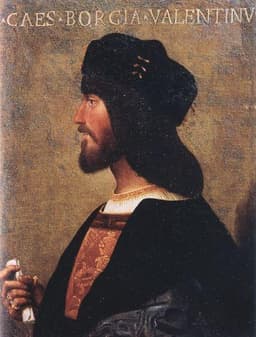
Cesare Borgia
General · Medieval
60.2Total
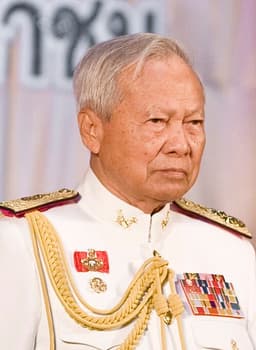
Prem Tinsulanonda
General · Modern
57.2Total
Basic Information
Born
1475
1920
Died
1507
—
Era
Medieval
Modern
Nationality
Italy
Thailand
Occupation
General
General
Civilization
Western
Eastern
Score Comparison
Military (10%)
67.5
50.0
Political (20%)
68.0
59.3
Influence (20%)
68.0
54.9
Legacy (20%)
40.0
47.5
Leadership (15%)
64.0
78.0
Strategy (15%)
66.3
60.0
TOTAL
60.2
57.2
Cesare Borgia — Complete Timeline
1493 AD
Appointment as CardinalPolitical Action◆ Major
Cesare Borgia was appointed cardinal by his father, Pope Alexander VI. This position gave him significant power within the Church and access to papal resources. He used his cardinalate to advance his family's political interests in Italy.
CardinalNepotismPapacy
Impact: regional
1498 AD
Resignation from the CardinalatePolitical Action◆ Major
Cesare Borgia resigned as cardinal to pursue a military and political career. He became the first person to voluntarily leave the College of Cardinals. This move allowed him to focus on conquering territories in the Romagna region of Italy.
ResignationMilitaryRomagna
Impact: regional
1499 AD
Conquest of the RomagnaWar◆ Major
Cesare Borgia, with French support, launched a campaign to conquer the cities of the Romagna. He captured Imola, Forl
ConquestRomagnaMachiavelli
Impact: regional
1503 AD
Fall from PowerPolitical Action
After the death of Pope Alexander VI, Cesare Borgia lost his political support. He was captured by his enemies and imprisoned in Spain. His territories in Italy quickly collapsed. This sudden fall demonstrated the fragility of his power base.
FallImprisonmentCollapse
Impact: regionaltragic
1507 AD
Death in BattleWar
Cesare Borgia was killed in a skirmish near Viana, Navarre, while serving as a mercenary captain. His death ended any chance of restoring his former power. He died at age 31, having failed to regain his Italian territories.
DeathMercenaryNavarre
tragic
Prem Tinsulanonda — Complete Timeline
1980 AD
Appointed Prime Minister after a coupPolitical Action◆ Major
Prem Tinsulanonda was appointed Prime Minister of Thailand by the military after a coup. He served for over eight years, overseeing a period of political stability and economic growth.
Prime MinisterMilitary RuleStability
Impact: national
1981 AD
Survived a coup attemptPolitical Action◆ Major
Prem survived a coup attempt by military officers loyal to the 'Young Turks' faction. The coup failed due to lack of support and the loyalty of key military units, allowing Prem to remain in power.
Coup AttemptPolitical CrisisMilitary
Impact: national
1988 AD
Resigned as Prime MinisterPolitical Action◆ Major
Prem resigned as Prime Minister after the general election, handing over power to a civilian government led by Chatichai Choonhavan. His resignation marked a rare peaceful transition of power in Thai politics.
ResignationDemocratic TransitionPeaceful
Impact: nationalconstructive
2016 AD
Appointed Regent of ThailandPolitical Action
After the death of King Bhumibol, Prem was appointed Regent of Thailand until the ascension of King Maha Vajiralongkorn. He served as a key figure in the transition of the monarchy.
RegentMonarchyTransition
Impact: national
Expert Analysis
Prem Tinsulanonda vs Cesare Borgia
# The Prince and the Peacemaker
In the winter of 1507, a thirty-one-year-old mercenary captain lay dead in a muddy ditch near Viana, Navarre, his body pierced by a dozen wounds. Four centuries later, in 1980, a sixty-year-old general in Bangkok accepted the prime minister’s seal from a military junta, beginning an eight-year tenure that would end not in bloodshed but in a peaceful transfer of power. Cesare Borgia and Prem Tinsulanonda both wore uniforms and commanded armies, yet their names evoke radically different echoes in history: one the archetype of ruthless ambition, the other the quiet architect of stability. What forces shaped such divergent paths?
Origins
Cesare Borgia was born in 1475 into the most infamous family of Renaissance Italy. His father, Rodrigo Borgia, became Pope Alexander VI in 1492, and Cesare grew up in a world where the boundaries between church, state, and crime were nonexistent. The Borgias were Spaniards in Italy, outsiders who clawed their way to power through bribery, assassination, and strategic marriages. Cesare’s childhood was a tutorial in Machiavellian logic before Machiavelli ever wrote a word: loyalty was a tool, morality a luxury, and power the only currency that mattered.
Prem Tinsulanonda, born in 1920 in Songkhla, southern Thailand, entered a very different world. Thailand had never been colonized, and its monarchy, though diminished after the 1932 revolution that established a constitutional system, remained the symbolic heart of the nation. Prem grew up in a Buddhist society that prized hierarchy, harmony, and deference to elders. His education at the Chulachomklao Royal Military Academy instilled a different kind of lesson: the soldier’s duty was to protect the nation and the throne, not to seize power for personal glory.
Rise to Power
Cesare’s rise was engineered by his father’s ambition. In 1493, at just eighteen, he was appointed cardinal—a position of immense ecclesiastical authority that he never wanted. Five years later, in 1498, he did what no cardinal had done before: he resigned the purple robe to become a military commander. It was a scandalous act that revealed his true nature. With French troops and papal gold, he launched his 1499 campaign to conquer the cities of the Romagna. He captured Imola, Forlì, and a dozen other towns, employing a mix of brutality and cunning that made him the terror of central Italy. His method was simple: crush resistance utterly, reward loyalty generously, and never leave a rival alive to plot revenge.
Prem’s path was slower and more circuitous. He rose through the ranks of the Thai army during the Cold War, a period when the military dominated Thai politics. In 1980, after a coup ousted the civilian government, the generals needed a leader who could stabilize the country without alarming the monarchy or the United States. Prem was the ideal choice: a career soldier with no personal political ambitions, a devout Buddhist, and a man known for his integrity. He accepted the prime ministership not as a conqueror but as a caretaker.
Leadership & Governance
Cesare Borgia governed the Romagna with a terrifying efficiency. He appointed a ruthless minister named Ramiro d’Orco to pacify the region, then, when the bloodshed had served its purpose, had him publicly executed to win the people’s favor. It was a masterstroke of political theater. Machiavelli, who watched Cesare’s career with fascination, later wrote that a prince must learn to be both lion and fox. Cesare was both: he could charm a cardinal into betrayal one day and strangle a rival with his own hands the next. Yet his rule was not purely destructive. He established courts, stabilized currency, and brought order to lands that had known only chaos. His military strategy—swift, decisive, and utterly ruthless—earned him a score of 72.0, the highest of his attributes.
Prem Tinsulanonda’s leadership was the antithesis of Cesare’s. He governed by consensus, not fear. His political score of 68.8 reflects his ability to navigate Thailand’s fractious military, civilian, and royal factions. In 1981, the “Young Turks” faction attempted a coup against him. Prem did not order mass executions. Instead, he waited, allowed the plot to collapse under its own disorganization, and then quietly purged the ringleaders. His leadership score of 89.0—the highest among all his attributes—came from his ability to inspire loyalty without demanding it. He was a regent, not a ruler; a steward, not a conqueror.
Triumph & Tragedy
Cesare’s greatest moment came in 1502, when he outmaneuvered a coalition of his enemies at Senigallia, luring them into a trap and executing them on the spot. He was at the height of his power, controlling much of central Italy. His tragedy followed swiftly. In 1503, his father died suddenly, and Cesare’s entire edifice collapsed. He had built nothing that could survive without the papal shield. Captured, imprisoned, and eventually exiled, he died in 1507 in a meaningless skirmish in Navarre—a mercenary captain fighting for a foreign king.
Prem’s triumph was more subtle. In 1988, after eight years as prime minister, he voluntarily resigned following a general election, handing power to a civilian government led by Chatichai Choonhavan. It was the first peaceful transfer of power in Thailand’s turbulent modern history. His tragedy, if it can be called that, came later. In 2016, after the death of King Bhumibol, Prem was appointed regent at the age of ninety-six. He had become the ultimate insider, the gray eminence behind the throne—a role that ensured stability but also perpetuated the military’s grip on Thai politics.
Character & Destiny
Cesare Borgia was a man of immense talent and no patience. He burned through life with a fury that consumed everyone around him, including himself. Machiavelli would later write that Cesare failed only because he could not control the election of the next pope—a stroke of bad luck that turned his genius to dust. But the deeper truth is that Cesare’s character was his destiny. He could conquer but not build; he could terrify but not trust. His total score of 60.4 reflects a life of brilliance wasted.
Prem Tinsulanonda was the opposite: a man who understood that power is not a prize to be seized but a trust to be held. His total score of 68.4 is higher, but numbers cannot capture the quality of his patience. He lived to be over ninety-nine years old, outlasting kings and generals, and died not in a ditch but in a hospital bed, surrounded by mourners. His character—modest, patient, devout—shaped a destiny that was long, stable, and quietly influential.
Legacy
Cesare Borgia lives on as the model for Machiavelli’s *The Prince*, a text that has shaped Western political thought for five centuries. His name is synonymous with cunning, ambition, and the dark arts of statecraft. He is remembered not for what he built but for what he inspired.
Prem Tinsulanonda is remembered in Thailand as a stabilizing force during a turbulent era. His legacy is less dramatic but more tangible: a peaceful transition of power, a monarchy preserved, a nation that avoided the worst of the Cold War’s violence. Outside Thailand, he is largely unknown—a fate that would have horrified Cesare and satisfied Prem.
Conclusion
Standing at the edge of the twenty-first century, we can see both men as products of their times: Cesare the blazing comet of Renaissance ambition, Prem the steady hand of Cold War survival. One died young, his dreams in ashes; the other died old, his work half-done. Cesare teaches us that power without patience is a fire that burns out. Prem teaches us that patience without power is a candle in the wind. Between the two lies the full spectrum of what it means to lead—and the eternal question of whether it is better to be feared or loved, to conquer or to endure.
Rankings
🥇
Cesare BorgiaLeader
Mil: 67.5Pol: 68.0Inf: 68.0
60.2
🥈
Prem Tinsulanonda
Mil: 50.0Pol: 59.3Inf: 54.9
57.2
+3.0 behind
How This Comparison Works
Algorithm
Each figure is scored on 6 dimensions (0—100 scale) based on structured historical data: Military (10%), Political (20%), Influence (20%), Legacy (20%), Leadership (15%), Strategy (15%). The weighted total produces the final ranking.
Data Sources
Scores are computed from structured sub-indicators in the database. Scale factors adjust for era (Ancient ×0.85, Modern ×1.0) and civilization size (Eastern ×1.05, Other ×0.80) to account for differences in population and military scale.
Maximum 3 Figures
Comparisons are limited to 2—3 figures to ensure readability and statistical meaningfulness.
Error Margins
±5 points per dimension — Sub-scores are derived from historical records with inherent uncertainty. Two figures within 5 points on a dimension should be considered roughly equivalent in that area.
Total Score Accuracy
±3 points overall — The weighted combination of 6 dimensions produces a total score with approximately ±3 points of uncertainty. Differences of less than 3 points are not statistically significant— the figures are effectively tied.
Known Limitations
- Historical records are incomplete and uneven across civilizations
- Figures from oral-tradition societies may be underrepresented
- Occupation labels can misclassify multi-role figures
- Scores measure capability and impact, not moral character
- Quantitative scoring is a comparison tool, not absolute truth
Capability Radar
Military (10%) — Battles & Warfare
Battles
55
20
Win Rate
60
25
Expansion
55
10
Political (20%) — Governance & Reform
Reform
40
55
Diplomacy
55
60
Economy
35
50
Influence (20%) — Cultural & Global Reach
Cultural
55
30
Global
60
30
Legacy (20%) — Historical Impact
Historical
70
40
Longevity
65
35
Leadership (15%) — Power & Stability
Tenure
45
65
Stability
30
60
Strategy (15%) — Tactics & Innovation
Strategy
60
30
Tactics
65
30
Reform
50
35
Similar Comparisons
Comments & Discussion
SirStatsAlot6/16/2026
Can't compare apples to hand grenades. Prem's "peaceful transfer" in 1988 was actually a carefully managed power handover where he stayed on as Privy Council chairman - controlling everything from behind the throne for another 30 years! Meanwhile Borgia's stabbed-to-death-in-a-ditch ending gets all the attention, but he conquered Romagna in under a year using actual strategy, not just daddy's papal armies. Your summary conveniently ignores Prem's role in the 1992 Black May massacre cover-up too.
老江湖问路6/16/2026
说是比较,不如说是硬凑。Prem的执政期恰逢泰国经济腾飞,换条狗当总理也能"稳定"。Cesare在1502年只用三个月就摆平了乌尔比诺公爵叛乱,这种临场决断力Prem一辈子没展现过。更别说Prem那套"静默政变"理论,说白了就是老油条政客的保命哲学,跟马基雅维利笔下的狐狸完全是两码事。你们历史爱好者就爱给平庸人物贴金。