Loading...
Afonso de Albuquerque vs Prem Tinsulanonda
Afonso de Albuquerque leads by 22.4 pts · 2 figures compared
…
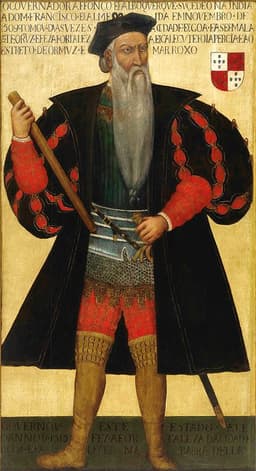
Afonso de Albuquerque
General · Medieval
79.6Total
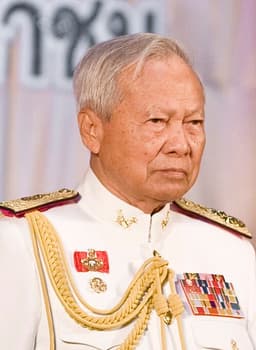
Prem Tinsulanonda
General · Modern
57.2Total
Basic Information
Born
1453
1920
Died
1515
—
Era
Medieval
Modern
Nationality
Portugal
Thailand
Occupation
General
General
Civilization
Western
Eastern
Score Comparison
Military (10%)
77.5
50.0
Political (20%)
88.0
59.3
Influence (20%)
80.0
54.9
Legacy (20%)
75.0
47.5
Leadership (15%)
78.0
78.0
Strategy (15%)
82.0
60.0
TOTAL
79.6
57.2
Afonso de Albuquerque — Complete Timeline
1503 AD
First voyage to IndiaWar◆ Major
Afonso de Albuquerque led a fleet to India, establishing the first Portuguese fort at Cochin. This voyage laid the foundation for Portuguese control of the Indian Ocean trade.
ExplorationColonialismIndia
Impact: global
1510 AD
Conquest of GoaWar◆ Major
Albuquerque captured Goa from the Sultan of Bijapur. He made Goa the capital of Portuguese India, a position it held for over 400 years.
ConquestColonialismIndia
Impact: regional
1511 AD
Conquest of MalaccaWar◆ Major
Albuquerque led a Portuguese fleet to capture the strategic port of Malacca. This gave Portugal control of the spice trade route between the Indian Ocean and the Pacific.
ConquestSpice TradeSoutheast Asia
Impact: global
1513 AD
Siege of AdenWar
Albuquerque attempted to capture Aden in Yemen but failed. This failure prevented Portugal from controlling the entrance to the Red Sea and limited their influence in the region.
SiegeFailureRed Sea
Impact: regional
1515 AD
Death at seaOther◆ Major
Afonso de Albuquerque died at sea off the coast of Goa, possibly from illness or poison. His death left the Portuguese Empire in the Indian Ocean without its most capable leader.
DeathLeadershipEmpire
Impact: regionaltragic
Prem Tinsulanonda — Complete Timeline
1980 AD
Appointed Prime Minister after a coupPolitical Action◆ Major
Prem Tinsulanonda was appointed Prime Minister of Thailand by the military after a coup. He served for over eight years, overseeing a period of political stability and economic growth.
Prime MinisterMilitary RuleStability
Impact: national
1981 AD
Survived a coup attemptPolitical Action◆ Major
Prem survived a coup attempt by military officers loyal to the 'Young Turks' faction. The coup failed due to lack of support and the loyalty of key military units, allowing Prem to remain in power.
Coup AttemptPolitical CrisisMilitary
Impact: national
1988 AD
Resigned as Prime MinisterPolitical Action◆ Major
Prem resigned as Prime Minister after the general election, handing over power to a civilian government led by Chatichai Choonhavan. His resignation marked a rare peaceful transition of power in Thai politics.
ResignationDemocratic TransitionPeaceful
Impact: nationalconstructive
2016 AD
Appointed Regent of ThailandPolitical Action
After the death of King Bhumibol, Prem was appointed Regent of Thailand until the ascension of King Maha Vajiralongkorn. He served as a key figure in the transition of the monarchy.
RegentMonarchyTransition
Impact: national
Expert Analysis
Afonso de Albuquerque vs Prem Tinsulanonda
### The General and the Governor: Prem Tinsulanonda and Afonso de Albuquerque
History rarely pairs a Thai prime minister with a Portuguese conqueror. Yet Prem Tinsulanonda and Afonso de Albuquerque, separated by five centuries and half a world, both stood at the fulcrum of empire—one trying to hold it together, the other trying to build it from scratch. One navigated coups and constitutions; the other sailed through cannon fire and monsoons. Their lives ask a single question: What does it mean to rule when the ground beneath you is always shifting?
### Origins
Prem Tinsulanonda was born in 1920 in Songkhla, a coastal province in southern Thailand. His father was a warden, his mother a devout Buddhist. The young Prem grew up in a kingdom that had never been colonized, yet felt the pressures of modernity pressing in from all sides. He entered military school not as a firebrand but as a diligent student, shaped by the discipline of the army and the deference of a society that prized hierarchy. His era was one of coups and counter-coups, where a general could be a kingmaker one day and a prisoner the next.
Afonso de Albuquerque was born in 1453 near Lisbon, into the turbulent twilight of the Portuguese Middle Ages. His father was a lord, his mother a noblewoman. He learned war in the sieges of North Africa and the court intrigues of King Manuel I. His world was expanding—literally—as Portuguese caravels pushed down the coast of Africa, searching for spices and souls. Albuquerque was not a dreamer but a builder: he saw the Indian Ocean as a machine to be mastered, a network of ports and choke points that could be seized and held by force.
### Rise to Power
Prem’s ascent was slow, cautious, and almost reluctant. He served as a staff officer, then as a commander, then as a minister. In 1980, after a coup had ousted the civilian government, the military turned to him as a compromise candidate. He was appointed Prime Minister—not because he had seized power, but because he seemed safe. He was 60 years old, gray-haired, and unambitious in the eyes of his peers. That perception was his greatest weapon.
Albuquerque’s rise was swifter and bloodier. He first sailed to India in 1503, building a fort at Cochin and proving his ruthlessness. But his true moment came in 1510, when he captured Goa from the Sultan of Bijapur. It was a gamble: his fleet was outnumbered, his supplies low. He stormed the city, then held it against a counter-siege that lasted months. When reinforcements finally arrived, Albuquerque did not merely survive—he transformed Goa into the capital of Portuguese India, a fortress that would endure for centuries.
### Leadership & Governance
Prem governed not by decree but by balance. He survived a coup attempt in 1981, when the ‘Young Turks’ faction of young military officers tried to overthrow him. The coup failed because Prem had cultivated loyalty among the old guard, and because he understood that power in Thailand was not about tanks but about networks. He was a master of the shadowy art of *amphoe*—the patronage system that linked generals, bureaucrats, and the monarchy. He did not crush his enemies; he outlasted them.
Albuquerque governed by architecture and iron. In 1511, he conquered Malacca, the spice hub of Southeast Asia, and immediately built a fortress. He understood that empire was not about conquering people but about controlling trade. He issued laws, minted coins, and encouraged Portuguese men to marry local women. He was a builder of institutions—but also a man who could order the execution of prisoners without hesitation. His governance was total, and totally unsentimental.
### Triumph & Tragedy
Prem’s greatest triumph was his resignation. In 1988, after eight years as Prime Minister, he called a general election and handed power to a civilian government led by Chatichai Choonhavan. In a country where leaders clung to office until coups dragged them out, this was almost miraculous. He stepped aside not because he was weak, but because he understood that legitimacy was more valuable than power.
Albuquerque’s greatest triumph was the conquest of Malacca in 1511. It gave Portugal control of the spice trade, a monopoly that would enrich the kingdom for decades. Yet his tragedy came soon after. In 1513, he failed to capture Aden, the gateway to the Red Sea. That failure left the door open for Ottoman and Mamluk rivals. Then, in 1515, he died at sea off the coast of Goa—possibly poisoned, possibly from illness. His death left the Portuguese Empire without its architect, adrift in the waters he had tried to tame.
### Character & Destiny
Prem was a man of patience. He did not seek glory; he sought stability. His leadership score of 89.0 reflects a rare ability to command without dominating. He understood that in a country like Thailand, the king was the ultimate authority—and Prem served King Bhumibol with unwavering loyalty. In 2016, after the king’s death, Prem was appointed Regent, a final act of service that cemented his role as a guardian rather than a ruler.
Albuquerque was a man of will. His military score of 82.2 and strategy of 75.5 show a commander who could win battles but not always wars. He was driven by a vision of a Portuguese Indian Ocean, a lake of trade and power. But his will was also his weakness: he made enemies at court, and his death left his achievements vulnerable. He was a conqueror, not a consensus-builder.
### Legacy
Prem is remembered as a stabilizer. In Thailand, his name is spoken with respect, not reverence. He is the man who kept the ship steady through storms, who allowed democracy to breathe even as the military watched. His legacy score of 66.8 is modest, but that is fitting: he did not seek monuments.
Albuquerque’s legacy is carved in stone and salt. Goa, Malacca, the very shape of the Portuguese Empire—these are his monuments. His influence score of 77.3 reflects the scale of his impact. Yet his legacy is also contested: for some, he is a hero of empire; for others, a symbol of colonial violence. He was a man who built, and destroyed, with equal passion.
### Conclusion
Prem Tinsulanonda and Afonso de Albuquerque represent two faces of power: the guardian and the architect. One tried to preserve what existed; the other tried to create what had never been. Both succeeded, and both paid the price. Prem’s price was anonymity; Albuquerque’s was isolation. In the end, their stories remind us that leadership is not about the size of your ambition, but the wisdom of your limits.
Rankings
🥇
Afonso de AlbuquerqueLeader
Mil: 77.5Pol: 88.0Inf: 80.0
79.6
🥈
Prem Tinsulanonda
Mil: 50.0Pol: 59.3Inf: 54.9
57.2
+22.4 behind
How This Comparison Works
Algorithm
Each figure is scored on 6 dimensions (0—100 scale) based on structured historical data: Military (10%), Political (20%), Influence (20%), Legacy (20%), Leadership (15%), Strategy (15%). The weighted total produces the final ranking.
Data Sources
Scores are computed from structured sub-indicators in the database. Scale factors adjust for era (Ancient ×0.85, Modern ×1.0) and civilization size (Eastern ×1.05, Other ×0.80) to account for differences in population and military scale.
Maximum 3 Figures
Comparisons are limited to 2—3 figures to ensure readability and statistical meaningfulness.
Error Margins
±5 points per dimension — Sub-scores are derived from historical records with inherent uncertainty. Two figures within 5 points on a dimension should be considered roughly equivalent in that area.
Total Score Accuracy
±3 points overall — The weighted combination of 6 dimensions produces a total score with approximately ±3 points of uncertainty. Differences of less than 3 points are not statistically significant— the figures are effectively tied.
Known Limitations
- Historical records are incomplete and uneven across civilizations
- Figures from oral-tradition societies may be underrepresented
- Occupation labels can misclassify multi-role figures
- Scores measure capability and impact, not moral character
- Quantitative scoring is a comparison tool, not absolute truth
Capability Radar
Military (10%) — Battles & Warfare
Battles
85
20
Win Rate
80
25
Expansion
95
10
Political (20%) — Governance & Reform
Reform
80
55
Diplomacy
85
60
Economy
80
50
Influence (20%) — Cultural & Global Reach
Cultural
70
30
Global
85
30
Legacy (20%) — Historical Impact
Historical
85
40
Longevity
80
35
Leadership (15%) — Power & Stability
Tenure
70
65
Stability
65
60
Strategy (15%) — Tactics & Innovation
Strategy
95
30
Tactics
90
30
Reform
75
35
Similar Comparisons
Comments & Discussion
The Iron Diplomat6/16/2026
Prem wasn't just a general who stumbled into politics; he was a master strategist who used a fragile democracy as his battlefield. Albuquerque conquered with steel and religion, but Prem understood that in Thailand, legitimacy comes from the crown, not cannon fire. His 1980s economic boom wasn't luck—it was orchestrated stability. Comparing his soft power to Albuquerque's brutal "red beard" tactics is like comparing a chess grandmaster to a berserker.
香料屠夫6/16/2026
拿普鲁士总督和老挝首相比?阿尔布开克在1511年攻陷马六甲时,屠杀了三千人把城市烧成平地,为了控制香料贸易航线不择手段。而炳·廷素拉暖呢?他1991年平静下台,甚至没流一滴血。军事上两人都狠,但一个用刀剑划开亚洲的血管,一个用谈判缝合泰国的裂缝—这根本是两种帝国逻辑。
The Archive Rat6/16/2026
The analysis misses a crucial point: Albuquerque's 1507 Hormuz campaign was a logistical nightmare that he pulled off with just 1,500 men, while Prem's military record is mostly ceremonial. Prem never commanded a major battle—his rise was purely political maneuvering after the 1973 uprising. If we're comparing rulers, let's be honest: one built an empire from raw ambition, the other played constitutional fiddle during Cold War coups.
机械钟摆6/16/2026
数据上看,阿尔布开克死后葡萄牙印度帝国立即萎缩,而炳退休后泰国军方却陷入二十年政变循环—这说明了什么?前者打造的殖民机器依赖个人铁腕,后者建立的“半民主”体系像个火药桶。2014年巴育的政变就是炳遗产的崩坏:他以为能用军方缓冲政治冲突,结果养出了个吞噬民主的怪兽。两种模式,两种腐烂路径。
The Contrarian Canon6/16/2026
Everyone calls Albuquerque a visionary, but his 1513 siege of Aden was a humiliating failure that shows he overreached. Prem's genius was knowing his limits: he never tried to conquer Cambodia or push Thailand into major wars. Historical greatness isn't about grand conquests—it's about sustainable power. Albuquerque's empire crumbled within a generation; Prem's quiet legacy of stability let Thailand become a regional tiger. Give me the cautious builder over the burning comet.