Loading...
Cesare Borgia vs Plutarco Elias Calles
Cesare Borgia leads by 1.7 pts · 2 figures compared
…
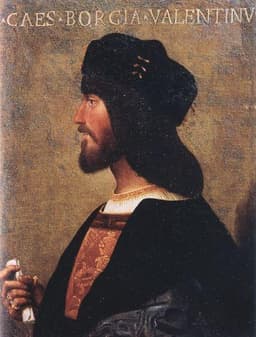
Cesare Borgia
General · Medieval
60.2Total
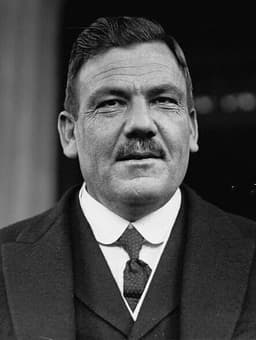
Plutarco Elias Calles
General · Modern
58.5Total
Basic Information
Born
1475
1877
Died
1507
1945
Era
Medieval
Modern
Nationality
Italy
Mexico
Occupation
General
General
Civilization
Western
Western
Score Comparison
Military (10%)
67.5
40.0
Political (20%)
68.0
70.3
Influence (20%)
68.0
68.0
Legacy (20%)
40.0
40.0
Leadership (15%)
64.0
78.0
Strategy (15%)
66.3
52.5
TOTAL
60.2
58.5
Cesare Borgia — Complete Timeline
1493 AD
Appointment as CardinalPolitical Action◆ Major
Cesare Borgia was appointed cardinal by his father, Pope Alexander VI. This position gave him significant power within the Church and access to papal resources. He used his cardinalate to advance his family's political interests in Italy.
CardinalNepotismPapacy
Impact: regional
1498 AD
Resignation from the CardinalatePolitical Action◆ Major
Cesare Borgia resigned as cardinal to pursue a military and political career. He became the first person to voluntarily leave the College of Cardinals. This move allowed him to focus on conquering territories in the Romagna region of Italy.
ResignationMilitaryRomagna
Impact: regional
1499 AD
Conquest of the RomagnaWar◆ Major
Cesare Borgia, with French support, launched a campaign to conquer the cities of the Romagna. He captured Imola, Forl
ConquestRomagnaMachiavelli
Impact: regional
1503 AD
Fall from PowerPolitical Action
After the death of Pope Alexander VI, Cesare Borgia lost his political support. He was captured by his enemies and imprisoned in Spain. His territories in Italy quickly collapsed. This sudden fall demonstrated the fragility of his power base.
FallImprisonmentCollapse
Impact: regionaltragic
1507 AD
Death in BattleWar
Cesare Borgia was killed in a skirmish near Viana, Navarre, while serving as a mercenary captain. His death ended any chance of restoring his former power. He died at age 31, having failed to regain his Italian territories.
DeathMercenaryNavarre
tragic
Plutarco Elias Calles — Complete Timeline
1915 AD
Governorship of SonoraPolitical Action
Calles served as Governor of Sonora from 1915 to 1919, implementing radical reforms including land redistribution, anti-clerical laws, and labor rights. His governorship established him as a key figure in the Sonoran dynasty and a proponent of revolutionary change.
GovernorshipSonoraReforms
Impact: regionalconstructive
1924 AD
Presidency of MexicoPolitical Action◆ Major
Calles was elected President of Mexico in 1924, serving until 1928. His administration continued revolutionary reforms, including land reform, labor rights, and secularization, but also faced opposition from the Catholic Church and conservative groups.
PresidencyMexican RevolutionReforms
Impact: nationalconstructive
1926 AD
Cristero WarWar◆ Major
Calles enforced anti-clerical laws, including the Calles Law, which restricted the Catholic Church's role in society. This sparked the Cristero War (1926-1929), a violent rebellion by Catholic peasants against the state, resulting in tens of thousands of deaths.
Cristero WarAnti-clericalismReligious Conflict
Impact: nationaldestructive
1928 AD
MaximatoPolitical Action◆ Major
After his presidency, Calles remained the de facto ruler of Mexico during the Maximato (1928-1934), controlling puppet presidents. He continued to influence policy, but his power waned as President L
MaximatoPolitical ControlCárdenas
Impact: national
1929 AD
Founding of the National Revolutionary Party (PNR)Political Action
Calles founded the National Revolutionary Party (PNR) in 1929, which later became the Institutional Revolutionary Party (PRI). This party dominated Mexican politics for over 70 years, institutionalizing the revolution's legacy and centralizing power.
Political PartyPRIInstitutionalization
Impact: nationalconstructive
Expert Analysis
Plutarco Elias Calles vs Cesare Borgia
### The Prince and the Jefe
In the winter of 1507, a solitary figure in battered armor bled out in a muddy ditch near the Spanish town of Viana. Cesare Borgia, once the most feared man in Italy, had been killed in a petty skirmish, his body stripped and left to rot. Four centuries later, in 1929, another strongman—Plutarco Elías Calles—stood in Mexico City and founded a political party that would rule his nation for the next seventy-one years. One died forgotten, a cautionary tale of ambition without roots. The other died a retired elder statesman, his legacy woven into the very fabric of his country. Why did the Cardinal and the Jefe—both ruthless reformers, both military commanders, both men who remade their worlds—meet such different fates?
### Origins
Cesare Borgia was born into the most scandalous family of Renaissance Italy. His father, Rodrigo Borgia, bought the papacy in 1492 and became Pope Alexander VI, a man who treated the Church as a family business. Cesare was made a cardinal at eighteen, a position of immense power that he never wanted. He was a creature of the Vatican, a prince of the Church who despised the clergy. His world was a chessboard of city-states, mercenary armies, and shifting alliances—a place where power was personal and trust was a weakness.
Plutarco Elías Calles was born in 1877 in the dusty state of Sonora, Mexico, to a poor family. His father died when he was a child; he worked as a bartender, a schoolteacher, and a mill hand before the Mexican Revolution gave him a rifle and a cause. He had no noble blood, no family dynasty. His world was a nation torn apart by war, a land of feudal haciendas and a Catholic Church that owned half the country’s wealth. For Calles, power was not about family—it was about institutions.
### Rise to Power
Cesare Borgia’s rise was a product of nepotism and nerve. In 1498, he did the unthinkable: he resigned his cardinalate—the first man in history to voluntarily give up the purple—to become a secular prince. His father gave him French troops, a papal army, and a license to carve out his own kingdom. In 1499, he stormed into the Romagna, a lawless region of petty lords and robber barons. City after city fell: Imola, Forlì, Rimini, Pesaro. He fought alongside his men, a general in the mud, and he ruled with a blend of terror and competence that made Machiavelli gasp.
Calles rose through the chaos of the Mexican Revolution. He was a competent administrator, not a charismatic caudillo. In 1915, as governor of Sonora, he banned the Church from politics, closed Catholic schools, and redistributed land to peasants. He was not a warrior like Pancho Villa; he was a builder. In 1924, he was elected president of Mexico. Where Borgia conquered with swords, Calles legislated with laws.
### Leadership & Governance
Borgia’s leadership was a study in controlled violence. He conquered the Romagna in two years, then appointed a brutal lieutenant, Ramiro de Lorca, to pacify the region. When the job was done, Borgia had de Lorca cut in half and displayed in the town square—a message that the prince, not his agent, held ultimate power. He built a centralized state, unified laws, and crushed the feudal lords. But his system depended entirely on his person. There was no bureaucracy, no party, no constitution. When his father died in 1503, the entire edifice collapsed.
Calles governed through institutions. As president, he built roads, schools, and irrigation systems. He enforced the anti-clerical laws of the 1917 Constitution, closing hundreds of churches and deporting foreign priests. This sparked the Cristero War (1926-1929), a bloody Catholic uprising that killed 90,000 people. Calles did not lead armies in the field; he directed the war from his desk, sending federal troops to burn villages and execute rebel leaders. When his presidential term ended in 1928, he did not cling to office. Instead, he created the National Revolutionary Party (PNR) in 1929—a political machine that would control Mexico for decades. He became the *Jefe Máximo*, the maximum chief, ruling through puppet presidents during the Maximato (1928-1934). The party, not the man, was the source of power.
### Triumph & Tragedy
Borgia’s greatest moment was the conquest of the Romagna. For a brief, brilliant period, he was the model of a new prince—ruthless, efficient, and visionary. Machiavelli, who met him in 1502, wrote that Borgia was the only man who understood how to seize and hold power. His tragedy was that his power was personal. When Alexander VI died, Borgia was caught between the French, the Spanish, and the Italian city-states. He was imprisoned, escaped, and died at thirty-one in a meaningless battle, his kingdom dissolved, his name a byword for corruption.
Calles’s triumph was the creation of a stable, one-party state. After a decade of revolution and civil war, Mexico needed order. Calles provided it. His tragedy was the cost: the Cristero War left deep scars, and his anti-clericalism poisoned Mexican politics for generations. But unlike Borgia, Calles did not die in the mud. He was forced into exile in 1936 by his own protégé, Lázaro Cárdenas, but he returned to Mexico in 1941 and died peacefully in 1945.
### Character & Destiny
Borgia was a gambler. He staked everything on his father’s papacy, on French support, on his own charisma. He was brilliant but brittle—he could build a state but not a succession. Calles was an organizer. He saw that the Mexican Revolution needed not a king but a party, not a dynasty but a system. He was cold, pragmatic, and patient. Borgia burned bright and fast; Calles built to last.
Their eras shaped them. Renaissance Italy was a world of city-states, mercenaries, and papal intrigues—a place where a single death could undo a kingdom. Post-revolutionary Mexico was a nation of peasants, generals, and intellectuals—a place where a party could outlive its founder. Borgia could not imagine a state without himself; Calles could not imagine a state without his party.
### Legacy
Cesare Borgia lives on as a character in Machiavelli’s *The Prince*, a symbol of amoral ambition. His name is synonymous with poison, betrayal, and the dark arts of power. He is a warning, not a model.
Plutarco Elías Calles is remembered as the founder of the Institutional Revolutionary Party (PRI), which ruled Mexico for seventy-one years. He is a controversial figure—hated by Catholics, admired by modernizers. His reforms secularized the state, built a modern economy, and ended the age of caudillos. He is a founder, not a footnote.
### Conclusion
Two men, two worlds. One died in a ditch, his kingdom a memory. The other died in bed, his party a machine. The difference was not in their ambition—both were ruthless—but in their vision. Borgia built a throne for himself; Calles built a temple for his party. One was a prince; the other was a jefe. In the end, the institution outlasts the man—and that is the cruelest lesson of power.
Rankings
🥇
Cesare BorgiaLeader
Mil: 67.5Pol: 68.0Inf: 68.0
60.2
🥈
Plutarco Elias Calles
Mil: 40.0Pol: 70.3Inf: 68.0
58.5
+1.7 behind
How This Comparison Works
Algorithm
Each figure is scored on 6 dimensions (0—100 scale) based on structured historical data: Military (10%), Political (20%), Influence (20%), Legacy (20%), Leadership (15%), Strategy (15%). The weighted total produces the final ranking.
Data Sources
Scores are computed from structured sub-indicators in the database. Scale factors adjust for era (Ancient ×0.85, Modern ×1.0) and civilization size (Eastern ×1.05, Other ×0.80) to account for differences in population and military scale.
Maximum 3 Figures
Comparisons are limited to 2—3 figures to ensure readability and statistical meaningfulness.
Error Margins
±5 points per dimension — Sub-scores are derived from historical records with inherent uncertainty. Two figures within 5 points on a dimension should be considered roughly equivalent in that area.
Total Score Accuracy
±3 points overall — The weighted combination of 6 dimensions produces a total score with approximately ±3 points of uncertainty. Differences of less than 3 points are not statistically significant— the figures are effectively tied.
Known Limitations
- Historical records are incomplete and uneven across civilizations
- Figures from oral-tradition societies may be underrepresented
- Occupation labels can misclassify multi-role figures
- Scores measure capability and impact, not moral character
- Quantitative scoring is a comparison tool, not absolute truth
Capability Radar
Military (10%) — Battles & Warfare
Battles
55
45
Win Rate
60
50
Expansion
55
30
Political (20%) — Governance & Reform
Reform
40
85
Diplomacy
55
65
Economy
35
60
Influence (20%) — Cultural & Global Reach
Cultural
55
70
Global
60
60
Legacy (20%) — Historical Impact
Historical
70
75
Longevity
65
70
Leadership (15%) — Power & Stability
Tenure
45
70
Stability
30
55
Strategy (15%) — Tactics & Innovation
Strategy
60
55
Tactics
65
40
Reform
50
60
Similar Comparisons
Comments & Discussion
The Butcher of Viana6/16/2026
Calles built a party that outlived him; Borgia built a name that died when he did. People forget that Borgia’s father, Pope Alexander VI, literally controlled the treasury of Christendom—yet Cesare couldn’t secure a single reliable ally after his dad died in 1503. Calles had no papal bankroll, just the Institutional Revolutionary Party, which shows institutions beat individual charisma every time. One was a dead dynasty; the other planted roots in concrete.
历史直尺6/16/2026
非要比较,那得看他们面对的是啥敌人。卡列斯打的是革命后的宪法危机,靠着工人和农民建立执政党;博尔贾打的是意大利城邦贵族,靠他爹的教皇位子借力。可你看,卡列斯的敌人想推翻共和国,博尔贾的敌人是他同盟的亲戚——家族政治天生脆弱。卡列斯死后十二年他的党还在掌权,博尔贾死后一年连他的领地被瓜分了。这不是个人能力问题,是结构决定命运。
The Jefe’s Ghost6/16/2026
Let’s cut the romanticism: Borgia was a tactical genius who couldn’t build loyalty beyond his own shadow. He alienated everyone—the Orsini, the Colonna, even his own brother. Calles, by contrast, was a master of patronage: the Confederación de Trabajadores de México (CTM) he helped create still mobilizes millions today. Borgia’s cruelty was personal (look up his assassination of the Duke of Bisceglie); Calles’s cruelty was institutional, like the Cristero War that killed 100,000. One was a psych
笑谈刀笔吏6/16/2026
有人吹博尔贾是马基雅维利的原型—可《君主论》里那个典范根本没活过四十岁。卡列斯呢?他活到六十九,把总统位子让给拉扎罗·卡德纳斯,后来还从流放地遥控党权。马基雅维利要是写续集,估计得改结论:靠父亲权势的君主最终被历史抛尸,靠机关政党的独裁者却活成了制度本身。这俩人的输赢不在于谁更狠,而在于谁更懂"走后门建大门"。
Silver Bullet6/16/2026
Every textbook says Borgia wanted to unify Italy—but he never even controlled the Papal States fully without his father. Calles actually unified Mexico’s post-revolutionary factions under the PNR, the party that became PRI. Different eras, sure, but Borgia also faced weaker states (like Urbino, not a nation-state) and still failed. Calles faced the U.S., agrarian rebels, Catholic militias, and oil companies—and he didn’t just survive