Loading...
Cesare Borgia vs John Lambert
Cesare Borgia leads by 3.5 pts · 2 figures compared
…
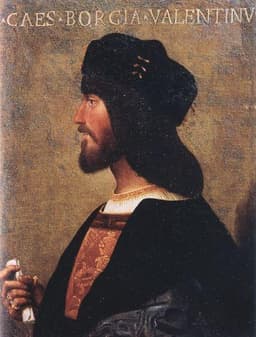
Cesare Borgia
General · Medieval
60.2Total
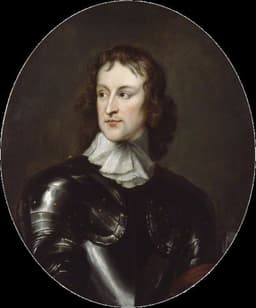
John Lambert
General · Modern
56.7Total
Basic Information
Born
1475
1619
Died
1507
1684
Era
Medieval
Modern
Nationality
Italy
England
Occupation
General
General
Civilization
Western
Western
Score Comparison
Military (10%)
67.5
70.0
Political (20%)
68.0
45.0
Influence (20%)
68.0
59.0
Legacy (20%)
40.0
50.0
Leadership (15%)
64.0
68.0
Strategy (15%)
66.3
55.0
TOTAL
60.2
56.7
Cesare Borgia — Complete Timeline
1493 AD
Appointment as CardinalPolitical Action◆ Major
Cesare Borgia was appointed cardinal by his father, Pope Alexander VI. This position gave him significant power within the Church and access to papal resources. He used his cardinalate to advance his family's political interests in Italy.
CardinalNepotismPapacy
Impact: regional
1498 AD
Resignation from the CardinalatePolitical Action◆ Major
Cesare Borgia resigned as cardinal to pursue a military and political career. He became the first person to voluntarily leave the College of Cardinals. This move allowed him to focus on conquering territories in the Romagna region of Italy.
ResignationMilitaryRomagna
Impact: regional
1499 AD
Conquest of the RomagnaWar◆ Major
Cesare Borgia, with French support, launched a campaign to conquer the cities of the Romagna. He captured Imola, Forl
ConquestRomagnaMachiavelli
Impact: regional
1503 AD
Fall from PowerPolitical Action
After the death of Pope Alexander VI, Cesare Borgia lost his political support. He was captured by his enemies and imprisoned in Spain. His territories in Italy quickly collapsed. This sudden fall demonstrated the fragility of his power base.
FallImprisonmentCollapse
Impact: regionaltragic
1507 AD
Death in BattleWar
Cesare Borgia was killed in a skirmish near Viana, Navarre, while serving as a mercenary captain. His death ended any chance of restoring his former power. He died at age 31, having failed to regain his Italian territories.
DeathMercenaryNavarre
tragic
John Lambert — Complete Timeline
1648 AD
Battle of PrestonWar◆ Major
John Lambert commanded parliamentary forces at the Battle of Preston, defeating a Scottish royalist army. The victory helped secure the parliamentary cause in the Second English Civil War.
BattleEnglish Civil WarParliament
Impact: national
1653 AD
Drafted the Instrument of GovernmentPolitical Action◆ Major
John Lambert was the principal author of the Instrument of Government, the written constitution that established the Protectorate under Oliver Cromwell. The document created a Lord Protector and a Council of State, but was never fully implemented.
ConstitutionProtectorateCromwell
Impact: nationalconstructive
1662 AD
Exiled to GuernseyPolitical Action◆ Major
After the Restoration, John Lambert was tried for treason and exiled to the island of Guernsey. He spent the remainder of his life in captivity, never regaining political influence.
ExileRestorationPunishment
Impact: nationaltragic
Expert Analysis
John Lambert vs Cesare Borgia
### The Prince and the Parliamentarian
On a spring day in 1503, Cesare Borgia, the most feared man in Italy, watched his father, Pope Alexander VI, die. Within weeks, his empire of conquest crumbled, his allies evaporated, and he was a prisoner in his own castle. A century and a half later and a thousand miles north, another general, John Lambert, stood in the halls of Westminster, drafting a written constitution for a new English republic. He believed he was forging a permanent future. Yet within a decade, Lambert too would be a prisoner, his life’s work erased by a restored king. Both men were military geniuses who shaped their age; both fell from power. But their paths, their purposes, and their ultimate fates reveal a profound divide between the raw ambition of Renaissance Italy and the principled, yet doomed, vision of Puritan England.
### Origins
Cesare Borgia was born in 1475 into the most notorious family of the Italian Renaissance. His father, Rodrigo Borgia, was a cardinal who became Pope Alexander VI in 1492, turning the papacy into a tool for family advancement. Cesare was raised in the Vatican, a world of Machiavellian intrigue where power was naked, loyalty was bought, and morality was a luxury. His education was in law and church politics, his inheritance the promise of a throne. In 1493, at just eighteen, he was made a cardinal, a prince of the Church.
John Lambert, born in 1619, came from a different world entirely. His father was a Yorkshire gentleman, but England was convulsed by religious and constitutional crisis. Lambert grew up with Puritan sermons and the common law, not papal bulls. He studied law at the Inns of Court but abandoned it for the battlefield when civil war erupted in 1642. Where Borgia was forged in the decadent court of Rome, Lambert was forged in the crucible of a revolution that sought to limit the power of kings and purify the church.
### Rise to Power
Cesare Borgia’s rise was a study in ruthless opportunism. In 1498, he shocked Christendom by resigning his cardinalate—the first man ever to do so voluntarily—to become a secular prince. He secured an alliance with the French king, married into the royal house of Navarre, and in 1499 launched his campaign to conquer the Romagna, a swath of papal territories ruled by fractious local lords. He captured Imola, Forlì, and a dozen other cities with a blend of French cavalry, Swiss mercenaries, and his own brutal cunning. He crushed his enemies by deception, assassination, and terror—most famously luring his treacherous captain, Ramiro de Lorqua, to a public execution in the town square of Cesena, leaving his body cut in two as a lesson.
John Lambert’s rise was more gradual and institutional. He proved his military skill at the Battle of Preston in 1648, where he commanded parliamentary forces against a Scottish royalist army. His victory was decisive—he outmaneuvered the Scots with a brilliant flanking march, capturing thousands. But Lambert was not just a sword; he was a constitutional mind. After Oliver Cromwell dissolved the Rump Parliament in 1653, Lambert was the principal author of the Instrument of Government, which established England’s only written constitution, dividing power between a Lord Protector, a council, and a parliament. He was, in effect, the architect of the English Republic.
### Leadership & Governance
Cesare Borgia governed as a Renaissance tyrant in miniature. He centralized authority, imposed order, and replaced corrupt local rulers with his own loyal officials. In the conquered Romagna, he appointed a harsh but efficient governor, then executed him to win popular favor. Machiavelli, who observed Borgia’s methods, wrote that a prince must learn to be both lion and fox. Borgia was both: he could charm a cardinal while poisoning a rival. Yet his governance was entirely personal. It depended on his father’s papal power, his own military reputation, and the fear he inspired. There was no constitution, no parliament, no ideology—only ambition.
John Lambert governed as a Puritan revolutionary. He believed in a godly commonwealth, in law as a check on arbitrary power, and in the sovereignty of parliament—at least of the right kind. As a general, he was Cromwell’s most trusted lieutenant, but he was also a political thinker. The Instrument of Government was a genuine attempt to create a stable republic, balancing executive power with representative institutions. Lambert was a skilled negotiator, a patient committee man, and a believer in constitutional order. Yet his governance was also flawed: it excluded many from power, relied on military force, and could not survive the collapse of the revolutionary consensus.
### Triumph & Tragedy
Cesare Borgia’s greatest triumph was the conquest of the Romagna. By 1503, he controlled a unified territory that no Italian prince had held for generations. He was poised to become the king of central Italy. His tragedy came with his father’s death. Without the papal shield, his enemies closed in. He was captured, imprisoned, and eventually escaped to Navarre, where he died in 1507 at age thirty-one, killed in a minor skirmish—a pathetic end for a man who had once terrified Italy.
John Lambert’s greatest triumph was the Instrument of Government. It was a moment of genuine constitutional creativity, a blueprint for a republic that might have lasted. His tragedy was that the republic did not last. After Cromwell’s death in 1658, the fragile commonwealth collapsed. In 1660, the monarchy was restored. Lambert was tried for treason, sentenced to death, then reprieved to life imprisonment. He spent his final twenty-two years exiled on the island of Guernsey, a forgotten prisoner, while the king he had fought against ruled in triumph.
### Character & Destiny
Cesare Borgia’s character was defined by amoral ambition. He was brilliant, charismatic, and utterly without scruple. He believed that power was its own justification. His destiny was to be a warning: that a prince who builds his state on fear and fraud builds on sand. Machiavelli immortalized him as the model of the new prince, but even Machiavelli admitted that Borgia’s fall came from trusting too much in fortune—and his father.
John Lambert’s character was defined by conviction and principle. He was a Puritan who believed in a godly cause, a lawyer who believed in law, a republican who believed in parliament. His destiny was to be a lesson: that even the most principled revolution can be undone by the forces it cannot control. He outlived his cause, watching his constitution be torn up, his comrades executed, his name erased from history books.
### Legacy
Cesare Borgia’s legacy is paradoxical. He was a failure in his own time, yet he became the archetype of the ruthless modern ruler. Machiavelli’s *The Prince*, written partly from Borgia’s example, has shaped political thought for five centuries. Borgia’s name is synonymous with poison, treachery, and the dark arts of statecraft. He is remembered not for what he built, but for what he represented.
John Lambert’s legacy is quieter but more substantial. The Instrument of Government was a landmark in constitutional history, a precursor to the American and French experiments in written constitutions. Lambert himself is remembered by historians as a capable general, a thoughtful politician, and a man of principle in an age of extremes. He is not a household name, but his ideas—limited government, parliamentary sovereignty, the rule of law—echo in every modern democracy.
### Conclusion
Cesare Borgia and John Lambert were both generals, both political architects, both men who rose high and fell hard. But Borgia built a state on his own ambition, and it died with him. Lambert built a constitution on a shared vision, and it outlasted him in spirit. In the end, the difference between them is the difference between a prince who rules by fear and a citizen who rules by law. One left a legend; the other left a legacy. The legend is more dramatic, but the legacy endures.
Rankings
🥇
Cesare BorgiaLeader
Mil: 67.5Pol: 68.0Inf: 68.0
60.2
🥈
John Lambert
Mil: 70.0Pol: 45.0Inf: 59.0
56.7
+3.5 behind
How This Comparison Works
Algorithm
Each figure is scored on 6 dimensions (0—100 scale) based on structured historical data: Military (10%), Political (20%), Influence (20%), Legacy (20%), Leadership (15%), Strategy (15%). The weighted total produces the final ranking.
Data Sources
Scores are computed from structured sub-indicators in the database. Scale factors adjust for era (Ancient ×0.85, Modern ×1.0) and civilization size (Eastern ×1.05, Other ×0.80) to account for differences in population and military scale.
Maximum 3 Figures
Comparisons are limited to 2—3 figures to ensure readability and statistical meaningfulness.
Error Margins
±5 points per dimension — Sub-scores are derived from historical records with inherent uncertainty. Two figures within 5 points on a dimension should be considered roughly equivalent in that area.
Total Score Accuracy
±3 points overall — The weighted combination of 6 dimensions produces a total score with approximately ±3 points of uncertainty. Differences of less than 3 points are not statistically significant— the figures are effectively tied.
Known Limitations
- Historical records are incomplete and uneven across civilizations
- Figures from oral-tradition societies may be underrepresented
- Occupation labels can misclassify multi-role figures
- Scores measure capability and impact, not moral character
- Quantitative scoring is a comparison tool, not absolute truth
Capability Radar
Military (10%) — Battles & Warfare
Battles
55
65
Win Rate
60
60
Expansion
55
40
Political (20%) — Governance & Reform
Reform
40
55
Diplomacy
55
50
Economy
35
45
Influence (20%) — Cultural & Global Reach
Cultural
55
35
Global
60
30
Legacy (20%) — Historical Impact
Historical
70
50
Longevity
65
40
Leadership (15%) — Power & Stability
Tenure
45
60
Stability
30
40
Strategy (15%) — Tactics & Innovation
Strategy
60
65
Tactics
65
70
Reform
50
55
Similar Comparisons
Comments & Discussion
Lambert's Ghost6/16/2026
Comparing Cesare Borgia, a man who literally murdered his own brother-in-law for political gain, to a principled constitutionalist like Lambert is an insult to the Puritan legacy. Borgia’s “genius” was just poisoning and papal favor; he never built a lasting institution. Lambert drafted the Instrument of Government, the first written constitution in English history. Borgia died in a skirmish at 31. Lambert lived to see his ideas crushed by monarchy, but his blueprint for republican law survived
古罗马铁粉6/16/2026
博尔贾懂的只有毒药和教皇爸爸,兰伯特有的是《政府约法》,西方第一部成文宪法!博尔贾31岁战死,兰伯特在伦敦塔里活着看到君主制复辟—但共和种子早已种下。他起草的那个文件,后来直接影响了美国的宪法辩论。一个靠爹靠杀,一个靠笔靠理,这也能比?博尔贾算什么“天才”,他连个稳定的城邦都没留传下来。
Skeptical Sam6/16/2026
The "Machiavellian intrigue" framing is doing heavy lifting here. Borgia’s fall wasn’t some tragedy—he was a failing warlord who overextended his daddy’s credit. Lambert’s republic collapsed because he couldn’t make Puritans agree on anything, not because he was virtuous. Borgia’s “empire” lasted what, two years? Lambert’s constitution survived two years before Cromwell dissolved it. Both were political failures. Let’s not romanticize losing power slowly as “principled” and losing fast as “ambit
数字侦探6/16/2026
两个人都失败得漂亮,但看数字:博尔贾统治的土地不超过亚平宁半岛的5%,而且全靠教皇军队撑腰;兰伯特推动的《政府约法》覆盖了整个英格兰、苏格兰和爱尔兰,虽然只活了两年。政治版图差两个数量级!别跟我扯什么文艺复兴魅力,博尔贾就是个地方军阀,兰伯特好歹是国家级宪法设计师。规模不同,不能等量齐观。
Classics Nerd6/16/2026
The comparison misses the deeper irony: Borgia was the model for Machiavelli's *Prince*, a cynical handbook on seizing power; Lambert was a Puritan trying to create a Christian commonwealth. Yet both ended up imprisoned—Borgia by the cynical Spanish, Lambert by a restored monarch. Military genius? Borgia's best move was hiring French mercenaries; Lambert's was at Dunbar, where he outflanked Charles II's forces. One used poison, one used parliamentary procedure. They're not parallels. They're opp
局外观察者6/16/2026
你们都在谈动机、谈道德,但忽略了一个关键:博尔贾死时万人唾骂