Loading...
Afonso de Albuquerque vs John Lambert
Afonso de Albuquerque leads by 22.9 pts · 2 figures compared
…
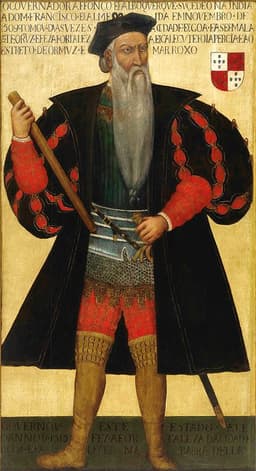
Afonso de Albuquerque
General · Medieval
79.6Total
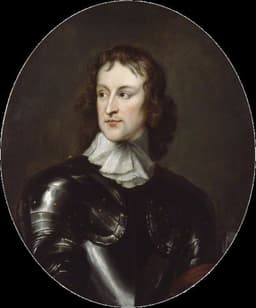
John Lambert
General · Modern
56.7Total
Basic Information
Born
1453
1619
Died
1515
1684
Era
Medieval
Modern
Nationality
Portugal
England
Occupation
General
General
Civilization
Western
Western
Score Comparison
Military (10%)
77.5
70.0
Political (20%)
88.0
45.0
Influence (20%)
80.0
59.0
Legacy (20%)
75.0
50.0
Leadership (15%)
78.0
68.0
Strategy (15%)
82.0
55.0
TOTAL
79.6
56.7
Afonso de Albuquerque — Complete Timeline
1503 AD
First voyage to IndiaWar◆ Major
Afonso de Albuquerque led a fleet to India, establishing the first Portuguese fort at Cochin. This voyage laid the foundation for Portuguese control of the Indian Ocean trade.
ExplorationColonialismIndia
Impact: global
1510 AD
Conquest of GoaWar◆ Major
Albuquerque captured Goa from the Sultan of Bijapur. He made Goa the capital of Portuguese India, a position it held for over 400 years.
ConquestColonialismIndia
Impact: regional
1511 AD
Conquest of MalaccaWar◆ Major
Albuquerque led a Portuguese fleet to capture the strategic port of Malacca. This gave Portugal control of the spice trade route between the Indian Ocean and the Pacific.
ConquestSpice TradeSoutheast Asia
Impact: global
1513 AD
Siege of AdenWar
Albuquerque attempted to capture Aden in Yemen but failed. This failure prevented Portugal from controlling the entrance to the Red Sea and limited their influence in the region.
SiegeFailureRed Sea
Impact: regional
1515 AD
Death at seaOther◆ Major
Afonso de Albuquerque died at sea off the coast of Goa, possibly from illness or poison. His death left the Portuguese Empire in the Indian Ocean without its most capable leader.
DeathLeadershipEmpire
Impact: regionaltragic
John Lambert — Complete Timeline
1648 AD
Battle of PrestonWar◆ Major
John Lambert commanded parliamentary forces at the Battle of Preston, defeating a Scottish royalist army. The victory helped secure the parliamentary cause in the Second English Civil War.
BattleEnglish Civil WarParliament
Impact: national
1653 AD
Drafted the Instrument of GovernmentPolitical Action◆ Major
John Lambert was the principal author of the Instrument of Government, the written constitution that established the Protectorate under Oliver Cromwell. The document created a Lord Protector and a Council of State, but was never fully implemented.
ConstitutionProtectorateCromwell
Impact: nationalconstructive
1662 AD
Exiled to GuernseyPolitical Action◆ Major
After the Restoration, John Lambert was tried for treason and exiled to the island of Guernsey. He spent the remainder of his life in captivity, never regaining political influence.
ExileRestorationPunishment
Impact: nationaltragic
Expert Analysis
Afonso de Albuquerque vs John Lambert
### The General and the Empire Builder: Two Paths to Power in an Age of Upheaval
In the autumn of 1662, a man who had once commanded armies and drafted the first written constitution in English history was rowed ashore on the windswept island of Guernsey. John Lambert, now a prisoner of the king he had helped defeat, watched the grey Channel waters close behind him. Half a century earlier and thousands of miles away, another general died at sea, gazing at the coast of Goa he had conquered. Afonso de Albuquerque’s body was lowered into the Indian Ocean as his fleet saluted the founder of an empire. One man ended his days in exile, the other in apotheosis. What drove these two brilliant commanders to such different fates?
### Origins: The Gentleman and the Nobleman
John Lambert was born in 1619 into the Yorkshire gentry, a class of prosperous landowners who believed in order, property, and the ancient rights of Parliament. His father, a lawyer, died when John was young, leaving him to inherit a comfortable estate and a Puritan education that stressed duty and discipline. The England of his youth was a land of mounting tension between Crown and Commons, where religious fervour mixed with constitutional grievance. Lambert absorbed the conviction that law, not royal whim, should govern the realm.
Afonso de Albuquerque arrived in the world in 1453, the year Constantinople fell to the Turks. He was born near Lisbon into the high nobility, his family steeped in crusading tradition and service to the Portuguese Crown. As a younger son, he had no inheritance to await; his path lay in the king’s wars. The Portugal of his youth was a small, ambitious kingdom on the edge of Europe, its eyes fixed on the spice routes of the East. Where Lambert learned to argue law, Albuquerque learned to command ships and men.
### Rise to Power: The Committee Room and the Quarterdeck
Lambert entered the historical stage not through battlefield glory but through the grinding logic of civil war. When the Wars of the Three Kingdoms erupted in 1642, he joined Parliament’s army as a cavalry officer. His rise was steady, not meteoric, and it came through competence. At the Battle of Preston in 1648, Lambert commanded the parliamentary forces that shattered a Scottish royalist army. The victory was decisive, but his true genius lay in the aftermath. While others demanded vengeance, Lambert helped negotiate the surrender terms that preserved order. He understood that war was a means, not an end.
Albuquerque’s path was forged in fire. His first voyage to India in 1503 saw him establish a fort at Cochin, the first Portuguese toehold on the subcontinent. Where Lambert climbed the ladder of parliamentary committees, Albuquerque climbed the rigging of carracks. His rise depended not on political manoeuvre but on audacity. In 1510, he captured Goa from the Sultan of Bijapur with a force that seemed laughably small. He held it against a massive counter-siege, then made it the capital of Portuguese India. The difference was stark: Lambert’s power came from persuasion and institutional loyalty; Albuquerque’s came from sheer, relentless will.
### Leadership & Governance: The Constitution and the Cannon
Lambert’s greatest political achievement was the Instrument of Government of 1653, the written constitution that established the Protectorate under Oliver Cromwell. It was a remarkable document, dividing power between a Lord Protector, a council, and a Parliament elected on a reformed franchise. Lambert believed that order required law, not the sword. Yet his political wisdom had a fatal flaw: he could not see that Cromwell would never accept limits on his authority. Lambert’s governance was rational, legalistic, and ultimately brittle.
Albuquerque governed by different principles. He understood that the Portuguese Empire in Asia could not be sustained by trade alone; it needed bases, alliances, and terror. After taking Goa, he welcomed Hindu merchants and allowed them to keep their temples, a pragmatic tolerance that shocked his chaplains. At Malacca in 1511, he slaughtered the Muslim defenders but spared the Chinese and Hindu traders. His military genius lay in knowing when to destroy and when to conciliate. He built an empire on fear and calculation, not constitutions.
### Triumph & Tragedy: The Heights and the Falls
Lambert’s finest hour came in 1653, when he stood as the architect of a new republic. But his tragedy followed swiftly. When Cromwell dismissed the Protectorate’s first Parliament, Lambert protested—and Cromwell cashiered him. The general who had drafted the constitution could not enforce it. After Cromwell’s death, Lambert tried to seize power himself, but the army and the nation had wearied of military rule. When Charles II returned in 1660, Lambert was tried for treason. His life was spared, but he was exiled to Guernsey, where he spent his last twenty-two years in captivity, painting flowers and writing poetry.
Albuquerque’s triumph was the conquest of Malacca in 1511, the gateway to the spice trade. But his tragedy came at Aden in 1513, where he failed to capture the fortress that commanded the Red Sea. It was the one great failure of his career, and it haunted him. Worse, his enemies at court poisoned the king’s ear. In 1515, recalled to Lisbon in disgrace, Albuquerque died at sea, possibly poisoned, possibly broken-hearted. Yet even in defeat, he had built something that endured: the Portuguese Estado da Índia would survive for centuries.
### Character & Destiny: The Lawyer and the Lion
Lambert’s character was that of a lawyer in armour. He believed in systems, in written rules, in the power of reason to order human affairs. But history does not always reward reason. In an age of revolution, he lacked the ruthlessness to crush his enemies and the charisma to command loyalty. He was too principled for the realpolitik of the Protectorate and too ambitious for the Restoration.
Albuquerque was a lion who knew no cage. He wrote to his king: “If I had done nothing else but take Goa, that alone would justify all my labours.” He was vain, cruel, and magnificent. His destiny was to build, not to administer. When he died, the empire he founded did not collapse because it was built on forts and fleets, not on his own person. Lambert’s constitution died with the Protectorate; Albuquerque’s empire outlived him.
### Legacy: The Forgotten Constitution and the Lasting Empire
Today, John Lambert is remembered only by specialists. His Instrument of Government was a brilliant experiment that failed, and failure leaves few monuments. Yet he anticipated ideas—written constitutions, separation of powers, parliamentary sovereignty—that would shape the world after his death. He was a man born too early for his vision.
Afonso de Albuquerque is remembered in every port from Goa to Malacca. His statue stands in Lisbon and his name is carved on the map of empire. He was the architect of a global Portuguese presence that lasted until the twentieth century. His legacy is visible, tangible, and contested.
### Conclusion: The Mirror of History
The difference between Lambert and Albuquerque is not simply one of success and failure. It is the difference between building a house of cards and a fortress of stone. Lambert’s England was a world of shifting alliances, where no constitution could anchor the storms of revolution. Albuquerque’s India was a world of rival sultans, where a single determined man could carve out an empire with ships and cannon. One man tried to build a system; the other built a stronghold. One died in exile, the other in the arms of his creation. History remembers the fortress, not the constitution—but both men, in their different ways, were trying to impose order on chaos. The question is not which was wiser, but which world we still inhabit.
Rankings
🥇
Afonso de AlbuquerqueLeader
Mil: 77.5Pol: 88.0Inf: 80.0
79.6
🥈
John Lambert
Mil: 70.0Pol: 45.0Inf: 59.0
56.7
+22.9 behind
How This Comparison Works
Algorithm
Each figure is scored on 6 dimensions (0—100 scale) based on structured historical data: Military (10%), Political (20%), Influence (20%), Legacy (20%), Leadership (15%), Strategy (15%). The weighted total produces the final ranking.
Data Sources
Scores are computed from structured sub-indicators in the database. Scale factors adjust for era (Ancient ×0.85, Modern ×1.0) and civilization size (Eastern ×1.05, Other ×0.80) to account for differences in population and military scale.
Maximum 3 Figures
Comparisons are limited to 2—3 figures to ensure readability and statistical meaningfulness.
Error Margins
±5 points per dimension — Sub-scores are derived from historical records with inherent uncertainty. Two figures within 5 points on a dimension should be considered roughly equivalent in that area.
Total Score Accuracy
±3 points overall — The weighted combination of 6 dimensions produces a total score with approximately ±3 points of uncertainty. Differences of less than 3 points are not statistically significant— the figures are effectively tied.
Known Limitations
- Historical records are incomplete and uneven across civilizations
- Figures from oral-tradition societies may be underrepresented
- Occupation labels can misclassify multi-role figures
- Scores measure capability and impact, not moral character
- Quantitative scoring is a comparison tool, not absolute truth
Capability Radar
Military (10%) — Battles & Warfare
Battles
85
65
Win Rate
80
60
Expansion
95
40
Political (20%) — Governance & Reform
Reform
80
55
Diplomacy
85
50
Economy
80
45
Influence (20%) — Cultural & Global Reach
Cultural
70
35
Global
85
30
Legacy (20%) — Historical Impact
Historical
85
50
Longevity
80
40
Leadership (15%) — Power & Stability
Tenure
70
60
Stability
65
40
Strategy (15%) — Tactics & Innovation
Strategy
95
65
Tactics
90
70
Reform
75
55
Similar Comparisons
Comments & Discussion
Barbarossa's Ghost6/16/2026
Lambert was a constitutional visionary undone by his own success. The man who wrote the "Instrument of Government" gave England its only written constitution—a radical claim to rule by law, not divine right. His inability to tame Cromwell's raw ambition mirrors the fatal flaw of revolutionary generals: securing power is easier than legitimizing it. Meanwhile, Albuquerque died worshipped, his empire built on Portuguese steel and maritime cunning. Lambert drew maps of liberty; Albuquerque painted
总督的叹息6/16/2026
说Lambert是败者,我不同意。这位约克郡绅士在1653年亲手起草了《政府约法》,是人类史上第一个成文宪法的雏形。他比拿破仑早150年试验宪政,可惜对手是克伦威尔这样的独裁者。Albuquerque靠着舰队和暴力建立了东方帝国,但Lambert用笔杆子挑战了国王的神权——这才是真正的革命。历史对他太残酷,把失败者钉在耻辱柱上,却忘了他的法律比剑更锋利。
数据铁锤6/16/2026
拿两位将军对比根本是鸡同鸭讲。Lambert指挥的新模范军不到2万人,Albuquerque在印度洋的战船有百艘,控制着胡椒、桂皮和马六甲的黄金航道。一个是大西洋的小池塘将军,一个是印度洋的跨洲帝国奠基人。Lambert输了政治棋局,Albuquerque死了也赢,但别忘了:葡萄牙帝国150年后就崩了,而Lambert的宪法思想滋养了英格兰的议会制。维度不同,怎么比?
Sands of Memory6/16/2026
Compare their outcomes: Albuquerque's bones dissolved in the Indian Ocean, immortalized as Portugal's great imperial architect. Lambert withered on Guernsey, his final years scribbling flower paintings in a jail cell. But pause—Albuquerque's screams died with his conquests; Lambert's Norfolk gentry spirit never broke. The nobleman built an empire that ultimately proved unsustainable; the gentleman drafted a constitution that echoes in modern governance. Who truly lost? The answer depends on whet
烽火断章6/16/2026
我是军事史学者,直接说结论:Albuquerque是海权时代的马基雅维利,Lambert是内战中的战术家而非战略家。前者的攻占果阿(1510年)和封锁马六甲(1511年)是帝国扩张的教科书案例,后者的邓巴战役胜利(1650年)再出色也只是一次战术闪光。更关键的是,Albuquerque活着就看到了帝国的巩固,Lambert却因政治投机在复辟后沦为阶下囚。两位都是悲剧人物,但一个是失败的英雄,另一个是失败的政客。