Loading...
Cesare Borgia vs Huang Xing
Cesare Borgia leads by 2.7 pts · 2 figures compared
…
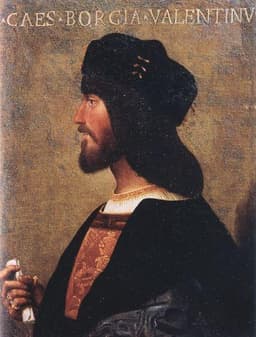
Cesare Borgia
General · Medieval
60.2Total
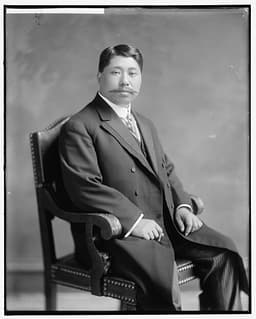
Huang Xing
General · Modern
57.5Total
Basic Information
Born
1475
1874
Died
1507
1916
Era
Medieval
Modern
Nationality
Italy
China
Occupation
General
General
Civilization
Western
Eastern
Score Comparison
Military (10%)
67.5
46.7
Political (20%)
68.0
53.8
Influence (20%)
68.0
62.0
Legacy (20%)
40.0
56.0
Leadership (15%)
64.0
62.0
Strategy (15%)
66.3
60.0
TOTAL
60.2
57.5
Cesare Borgia — Complete Timeline
1493 AD
Appointment as CardinalPolitical Action◆ Major
Cesare Borgia was appointed cardinal by his father, Pope Alexander VI. This position gave him significant power within the Church and access to papal resources. He used his cardinalate to advance his family's political interests in Italy.
CardinalNepotismPapacy
Impact: regional
1498 AD
Resignation from the CardinalatePolitical Action◆ Major
Cesare Borgia resigned as cardinal to pursue a military and political career. He became the first person to voluntarily leave the College of Cardinals. This move allowed him to focus on conquering territories in the Romagna region of Italy.
ResignationMilitaryRomagna
Impact: regional
1499 AD
Conquest of the RomagnaWar◆ Major
Cesare Borgia, with French support, launched a campaign to conquer the cities of the Romagna. He captured Imola, Forl
ConquestRomagnaMachiavelli
Impact: regional
1503 AD
Fall from PowerPolitical Action
After the death of Pope Alexander VI, Cesare Borgia lost his political support. He was captured by his enemies and imprisoned in Spain. His territories in Italy quickly collapsed. This sudden fall demonstrated the fragility of his power base.
FallImprisonmentCollapse
Impact: regionaltragic
1507 AD
Death in BattleWar
Cesare Borgia was killed in a skirmish near Viana, Navarre, while serving as a mercenary captain. His death ended any chance of restoring his former power. He died at age 31, having failed to regain his Italian territories.
DeathMercenaryNavarre
tragic
Huang Xing — Complete Timeline
1905 AD
Co-founded the TongmenghuiPolitical Action◆ Major
Huang Xing co-founded the Tongmenghui (Revolutionary Alliance) in Tokyo with Sun Yat-sen. He became its military leader, organizing armed uprisings against the Qing dynasty.
TongmenghuiRevolutionMilitary
Impact: nationalconstructive
1911 AD
Led the Wuchang UprisingWar
Huang Xing led the Wuchang Uprising, which sparked the Xinhai Revolution. He commanded revolutionary forces against Qing troops, securing initial victories that led to the dynasty's collapse.
Xinhai RevolutionUprisingMilitary
Impact: nationalconstructive
1912 AD
Served as Minister of War in the RepublicPolitical Action◆ Major
Huang Xing served as Minister of War in the provisional government of the Republic of China. He worked to organize a national army and defend the republic against counter-revolutionary forces.
GovernmentMilitaryRepublic
Impact: nationalconstructive
1913 AD
Led the Second Revolution Against Yuan ShikaiWar◆ Major
Huang Xing led the Second Revolution, an armed uprising against President Yuan Shikai's authoritarian rule. The rebellion failed due to lack of coordination and military inferiority, forcing Huang into exile.
Second RevolutionYuan ShikaiExile
Impact: nationaltragic
1916 AD
Died in Exile in ShanghaiPolitical Action
Huang Xing died in Shanghai after returning from exile in Japan and the United States. His death marked the loss of a key military leader of the Chinese revolution, though his legacy endured.
DeathExileRevolution
Impact: nationaltragic
Expert Analysis
Huang Xing vs Cesare Borgia
# The Prince and the Patriot: Cesare Borgia and Huang Xing
In the autumn of 1503, Cesare Borgia stood at the pinnacle of his power. His armies had subdued the fractious cities of the Romagna, his name was whispered with terror across Italy, and Niccolò Machiavelli was watching him closely, taking notes that would become a manual for princes. Four centuries later and half a world away, a young Chinese revolutionary named Huang Xing was preparing to lead an uprising that would topple an empire. One man sought to build a kingdom through cunning and steel; the other, a republic through sacrifice and organization. Both would see their dreams shattered, but their paths reveal the deep chasm between medieval ambition and modern revolution.
Origins
Cesare Borgia was born in 1475 into the most notorious family of Renaissance Italy. His father, Rodrigo Borgia, would become Pope Alexander VI, and Cesare was raised in the heart of the Catholic Church’s power structure. The Borgias were Spanish by origin, outsiders in Rome, which made them ruthless in their pursuit of legitimacy. Cesare was given a cardinal’s hat at eighteen, a position of immense spiritual authority that he never truly believed in. His world was one of poison rings, secret alliances, and the constant threat of assassination—a world where morality was a luxury for the weak.
Huang Xing was born in 1874 in Hunan, China, as the Qing Dynasty was crumbling under the weight of foreign humiliation and internal decay. Unlike Borgia, Huang came from a modest scholarly family. He studied in Japan, where he encountered Western ideas of democracy and nationalism. His China was a civilization in crisis, torn between ancient traditions and the brutal realities of colonialism. Where Borgia inherited a world of cynical power games, Huang inherited a world of urgent reform and existential threat.
Rise to Power
Borgia’s path was paved by his father’s tiara. In 1493, at eighteen, he was made cardinal—not for piety, but for politics. Yet Cesare was restless. In 1498, he did what no cardinal had done before: he voluntarily resigned his sacred office to become a general. This was a shocking act of ambition, a declaration that he would forge his own destiny through steel, not scripture. With French backing, he launched his campaign in 1499 to conquer the Romagna, capturing Imola, Forlì, and other cities with a blend of military skill and cold-blooded diplomacy.
Huang Xing’s rise was harder, more democratic. In 1905, he co-founded the Tongmenghui (Revolutionary Alliance) in Tokyo with Sun Yat-sen. While Sun was the intellectual and spiritual leader, Huang became the military organizer—the man who would actually lead men into battle. His Wuchang Uprising in 1911 was the spark that ignited the Xinhai Revolution, toppling two thousand years of imperial rule. Huang commanded from the front, a general who shared the dangers of his soldiers, not a prince directing from a palace.
Leadership & Governance
Cesare Borgia ruled through fear and calculation. His military strategy—scored at 72.0—was his greatest strength. He understood that a prince must be both lion and fox, and he employed treachery as readily as siegecraft. His most infamous act was the "peace of Sinigaglia," where he invited his rebellious captains to a banquet and had them strangled. But his political genius—scored at 54.0—was limited. He could seize power but could not build institutions. His rule was a one-man show, dependent entirely on his father’s papacy and his own terrifying presence.
Huang Xing, by contrast, was a builder. His leadership score of 75.5 reflects a man who inspired loyalty through example, not terror. As Minister of War in the new Republic in 1912, he tried to organize a national army from scratch—a task that would have tested Caesar himself. But his military score of 42.1 reveals his limitations: Huang was a revolutionary general, not a tactical genius. His strength was political organization and moral authority, not battlefield brilliance. The Second Revolution of 1913, his attempt to overthrow the dictator Yuan Shikai, failed because Yuan controlled the real army and the foreign loans.
Triumph & Tragedy
Borgia’s triumph was the conquest of the Romagna—a brutal masterpiece of state-building that Machiavelli would later hold up as a model. But his tragedy came swiftly. In 1503, Pope Alexander VI died, and Cesare’s entire edifice collapsed. He was captured, imprisoned, and eventually escaped, only to die in a meaningless skirmish near Viana, Navarre, in 1507, fighting as a mercenary for a Spanish king. His kingdom vanished with his father’s breath.
Huang Xing’s triumph was the Wuchang Uprising—the moment when a generation of Chinese dreamers finally broke the imperial chains. But his tragedy was the failure of the republic. Yuan Shikai’s betrayal, the warlord era that followed, and Huang’s own exile and death in Shanghai in 1916 at the age of forty-two—these were the wages of a revolution that could not find its footing. He died knowing the republic was already dying.
Character & Destiny
Cesare Borgia was a man of the Middle Ages—or rather, the Renaissance’s dark underbelly. He believed that power was the only reality, that trust was weakness, and that history belonged to those who dared. His personality was cold, calculating, and utterly self-interested. He was Machiavelli’s ideal prince, but the ideal prince had no successors. Borgia’s destiny was to be a warning, not a model.
Huang Xing was a modern man, shaped by the Enlightenment and the painful birth of nationalism. He believed in institutions, in the people, in a cause larger than himself. His personality was warm, self-sacrificing, and collaborative. He was the organizational genius behind a revolution that needed both a Sun Yat-sen to dream and a Huang Xing to act. But his destiny was to be forgotten by the very republic he helped create.
Legacy
Cesare Borgia’s legacy is paradoxical. His influence score of 67.0 is driven almost entirely by Machiavelli’s *The Prince*, a book that used him as its central example. Borgia the man was a failure—his state vanished, his name became synonymous with poison and treachery. But Borgia the idea became immortal. Every ruler who has ever justified ruthlessness in the name of stability has invoked his ghost.
Huang Xing’s legacy is more concrete but less famous. His legacy score of 66.6 reflects his role as a co-founder of modern China. The Republic of China may have failed, but Huang Xing’s efforts laid the groundwork for the revolutionary movements that followed. In mainland China today, he is honored as a martyr of the revolution, though his name is less known than Sun Yat-sen’s. His true legacy is the Wuchang Uprising itself—a moment of courage that changed history.
Conclusion
Cesare Borgia and Huang Xing never met, but they faced the same fundamental question: how does a man change the world? Borgia answered with the sword, the poison, and the lie. Huang Xing answered with the organization, the sacrifice, and the dream. One built a kingdom of sand; the other, a foundation of stone that others would build upon. In the end, Borgia’s story is a cautionary tale about the limits of pure ambition, while Huang Xing’s is a testament to the power of collective action. Both men failed in their lifetimes, but one failure taught a prince how to rule, while the other taught a nation how to rise. History, it seems, remembers not the victors but the lessons.
Rankings
🥇
Cesare BorgiaLeader
Mil: 67.5Pol: 68.0Inf: 68.0
60.2
🥈
Huang Xing
Mil: 46.7Pol: 53.8Inf: 62.0
57.5
+2.7 behind
How This Comparison Works
Algorithm
Each figure is scored on 6 dimensions (0—100 scale) based on structured historical data: Military (10%), Political (20%), Influence (20%), Legacy (20%), Leadership (15%), Strategy (15%). The weighted total produces the final ranking.
Data Sources
Scores are computed from structured sub-indicators in the database. Scale factors adjust for era (Ancient ×0.85, Modern ×1.0) and civilization size (Eastern ×1.05, Other ×0.80) to account for differences in population and military scale.
Maximum 3 Figures
Comparisons are limited to 2—3 figures to ensure readability and statistical meaningfulness.
Error Margins
±5 points per dimension — Sub-scores are derived from historical records with inherent uncertainty. Two figures within 5 points on a dimension should be considered roughly equivalent in that area.
Total Score Accuracy
±3 points overall — The weighted combination of 6 dimensions produces a total score with approximately ±3 points of uncertainty. Differences of less than 3 points are not statistically significant— the figures are effectively tied.
Known Limitations
- Historical records are incomplete and uneven across civilizations
- Figures from oral-tradition societies may be underrepresented
- Occupation labels can misclassify multi-role figures
- Scores measure capability and impact, not moral character
- Quantitative scoring is a comparison tool, not absolute truth
Capability Radar
Military (10%) — Battles & Warfare
Battles
55
35
Win Rate
60
30
Expansion
55
20
Political (20%) — Governance & Reform
Reform
40
60
Diplomacy
55
55
Economy
35
30
Influence (20%) — Cultural & Global Reach
Cultural
55
40
Global
60
40
Legacy (20%) — Historical Impact
Historical
70
55
Longevity
65
45
Leadership (15%) — Power & Stability
Tenure
45
40
Stability
30
25
Strategy (15%) — Tactics & Innovation
Strategy
60
45
Tactics
65
40
Reform
50
50
Similar Comparisons
Comments & Discussion
ROMAGNA'S GHOST6/16/2026
Look, Machiavelli was wrong about Cesare. He didn't fail because of fortune; he failed because he had zero staying power without daddy's papal army. The moment Alexander VI died in 1503, Cesare's whole house of cards collapsed. Borgia was a glorified warlord who thrived on fear, not leadership. Huang Xing, by contrast, built the Hubei Military Academy from scratch in 1903, secretly training revolutionaries for years. Borgia conquered cities; Huang built institutions. That's the difference betwee
橘子洲头炮手6/16/2026
把黄兴和波吉亚放一起比,简直是对革命烈士的侮辱。黄兴领导黄花岗起义时,亲自持双枪冲锋,身负重伤还坚持作战;波吉亚呢?他派人暗杀亲妹夫阿拉贡公爵,为的是抢人家的领地。一个是把性命献给共和理想的真汉子,一个是躲在教皇爸爸阴影下玩阴谋的毒药王子。历史不该这样和稀泥,波吉亚根本不配和黄兴相提并论。同盟会谁不知道黄兴是"孙行者"的先锋大将?
SKEPTICAL ANALYST6/16/2026
Let's be real: the comparison is apples to oranges. Cesare controlled maybe 30,000 square kilometers of divided Italian states; Huang was organizing a revolution across millions of square kilometers with zero central budget. Borgia's success relied on his father being the Pope—talk about nepotism. Huang founded the Huaxinghui in 1904 with just 200 members and led real guerrilla campaigns. The only thing they share is ambition, but one had armies and poison; the other had ideas and bullets. Conte
春秋笔法家6/16/2026
分析者回避了一个关键:波吉亚教会了马基雅维利如何做君主,黄兴却教会了我们如何做公民。1513年《君主论》出版时,波吉亚已死了六年,空留一套权术教科书;而黄兴在1912年坚决推举袁世凯任总统,自己退居实业,这种"功成不必在我"的境界,波吉亚永远不懂。两人的差异,是君主集权与民主共和两种政治哲学的终极分野。你选哪边?